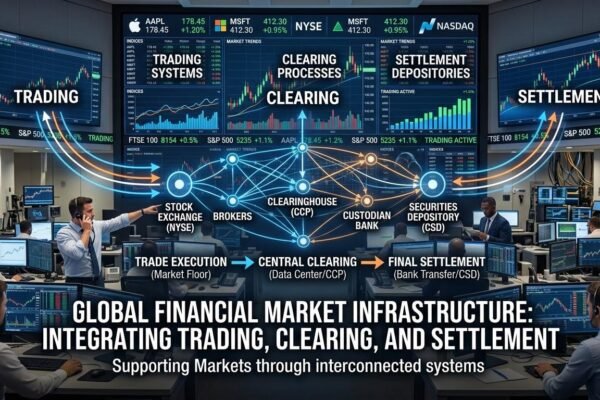
What Is Financial Market Infrastructure? Understanding Trading, Clearing and Settlement Systems
Introduction Financial markets enable people, firms and governments to borrow funds, invest their wealth and sell and buy financial instruments….
Well-Researched Information You Can Trust
Introduction Financial markets enable people, firms and governments to borrow funds, invest their wealth and sell and buy financial instruments….

Introduction Algorithmic trading involves the use of computer-based programs to interpret and trade on financial market data based on a…

Introduction The financial technology (fintech) sector is revolutionizing capital markets by disrupting the way investors buy and sell securities, companies…

Cryptocurrency investors sometimes need access to cash without selling their digital assets. Selling Ethereum (ETH) can provide immediate funds, but…

Introduction The process of starting a business in Nigeria is a great opportunity to gain income, skills and become self-employed….

Navigating the modern market’s treacherous currents presents a paradox: how to pursue ambitious growth without exposing capital to devastating volatility? As traditional “buy and hold” tactics falter, the solution lies in a more sophisticated, data-driven approach. At the forefront of this evolution in algorithmic trading platforms is Vincere Portfolios, a firm that has engineered an answer by mastering a principle once reserved for elite institutions: that superior market risk management is achieved through a dynamic blend of diversified, uncorrelated strategies. Why is Automated Algorithmic Trading Becoming So Popular for Individual Investors? The appeal of automated algorithmic trading lies in its ability to execute a disciplined strategy without the emotional baggage that often plagues human decisions. Researchers have long documented the “disposition effect,” a bias where investors sell winners too early and hold losers too long, a finding highlighted in foundational studies by Terrance Odean at UC Berkeley. Automated systems simply operate on pre-defined rules, sidestepping these costly impulses. This move toward systematic trading isn’t a niche trend. Data from InsightAce Analytic shows that automation and algorithmic strategies are driving nearly 61% of the increased demand for futures trading services. It’s part of a broader “democratization” of finance, where tools once exclusive to hedge funds are now available to busy professionals and retirees. Platforms like Vincere Portfolios are at the center of this shift, offering what they call “Institutional Quality Algorithms For Individual Investors” and aiming to level the playing field. How Do Uncorrelated Algorithms Actually Help Manage Market Risk? Real diversification isn’t just about owning different stocks, but also about owning different strategies. Uncorrelated algorithms are built to operate independently from each other and from the market’s overall direction. One algorithm might be designed to capture short-term momentum, while another focuses on mean reversion. If one strategy hits a rough patch, others in the portfolio are designed to perform, helping to smooth out the equity curve and lower overall volatility. Vincere Portfolios builds its entire offering on this principle. Instead of a single “one-trick pony” strategy, the firm licenses a suite of over 12 uncorrelated futures trading algorithms. The result? A documented maximum drawdown (the largest peak-to-trough decline) of just -10.39% since its start on January 1, 2020. For investors who care as much about preserving capital as they do about growing it, a figure like that is a powerful indicator of risk management at work. What Makes Vincere Portfolios Different From Other Trading Algorithms? In the Wild West of retail algorithmic trading, where digital snake-oil salesmen promise overnight riches, discerning investors look for signals of institutional-grade legitimacy. Vincere Portfolios doesn’t just participate in the market. In fact, it redefines the standards of trust and performance, standing apart on three foundational pillars: • Absolute Control Over Your Capital: While lesser platforms lure investors into depositing capital with unregulated offshore entities, Vincere establishes a firewall of security. An investor’s funds never leave their own U.S.-regulated brokerage account or IRA. Vincere’s technology is granted secure, trade-only access, ensuring clients retain ultimate control and custody of their assets at all times. • Institutional-Grade Strategy, Not Reckless Gambling: The landscape is littered with high-risk “get rich quick” systems notorious for catastrophic losses. Vincere Portfolios operates on a different plane. Its strategies are developed in-house by a team of former quantitative fund researchers, focusing on disciplined risk management. Every position is protected with a predefined stop loss, and all trades are closed daily, eliminating overnight market exposure. • Uncompromising Transparency and Verifiable Performance: In an industry where many operators hide behind anonymity, Vincere puts its leadership front and center. However, the ultimate proof is in the numbers. The firm provides a verifiable, multi-year track record that speaks for itself: a staggering 2,232.11% compounded ROI since 2020, achieving profitability in 87.2% of all months. What Is the True Cost of Vincere Portfolios if It Has a 0% Fees Model? Vincere Portfolios doesn’t use a traditional fee structure. Instead of charging for asset management, it operates on a software licensing model. This means clients pay for access to the technology itself, not ongoing management fees or a percentage of profits (carry). It’s a key distinction that aligns the company’s success with the value of its technology, rather than by taking a cut of a client’s gains over time. This model does, however, require a significant capital commitment. The company reports that access to a partial suite of its algorithms starts with a $30,000 capital base. The full, optimized suite is designed for accounts of $90,000 to $120,000 and above. This positions Vincere as a premium investment in institutional-grade technology for serious investors. So while the “0% Fees or Carry on Profits” claim is accurate for their ongoing model, the upfront licensing cost is the main financial consideration….

Introduction Blockchain has come a long way from its roots in cryptocurrencies and is now being eyed as a backbone…

Introduction Financial institutions rely on reliable identity information to establish who their customers are, if transactions are genuine, and if…

Introduction In financial institutions, a tremendous amount of information is created and shared on a daily basis. Banks will keep…

Introduction While cash transfers are vital for global commerce, migration, investment, online business and business growth, sending money across borders…

Introduction There are many agreements, records, approvals and transactions that involve multiple parties that need to be coordinated for financial…

Introduction The financial markets rely on the acceptable and dependable capacity of institutions to issue, trade, transfer, record and settle…

Introduction What started as being closely linked to crypto currencies has now evolved into a technology that banks and other…

Introduction AI isn’t a technology that will supplant the way financial services currently process information, detect patterns, routine work, or…

Introduction The financial industry has faced a growing challenge to manage the vast influx of data required for financial compliance…
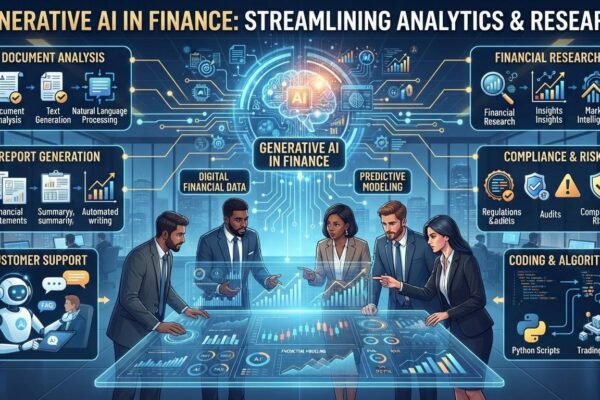
Introduction With the ability to create new messages, summaries, explanations, code, reports and more from a vast amount of information,…

Introduction The forecasting and risk management are activities which are essential to businesses, banks, investment firms and other financial institutions….

Introduction Traditionally, applying for a loan has entailed gathering financial records, credit histories etc. and waiting until a lender would…

Introduction Today’s financial activity creates tons of data every second and it is difficult to spot fraud for banks and…

Introduction Artificial Intelligence (AI) is transforming the way banks and financial service providers to operate, communicate, evaluate risk and make…

Introduction The way people invest is vastly different today after online brokerage companies have come into existence. Investors no longer…

Introduction In the past stock exchanges were not always the fast and easy Internet-based trading platforms that investors are familiar…

Introduction Stock exchanges are one of the most important elements of modern financial infrastructure, as they are responsible for making…

Introduction The vast number, velocity, and complexity of today’s financial markets are increasingly putting a strain on stock exchanges that…