
Introduction
The financial sector operates within a heavily regulated space. There are many regulations, rules and laws that financial institutions such as banks, investment firms and payment providers need to be compliant with. Businesses need to know who their customers are, track activity, prevent financial crime, keep confidential information secure and be able to keep accurate records. Manual compliance processes can be time-consuming, costly and prone to human error. To make compliance easier, financial institutions can utilize a variety of technologies collectively known as ‘RegTech’. By using automation, AI, machine learning, analytics and more, businesses can improve their compliance processes. Overall, financial institutions can improve monitoring, reduce time spent on repetitive tasks and improve their response to regulation by using automation. Whilst these processes aren’t removing the need for humans, they can provide great tools to improve compliance.
10 Ways RegTech Can Help Simplify Financial Regulation
1. Know Your Customer
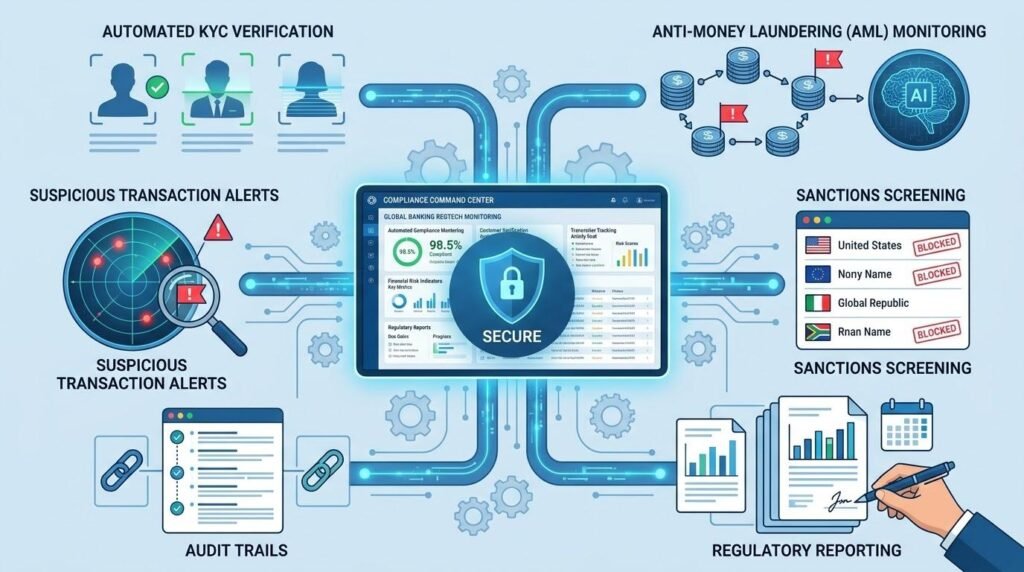
Know your customer processes are put in place to ensure that financial institutions know who their customers are. Traditionally this would include collecting ID, verifying personal details and manually searching through customer records. KYC automation can simplify this process. The system can search through documents, check biometric information and look up customer identity. Optical character recognition can be used to extract information from documents. The system can also be used to verify information. If there are any missing documents it can be identified and if anything doesn’t match up it can be flagged up. This means that financial institutions can improve customer onboarding, improve consistency and reduce repetitive manual processes.
2. Anti-Money Laundering Monitoring
Anti-money laundering processes require financial institutions to identify and investigate any suspicious activity that could indicate illegal funds. This can be difficult to do manually as there can be large amounts of data to go through. Anti-Money laundering automation can help with this. The system can detect any suspicious activity by looking at patterns in transactions, customer activity, payment history and more. Using machine learning, any unusual activity can be detected. For example, if there are regular payments between linked accounts, unusually large payments or payments within high risk jurisdictions. If there is a match for any of the risk indicators set up, a flag can be raised so that compliance can be looked at. This helps institutions identify what needs to be investigated, reduces the amount of work needed to manually monitor transactions and improves detection of potential financial crime.
3. Sanctions Screening Automation
As part of compliance, financial institutions need to ensure that they aren’t providing prohibited services or processing transactions with individuals, organizations and entities that are subject to any sanctions. Traditionally this would be done manually by compliance looking at customer and payment information to see if they’re on any sanction lists. However, with different ways people’s names can be spelled, this can be difficult. Automation can help by searching through customer and payment information to ensure they aren’t on any relevant sanctions lists. The system can use advanced matching to detect any potential name variations. This can help with regularly updating lists. If any new restrictions are brought in by regulatory bodies, you can be notified. However, it is important to look at any matches carefully as whilst names may look similar, they may not be the same person. Combining automation with manual checks can help to reduce missing matches.
4. Regulatory Reporting
Financial institutions need to provide various regulatory reports. These can be difficult to do manually as they need to be completed within certain timeframes and to a high standard. They can include transactional data, financial positions, capital requirements, customer activity and risk. Automation can help with this. The system can search through linked databases to extract the right information and put it into the correct format. If there is any missing information, any inconsistencies and any errors, this can be identified. This reduces the amount of repetitive data entry and means compliance can focus on looking at key figures. It is important to ensure that the system is up to date with current regulations as incorrect automated reports can cause compliance issues.
5. Audit Trail
An audit trail means that there is a record of everything that has been done within the financial institution. This can be difficult to do manually, especially if there are many people involved with compliance, multiple departments and different systems. Automation can help by recording key events. This can include customer verification, transaction checks, and changes to customer information, approvals and any suspicious activity alerts. The system can also include details such as timestamps, user information, system actions and relevant data. This makes it easier for internal auditors, compliance and regulatory bodies to look back at previous activity. However, it is important to ensure that the audit trail isn’t tampered with. Financial organizations need to ensure that they have proper record keeping and documentation processes in place.
6. Suspicious Activity Alerts
It is important to know when there is any suspicious activity within financial activity to prevent fraud, money laundering and other financial crime. Compliance automation can help with this. The system can monitor transactions and look for any suspicious activity based on rules, risk indicators and patterns. If there is any inconsistency with a transaction or account, an alert can be raised. For example, if there are regular large payments, unusual withdrawals or payments in unexpected locations. This means compliance can identify what needs to be looked at. The alerts can be prioritized based on risk to ensure staff are focusing on what needs to be investigated urgently. However, just because there is an alert doesn’t mean there is criminal activity. Financial institutions need to ensure they have proper processes in place to investigate. They also need to ensure they have proper documentation and report any suspicious transactions/activities.
7. Reduce Repetitive Tasks
Compliance can often include repetitive tasks. This can include collecting documents, allocating cases, asking for additional information, checking records and creating reports. If everything is done manually, this can take up a lot of time. Automation can help to simplify these tasks. The system can allocate tasks, track deadlines, send alerts and allocate to the correct staff. For example, if there aren’t enough documents for customer identification or there is an alert to look into, the compliance officer will be alerted. If cases haven’t been resolved within set deadlines, they can be escalated. This helps with collaboration between departments and ensures nothing important is missed. This means staff can focus on investigating any unusual cases.
8. Compliance Risk
Different financial institutions will have different levels of risk based on their customers, products, services, location and transactional activity. It is important to have a consistent way of identifying risk so that areas can be identified where increased monitoring and further due diligence may be required. RegTech can help with this. The system can search through different data sources and apply risk indicators. For example, if a customer is working within a high risk industry or there are transactions with certain jurisdictions, they may need to be looked at further based on the risk based approach. If any relevant customer information changes or new risk indicators come in, the risk profile can be updated. This means financial institutions can be more responsive and resources can be allocated more effectively. However, it is important that the risk scores are based on reliable information.
9. Improving Regulatory Updates
Regulations aren’t static. Governments, central banks, financial intelligence units and regulatory bodies regularly bring in new requirements, update current rules and provide guidance. This can be difficult to keep track of for compliance. Especially for organizations that operate in multiple countries. Automation can help with this. The system can track relevant publications, keep compliance requirements organized and alert the relevant staff when something important has changed. Some systems can also map the requirements to internal policies and controls to help identify where changes may be required. If there are any changes to customer due diligence requirements, compliance can use automated tracking to look at the relevant processes and allocate tasks. However, this shouldn’t replace legal interpretation. Financial institutions need to ensure they are aware of any updates, understand how they apply and ensure that their internal policies are updated.
10. Documenting Compliance
Financial institutions need to have reliable documentation to show how they identify, assess, monitor and manage risk. If there isn’t good record keeping, it can be difficult to find key information. Compliance automation can help with this. The system can keep all relevant information in one place. This can be searched easily based on customers, transactions, investigations, compliance requirements and internal controls. The system can also keep a history of documents, show what was approved and alert staff when information needs to be reviewed. This reduces the risk of missing any documents and makes it easier to find key compliance information. Having all information in one place also improves communication between departments. Authorized staff can access the same information. However, financial institutions need to ensure they have the correct retention periods, access restrictions, privacy and data protection.
Key Considerations
Whilst RegTech can offer many benefits to financial institutions, it is important to note that the responsibility for regulation still falls on the organization. Banks and regulated bodies need to ensure that they are compliant with relevant legislation, regulations and requirements. This means that automated systems should be put in place with clear governance. It should be clear who is responsible for approving controls, investigating alerts, reviewing the system and dealing with compliance issues. It is important that the system is explainable. If any risk decisions or monitoring decisions are made using AI or machine learning, compliance should be able to understand why key outputs are happening. They should be able to investigate any unexpected results. You should also monitor automated models to ensure they aren’t incorrectly categorizing, being unfair and that they are performing well.
It is important to ensure that the data being used is accurate. If there are any inaccuracies with customer information, out of date sanction lists, incomplete transaction information or inconsistent data across databases, this can impact the results of screening and monitoring. Financial institutions should implement data validation processes, regularly test the system and have controls in place to resolve any errors. They should also think about data privacy, cyber security, access and legal requirements around customer information. Before implementing RegTech, organizations should ensure that the system can meet their compliance requirements, operational requirements and risk. Technology should be carefully considered, automated controls should be regularly tested and updated and there should still be some human involvement.
Conclusion
Automation is changing the way banks, investment firms and other financial organizations manage their compliance. By using KYC automation, anti-money laundering monitoring, sanctions screening, regulatory reporting, audit trails, suspicious activity alerts and more, RegTech can help financial institutions streamline complicated processes. This reduces repetitive manual processes, improves access to compliance information and means that staff can focus on investigating and making professional judgments. However, it is important that financial institutions have accurate data, clear responsibility, explainable decisions and regularly test their systems to ensure they are compliant with relevant legislation and requirements. With the right governance in place, automated compliance can help financial organizations to manage compliance more efficiently. This will improve transparency, control and confidence in the financial system.
Get more well researched information about Robotic Process Automation in Banking here.