
Introduction
With the rise in technologies associated with banking, online and digital payments, fraud has become much more sophisticated. Fraud can occur through people stealing identities, hacking accounts, changing payment details and exploiting system weaknesses. Traditional fraud detection can be difficult to detect more complex issues due to having lots of rules. However, AI and Machine Learning have helped financial institutions to become more secure by analyzing large sets of data to highlight anomalies. This helps organizations detect suspicious activity quicker, prioritize and prevent financial loss to customers.
12 AI Technologies for Fraud Detection
1. Machine Learning Algorithms
Machine learning is one of the most important technologies for detecting fraud in financial services. This allows systems to look at past data to help identify patterns that could be fraudulent and identify suspicious activity. Unlike traditional systems, these models can learn and improve based on new information. Algorithms such as Decision Trees, Random Forests and Gradient Boosting can highlight any anomalies, looking at factors such as transaction amounts, locations, payment frequency and customer history. For example if a customer typically makes low value transactions but suddenly tries to make several high value payments this will be highlighted and given a high risk rating.
2. Behavioural Analytics
Behavioural analytics looks at how customers typically interact with their accounts. Using AI the system can look at login times, payment frequency, spending patterns, devices used and usual payment locations to create behavioural profiles. If there is any sudden changes to this activity the system can look into this to see if there has been a genuine change to the customer’s behaviour or if there is evidence of fraud. Examples of this could be frequent transfers to unknown payees, unusual withdrawals or payments made at odd times. This technology is useful as some criminals can gain genuine login details so password checks won’t help identify if the real account holder is accessing the account.
3. Automated Transaction Monitoring
This allows financial institutions to look at transactions and identify any issues that could be fraudulent, money laundering or other financial crimes. AI can look at factors such as payment amounts, payee, customer profile, frequency and account relationships. This can highlight any suspicious patterns in thousands or millions of transactions. This means employees don’t need to manually check all payments. For example if there are multiple transfers to unknown accounts, unusually high deposits or frequent payments just under the threshold this could be flagged up for further investigation. Adding this to your programme will help you prevent financial crime by improving automated transaction monitoring efficiency to help identify any suspicious activity quicker and focus on the most risky transactions.
4. Anomaly Detection
Using AI and statistical tools, this technology will highlight any unusual transactions or account activity. Instead of looking for known fraud methods the system will look at what is considered usual for that account, customer group or financial institution. This means any significant differences can be highlighted. For example if an account is suddenly receiving many small deposits before transferring the total to an unknown destination this could be considered suspicious. This tool is useful as criminals will constantly change how they commit fraud so having this can help financial institutions identify unknown threats.
5. Real Time Monitoring
This allows financial institutions to look at transactions in real time. Using AI the system can analyze payment details, customer behaviour, device information and payee information in a short period of time. If a transaction is given a high risk rating you can receive instant alerts, ask for further verification from the customer, hold the payment or pass onto a fraud investigation team. For example if a customer is trying to send a large amount to a new payee immediately after logging in from an unknown device. This will help you respond quicker to any suspicious funds.
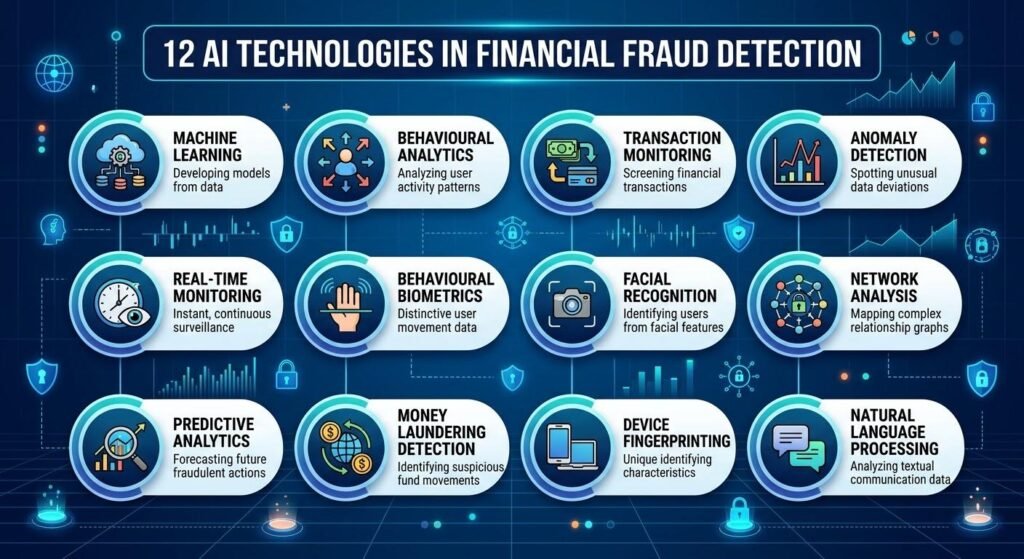
6. Behavioural Biometrics
This uses unique ways people interact with devices to help verify their identity. Using AI the system can look at how fast someone is typing, mouse movements, touch screen gestures, browsing behaviours etc. This gives more information than standard verification methods. If someone has gained access to the customers credentials but their interaction with the banking app is different than the system could flag this up. This is particularly useful for identifying account takeovers. The Federal Reserve also identifies behavioural biometrics and device risk indicators as useful parts of a layered approach to fraud prevention.
7. Identity Verification and Face Recognition
AI can help financial institutions identify identity theft. Face recognition will compare the face of the customer against their ID or previously verified photo. Liveness detection ensures they are physically present, rather than a picture, video or recording. This can help identify any discrepancies that show someone is trying to open an account using stolen personal details. Some systems can also look at document verification, facial features and unusual verification patterns. With criminals becoming more sophisticated with impersonation and deepfakes you can use face recognition along with other verification methods to help protect against identity theft.
8. Network Analysis
Network analysis looks at how accounts, people, devices, payees and transactions are related to each other. Using AI the system can identify any suspicious relationships. For example if multiple accounts are receiving money from unrelated customers before transferring into one account. Whilst individually they may seem fine, overall they could be a sign of money laundering or using money mule accounts. This can help investigators to identify relationships between accounts. This is useful for identifying organized financial crime.
9. Predictive Fraud Analytics
This uses past information, statistics and machine learning to predict the likelihood of fraud occurring. Financial institutions can look at past instances of fraud, transaction details, customer behaviour, device information and new threat patterns to identify what needs to be focused on. This will give a risk rating to help organizations know what transactions are low risks and what could be dangerous. For example if a payment is going to an unknown payee, the value is unusual and it has come from a recently compromised device it could be given a higher risk rating. This will help fraud teams to utilize their resources better and prevent financial loss. However this should be used to help identify risk factors.
10. Money Laundering Detection
Using AI financial institutions can identify suspicious activity that could be hiding the source of illegal funds. This looks at transaction history, customer details, payment relationships, geographical patterns and unusual money movements. Common signs of this could be structuring (splitting large payments into smaller ones), quick transfers between accounts and payments that seem out of line with what the customer usually does. Machine learning can also help identify relationships between seemingly unrelated accounts. This can help prioritize suspicious activity reports. The Financial Conduct Authority recognize that machine learning and AI can help enhance transaction monitoring and prioritize alerts that could be linked to money laundering 2.
11. Device Fingerprinting and Geolocation
These can help give extra information to help financial institutions identify if an account is being accessed legitimately. Device fingerprinting looks at the device information such as operating system, browser type, device ID and network information. This will help identify any devices the customer has used before. Geolocation looks at the rough location where transactions or logins are coming from. If an account is being accessed from an unknown device or location the AI can use this information along with transaction history and behavioural information to calculate the risk. For example if an account is accessed from another country and shortly after there is an unusual transaction from another far away location this could be flagged up for further verification. This will be most effective when used alongside other security measures.
12. Natural Language Processing and Prioritization
Natural Language Processing allows AI to analyze and understand large amounts of text. This could be customer complaints, payment descriptions, investigation notes and suspicious activity reports. This can help organizations identify mentions of scams, impersonation, suspicious payments and other signs of financial crime. It can help investigators organize information, summarize past cases and identify similarities, when used alongside transaction monitoring this can help prioritize alerts. This will save time for investigators as they won’t need to look through repetitive information. They can focus on complex cases that require professional judgment. However you will need to double check automated summaries and categorizations.
Challenges of AI Fraud Detection
1. False Positives and Changing Tactics
AI fraud detection is not 100% accurate. One major issue is identifying false positives. This occurs when genuine payments are flagged up as suspicious. This could be a customer travelling overseas, making a high value purchase or making an unusually high payment. This can cause issues for customers, delays to payments, increased investigation costs and less confidence in financial services. Financial institutions will need to regularly review their models, improve the quality of data they are using to train their models and adjust the thresholds. Another challenge is criminals constantly changing their tactics. More criminals are using stolen credentials, social engineering, automated attacks and deepfakes so financial institutions need to update their detection.
2. Data Protection and Manual Investigation
As AI fraud detection requires large amounts of financial and personal information it is important to ensure this is protected. Financial institutions should ensure customer data is encrypted, have proper access controls, securely store data and share information responsibly. You should also ensure your models aren’t making incorrect predictions, unfair decisions or have weaknesses that could put customers at risk of being unfairly restricted. Manual investigation is also important as just because there are suspicious patterns doesn’t mean there has been financial crime. Having experienced investigators will help investigate why the customer is doing this, look at transaction details, business relationships and other relevant information. They can also spot any mistakes in automated decisions and investigate complex cases that involve multiple accounts or countries. AI should be used to enhance professional judgment.
Conclusion
AI fraud detection is changing how financial institutions identify and respond to suspicious financial activity. Using technologies such as machine learning, behavioural analytics, automated transaction monitoring, anomaly detection, biometrics and predictive analytics can help organizations analyze large amounts of transactions quicker and identify any potential threats. It can also help improve real time alerts to help detect account takeovers and identity theft. It can also help identify signs of money laundering. To be successful you will need to constantly improve your systems, ensure data is protected, accurately identify risk and have the correct amount of manual oversight. By using advanced technology and experienced investigators financial institutions can improve fraud prevention, reduce financial loss, protect customer information and have more confidence in digital financial services.
Get more well researched information about AI-powered fraud detection here.