
Introduction
The financial services industry is undergoing a major shift with artificial intelligence beginning to play a big part in business processes. Businesses such as banks, insurance companies, investment firms and many others are starting to integrate smart solutions to make processes more efficient, cut down on costs, and improve customer experience. AI agents have been becoming increasingly popular in the financial sector. They can be used to help with co-ordinating various tasks, searching for information, analyzing documents and starting approved processes. They can be used to reach specific goals with minimal human input. They are being adopted across the industry to help with information management, customer service, suspicious activity investigations and overall decision making.
What are AI Agents?
AI agents are pieces of software that use artificial intelligence to understand what their goal is, analyze information, make decisions and complete tasks using other tools. They can be used to search for customer information, analyze financial documents, compare information between databases, and decide what needs doing next. An example of this would be if an agent was managing a loan application request, they would search for the documents provided, find any missing information, search for relevant information, and then pass the application to the correct member of staff. They are useful for processes that require multiple departments or pieces of software to be involved. As described by IBM of AI agents in finance, they can be used to help with financial processes by managing tasks.
Differences between AI Agents, Chatbots and Automation
Whilst AI agents, chatbots and automation tools can all be used to help improve efficiency within a business, they differ in what they can do. Traditional chatbots and automation tools will be more basic. Chatbots will usually just answer questions based on set rules or scripts, whilst automation tools will carry out instructions to complete repetitive tasks. AI agents can help with understanding what the goal of the task is, choosing the right tool to use, adapting to new information and managing multiple tasks to complete a task. However, they do not have full freedom to do what they want and will rely on having access to the correct information, having the right permissions, having good integrations, and having some human oversight. Financial institutions will need to set clear boundaries for what they can do.
12 Ways AI Agents are Changing Financial Services
1. Improve Customer Service
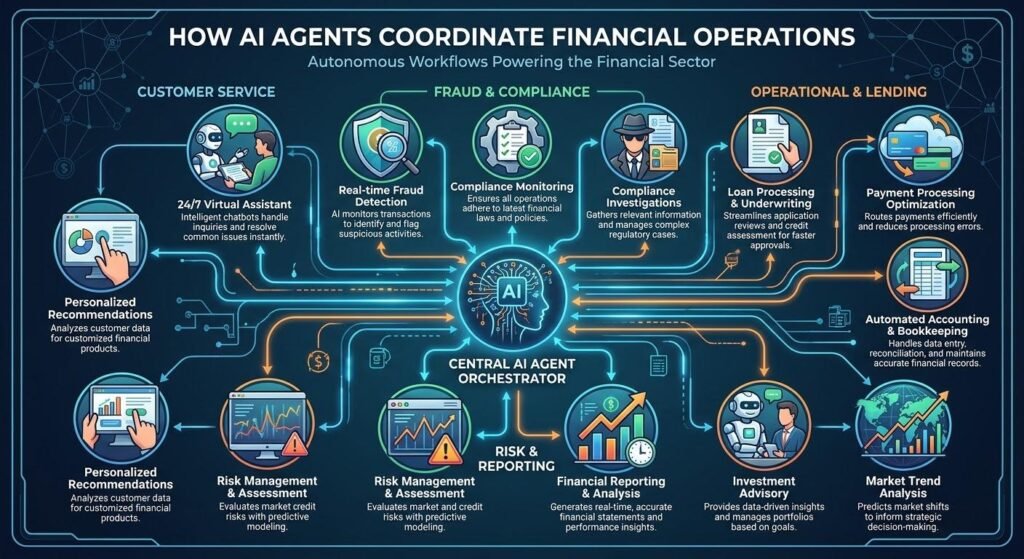
One of the most noticeable uses of AI agents within financial services is improving customer service. Financial institutions will receive many inquiries regarding their accounts, including balance checks, transaction history, payments, loans & service requests. AI agents can be used to search for relevant customer information, understand what the inquiry is about and give the correct response. They can complete multiple steps in a service request, including checking the status of a transaction, searching for supporting information and passing on any unresolved requests to a member of staff. This will reduce the workload of a customer service team and can cut down on waiting times. They can also keep track of the context of a request, meaning customers will get a more consistent response.
2. Assist with Compliance Investigations
Financial institutions will have to follow regulations to prevent money laundering, financial crime, fraud and other illegal activities. Compliance investigations usually require staff to look at transaction histories, customer information, risk factors and supporting documents. AI agents can be used to search for the relevant records, compare transaction patterns, identify any anomalies and organize evidence. They can also prioritize cases based on pre-defined risk factors. Whilst they will not replace compliance staff they can provide organized information to help with faster investigations. Any important findings will still need to be reviewed by human investigators to understand the situation.
3. Improve Loan Processes
A loan process includes many steps including receiving the application, verifying documents, assessing creditworthiness, approving and tracking repayments. AI agents can be used to manage this process by searching for the documents provided, checking all the required information is there, and identifying any inconsistencies. They can also update the applicant on the status of their application, organize supporting documents and pass the completed application to the correct loan officers. If the borrower already has an existing loan they may also help to track repayments, identify any overdue accounts and organize information. This will reduce any delays in the administration process. However, financial institutions should still have the correct human oversight when making decisions on credit.
4. Improve Financial Research
Financial research involves looking at lots of information. AI agents can be used to search for information from approved sources, summarize key changes, compare financial data and create useful reports. This could include an investment research team using an AI agent to monitor chosen companies, search for the latest financial results and identify any changes that may impact their analysis. They can also help staff quickly find the relevant information. However, they should not be trusted to provide reliable investment advice. The sources should be verified, assumptions checked and market conditions considered.
5. Automate Claims Process
Insurance companies will receive a high volume of claims relating to accidents, damage, medical costs and other events. To process these claims documents will need to be gathered, policy details reviewed, information verified and determine if more evidence is needed. AI agents can be used to manage this process by searching for policy information, organizing documents, identifying any missing information and passing claims to the correct department. They may also prioritize claims based on urgency or pre-defined processing requirements. This can improve the efficiency of the claims process. However, any claims with disputed information, complex situations or large financial implications should be reviewed with the correct human oversight. Insurance professionals will still be responsible for ensuring decisions are made in line with policy and regulation.
6. Help Internal Staff with Daily Tasks
Financial institutions will have staff working across many departments including accounting, HR, customer service, compliance and operations. Many of these staff will spend time finding internal policies, creating reports, searching for information and providing answers to general admin requests. AI agents can be used as an internal assistant to search for information from approved company databases, summarize documents, create responses and guide staff through processes. For example, if an employee was looking for information on a reimbursement policy they could receive the relevant guidance without needing to contact multiple departments. They can also manage general tasks between integrated systems to reduce repetitive tasks. This means staff can focus on tasks requiring professional judgment, communication and specialist knowledge. There should also be the correct restrictions in place.
7. Improve Fraud Detection
Banks and other financial service providers will have the responsibility of preventing fraud. Suspicious transactions can cause significant financial loss. AI agents can be used to help with fraud investigations by searching for transaction histories, comparing customer activity, identifying any unusual patterns and organizing relevant information. If a transaction has triggered a pre-defined risk factor the agent may search for supporting documents, prioritize the claim and manage approved notifications/escalation processes. This can help with more efficient investigations. However, unusual activity does not necessarily mean fraud has occurred. The evidence should be reviewed by professionals to consider why this may have occurred and ensure measures are in place to protect genuine customers.
8. Improve Payment Processes
Payment processes include verifying transactions, tracking settlements, matching records and reconciling. AI agents can be used to search for payment information, compare transaction records, identify discrepancies and organize exceptions. For example, if there is a discrepancy between payment information and accounting records the agent can identify this and alert the relevant staff member. They may also trigger pre-approved steps in the process, such as requesting extra verification or passing the exception on to the finance department. This reduces manual checks. However, actual payments, account transfers and other sensitive financial activities will need to be tightly controlled with the correct approvals.
9. Assist with Risk Management
Financial institutions will have to manage various risks including credit risk, market risk, operational risk and regulatory risk. This requires constant monitoring to identify any changes that may impact the business. AI agents can be used to search for relevant information from approved internal systems, analyze risk factors, compare current records against set thresholds and create alerts for the risk management team. They can also help to manage the gathering of information for regular reviews. For example, they may highlight any loan accounts that need extra attention due to changing repayment patterns. This can help with more efficient monitoring. However, the findings should be validated by risk professionals to ensure any important decisions are based on accurate information and following risk management policies.
10. Manage Financial Reporting
Financial reporting requires information to be gathered from various departments, verified, summarized and documented. AI agents can be used to manage this by searching for approved financial records, organizing supporting documents, identifying any missing information and creating initial reports. They may also compare figures between integrated systems and identify any discrepancies. This can reduce the admin required for regular reporting. However, the reports should not be taken as final or accurate. The calculations should be reviewed by accountants and financial professionals to ensure they are accurate, supported by evidence and follow accounting standards, regulations and approval processes.
11. Assist with Treasury Management
The treasury department will be responsible for keeping track of cash positions, managing liquidity, managing payment processes and ensuring the organization has enough money. AI agents can be used to search for information from approved banking systems, review cashflow records, track payments and create summaries. They can also identify any unusual activity or highlight any cashflow concerns. They can also help teams get a clearer picture by managing information between financial applications. However, decisions relating to moving funds, investing, borrowing and other large financial decisions should have the correct authorization in place. Treasury professionals should be in control of sensitive financial decisions.
12. Manage Supplier & Procurement Processes
Financial institutions and other businesses will regularly deal with paying suppliers, procurement requests, contracts and supplier information. These processes require multiple approvals and accurate information to avoid any unnecessary spending or incorrect payments. AI agents can be used to search for supplier information, review invoices, compare information against purchase orders, identify any missing documents and pass requests to the correct approval officers. They can also track the progress of procurement and alert staff when further action is required. This can help create a more efficient process. However, on boarding new suppliers, approving contracts and authorizing payments should follow set verification processes to prevent unauthorized transactions and conflicts of interest.
Security, Accountability & Human Oversight
Despite the benefits of using AI agents there are some important security considerations to think about. As they may have access to customer information, payment applications, internal databases and confidential documents there is a risk of unauthorized access causing sensitive information to be exposed. Data should be encrypted, identities verified, roles set up and strict permissions managed. They should only have access to the information they need to complete their tasks. Sensitive tasks should also have extra approvals. Financial institutions should have detailed logs of what information they have accessed, what they have done and when. This can help with investigations and accountability with regulation.
It is also very important to ensure the processes are resilient. Financial institutions cannot fully rely on AI agents. There is a risk of errors, incorrect outputs, integration issues and cyber threats. Regular testing should be carried out to ensure the processes run as expected. Monitoring should be in place and backup processes should be in place. Staff should also have the ability to intervene if the systems are acting unexpectedly. Human oversight is very important when making decisions. Credit approvals, insurance settlements, suspicious transaction investigations and money movement should not be left to AI agents. They should not have full freedom to move money, change account ownership, approve large financial decisions or make changes to sensitive customer information. Clear approval requirements, transaction limits, independent verification and the ability to pause the agent will help reduce the chance of unauthorized financial activity.
The Future of AI Agents in Financial Services
AI agents are likely to become more important going forwards as financial institutions start to use more integrated applications, smart data systems and automated processes. They can help with streamlining processes across departments making financial processes quicker, more organized and reducing repetitive tasks. They may be used by banks to improve customer assistance and compliance investigations, by insurance companies to manage claims and policies, and by investment firms and treasury departments to gather and analyze information more efficiently. However, they will need to be invested in to ensure they have reliable infrastructure, secure integration, trained staff, clear policies and monitoring in place.
Conclusion
AI agents are transforming financial services by providing smarter ways to manage tasks, search for information, analyze documents and start approved processes. They can be used to improve customer service, compliance, loans, financial research, insurance, fraud prevention, reporting, treasury management and internal processes. Unlike traditional chatbots and basic automation they can manage integrated tasks with the correct permissions and secure integration. However, they should have increased security measures in place. Financial institutions should ensure their data is secure, processes are resilient, they can be audited and there is meaningful human oversight to reduce the chances of errors and unauthorized financial activity. If used responsibly they can improve efficiency whilst allowing financial professionals to make important decisions.
Get more well researched information about AI agents in financial services here.