Introduction
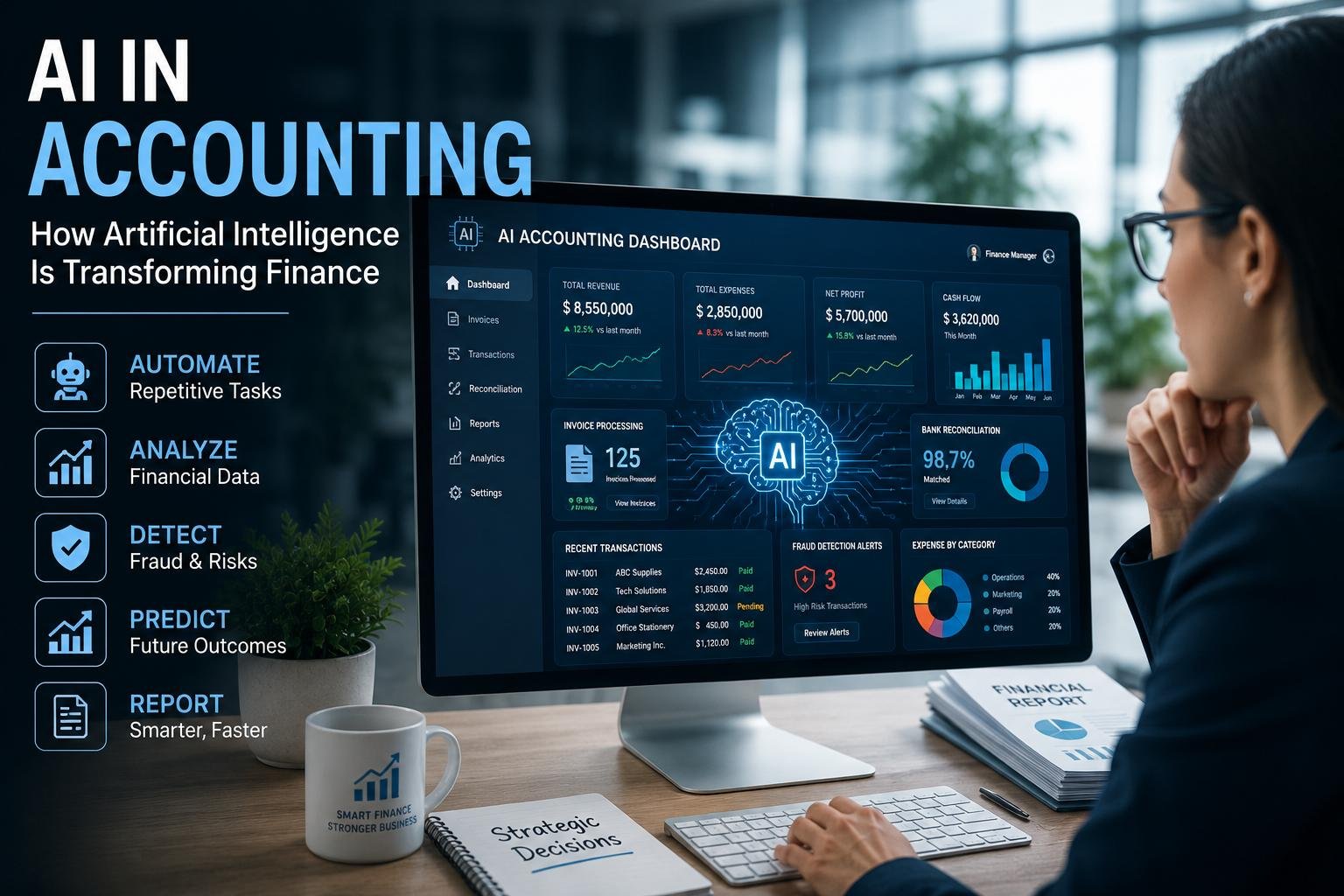
Accounting used to consist of manual and repetitive work, and accurate record keeping, spreadsheets and manual verification. AI is transforming the financial sector by streamlining information processing, pattern recognition, and repetitive tasks, which leads to increased efficiency and effectiveness. With the increasing number of transactions businesses have to process and the need for timely financial reporting and accurate analysis, the advent of AI in accounting is particularly pertinent. The accounting software solutions that are powered by AI can help you with data entry, processing of bills, accounts reconciliation, fraud detection, forecasting and auditing. While these technologies often don’t replace the accountant, they can decrease repetitive tasks for the accountant to allow time to interpret, plan, control and make decisions.
Introduction to AI in Accounting
AI in accounting is technology utilizing machine learning, natural language processing, pattern identification, and other capabilities of AI to automate or help with accounting-related tasks that would otherwise necessitate a considerable amount of human involvement. The AI accounting system can learn from previous transactions, identify repetitive transaction patterns, extract data from documents, and alert the users when they try to run any unusual transactions that require an audit to make sure that the system isn’t abused. Invoices, for instance, can be read and matched to the supplier, the invoice number, the date and the tax amount and the total, and a possible accounting treatment can be suggested. Likewise, an Artificial intelligence in accounting could be used to review transactions for any type of irregularities and notify unusual transactions. The technology will eliminate repetitive work and explore exceptions, analyze evidence and grasp information concerning finances.
Automated Data Entry and Invoice Processing
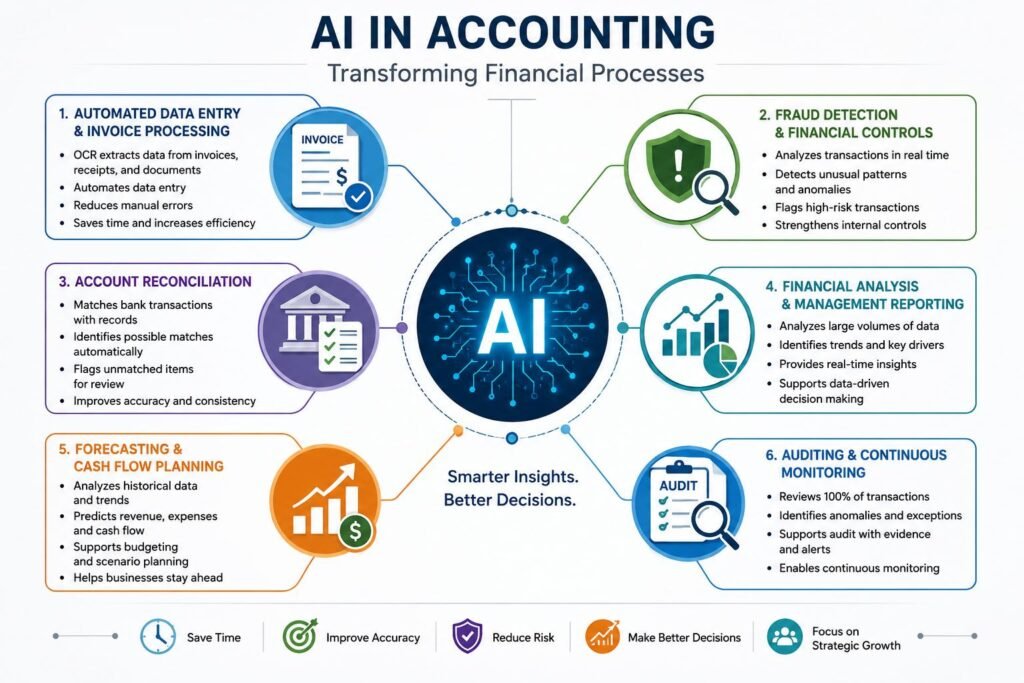
AI has proven to be a valuable tool in automating data entry. A lot of time is spent by many finance teams entering data from all the paperwork they receive into accounting systems: Invoices, receipts, purchase orders, bank statements, etc. It can use Optical character recognition (OCR) and Artificial Intelligence (AI) to identify and add the relevant information to papers, and to transform unstructured information into accounting information. The system can be optimized to better classify the transactions which are repetitive in nature based on the previous transactions, by utilizing machine learning. Invoices can contain supplier details, amounts, dates, payment terms and tax information that can be automatically extracted by software which may speed up this process without having to input each of these fields. This reduces repetitive tasks, and the likelihood of transcription errors. No doubt documents and transactions will be reviewed by accountants, but when the routine information is captured automatically, it can be more efficient.
Fraud Detection and Financial Controls
Another way that AI can aid fraud detection is by spotting trends in customer transactions. Another way that AI can assist in fraud detection is by identifying patterns in customer transactions. Traditional financial controls, based on rules, reviews and manual sampling are hard to apply to examine all transactions in a large company. AI can analyze earlob data at scale and identify patterns of unusual activity, such as higher payments than usual, duplicate invoices, variations in the supplier’s information, payments outside of business hours, and transactions that are out of the norm. If the system is well-designed, it can detect indicators of risk, or raise an alarm to investigate. This is useful to guide finance and internal auditors to concentrate on the areas that need their attention: those transactions that require a close eye. AI is therefore best used to complement rather than supplant current controls, to be used as a layer of monitoring and detection.
Reconciliation Becomes more Efficient.
Another application for AI is bank and account reconciliation. Reconciliation is to ensure that there are no differences between records, and that balances agree; and to investigate differences when they do not agree. When your organization has hundreds or thousands of transactions, it can be time consuming to do the manual work to match them. AI systems that leverage the power of the ledger can be used to identify and match bank transactions to records, identify the possibility of a match and flag exceptions for manual review. The more the time goes on, the more software can be developed to find repeating patterns in the description, amount, date and reference to customers. This helps to reduce the matching and can help for recon consistency. However, there are differences that are not accounted for that will need to be analyzed and looked at carefully as it may seem as though there is a mismatch when in fact it may be because of time, accounting error, missing transaction, or another reason the software can’t definitively determine without context.
Financial Analysis Management Reporting
The impact of AI on finance analysis is another noteworthy transformation. Another significant transformation is the impact of AI on finance analysis. While traditional reporting provides insights into past events, AI-powered analytics can reveal patterns and connections in vast amounts of data, aiding in making more informed decisions. They can analyze revenue, expense, customer behavior, cash movement, inventory data, etc. and identify changes that require attention based on AI. The potential for exploring questions and uncovering drivers of performance can be achieved with intelligent dashboards or Natural-Language Interfaces. For instance, management might want to know why its operating expenses have gone up or which customers are responsible for the most revenue growth. While AI can reveal patterns faster, it is crucial to ensure that everything is interpreted in the context of business. While numbers may show a correlation, they do not always demonstrate why something occurred, and so it is important to use professional judgments when financial analysis is used for important decisions.
Forecast and Cash flow Planning
Another space in which AI can assist with financial forecasting is by analyzing past data to predict future trends.AI can also help with financial forecasting by analyzing historical data to forecast future trends. Estimates of expected revenues, costs, cash flows, demand, and other financial outcome are essential for decision-making in the business. Historical averages and assumptions prepared manually can be a major part of conventional forecasting methods. AI models can analyze more data and uncover trends in other variables, and make predictions that are more responsive to changes. A cash-flow forecast may be assisted by an AI system, which could take into account payment history, trend and seasonal sales, and expense patterns. This can enable teams to detect cash shortages in a timely fashion. But, AI predictions are not set in stone. Inaccuracies can arise due to unanticipated economic situations, shifts in customer attitudes and behaviors, new regulations, supply disruptions, and quality of the source data. For significant financial decisions, human review is required and is a necessity when using forecasts.
Utilize AI for Auditing and Continuous Monitoring.
AI also enables auditing to become more comprehensive and continuous, with more information being analyzed. Audit technologies don’t only scan for unusual records, but can also examine vast populations of transactions to alert auditors to possible unusual records or relationships. AI can help you to review journal entries, compare supporting documents, spot anomalies and identify areas of greater risk. This can help the audit process to concentrate on evidence since professionals can spend less time looking for exceptions and more time examining evidence. AI can be used to aid in continuous monitoring rather than just scheduled monitoring. Subsequently, auditing goes beyond the simple act of attesting to the accuracy of the account and involves professional skepticism, independence, evidence evaluation and accountability. While AI can discern patterns, it is up to trained professionals to interpret these patterns and ascertain their significance and if they represent a material problem.
The Benefits for Accountants and Businesses
Beyond just saving time, there are other benefits of AI in accounting. Automation can help eliminate repetitive tasks so that accountants can spend more time on analysis and advisory, budgeting, controls and strategic planning. Quicker processing may enhance the accessibility of monetary information; permitting managers to make choices without having to wait for a lengthy manual report. AI can also be used to ensure consistency by adhering to the same rules and patterns for vast amounts of transactions. Businesses can also scale the number of transactions that their system can process without the same proportion increase in manual data entry. Finance information can be processed and organized in connected digital systems and can be beneficial for remote and distributed teams. This provides accountants with a chance to build up their analytical, technological, communication and advisory capabilities, rather than just getting engrossed in routine bookkeeping tasks.
Limitations and Risks of AI in Accounting
While AI can be a powerful tool in financial management, it does not have a flawless record. There is one major downside, which is poor quality data. The recommendations or forecasts generated by an AI model can be inaccurate if the accounting system does not have the complete, accurate, consistent, and well-structured information. Financial systems are also sensitive, and privacy and security are concerns. Organizations need to evaluate data storage and access, security, and usage of AI services. Explainability is another challenge as some of the advanced models are difficult to explain the reasoning. This can be an issue when there is a need to be clear, and held accountable, in financial decisions. However, AI also can produce false positives, miss key factors, or duplicate biases in the historical data. Hence, it is crucial that human oversight, access restrictions, testing, documentation, and a clear approval process are still integral to the accounting process when incorporating AI.
Could AI replace Accountants?
Artificial intelligence will not take the place of accountant, as it isn’t just about replacing the numbers and figures. Accounting is far more than just inputting transactions and making balances. Prosci is a skilled handler of financial information, applies accounting standards, communicates with management, assesses risk, creates controls, guides business decisions and applies judgment when there is a lack of clarity. The advantages people have over AI are that they are better at adding context, ethical decision-making, providing accountability, communicating, and making more complex decisions. The areas people excel at that AI can’t is adding context, ethical decision making, providing accountability, communicating, and making more complex decisions. The change is more towards the accounting job changing than its disappearance. It seems like accountants with a solid grasp of AI could be more valuable, as they’ll be able to leverage their financial knowledge alongside technology. The rise in questioning, validation and translation of automation and financial data to actionable recommendations will be a critical need for businesses in the future.
How Businesses Can Adopt AI Responsibly
Rather than jumping on the bandwagon of AI usage, companies should start with specific issues in accounting and integrate AI solutions where and when they are needed. The first step in a company could be to determine activities that are repetitive and take up significant staff time, such as invoice entry, transaction matching, expense categorization or preparing reports. It can then determine if a solution that integrates AI will fit into current accounting systems and if there will be a cost benefit to the solution. Staff to be trained in technology and review process related to the technology. It is also important to set guidelines around who can authorize AI-generated entries, what to do about exceptions and how to record AI recommendations. Testing should be conducted prior to a new system being used for financial processes that are critical to the system. A step-by-step approach enables enterprises to calculate precision and enhance controls prior to scale out AI.
The future of Artificial Intelligence in Accounting
Cooperation between financial professionals and intelligent software will probably be increased in the future of accounting. With the growth in capabilities of AI systems, accounting platforms can handle more and more entire processes, instead of just specific tasks. A transaction might get picked up, classified, compared to transactions, compared against controls, be part of a report and be assessed for unusual activity and then have limited manual review. Financial experts would then be able to spend more time on the review of exceptions, discussions of results, planning for various scenarios, and recommendations to business leaders. It isn’t all of the accounting process that will be completely independent. Implementation will be affected by regulations, standards, security needs and human liability. The key to successful organizations is not relying on automation alone but using the right controls, accurate information, competent people and good governance along with using AI, not as a substitute for good financial governance.
Conclusion
AI is reshaping accounting in multiple ways, from the way that financial data is captured, processed, analyzed, checked, to how it’s reported. AI-powered data entry and invoice processing can minimize repetitive tasks, and AI can aid in fraud detection and reconciliation to streamline the process for teams. Properly performed financial analysis and forecasting can give faster insights and audit technologies can analyze a larger volume of information for unusual patterns. These capabilities can lead to increased efficiency, scalability, and access to timely information, but they also come with potential risks such as data quality, security, explainability, and dependency on automation. As a result, using AI isn’t a definitive way to make decisions but a helpful accounting assistant. By using it wisely, having robust controls in place, training teams and having some human oversight, businesses can create more efficient finance functions and maintain professional judgment.
Get more well researched information about AI in accounting here.