
Introduction
Many financial businesses are beginning to implement automation technologies to improve efficiency, reduce costs, improve security and provide better services. Many processes, including loan applications, customer verification, monitoring activity, producing reports and meeting regulation requirements, are often repetitive and can take up a lot of time. In many organizations, processes are completed using Robotic Process Automation (RPA). However, due to the complexities of financial services, traditional automation solutions are no longer enough. Intelligent Automation (IA) provides a more intelligent solution to automation by combining automation with Artificial Intelligence (AI), Machine Learning (ML), Natural Language Processing (NLP) and document understanding. Whilst both can be used to simplify business processes, there are differences between the two solutions. This will help financial businesses decide which solution would be most beneficial to meet their business requirements and ultimately their digital transformation goals.
Robotic Process Automation in Financial Services
Robotic Process Automation is a form of automation where software robots can be used to complete repetitive, structured and rule based activities. Robots can be used to interact with existing applications, databases, spreadsheets and other platforms to complete defined actions. RPA can be used effectively where processes have clear patterns. For example, banks can use RPA to move information between systems, update customer details, complete standard reports, balance transactions and complete standard payments. This can save time by using software robots to carry out tasks instead of employees carrying out tasks manually. As traditional RPA operates using defined rules, it can be used best where there are set processes.
An advantage of using RPA is it can improve productivity without changing any existing technology. The bots can interact with applications using the interface, meaning they can complete some tasks even if the technology is outdated. This can be useful for financial businesses that use legacy banking systems and may not be able to invest in upgrading their systems. RPA can run 24/7 to allow organizations to complete standard processes outside of the usual working hours. However, traditional RPA may struggle with tasks that have unexpected changes or incomplete information. The robots may not be able to complete tasks if the interface of the system has changed or if the transactions do not follow the defined rules. This makes RPA best to use where there are set processes.
Intelligent Automation in Financial Services
Intelligent Automation takes the traditional RPA and adds the ability for the system to understand information. This includes technologies such as AI, ML, NLP, Computer Vision and Intelligent Document Processing. Intelligent Automation can complete more complex tasks by combining different functions together. Unlike traditional RPA, Intelligent Automation can understand information from different sources. This means information can be identified, documents can be classified and changes can be made based on trained models. Intelligent Automation can be used to analyze a loan application, extract information from documents, identify any missing information and identify any unusual patterns in the finances. This makes Intelligent Automation valuable to use in financial businesses where information is often unstructured.
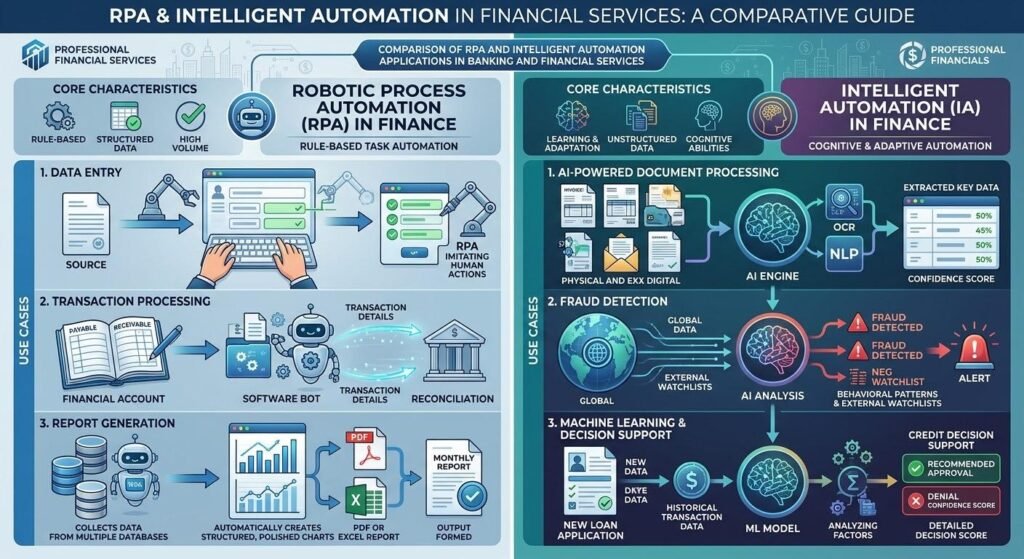
Differences between RPA and Intelligent Automation
Both RPA and Intelligent Automation aim to improve business efficiency, however there are some major differences between the two. Traditional RPA works best with structured information, defined rules and clear processes. Intelligent Automation uses the previous functions but adds AI based technologies to understand unstructured information. There are many differences between the two such as the requirements to implement, flexibility, maintenance and costs. For example, RPA bots may be used to move information from a completed application into the banking database. Intelligent Automation could look at the application, extract information, identify any inconsistencies and move the information. It is important to consider how much you want to automate and how complex the tasks are.
Loan Processing and Credit Checking
Loan processing can be very beneficial to use in financial businesses. Traditional RPA can be used to complete repetitive tasks such as adding customer information, checking mandatory fields have been completed, moving documents between systems and updating the status of the application. This can help reduce any delays with administration and allow loan officers to focus on more challenging tasks. Intelligent Automation can look at supporting documents, extract information from bank statements, identify any inconsistencies and analyze the financial information. Machine Learning models can also identify patterns that relate to credit risk so lenders can prioritize applications that need further investigation. However, any credit checking carried out using automation should be closely monitored to avoid any discrimination. Financial businesses should ensure that credit decisions are clear, follow any applicable regulations and have the correct amount of human input.
Fraud Detection
Financial businesses need to identify any suspicious transactions, investigate any unusual activity and respond to any potential threats quickly. Traditional RPA can be used to manage fraud by collecting transaction information, checking for defined risk factors, raising alerts and moving information to the investigation team. However, fraudsters often change their methods so it can be difficult to identify new threats using defined rules. Intelligent Automation can be used to identify any unusual patterns in transactions using Machine Learning and advanced analytics. This can organize supporting information and summarize any information from the investigation. An intelligent system may highlight any transactions that are very different to what the customer usually spends. However, important alerts still need to be investigated by humans as inaccurate predictions could mean accounts are unfairly restricted or fraud may be missed.
Customer Service
Financial businesses often receive many customer queries relating to their account, payments, cards, loans and other banking related queries. Traditional RPA can be used for simple customer service tasks such as looking up account information, updating customer details, completing standard requests and sending automated messages. These bots will work well if the customers’ requests follow a clear process. Intelligent Automation can add extra functionality by using AI virtual assistants, chatbots and language processing. This can understand customer queries, identify why they are contacting, find the relevant information and reply appropriately. Complaints can also be classified based on how urgent they are and complex issues can be sent to the right department. However, financial organizations should ensure there are clear escalation processes as the automated systems may not understand unusual requests, sensitive complaints and situations that require empathy.
Compliance Monitoring
Compliance monitoring is an important area for financial businesses to use. They need to ensure they follow regulations, keep accurate records and identify any activity that may suggest any wrongdoing or financial crime. Traditional RPA can be used to complete simple compliance tasks such as moving regulation information, checking mandatory fields, organizing customer details and creating reports from structured databases. Intelligent Automation can be used to complete more challenging compliance tasks by analyzing documents, communications, classifying transactions and identifying any unusual patterns. Machine Learning can be used to identify any potentially suspicious transaction behavior and document understanding can be used to extract relevant information from compliance documents. This can improve the speed and consistency. However, this should be done using the correct governance processes. Financial businesses should ensure accurate information is being used, the correct auditing is in place, confidential information is protected and the correct regulations are being followed.
Financial Reporting
Financial reporting requires information to be collected from different systems, checked, balanced and reports created for internal and external stakeholders. Traditional RPA can be used to complete repetitive tasks such as moving information between spreadsheets, balancing transactions, calculating standard totals and creating scheduled reports. This can reduce manual effort and can be used where there are clear defined rules. Intelligent Automation can be used to complete more complex reporting tasks by extracting information from invoices and financial documents, identifying any unusual entries, classifying transactions and highlighting any inconsistencies. This can help the finance team by summarizing large amounts of information and identifying any patterns. However, the reporting should be validated properly as inaccurate information from the source, incorrect model outputs and incorrectly set up workflows can affect financial statements.
Costs, Capabilities and Integration
The costs of using either RPA or Intelligent Automation will depend on the organizations requirements, current technology, licensing and how they plan to implement. Traditional RPA will generally be cheaper to implement as it is focused on completing specific repetitive tasks. Costs may be incurred by purchasing licensing, developing bots, maintaining the systems and training the staff. However, this can often be a simple process if the processes are well defined. Intelligent Automation will generally be more costly to implement as it requires additional technology, preparation of data, development of models, integration, testing and specialist knowledge. Ongoing costs may also be incurred by using cloud computing, AI, cyber security and monitoring models. Intelligent Automation can provide more value in the long term by completing more complex workflows. However, this will depend on how well it is implemented.
Integration is an important aspect to consider. Traditional RPA can integrate with existing applications by using the interface. This can be useful if the organization has legacy systems. However, changes to the layout of the application, security and processes can cause issues with the automation and increase the maintenance required. Intelligent Automation often requires a higher level of integration with databases, document management systems, application programming interfaces, analytics and AI. Financial businesses should ensure the technology can communicate securely and provide accurate information. They should also consider if their current technology will be able to handle the required processing power, data storage and performance. A well planned integration will reduce any issues with disconnected systems, duplicate information and any disruption to processes. It will also ensure they are not spending unnecessary money on technology.
Limitations and Governance
Neither RPA nor Intelligent Automation will be completely risk free. Traditional RPA can become unreliable if there are frequent changes to processes, application interfaces and unexpected information. As it uses defined rules, it cannot be used for tasks that require a lot of interpretation. Intelligent Automation has additional concerns around data quality, algorithm bias, model accuracy, cyber security, transparency and regulation. The machine learning models may produce inaccurate predictions if they have been trained using incomplete or non-representative data. Language processing may also not understand the context and produce inaccurate responses. Financial businesses should have clear governance in place around data protection, controlling access to information, testing, human input, model validation and incident management. They should also have detailed auditing in place and know who is responsible for the decisions made using automation. This will ensure automation is improving efficiency without affecting customer confidence, financial stability and regulation.
Deciding on the Right Automation
When deciding whether to use traditional RPA or Intelligent Automation, financial businesses should consider what type of processes they are carrying out. Traditional RPA is generally the best option for repetitive tasks that rely on structured information, predictable processes and clear rules. This includes simple data entry, balancing transactions, creating reports and updating standard accounts. Intelligent Automation should be used for processes that include unstructured documents, multiple sources of information, identifying patterns, classifying and decision making. This could include assessing loan documents, complex fraud investigations, analyzing customer queries and advanced compliance monitoring. Consider what return on investment you expect to get, how complex the implementation will be, what skills your staff have, what technology you have in place, what regulations you have to follow and what impact automation errors may have. You can analyze the processes to see what areas you can improve the most and whether you really need the additional AI capabilities.
Many financial businesses will find it most practical to use a combination of both technologies. This way you can use RPA to complete predictable admin tasks and Intelligent Automation to complete information heavy tasks. For example, an intelligent system can be used to extract information from loan applications; check documents are complete and identify any unusual information. The RPA bot can then move the approved information into the core system. AI can be used to identify any suspicious transactions and prioritize cases for investigation whilst RPA can complete standard notifications and updates. However, clear responsibilities should be in place, the technology should be integrated, staff should be trained, the systems should be monitored and the correct amount of human input should be in place. Start with simple projects, measure your performance and slowly increase your automation as your technology and governance improves.
Conclusion
Both traditional Robotic Process Automation and Intelligent Automation play an important role in improving financial services. Traditional RPA is a practical and accessible solution for repetitive, rule based tasks that use structured information and clear processes. Intelligent Automation improves on this by adding Artificial Intelligence, Machine Learning, Natural Language Processing and document understanding, whilst Intelligent Automation may cost more, require more technical knowledge and governance, it can provide more benefits to processes. Overall, financial businesses do not need to choose just one. By considering their business goals, current technology, risks and resources they can use a combination of traditional RPA and Intelligent Automation to create efficient, flexible, secure and customer focused financial processes.
Get more well researched information about Intelligent Automation vs. Robotic Process Automation here.