Peer-to-peer computing is a method of networked computing that employs a collection of connected computers that can communicate, share information, and share resources without relying on one central server. In traditional client-server applications, applications (clients) make requests for services or information from a central server that handles resources and responds to requests. A peer-to-peer model shares some of these responsibilities among the participating devices, so that individual computers can be clients and resources themselves.
This configuration has gained significance in applications like file sharing, distributed applications, communication systems, content distribution and collaborative systems etc. The knowledge of peer to peer computing gives us a good starting point for understanding how modern networks can organise computing resources flexibly and in a distributed manner.
What is Peer to Peer Computing
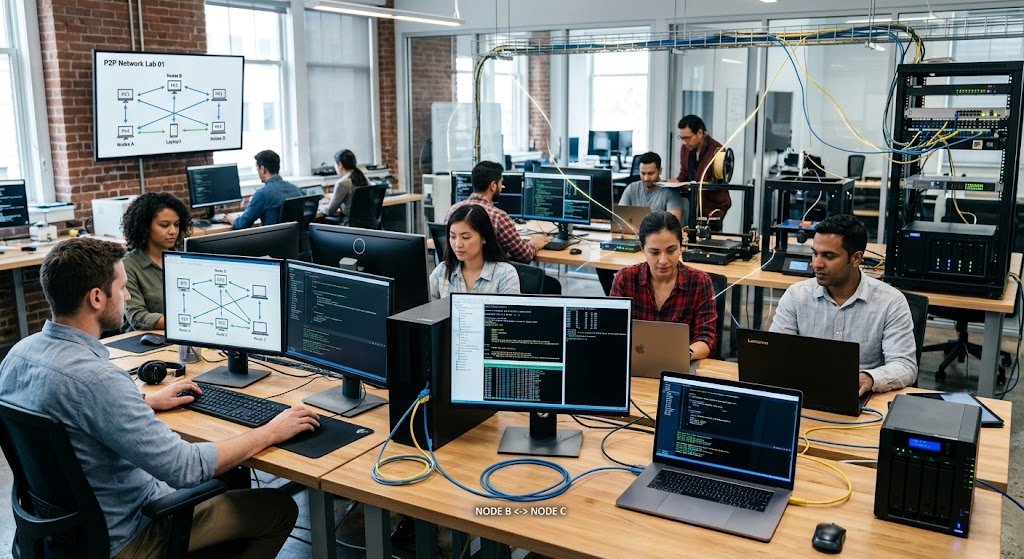
Peer-to-peer computing is a type of network architecture where devices that participate in the network, called peers, can directly communicate with each other and share resources or services. In a P2P network, unlike a traditional client-server network where a server typically plays a well defined role as the primary provider of resources, peers can request and provide resources. A computer can download information from another peer and at the same time make its resources (such as information, processing power, storage space) available to other participants. This can lead to decentralization of reliance on a single centralized system and to a network with many interconnected systems sharing resources. How a P2P network is organized can be very different, from a small network of direct links between computers to a very large network of distributed systems with thousands or millions of participating devices.
Peer-to-peer computing is fairly simple: Each computer that participates in a peer-to-peer system communicates as equals, instead of relying solely on a central authority for each interaction. In practice, however, there are various degrees of decentralization to P2P systems. Other systems have centralized servers to perform some operations like authentication, indexing, coordination, or discovery, while the actual exchange of resources takes place between peers. Other systems assign these functions to the computers that are participating, thus minimizing central points of control. This flexibility can be beneficial in scenarios where organizations require scalable resource sharing, distributed communication, or enhanced fault tolerance. With the advancement of network technologies, P2P computing principles have been applied to many applications spanning the internet and private networks.
How P2P Networks Work
A peer-to-peer network starts with a group of devices which can communicate with each other in a way that is permitted by a set of network protocols. The resources that one participating computer has can be needed by another participating computer; they can be files, space, processors, bandwidth, or services of applications. If the peer needs a resource, it can find the other peer that has the resource and communicate with that peer. A discovery mechanism may be needed to find peers to match if the architecture requires it. After establishing a connection, the devices can directly exchange information or via other participating devices. While some P2P systems still incorporate some supporting infrastructure for discovery, security or management, this scheme enables resources on the network to be spread out, instead of being focused on a single server.
There are several ways of structuring P2P networks. An unstructured P2P network allows peers to join and leave the network dynamically and the relationships between each device is not organized. A mechanism is needed to search for information in these networks that invades several peers till the desired information is located. Structured P2P networks have a more organized approach to finding resources, typically employing distributed data structures that can be used to identify which peers are responsible for specific information. Hybrid systems use P2P communication along with some central services. These methods clearly show that peer to peer computing is not just the lack of servers. Rather, it is a way of designing a system in which the elements of the network are responsible and share resources, and the extent to which this is decentralisation depends on the system in question.
Peer-to-Peer File Sharing
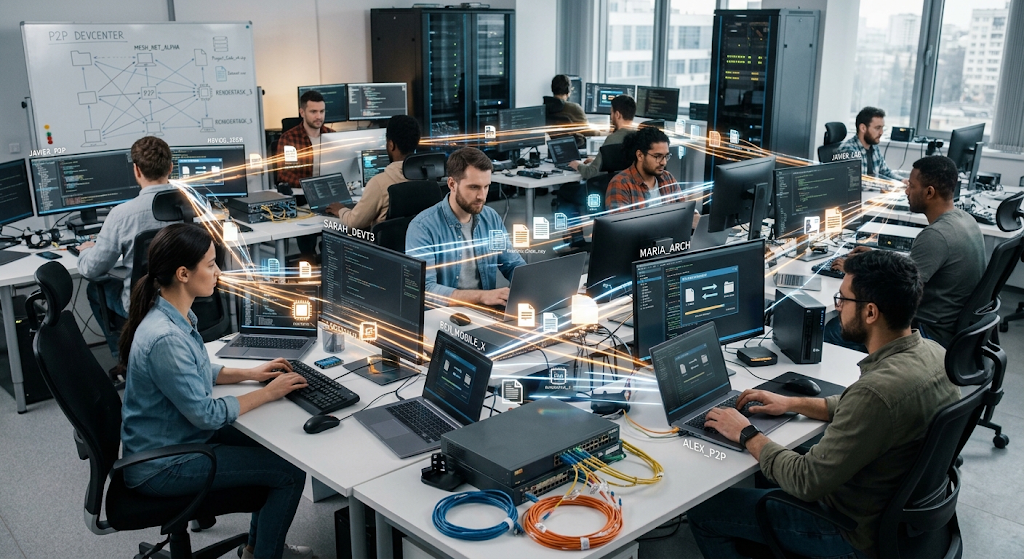
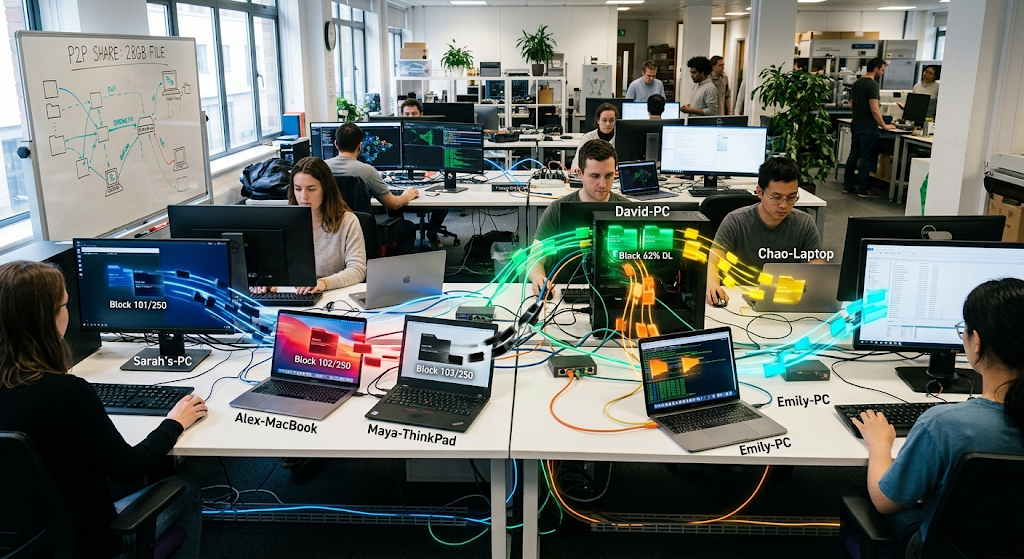
Peer to peer computing is known for the file sharing application. In a normal download system, the user can download a file from a central server. A lot of users accessing the same large file at the same time will generate a significant amount of network traffic and processing on the server. Participating computers can share the responsibility by using a P2P file sharing system. A peer can get some pieces of the file from other peers who have other pieces, instead of receiving the whole file from a central place. The downloading computer can then put the pieces together to create the desired file. This could share the bandwidth needs throughout the network and decrease the strain on one server.
P2P sharing of files can also promote the availability of resources when many participants share similar content. One peer could be disconnected but still have a part of the file they need. The system may then still continue to run provided that enough devices are still available to participate. This can be very helpful for distributing large datasets and software packages, as well as media files and other digital resources. But copyright, privacy problems, malicious content, and unauthorized sharing are also concerns raised by file-sharing networks. While a technically robust peer-to-peer system is necessary, it still needs the proper policies and security measures to ensure that the resources being shared are not malicious and/or bogus. As a result, organisations need to evaluate the technical gains along with the legal and security aspects of implementing P2P file sharing technologies.
Decentralized Applications
Peer-to-peer computing is also very closely allied to decentralized applications (also known as distributed or decentralized applications according to the application architecture). A decentralized application tries to spread some of the application functions between different computers involved in the application rather than all of the processing and data management to one central server. This can make the application more resilient in case a participating computer fails, as the system may not be unable to work. The communication, storage, identity and coordination mechanisms of decentralized apps are different, and while there is no single design to fit all systems, certain commonalities exist.
A benefit of DApps is that they can potentially decrease the reliance on a central middleman. A centralized application can lead to users relying on the organization that manages the application server to ensure its availability, security, and adherence to access rules. The distributed design may shift some responsibilities to the participants of the network. This can help build resilience and open up new avenues for cooperation. Meanwhile, decentralisation does not necessarily imply security, privacy, reliability and fairness. Careful design of authentication, authorization, data integrity, software update and dealing with undesirable participants will be necessary. Thus, decentralized applications are more about the responsibilities being thoughtfully allocated and not about the absence of a central server.

Communication Platforms and P2P Interaction
Another potential application of the principle of peer to peer is in communication. In the traditional communication services, the infrastructure is central to the functioning of the services, with services such as connecting users, storing information, routing messages, or administering accounts. P2P communication systems can allow participating devices to establish direct or distributed connections for exchanging information. It can be used for messaging, voice communication, video communication, collaborative activities or other real-time interactions depending on the application. In some cases, direct communication can alleviate traffic going through the central infrastructure layer, but many modern communication platforms take hybrid approaches that involve direct communication between peers and central infrastructure.
When network conditions are not ideal, it can be beneficial to be able to communicate with other peers without having to rely on centralized infrastructure. In certain distributed communication systems, devices can be used to relay information about other devices, enabling communication to take place through other available channels. This principle can help create resilient communication networks in situations where connectivity is unreliable, or infrastructure is limited. However, there are some technical considerations to take into account when using P2P communication. Devices should ensure that the connections are secure, that identity/identities are verified if needed, that sensitive information is protected, and that unauthorized access is prevented. Thus, encryption, authentication, and suitable network protocols are crucial to the development of trustworthy peer-to-peer communication systems.
Content Distribution and Streaming
P2P computing can also be used to distribute digital content over large networks. In traditional CD, user access to information is heavily reliant on the servers and content delivery infrastructure. If the demand is high, providers might require extra servers and bandwidth to keep up performance. A P2P approach can enable users with already downloaded parts of content to share the parts of content with other users. The greater the number of users involved, the more sources of content may be available, allowing the load of a network to be spread across the users.
This can be helpful when you’re trying to share a large file or a resource that is highly sought after. Distributed delivery mechanisms have the potential to benefit software updates, datasets, educational resources, and other digital content. But the efficiency of a P2P distribution system is reliant on the availability of the participants, bandwidth of the network, system design, security measures etc. When a large number of peers disconnect at the same time, the resource availability could decrease. Therefore, developers need to develop mechanisms to find reliable peers, to ensure the data received is correct, to control the network congestion, and to recover from failures. All of this illustrates the challenges involved in designing P2P systems to ensure reliable operation at scale.
Resource Sharing Beyond Files
Peer-to-peer computing can be more than a file sharing system. Computers can potentially share processing capacity, storage, bandwidth and other resources. Distributed computing projects can break down problems into smaller workloads and assign them to each computer that participates in the project. Each computer performs a specific task and sends the results back to the rest of the system. If a large number of computers are contributing their processing power, then a large computational problem can be potentially solved more efficiently than it can be solved on a single computer with limited resources.
Storage can also be distributed resource sharing. All data can be stored on one server, or it can be spread among the participating devices. These may also offer redundancy and enhance resilience if one of these devices is unavailable. Another option is bandwidth sharing, where computers share the bandwidth to transfer information throughout a network. The applications are examples of one of the key concepts of P2P computing – that the network participants can not only be consumers but also contributors. Sharing resources, however, requires careful management as the devices sharing the resources are not equally reliable, performing, available, or trusted.
Peer-to-Peer Computing has the following advantages
Resource distribution is one of the key benefits of P2P computing. The network does not have to rely on any single computer for any function, as more than one computer can provide it. This can minimize the impact of a failure of individual servers and spread workloads among the participating devices. However, in some cases, additional participants could offer extra bandwidth, storage, or computational power, allowing P2P systems to scale. Here’s an interesting relationship between numbers of active participants and resources available to the network: the more active participants in the network the more it can be strengthened if they provide resources that are useful.
Flexibility is another benefit. Peer-to-peer architectures can be constructed in situations where there is no need to have a centrally located infrastructure. They can support direct collaboration between users and enable resources to be shared across geographically distributed devices. Another benefit of the P2P system is that it can enable the efficient utilization of the existing computing resources as computers that are underutilized can share their processing power, storage space, or bandwidth. The advantages make the architecture applicable to distributed applications, content distribution, collaborative computing and other networked applications where the resources are naturally distributed in many participants.
Challenges of P2P Networks
Peer-to-peer systems offer great advantages, but have serious drawbacks. One of the biggest issues is security as not all of the participating devices may be equally trustworthy. A malicious peer might try to send harmful software, furnish incorrect info, intercept conversations, or disrupt network operations. P2P systems must thus have robust authentication, encryption, integrity, access control and suspicious activity detection systems. In the absence of proper safeguards, a distributed network may be very hard to verify who can be trusted to be a member of the network.
There can be issues of management and reliability, too. Peers may reconnect and disconnect at random times; addresses or hardware may fail; a peer may be suddenly removed from the network. This can make it harder to discover resources and make them available in a well-controlled centralized setting. There may also be differences in network performance depending on the capabilities of the different participants in the network. In addition, distributed resources could be more difficult to monitor and control by the organizations. P2P computing isn’t necessarily superior to client-server computing because of these constraints. Rather, it is dependent on the needs, risks and working conditions of the specific system.
Peer to Peer Computing vs. Client Server Computing
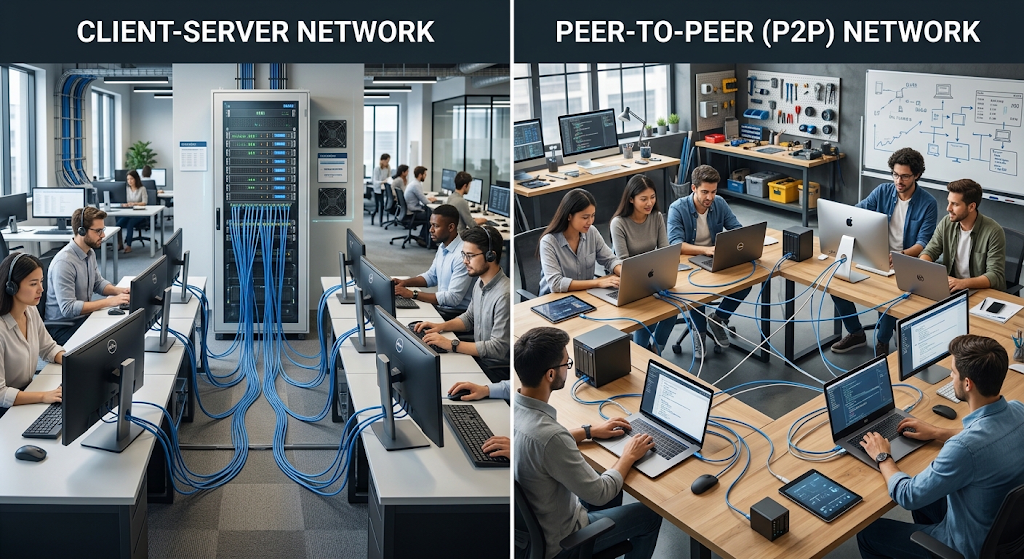
The distinction between P2P and client-server computing can be explained by looking at how the responsibilities are distributed. Generally, in a client-server architecture, there will be servers dedicated to providing services and client devices that are requesting and consuming those services. Security policy, maintenance, data storage and monitoring can be more easily organized under centralized management. But over-dependence on centralized infrastructure can lead to bottlenecks or single points of failure in the event of a failure in the redundancy system. As a result, organisations tend to be investing in multiple servers and other technologies to provide increased availability and load-share.
In a P2P architecture, the computers who are involved in the process of participation can offer and use resources. Therefore, responsibilities are shared by peers rather than dedicated servers. This can increase the resilience and utilization of resources in suitable environments, and can also increase management and security complexity. Modern networked systems often employ both methods and not just one. A service could have a central server that manages and coordinates accounts in an application, but it could have direct peer connections for some kinds of data transfer. The hybrid architectures are an example that P2P and the client-server model are not necessarily adversarial systems, but they can work together if properly designed.
The Role of P2P Computing in Net-centric Systems
Net-centric computing is based on the premise that the use of an interconnected network is a key component in accessing information, applications, services, and computing resources. Peer-to-peer computing is one of these alternative modes of network resource organization within the general context. Instead of having every major operation done on a centralized server, P2P systems acknowledge that connected devices can do something back to it and communicate straight. This can enable distributed resource sharing, distributed applications, resilient communication and distributed services.
The importance of P2P computing is especially significant because of the increasing number of connected devices. The network of smart phones, personal computers, servers, sensors and other devices can offer significant computing and communication power. Some of these resources can be coordinated using P2P principles, but not all of them can be. Centralized systems are still very significant, but distributed systems can offer other design choices for scalable and resilient net-centric systems. The best systems will be a mixture of centralized coordination with decentralized resource sharing as appropriate to the needs of its users and applications.
The Future of Peer-to-peer Computing
Peer-to-peer computing will find itself increasingly embedded in other distributed technologies in the future. The advent of faster network speeds, edge computing, distributed storage, artificial intelligence, and connected devices can bring new possibilities for direct collaboration by computers. Edge environments are especially interesting because they bring computing resources closer to the users and data sources. To complement this, the principles of P2P can be applied so that devices in close proximity can share information and resources, rather than always needing to communicate with more distant and centralized infrastructure. These systems can be used to support applications that need to be communicated quickly, processed locally, and make efficient use of the available resources.
Meanwhile, a better way to deal with some of the longstanding issues will be needed in future P2P systems. Those factors will continue to be relevant and will be some of the most important aspects of security, privacy, identity management, resource verification, interoperability and reliability. As distributed protocols and automated network management grow, it may be easier to synchronically manage many devices participating in this. Peer to peer computing can still be useful as one of several possible architectures for distributing resources as organizations become more complex and have a digital environment. Its future value will be contingent upon the identification of conditions under which participation is distributed in meaningful technical and operational ways to provide technical and operational benefits.
Conclusion
P2P computing offers an important alternative to the traditional model of networked computing. The model enables computers to communicate and share resources on an equal basis, which means that the responsibility for the resources can be shared among the participating computers and is not dependent on any one central system. It can be used for applications such as file sharing, communication platforms, content distribution, distributed processing and resource sharing, etc. With appropriate architecture, these capabilities can enhance flexibility, utilization of resources, and resilience.
P2P computing has also been accompanied with challenges in terms of security, reliability, resource management, privacy, and network performance. It should not, therefore, be considered as a replacement for client-server computing in general. Instituting P2P is rather a worthwhile approach in organizing networked resources, however. In a modern “net-centric” system, centralised and decentralised solutions can be combined into efficient, robust services. Peer-to-peer computing will continue to be an important topic for anyone studying how to design and operate a modern networked system as networks continue to grow and more and more devices and computing resources are connected to them.