Introduction
Cloud computing has become an essential part of the financial sector. It offers banks, fintechs, insurance providers and other financial firms the ability to modernize their operations. With more reliance on digital platforms, financial institutions are looking for safe infrastructure to store information, complete transactions, manage accounts and provide services effectively. When choosing a cloud environment for your organization it is important to understand each type of cloud so you can identify how you will manage your technology infrastructure. There are three main cloud options to choose from; public, private and hybrid clouds. Each option has different benefits.
Understanding the Three Main Cloud Types
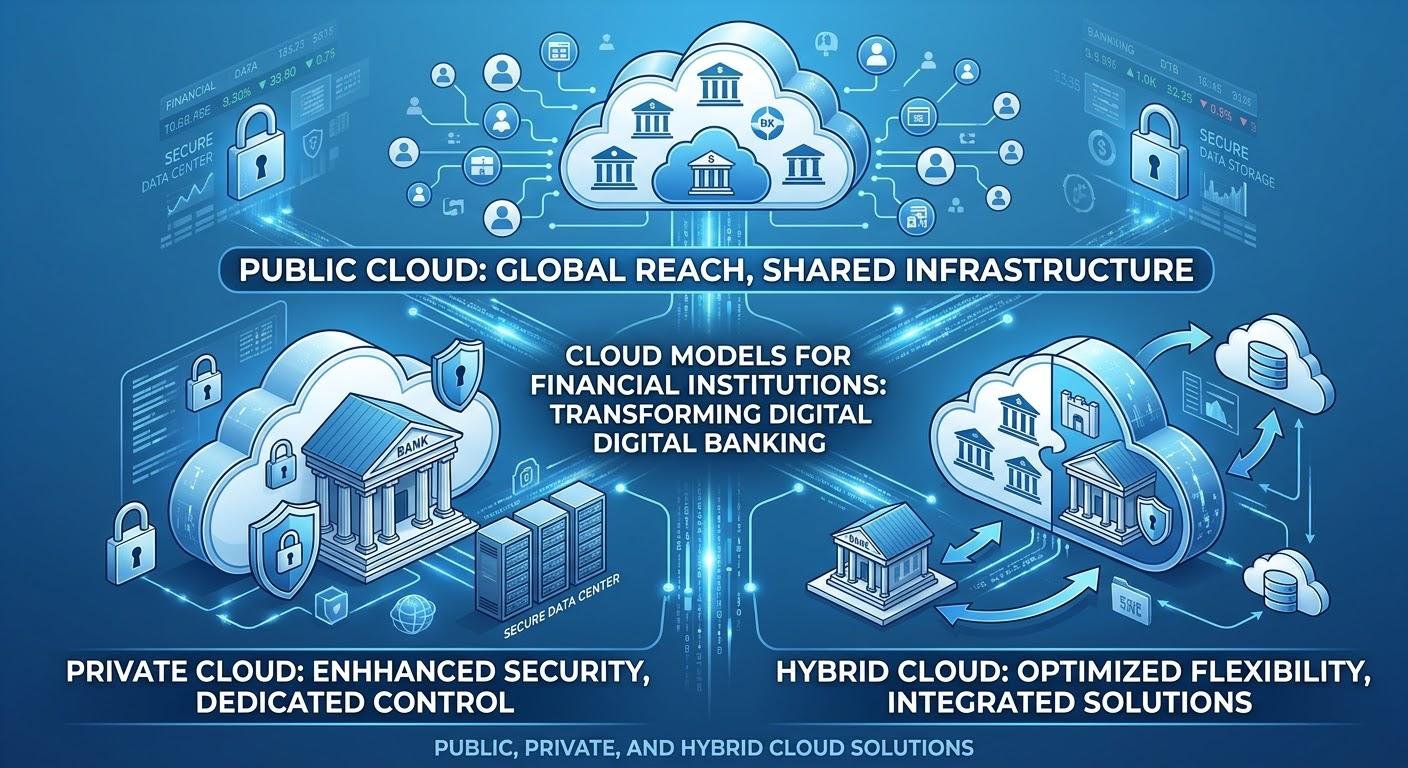
Cloud deployment models refers to how organizations use and manage their cloud computing resources. It can affect how your organization manages its systems, processes and how they can provide computing resources. Financial institutions will need to understand what kind of cloud they use to effectively run their business, provide a good customer experience, manage cybersecurity and meet regulatory requirements. A public cloud will provide computing resources from a 3rd party. A private cloud will provide dedicated resources for your organization. A hybrid will provide a blend of public and private resources so your business can manage their applications and processes. All three of these can help with digital transformation however your financial resources, security requirements, technical capabilities and overall business goals will determine what you choose.
1. Public Cloud: Cost-effective and Scalable
A public cloud is when computing resources are provided via the internet by 3rd parties. This means companies like Amazon Web Services, Microsoft Azure and Google Cloud can provide a range of services for their clients. This includes storage, databases, networking and computing. Financial institutions can benefit from this as they do not need to purchase and manage lots of physical servers. One main benefit of using a public cloud is it can be cost-effective. Organizations will generally only pay for the resources they use. This can be beneficial for fintech startups and smaller financial businesses as they can use advanced technology with little capital outlay. Using a public cloud can also save time for your organization as they can easily add new digital services.
Scalable
Using a public cloud can also be scalable. For example, if your digital banking app receives a lot more traffic during salary payments, festive times or promotions you can easily increase your computing power with a public cloud provider. You can scale your computing resources to manage the demand and then scale them back down again. This can help your organization stay efficient as you are not paying for extra resources. Public clouds can also help speed up your development as you can easily use computing resources. However, you will need to carefully manage your usage as it can result in increased running costs due to unexpected demand, poor resource management and extra services.
Security
Although public cloud providers will spend a lot on cybersecurity, financial institutions need to understand what they are responsible for. The infrastructure will generally be secure however you will be responsible for securing your applications, managing access, setting up security features and securing your data. Your bank will also need to consider data protection, regulatory requirements, encryption and where your data is being stored. Public clouds can also help your organization with security, monitoring, backups and disaster recovery. However you will need to be careful when using a public cloud for sensitive financial processes. Make sure your provider can help with any relevant regulations and contracts.
2. Private Cloud: More Control
A private cloud is when your organization will have dedicated computing resources. This can either be managed internally (datacenter) or externally. This can give your organization more control over their technology. This is popular with established banks, insurance providers and financial organizations as they will be handling very confidential information or may have strict regulations. This can be more costly and require more technical management however can help you create strict security policies and processes.
Security, Control and Regulation
One of the main reasons financial institutions will choose a private cloud is due to the amount of control you have. Banks will hold personal information about individuals, their accounts, payments and financial documents which need to be carefully secured. With a private cloud you can set up specific access controls, encryption, networking and monitoring. It can also help you know where specific information is being stored and how certain systems are managed. However, you will still need to invest in qualified staff to manage security, regular security checks, software updates, backups and disaster recovery.
Cost and Scalability
A private cloud can be quite costly to set up. Your organization may need to purchase servers, networking, storage, security and software. You will also need staff with the correct skills to manage your infrastructure. This can be unattractive for smaller fintech businesses. A private cloud may also not be as scalable. As you will need to purchase additional equipment, set up and configure. Unlike a public cloud you cannot easily scale your resources. You will need to consider if having more control is worth the cost and effort.
3. Hybrid Cloud: Flexible and Control
A hybrid cloud is a combination of both a private and public cloud. This means financial institutions can use both. This means you will be able to decide where to place your applications and databases. For example, your bank may want to keep their confidential customer data and sensitive processing in a private cloud however they can use a public cloud to host their website, mobile app, customer communications and testing. This can provide a balance between having control and scalability. This can be useful for financial institutions that want to upgrade their technology but do not want to move all sensitive information.
Security and Manage Workloads
Having a hybrid cloud can also give your organization more flexibility for securing different types of information. You can keep sensitive workloads in a private cloud and other less sensitive applications can be provided via a public cloud. For example, your bank may want to process confidential customer data in their private cloud but can use public cloud computing to analyze anonymised transaction data to improve their customer services. However, you will need to ensure you have secure connections, consistent access controls, encryption and monitoring. You also need to ensure you have no unauthorized movement of data. If not managed correctly you can increase the security risks.
Cost-effectiveness and Flexibility
A hybrid cloud can help your organization manage their technology costs. If you require extra computing resources you can use a public cloud. This is sometimes known as a cloud burst. This can help you manage your workloads more efficiently whilst keeping key systems in a private cloud. A hybrid cloud can also help with gradual digital transformation. You can move your applications into the cloud slowly. However, you will need integration tools, technical knowledge and careful financial planning. This can make things more complex.
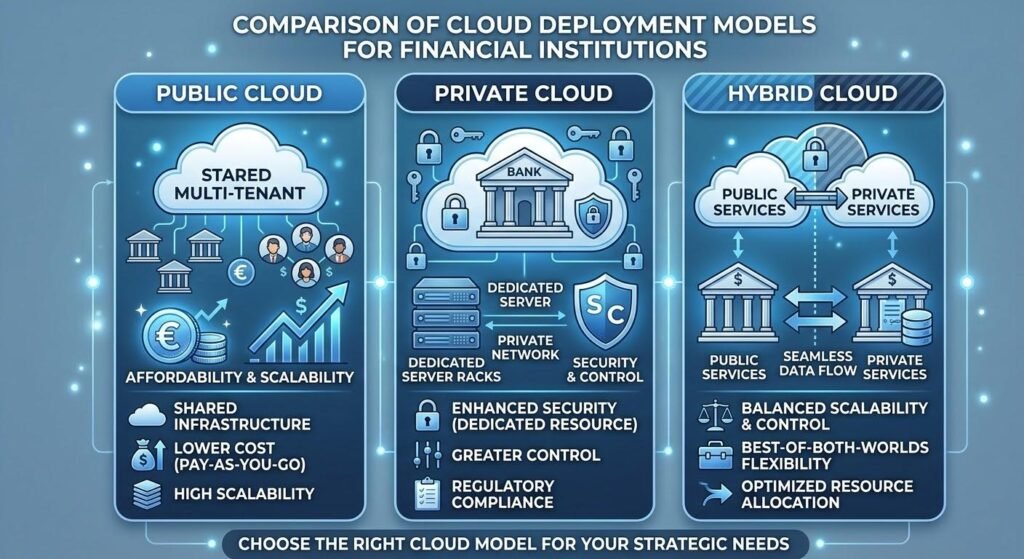
Comparison between Public, Private and Hybrid Clouds
Each of the clouds has different features. A public cloud will generally be cheaper to set up and scalable. This can be useful for fintech startups and organizations looking to develop digital services. A private cloud will give you more control over your infrastructure however will be costly to set up and manage. A hybrid cloud can give you the best of both worlds. However you will have some integration issues. There will not be one safe and cheap option. Financial institutions will need to consider what they need to run their operations, what regulations they have, their current technology and the expertise they have.
Examples
A fintech startup may choose a public cloud as they need an affordable infrastructure, quick development and can scale to more customers. A large commercial bank may choose a private cloud as they want more control over their systems which are very sensitive. An established financial institution may choose a hybrid cloud as they want to upgrade their digital services. They can keep their sensitive databases in a private cloud but use a public cloud for their customer facing applications, analysis and extra computing resources. As a whole, you should consider your size, business model, security and technology maturity.
Things to Consider
When choosing your cloud type you should consider the following factors. Firstly, think about the sensitivity of your information. Are there any applications that need dedicated security and extra access control? Secondly, consider what regulations you have, data protection requirements and contract requirements. You will need to ensure your chosen cloud meets these. Thirdly, consider what your initial and ongoing costs will be. This can include infrastructure, subscriptions, management, security and training. You will also need to think about scalability. Financial services will need to manage their transaction volumes. Lastly, consider your technical capabilities, disaster recovery, reliability of your provider and integration. This will ensure you do not make any costly infrastructure decisions.
Conclusion
There is no one answer to what is the best cloud type for financial institutions. Every organization will have different priorities and risk requirements. A public cloud may be a good option for fintech startups and organizations who want to keep costs low, have quick deployment and scalable resources. A private cloud will be a better option if you need dedicated resources, more control and bespoke security for sensitive workloads. A hybrid cloud can provide a good balance between a public and private cloud. This can be useful for organizations that have different types of financial information. Overall it will depend on your security requirements, regulation, resources and business goals. By carefully considering these factors you can implement a cloud strategy to improve efficiency, innovate, protect customer information and improve your competitiveness in the digital financial industry.
Get more well researched information about Cloud Computing for Financial Institutions here.