Introduction
Cloud computing is now a crucial part of the banking industry and has allowed organizations to store information, run applications and process transactions as well as provide digital services without relying on infrastructure. When looking at implementing cloud computing, financial institutions will need to choose between a single or multi-cloud strategy. A single cloud strategy will mean that the institution is relying on one provider to provide most or all of the cloud based services. A multi-cloud strategy will involve running applications, services and workloads across multiple providers. Both strategies have their pros and cons to consider including reliability, infrastructure costs, security, performance and management. Understanding what each strategy involves will help banks and fintechs make an informed choice to implement a model that will support their business goals and not add unnecessary complexity.
Understanding Single and Multi-Cloud
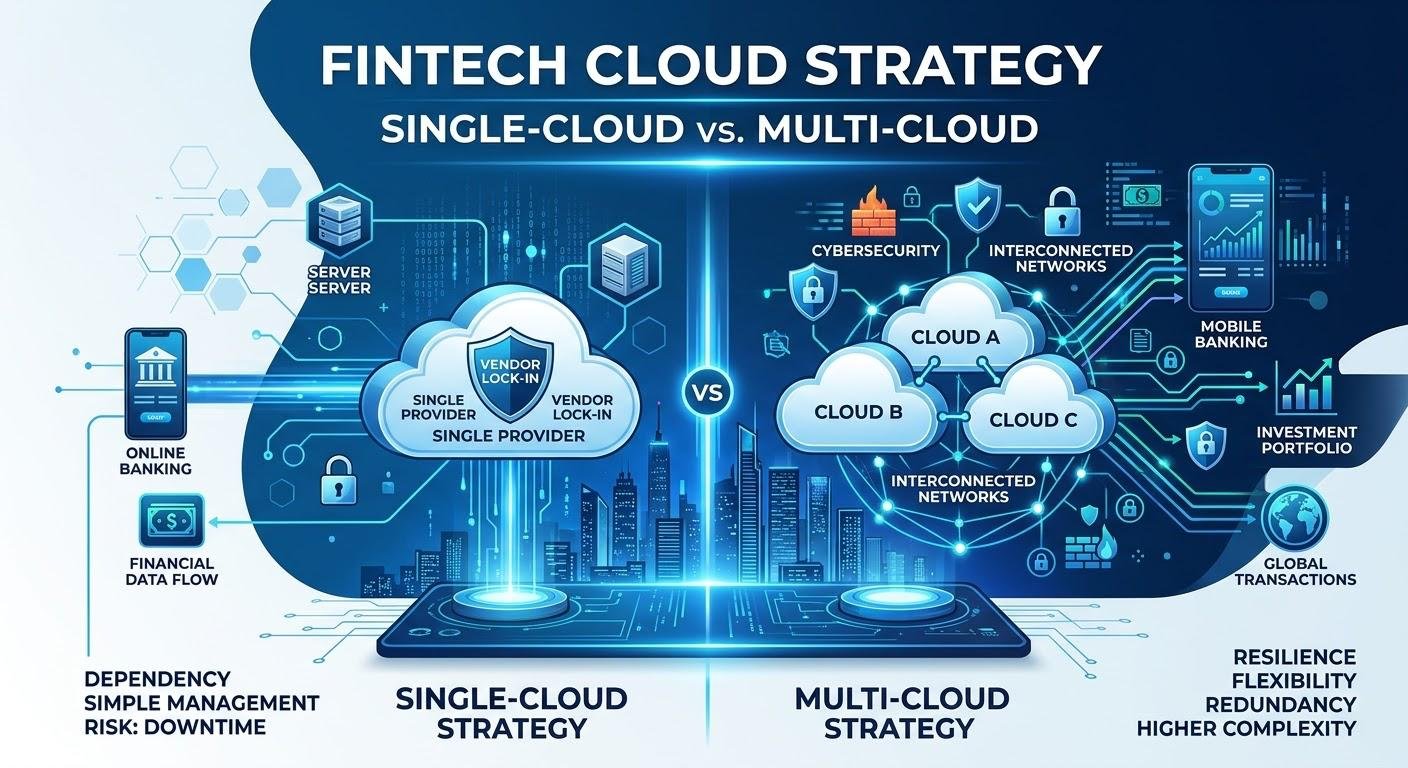
A single cloud strategy will see the bank or fintech using just one provider. This makes it simple to manage as they will have a good understanding of how the provider works, what security there is, pricing and management tools. Applications can also be easier to integrate as all are in the same environment. However, this can cause a lot of dependency issues as if the provider is down or has technical issues, then the applications may not be available. If the business is growing and expecting higher customer expectations, this could become a real issue.
A multi-cloud strategy will involve using multiple service providers. This could mean using Amazon Web Services for customer facing applications, Microsoft Azure for internal business applications and Google Cloud for Data analytics. The idea here is to use the best providers for each application. This gives the financial institution more flexibility with their technology. However, it also means more coordination is needed as there will be multiple management tools, security settings, service agreements and technical requirements. This should be carefully planned.
Reliability
This is one of the most important factors to consider when choosing a cloud strategy. A single cloud strategy can help the bank or fintech to have reliable services. This is as the provider will have good infrastructure, monitoring tools and guarantees. Large providers will have multiple datacenters and availability zones which help with business continuity if there are any technical issues. However, if a large provider has an outage, this can cause problems with applications that heavily rely on them. A multi-cloud strategy can help to avoid this by having another provider to run essential services. However, this only happens if applications have been designed correctly, failover tested, independent network connections and backup systems are in place.
Lock-in
A vendor lock-in issue will occur when an organization has become heavily reliant on one technology provider. This could be because the bank has developed their systems around specific databases, cloud services, APIs and management tools. This is an important factor for financial institutions as there can be large costs involved in changing providers. A single cloud strategy can cause more dependency issues if applications have been designed around specific providers. A multi-cloud strategy can help to reduce this issue by encouraging more flexibility. However, this does not completely eliminate the issue. Financial institutions should look to use open standards, easily portable applications, clear documentation and technologies that can be easily migrated in the future.
Infrastructure Costs
A single cloud strategy may provide cost savings. This is as you can negotiate pricing based on how much you use. There will also be less administrative costs as there is only one provider to manage. A multi-cloud strategy may incur extra costs. This is as there are multiple subscriptions, data costs, monitoring tools, security tools and training costs. Large volumes of information may incur high costs to move between providers. Some cloud services charge for data being sent out. However, there can be cost savings as you can move workloads to providers who can offer you better pricing or services. Banks should look at the overall cost of ownership including migration, integration, management, staffing and potential downtime.

Data Portability
Data portability means the ability to move data between systems. This is important for banks and fintechs to ensure they can move their data accurately, effectively and efficiently. A single cloud strategy may be easier to manage, if the data is stored in specific formats, databases or services it can make it difficult to move large volumes of data. A multi-cloud strategy encourages organizations to think about this from the start. Financial institutions can help this by using standard data formats, compatible databases, clear API documentation and automated migrations. Regular testing should also be carried out to ensure there are no compatibility issues.
Performance
Performance depends on how quickly your applications are processing requests, communicating and providing data. This can impact the performance of mobile banking, payments, fraud detection and online customer support. A single cloud strategy can provide good performance if the provider has data centres near your customers and enough resources. This can also make applications communicate quicker. A multi-cloud strategy can also provide performance improvements by moving workloads to providers that can provide the correct infrastructure, location and specialist resources. A fintech could move their customer facing applications to a region near their main users but move their data analytics to another provider. However, this can cause latency issues. You should always look at the response times, dependencies and processing times of your applications.
Security Management
Security management is a big consideration for financial institutions. A single cloud strategy can be easier to manage. This is as there will be one provider to manage user access, monitoring, encryption and compliance. However, you should always understand the shared responsibility model. This is as the provider will have some security in place but you will still have to manage areas like identity, application security and data security. A multi-cloud strategy can also cause issues. This is as each provider will have different user access, monitoring, encryption and configuration requirements. This can cause issues with mis-configured services. Financial institutions should have centralized identity, consistent security, monitoring, encryption and independent security reviews.
Workload Decisions
In order to successfully implement cloud computing, you should decide which workloads to place in each environment. Some workloads may be better suited to single clouds. These could include internal accounting, staff management and reporting applications. Other workloads may be better suited to multi-clouds. This could include specialist services, location flexibility and independent recovery. A bank may run their core transaction processing in a single cloud but also have a second cloud for disaster recovery and specific analytical applications. If you have highly sensitive financial information you should only place it in environments that comply with any regulations, privacy and security requirements. You should always look at technical dependencies, data sensitivity, performance, recovery requirements, costs and compliance requirements to ensure you are placing workloads in the correct environments to meet your business needs.
Backups
Regardless of whether you have a single or multi-cloud strategy you will need to have a backup strategy. A bank will want important information to be protected from accidental deletion, cyber-attacks, system failure, software issues and unexpected outages. A single cloud strategy can help with having good backup solutions. This is due to having multiple availability zones, location based storage and automatic recovery. However, by having everything within one provider you may be affected by some issues. A multi-cloud strategy can help to provide further protection. This is as you will have independent copies of your important information in another provider. Financial institutions should have clear backup times, encryption, user access and retention policies. They should also perform regular testing to ensure they can recover. You should always look at your recovery time objectives and recovery point objectives.
Multi-Cloud Complexity
Whilst a multi-cloud strategy can provide flexibility, it can add pressure on technical teams. Each provider will have different interfaces, billing, monitoring, security and support. If not managed well you may have issues with inconsistency, duplicate services, unclear responsibilities and unexpected costs. Banks and fintechs can help with this by using centralized cloud management tools. This will provide insight into your workloads, costs, performance and security. Using Infrastructure as Code can help to automate the creation and configuration of resources. Using containerization and orchestration tools may help with application portability. However, this will require technical knowledge and will need maintaining. Start with a small amount of providers, have clear governance responsibilities and only scale up if there are clear operational and cost benefits.
Business Benefits of Multi-Cloud
A multi-cloud strategy should be considered from a business perspective. Financial institutions should consider whether the benefits outweigh the increased costs, management and risk. You should look at key performance indicators such as application availability, transaction processing, recovery time, infrastructure costs, security incidents and data movement costs. You should also consider whether you have more leverage, reduced dependency and access to services that would be harder to obtain from a single provider. If you are only increasing your admin costs by using a second cloud provider and not gaining any benefits in terms of reliability, performance and business continuity then it may not be worth it. Banks should perform pilot projects to compare results to their current infrastructure. They should also look at performance over the correct period of time. This will help decision makers to understand where they are gaining real benefits from using a multi-cloud strategy.
Conclusion
Banks and fintechs should consider their operational requirements, costs, security responsibilities and long term tech goals when choosing between a single or multi-cloud strategy. A single cloud can provide simplicity, integration and cost savings. However, there can be increased dependency issues. A multi-cloud can provide more flexibility, provide alternative recovery options and distribute workloads based on provider capabilities. However, there can be increased costs and complexity. There is no one size fits all solution. A realistic solution may be to have a core provider and use a second cloud for specific workloads, independent backups or disaster recovery. Overall it is important to have reliable services, secure data, portability and real business benefits. By making informed decisions regarding workload placement and regularly performing performance reviews financial organizations can create cloud environments that will help with innovation without causing unnecessary operational issues.
Get more well researched information about Multi-Cloud vs. Single-Cloud Strategy here.