Introduction
AI is ushering in a new era of banking, transforming how banks interact with their customers, process transactions, and combat fraud. Artificial Intelligence is changing the banking landscape, making it more efficient and effective in how financial institutions communicate with customers, process transactions and prevent fraud. AI is helping in the banking industry to automate manual tasks, analyze financial data and deliver personalized service. In the banking sector, AI is utilized for automating routine tasks, analyzing financial data, and providing personalized services. Now it’s becoming a part and parcel of banks and the fintech providers to streamline and automate simple processes, analyze financial information, and offer customized service. They can be changes that can improve the culture of banking, make banking easier, simpler and faster for the people and for business, and should benefit each one of them. But the application of the Artificial intelligence has its cybersecurity, privacy, fairness and reliability issues as well. For example, if a customer or an employee ingests information without scrutiny it could result in false outputs by AI that may mislead them, making fact checking an important consideration in responsible usage. It’s crucial to take the time to understand the pros and cons of these solutions, as a solution provider or a banker relying on one.
Artificial Intelligence in Digital Banking
In digital banking, the applications of AI technologies such as machine learning, NLP and predictive analytics to automate processes, tasks and functions. They can use these technologies to analyze transaction history, detect odd transactional activity, analyze customer enquiries and help them with monetary decision making. It could be an AI banking application that sorts purchases, predicts clients’ bills or identifies an unusual purchase, as an example. It can also be used to enhance the internal process, risk management as well as resource allocation of the financial institutions. This is good, but it doesn’t necessarily assure fair and just results. It depends on the quality of the data, protection mechanisms of the entity used and its design.
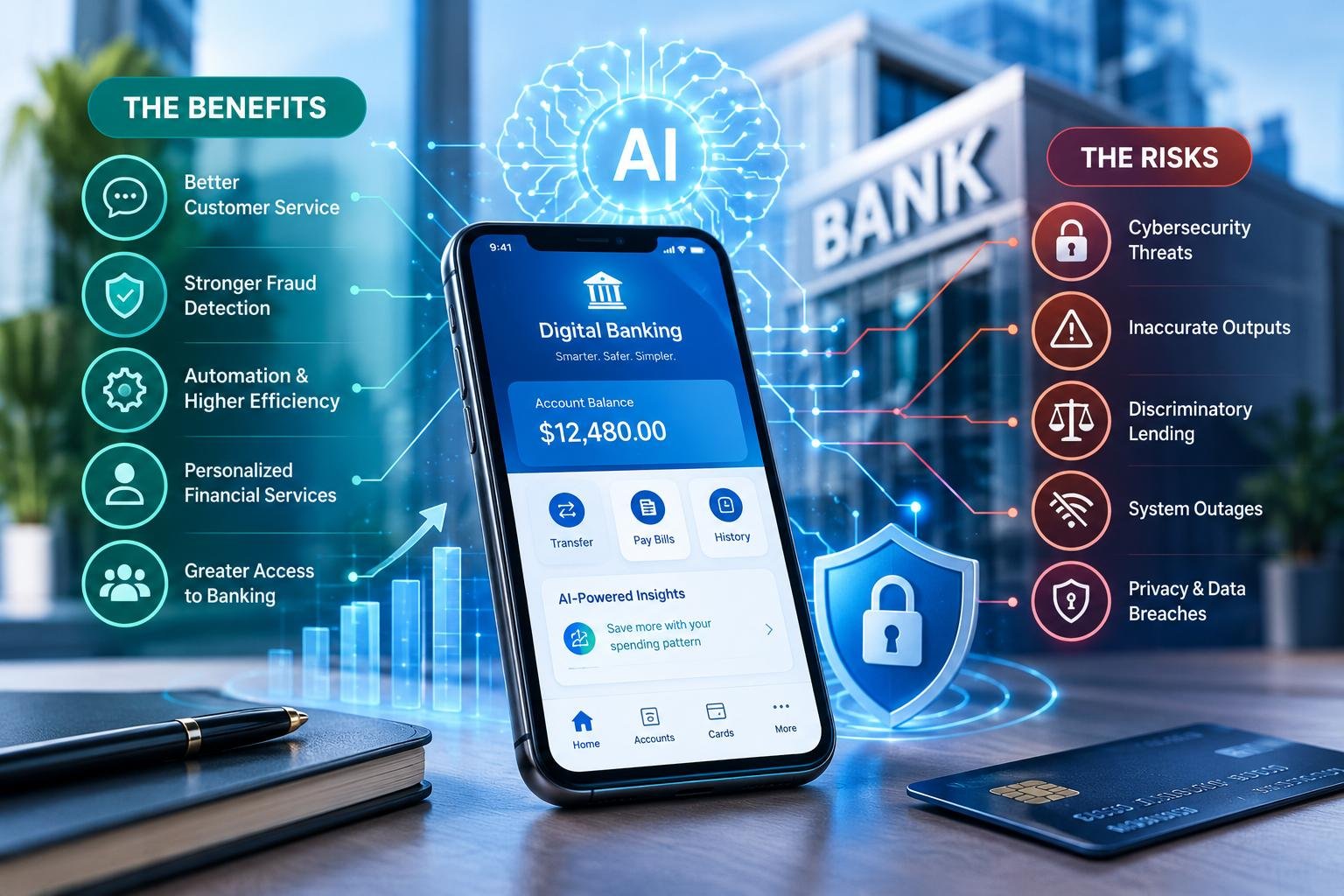
The Benefits of AI in Digital Banking.
1. Quick Response to Customers and Automated Services
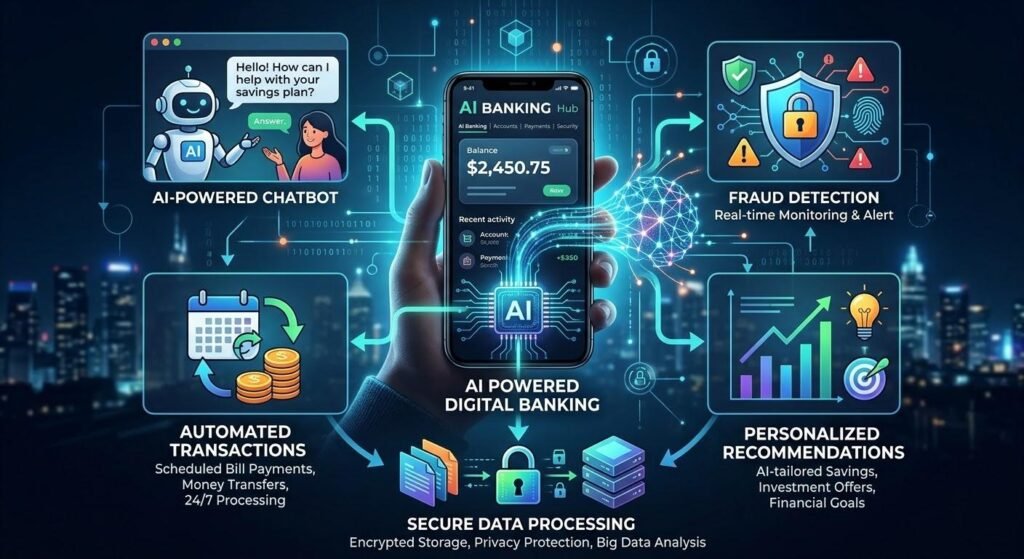
AI in banking is among the most prominent benefits that can deliver faster customer service. AI chatbots and virtual assistants enable clients to receive answers to their basic questions instantaneously without having to wait for a human customer service representative, like how to check their account balance, view their transaction history, card services, or the payment choices they have. Many of the systems are on 24/7 service and the customers can obtain assistance outside of business hours. AI can also streamline repetitive tasks like categorizing transactions, reminding customers of overdue payments, assisting with identity verification, and handling some account management tasks. Such functions minimize repetitive tasks of the bank staff and enable them to focus more on complex customer requirements. However, there should be a mechanism in place to deploy humans when additional information is required or the transaction has problems that can only be solved by human intervention, or when there are discrepancies in transactions.
2. New Capabilities for Enhanced Fraud Detection and Security Monitoring
AI can improve fraud monitoring by filtering through a significant amount of transactions and identifying patterns that are associated with fraud. Atypical locations, devices, spending patterns and transactions can be identified through machine learning models, as these are typically identified by a rule-based security system. If it is a payment that is suspected of fraud then the system can notify the payment to be investigated and/or further verified. This allows banks to take swift action to combat account takeover, fund transfers and other financial crimes. AI can also be employed to continuously monitor by analyzing transactions as they occur. But, there are times when suspicious activity alerts are not accurate. Payments that are authorized may be returned and sophisticated scams may not be identified. Therefore, there should be a combination of AI monitoring and strong identification platforms, system testing, and manual investigations by employees as necessary.
3. Increased Efficiency with the use of Resources and Reduced Costs
AI can work to improve bank processes and save precious time and resources by eliminating repetitive tasks. Automated systems can be utilized to process documents, onboard customers, reconcile transactions, and review for compliance and financial transactions. These tools can handle information rapidly, decreasing administrative delays and allowing staff to handle bigger workloads. The enhanced efficiency can also be advantageous for banks in terms of the reduction of operating costs, which can be invested in customer service, innovation and security. Automation has the potential of being helpful to smaller financial institutions, but it might not be the same kind. For example, some services could be offered that do not require any additional staffing. There are some cons to AI, though, which will require the use of technology, training for employees, cyber security and continued maintenance. By institutions, improvements in service performance and quality that can be measured and quantified should be weighed with the cost of the improvement.
4. Personalized Banking Experiences
By leveraging AI, banks can offer services that are more tailored to specific financial situations and preferences. Digital banking platforms can deduce budgeting tips and reminders about saving based on spending trends, income deposits, saving patterns and recurring expenses. Customers can get alerts if their spending is rising, if they are coming up to a bill that may impact their remaining balance or if they are nearing their own savings goal. Financial institutions can also leverage AI to make product recommendations to customers, such as a savings account or loan option, based on their data. While these recommendations can help to make financial management easier, it is important to avoid too much personalization or manipulative marketing. Customers need to be aware of the reasons for the recommendations and be in control of the data, and make choices without pressure.
5. Potentially Improved Access to Financial Services
AI can be used to provide financial services to those that don’t have traditional banking access. There are a number of ways that digital onboarding can help, such as making identity verification easier, and automation can help customers who would not be able to make the journey to a brick-and-mortar branch. Some lending systems use AI to evaluate further monetary details for making credits decisions for individuals that don’t have traditional credit scores. This can provide a chance to underserved communities and informal workers, and small business owners. Language and easier explanations can also help enhance the accessibility that AI-powered interfaces can provide. But these gains are conditioned on the availability of a reliable internet connection, an adequate digital infrastructure and responsible system design. Those who don’t have smartphones, reliable internet access, or digital savvy might still be left behind. Banks, therefore, need to see AI as an enabler for access expansion and not a substitute for inclusive services and those that are suitable and appropriate to human assistance.
Unanticipated Risks and Challenges of using AI-driven Digital Banking
1. Cybersecurity Threats and Data Breaches
While AI can bolster fraud prevention measures, it may also create new security risks. Cybercriminals can leverage AI to generate realistic phishing content, clone voices, automate attacks or generate even more advanced attacks on financial institutions and their clients. AI-powered banking systems could even be the subject of attempts to tamper with training data, take advantage of software vulnerabilities, or access to sensitive data without authorization. A data breach could mean that your account information, transactions, identity documents and more are out there and in the hands of others. This can result in economic loss and loss of the customers’ confidence. Banks must implement measures for information security such as encryption, access controls, secure authentication, periodic security testing and response planning. To prevent additional losses, it’s important that customers are also well-informed about how to identify a scam and how to report it.
2. Inaccurate Outputs and Unreliable Decisions
AI systems may generate false data, misinterpret customer orders, or offer incorrect suggestions due to incomplete data. A financial prediction tool could give a customer a bad estimate on his or her future cash flow, or a Chabot could give the wrong instructions. Unreliable outputs can result in confusion or lead to decisions which are not in the best interests of the customers in lending and account management. This can happen for a variety of reasons, such as data quality, model limitations, shifting economic scenarios, or inadequate testing. Financial institutions need to check key outputs prior to taking consequential decisions, and ensure there is clarity over what to do if an error is made. It’s crucial for customers to also not take the advice that comes from an AI as gospel when it comes to their finances. In the event of an error that may impact access to money, credit and key banking services, human review, independent verification and clear communication are especially vital.
3. Discriminatory Lending and Unfair Treatment
The use of AI models in lending can perpetuate and re-create discrimination if the data used to train them includes discriminatory patterns or if the data appears to be neutral but is a proxy for a protected attribute. An automated system, for instance, may penalize job seekers from certain communities due to the locations where they work or lived, or their access to credit in the past. This can limit the opportunity for small business owners and people that are already facing financial challenges. Automated decisions can be challenging for customers to appeal if the banks can’t tell us why. Financial institutions should consider models to test for adverse outcomes, ensure that there is representative and appropriate data, document their decision making process, and explain adverse decisions meaningfully, to mitigate these risks. There needs to be a level of authority that can be relied upon to investigate and rectify the unfairness that the system tends to produce, not just simply what it suggests.
4. System Outages and Excessive Automation
Digital banking services rely on technology that can fail, have connectivity issues, be hacked and suffer from unforeseen outages. When AI systems are not available or the errors they generate are pervasive, customers might find it difficult to get support, make transactions and resolve immediate issues with their accounts. These situations can be exacerbated by over-automation, as institutions have eliminated people’s options or workers are not trained to step in. Foregoers who have complex complaints, disability or special financial situations may also be frustrated with automated processes. Banks need to have backup systems, regularly test recovery systems and offer other means of access like a telephone service or a staffed service centre. Staffs need to be aware of the systems’ make, model, and type and when to override the system. Digital banking needs to be resilient, as well as technologically innovative, and requires the help of humans.
Responsible AI Governance in Digital Banking
1. Transparency and Secure Data Handling
Transparency can be used to communicate with customers when AI is being used, the information that is being used to make a decision, and how to seek assistance or challenge an outcome. When an automated process has an impact on a credit application, fraud investigation, or access to the bank account, a bank should provide information on the process in a way that is understandable to customers. Data security is also crucial, as AI systems could come across large portions of personal and financial information, which may be susceptible. Only essential information/record should be gathered, retention periods should be determined, only those authorized to access the information/record should have access to it and compliance ensures all applicable privacy and financial regulations are followed. Clear and open communication on how and why data is used and protected for customers, these practices promotes accountability and minimizes the risk of technological convenience compromising confidentiality or individuals’ rights.
2. Ensure Human Oversight and Ongoing Monitoring.
However, AI cannot be used as a replacement for professional judgment in all cases, and human oversight is required to ensure that AI is used appropriately. Bank staff should evaluate “high impact decisions,” examine the results of decisions that are “unusual” and “intervene” when results of systems are “reliably” wrong or potentially discriminatory. Customer behavior, fraud techniques and the economic environment are constantly evolving, so institutions should track the performance of AI on an on-going basis. Regular testing can identify when the accuracy is decreasing or new security issues are being detected, or if there are differences in how various groups of customers are being treated. There needs to be a clear responsibility for teams that build, approve and oversee AI systems. Banks need to have protocols in place to report mistakes, process complaints and rectify and reverse negative decisions. People, procedures and accountability are needed to provide effective oversight, and to do so, they must have the capacity to shut down a system when the risk becomes too great.
Conclusion
AI has great potential to empower digital banking to be faster, more personalized, efficient and accessible. It can enhance fraud monitoring, automate repetitive tasks, aid in financial planning, and enable institutions to cater to customers on a large scale. However, with these benefits also come significant risks, such as cyber security threats, privacy breaches, false results, discriminatory lending practices, technical difficulties and over-dependence on automation. To ensure the responsible use of AI, data handling is crucial, decision-making processes must be transparent, frequent testing and monitoring are needed, human oversight is required, and robust governance structures must be put in place. Banks also need to maintain suitable options that allow for customers to access assistance when needed. On the consumer side, it is crucial to be vigilant against fraud and to double-check critical financial data, and on the business side, it is important to assess the advantages and drawbacks of AI tools in your financial operations. In conclusion, AI can enhance the digital banking experience provided it is innovative without compromising on accountability, fairness, reliability, and safeguarding customer interests.
Get more well researched information about Artificial Intelligence in Digital Banking here.