
Introduction
While programming languages, system architecture, testing tools, databases, and deployment platforms are all components of software development, they are not the only ones that make a successful software project. Clear communication is also essential as software is generally created by a team with varying responsibilities, skills, and technical knowledge. Technical writing is a systematic method for conveying information throughout the development process. Requirements documents tell people what the system should do, design documents tell how it works, developer documents tell how to make the system and user guides tell people how to use the finished product. If there is no reliable documentation, making key decisions can be challenging, technical information can be limited to a handful of people and teams can spend time looking for information or redoing work. Professional technical writing, in that sense, is a crucial communication medium between people, processes and technology in the course of any software development project.
Technical writing is a way of communicating with readers.Technical writing in software development is a means to communicate with readers.

Technical Writing in Software Development
Technical writing in software development is the process of producing clear, accurate and well-organized documents that convey technical information to a particular audience. Technical writing is often more specific than general business writing, and is typically geared toward requirements, processes, systems, configurations, procedures, features, or technical decisions and directions, and instructions. The reader(s) could be software developers, project managers, business analysts, testers, system administrators, customers or simply the common user; the writer should adjust the amount of detail and terminology to the target audience. These are typically software requirements specifications, system design documents, application programming interface documentation, installation instructions, documents for testing, troubleshooting guides, release notes, knowledge bases and user manuals.
Good technical writing is not just the documentation of a finished product. It helps with decision making and collaboration during the project’s development phase. Having accurate documentation and being able to update it as the project evolves is a reliable reference for teams, minimizing confusion and ensuring consistency throughout the software development life cycle.
Technical Writing During Requirements Gathering
Requirements gathering is one of the earliest and the most crucial phases in the software development life cycle since it sets the goals that the software system is supposed to meet. Technical writing is a way to convert conversations, business requirements, user expectations, and technical limitations into organized requirements that developers and other stakeholders can comprehend. A good requirements document will include user roles, functional requirements, non-functional requirements, system behaviour, constraints, assumptions, acceptance criteria and dependencies. This documentation provides a common ground for customers, business analysts, designers, developers, and testers. It can also help eliminate ambiguity because it translates informal statements into specific descriptions which can then be reviewed and tested.

Poorly documented requirements can lead to misunderstandings between team members, which can result in rework and conflicts. From this perspective, professional writing serves as a first line of defense in assuring software quality because key expectations are captured and examined, clarified, and communicated in advance to important resources being invested in software development.
Enhancing the Communication between Stakeholders
In software development projects, there are often stakeholders with different technical backgrounds. Both the business owner and the developer can think of a business problem in different ways; for example, the business owner might consider customer experience, while the developer might consider the databases, application logic, APIs, and system architecture. Technical writing can help overcome this communication problem by converting the complicated requirements into a language understandable by different participants. Business goals and technical implementation details can be differentiated by well-structured documents and demonstrated how these are linked. This will make a meeting more fruitful as participants can either refer to a documented requirement rather than rely solely on memory and informal conversation.
However, documentation can also be used to prove that things have been agreed already, which can be helpful when a project is spanning several months and project personnel are being changed. Technical writing can be said to enable accountability, along with communication. It aids in keeping the software being developed aligned with the original goals and expectations of those who requested it.
Technical Writing in System Design and Architecture
After defining requirements, software teams must figure out the design and implementation of the proposed system. At this stage, technical documentation proves useful because there can be a number of interrelated decisions for system architecture, which may not be effectively conveyed through discussions. Architecture documents can provide explanations about the big picture components of an application, the relationships between services, application data flows, databases, external application integration, security considerations, infrastructure requirements, and technology options. Documentation of the design can be used to justify the choice of a specific design solution rather than an alternative. Documenting such decisions becomes an architectural history which can be helpful when the system will need to be changed in the future.
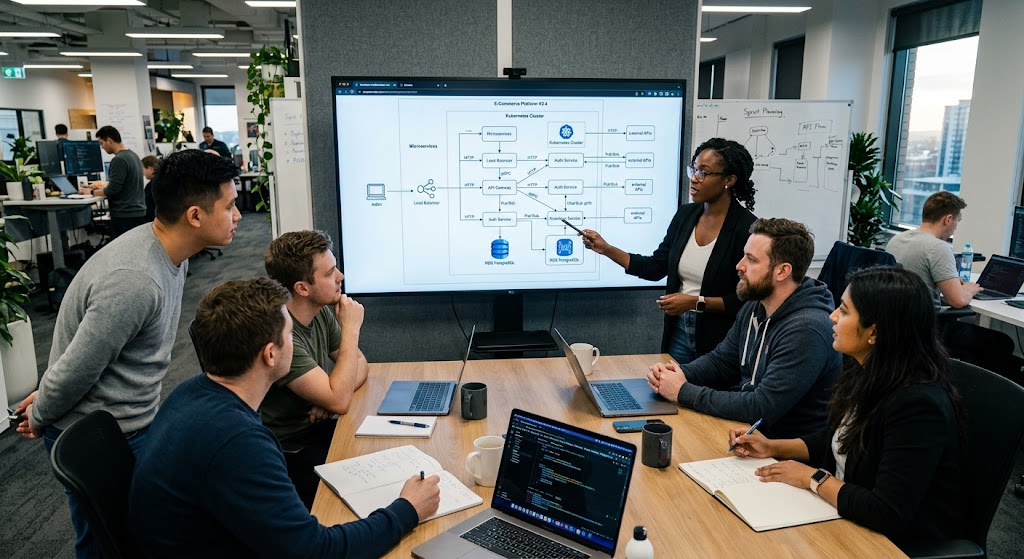
Having the documentation makes it easier for developers who want to join the project to understand why things are designed that way rather than assuming that everything is by coincidence or arbitrary. Design documents are also useful for technical and non-technical stakeholders to view potential solutions prior to implementation. Technical writing is then used to assist in the process of making the abstract architectural ideas into information that can be discussed, evaluated, approved, and implemented consistently.
How Documentation Improves Knowledge Transfer
A major benefit of organising and sharing knowledge through professional documentation is to maintain and share knowledge within a software development team. There are a lot of pieces of knowledge created in the context of a software project, relating to business rules, technical decisions, application behaviour, development procedures, infrastructure, known issues and operational requirements. When this information is kept within the head of any one employee, the organisation can become reliant on a few individuals. Documentation is a more dependable means for retaining and sharing that knowledge. This is particularly relevant when developers rotate roles or staff members depart from an organization or when new team members take part in the ongoing project. Documentation can describe the purpose of the system, how the parts of the system relate to each other, how common tasks are accomplished, and where the important resources are located. The ultimate advantage that organizations can gain from having documented knowledge is that it can be accessed over and over again, rather than during meetings or personal explanations.
Facilitate Partnerships among Development Teams
Today, software projects generally are team-based and involve developers, designers, testers, DevOps experts, security specialists, product managers, technical writers, and support personnel. These groups could be located in various parts of the project, even in different offices, or time zones. Technical documentation provides a single source of information which enables these groups to coordinate their activities. An API document, for instance, can educate developers on how to use another service, and a deployment document can educate operations staff on how to deploy an application. Requirements and acceptance criteria are used by testing teams to decide what to test and the support teams can use troubleshooting information to address users’ issues.
If there isn’t a way to document the work, collaboration can also rely on a lot of meetings and availability. Well documented, team members can work more independently, but still adhere to agreed processes and technical standards. This helps to improve communication and to minimise the chances of teams forming incompatible ideas about the same software system.
Technical Documentation During Software Development
Technical writing goes on as the programmers translate designs and requirements into a working software during the development stage. Developer docs can describe coding conventions, project structures, how to get started, dependencies, configuration needs, database structures, API endpoints, development environments, and ways to contribute. They are useful when multiple developers are working on the same piece of code and give everyone the same direction on how the project should be managed. Documentation can also be used to capture important decisions that are made during implementation which may not be evident in the source code. While a well named and organized source code is understandable, a code base can not always explain the business requirements, the necessity of complex architectural decisions.
The lack of context is filled by documentation provided by developers. It can also help to minimize unnecessary interruptions as when developers can refer to an established reference when they ask someone on another team to explain what they are doing anyway. Thus technical writing can help improve the efficiency of the development and improve consistency throughout the codebase.

Documenting as part of testing
It is very important to have accurate information to rely on when testing, as testers should be able to understand what the software does before checking that it is working correctly. This information is organized in the requirements documents, acceptance criteria, test plans, test cases and defect reports. A documented requirement can be a reference for evaluating a feature, and a test case can be a record of conditions, steps, expected results, and actual results of a scenario. Technical Writing also facilitates communication between testers and developers when a defect is found. A defect report should definitely contain sufficient detail for the developers to understand the problem, be able to reproduce the problem if possible, and identify the potential impact. A lack of clear, concise reporting can result in redundant communications and delays. Documentation, on the other hand, allows testing teams to clearly communicate issues and provides development teams with valuable information to resolve issues. Thus, documentation also helps to improve the quality of software by establishing the link between requirements, test activities, defects and corrective actions.
Technical Writing During Deployment

When you’re deploying, there is yet another aspect that accurate documentation can help you avoid expensive errors. Transferring software from a development environment to a production environment can include changes to configuration files, databases, environment variables, authentication systems, servers, cloud resources, security settings, monitoring tools, and rollback procedures. These requirements can be recorded in a repeatable deployment process that can be followed by authorized team members. An organization could have a deployment guide that outlines prerequisites, preparation steps, verification steps, common issues and recovery steps, rather than relying on the memory of one employee. This can be particularly useful when deployments are outside of working hours or when the developer of the application is not available. Documentation can also help organizations establish consistency between different environments and releases. If procedures are documented and reviewed, teams can become aware of outdated procedures and refine them as time goes on. Good deployment documentation then aids reliability by eliminating all possible doubt and assists technical staff in executing more complicated operations in a controlled and predictable way.
Create Documentation to Support Maintenance and Long-term Maintainability
The creation of software isn’t complete after an application has been published. There are regular maintenance tasks that need to be carried out in most of the systems, such as bug fixes, security updates, performance optimization, configuration, feature installs, and compatibility. The value of technical documentation increases during this extended period as maintenance developers may not be the same as the original developers. Documentation can describe system architecture, dependencies, configuration requirements, database relationships, integration points, known limitations and past technical decisions. This information provides a foundation for the maintenance team to use when they are investigating a part of the application they don’t know.
Otherwise, the developers might have to invest significant time in building knowledge from the source code, previous message content or talking to their previous team members. Documentation also helps with safer changes, since the developers can be more aware of how a change can impact other parts. Having these documents with the software will thus directly help maintainability. It helps to maintain knowledge within a system and minimises the time and effort spent in understanding a system as it changes.
Supporting Employee Onboarding
When new employees enter an existing software development project, they have to learn the ropes quickly as they are likely to experience this steep learning curve. They must know the organization, the development objectives, the development processes, the technical environment, the code base, the tools, who is responsible and what are the conventions of the project. A documented system can greatly enhance this process by allowing new team members to access information before seeking it from other team members. An onboarding guide could include information on how to get access to the application, set up a development environment, install and use the application, access the appropriate repositories, understand the terminology used with the project, and learn about the project’s workflow.
A few more technical documents can then give more detail on architecture, APIs, databases, testing, deployment and troubleshooting. This is a way that new employees learn in increments instead of getting a lot of information in a random, informal way. It also lightens the load of the team members who are experienced, where they would have to repeat a lot of instructions. Effective documentation is thus more streamlined and assists in the onboarding process to get new hires to be productive with greater confidence.
Troubleshooting and User Support
Technical writing also has a significant part to play once software gets to its users. When people have issues, they desire information about the potential causes and solutions. Users and support staff can easily troubleshoot common problems with troubleshooting guides, frequently asked questions, knowledge-base articles, explanations of errors, and support procedures. Documenting problems logically instead of a random laundry list of solutions is good troubleshooting documentation. Can include symptoms, possible causes, suggested checks, and next steps.
Documentation is valuable to support teams as it establishes a uniform approach to recurring issues. Each support person does not have to come up with their own solution, but can use known processes which can be reviewed and enhanced. The user documentation also decreases the amount of trivial problems that need direct help. Support teams can spend more time on more complex problems that need specialized attention when they can locate clear instructions for common problems.
Technical Writers in Software Projects
Technical writing plays a crucial role in software projects.Technical writers are an integral part of software projects.

A technical writer can participate in software projects by converting intricate technical data into organized and easily comprehensible documentation. They can be involved in interviewing developers and subject-matter experts, research technical processes, organize information, write documentation, edit, create diagrams, develop guides for users and keep documentation current and up to date as products change. Technical writers don’t replace developers or engineers; they work with technical specialists to make their knowledge more understandable and usable. This partnership can be especially beneficial, as a subject-matter expert might know a system very well, but not be able to always create a thorough documentation when the need arises. A technical writer can ask clarifying questions, find missing information, structure scattered information, and present the final product to the audience’s needs. Organizations can benefit from embedding technical writers into the software development process, instead of documentation being an afterthought, to produce more valuable documentation and enhance communication throughout the software development lifecycle.
Best Practices for Effective Software Documentation
Good software documentation must be: Accurate, Relevant, Organized, Understandable, and Up to date. A good practice is to specify the target audience before writing, as it may be a developer reference and not a user guide for beginners. Clear procedures, meaningful headings, consistent terminology, and examples (where applicable), and logical organization should also be used in documentation. Images like process flows, screenshots, tables, and architecture diagrams can add value when conveying information more effectively than paragraphs. Also it is important to have some form of ownership so that someone has the responsibility to review and update key documents.
Even though documentation may be outdated, it can be as big of a problem as no documentation at all, since readers might be reading instructions that are no longer applicable to the system. Documentation should thus be considered as a dynamic component of the project. Combining documentation review into the development process, release process and change management process can help to keep important information accurate as the software changes.
Documentation Skills and Project Success
Let’s talk about the dangers of poorly communicated information and how valuable technical writing is. Fuzzy requirements can lead to the wrong features, fuzzy designs cause inconsistent implementations, failing to document tests can keep defects unaddressed and deployment can raise issues due to lack of instructions. Likewise, insufficient documentation of maintenance can slow and cost more for future changes. While documentation cannot solve all software development issues, it does offer a clear and effective communication strategy for identifying and solving issues earlier.
It also helps to maintain continuity between the various phases of the project. Requirements can influence design, design can drive development, development can aid testing, testing can lead to release decisions, and deployment documentation can help with operations and maintenance. In this context, documentation is not a part of software development. It relates various activities that create and sustain a software product.
Conclusion
To develop successful software projects, technical writing plays an integral role since it is software development that relies on a good flow of information from the initial stage to the completion stage. Requirements documentation is used to determine what should be built, design documentation to design systems in a way that will be reliable, developer documentation to implement the systems to meet the requirements, testing documentation to ensure that systems behave as expected, deployment documentation to ensure reliable releases, and maintenance documentation to ensure that the systems are built and maintained in a way that will preserve knowledge for future development. This communication is then carried on to customers and support teams when software is released by user guides and troubleshooting materials. These are just a few functions that can be enhanced through documentation, among others.
Documentation can aid collaboration, knowledge sharing, onboarding, troubleshooting, decision making and long-term sustainability. By recognizing technical writing as an ongoing process, rather than a last step in administration, organizations can ensure that vital information is captured and that the software’s communication requirements are addressed across the entire software lifecycle. With the growth of software systems and the collaboration between teams, technical communication is one of the most practical pillars of successful and sustainable technology projects.



This was beautiful Admin. Thank you for your reflections.