
Introduction to Software Architecture
The software architecture is the base upon which a software system is designed, built, and developed, and also influences the relationship between the system components and the ways the software system can grow over time. A building must have a sound architectural design plan before it is built, and software applications must have a well-designed structure to support the existing functions and requirements while accommodating future modifications. The software architecture is a high level decision making process of system components, data management, method of communicating components, deployment strategy and technology choices. These decisions can affect the application’s maintainability and how efficiently it runs for varying workloads and how secure it is in processing user data.
In contemporary software development, it’s not just the gigantic corporations that need to worry about software architecture. Architectural decisions are also important for startups, small businesses and individual developers who may have software systems that need to scale quickly as the number of users, features, or demands of the business grow. Technical constraints, high development costs and inability to improve the project in the future can result from poor architectural decisions that are taken early in the project. But on the other hand, if it’s an architecture well designed, it gives them the path to follow and enables them to construct in a trustworthy, versatile and high performing way.
Business objectives are tied closely to software architecture because the choices made with regards to software often have a direct impact on the product’s competitiveness and growth. An application for millions of users will have different considerations for architecture than a small internal application. Gaining insight into the various types of architecture, architecture patterns, and architecture principles will enable developers and technology leaders to choose an approach that best suits the needs of their project, rather than picking a trendy one.
The Role of Software Architecture in Software Development
Software architecture is one of the key factors that can make or break an application for the long term. Programming languages and frameworks enable developers to write code, but architecture is the structure or design that organizes the code and the interdependencies among its various components. A robust architecture is effective in enhancing development efficiency by defining clear boundaries between the various elements of the system and supporting teams to add new features, resolve issues, and maintain the existing functionality.
One of the most significant factors why architecture is so significant is that it influences the capability of a system to deal with growth. The more users the application receives, the more data it is able to handle or the more it becomes equipped with functionality, the more important it is for the underlying architecture to be expandable without significant disruption. Awareness of how architectural decisions affect scalability enables organizations to assess whether their software system will be able to scale up with increasing demand. Architecture decisions help determine if the system can be scaled with additional computers, workloads and adapt to business requirements.
In addition to scalability, architecture has an impact on maintainability, performance, security and reliability. If an application is not well-structured, it could lead to unexpected issues in other parts that make changing later on difficult. A good architecture helps to minimize complexity by dividing responsibility and facilitating the communication of components. This makes development teams more efficient and helps mitigate risk of changes that may be implemented in the future.
Key Principles of Effective Software Architecture

Modularity and Separation of Concerns
One of the key principles of software architecture is modularity. It’s partitioning a software system into independent, lesser systems, where each one is responsible for its specific work. Modular systems have different components that are connected to each other in a certain way to achieve a specific function, as opposed to a single large block of code, where each feature is closely linked to one another.
Separation of concerns makes applications and systems more maintainable as developers can make changes to one section of an application without impacting other parts of the application. For instance, user authentication, payment processing, and reporting functions can be kept in separate modules, making it simpler to upgrade every one of them as the need arises. This principle is applied in many forms of architecture, such as microservices and layered architecture, as these define better system boundaries.
Scalability and Flexibility
Scalability – the ability to scale without significant performance issues. The application may be fine when 100 or 200 users are accessing it, but may have problems if thousands or millions of users start to use it. Software architecture will dictate the ability to increase the system’s size with methods including the addition of more servers, greater distribution of services, and increased efficiency in how services are used.
Flexible design also helps organizations to adjust to new business needs and technologies. Architecture should not impose undue constraints on software projects which are evolving after they are deployed. It is easy to add new features to a flexible system, keep up with evolving customer needs, and meet market demands.
Security by Design
Security concerns should be taken into account at the architectural design stage and not installed at the end of development. The security of sensitive data stored, moved and guarded across the system is dependent on software architecture. The decisions made regarding authentication, authorization, encryption, network structure and data access control all impact overall security.
As cyber security threats grow, it has become more critical than ever to rely on secure designs for modern applications. For instance, creating critical service separation, restricting access between services and deploying robust identity management can minimise potential attack vectors. Security-oriented architecture helps organizations keep trust and secure user data.
Ensuring Reliability and Fault Tolerance
A reliable software system should be able to keep running if the unexpected problem is encountered. Architectural influences on reliability include how failures are detected, managed, and recovered. Fault tolerance-based systems can isolate failure, where one failure doesn’t cause the whole application to fail.
Redundancy, backup systems, monitoring and distributed services enhance reliability. In industries like the financial sector or healthcare, where the consequences of downtime can be significant, reliable architecture is crucial for applications that need to run critical operations.
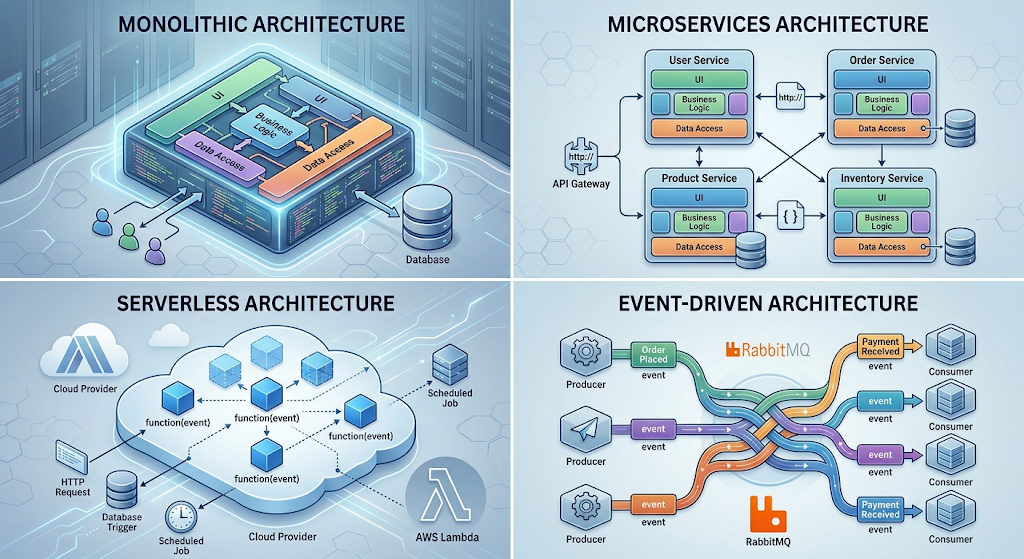
The Most Frequent Types of Software Architecture
There are many software architecture approaches that will help deal with various problems. No one architecture fits all projects. The selection will rely on various factors including application complexity, anticipated growth, team skillset, budget, and performance expectations.
Monolithic Architecture
A monolithic software architecture is one of the old-style ways to write and deploy software where all components are created and served in one app. Typically, in this approach the user interface, business logic and database operations are all part of the same application codebase.
Initially, monolithic systems can be simpler to develop since the developer focuses on a single application instead of multiple independent services. The deployment is typically very simple, as the system is deployed as a whole. It can be useful for small-scale applications, prototypes and projects of limited complexity.
But as applications expand, monolithic architecture may become difficult. Since all parts are interrelated, an alteration of one part may necessitate alterations in other parts of the system. A further problem, particularly when only one part of the application needs more resources, is that it can become inefficient to scale the entire application. As the codebase becomes more and more complex over time, large monolithic applications might become difficult to maintain.
Microservices Architecture
In the microservices architecture, an application is broken down into smaller, independent services that are connected to one another via APIs or messaging systems. Each service’s domain is a particular business function, like user management, payments, inventory or notifications.
The one great thing about microservices is the scalability factor. Services can be scaled separately per individual service. For instance, an online shopping web site can allocate more resources to its payment service, without scaling the application as a whole, during periods of high transaction volume.
With microservices, the development speed is also improved since each of the various teams can work on separate services concurrently. The technologies used can vary from service to service depending on their requirements and specifications. This flexibility is the reason why microservices are becoming popular among big organizations for developing complex applications.
While there are benefits to microservices, there are also some challenges. It can be difficult to deploy, monitor and communicate with multiple services. Developers need to deal with coordination, data consistency problems, network failures, etc. If not planned correctly, microservices can introduce more complexities.
Serverless Architecture
With serverless architecture, developers can create and deploy applications without the direct control of traditional servers. Infrastructure is managed by cloud providers and resources are automatically allocated when functions are called.
This is helpful in applications that have variable workloads as resources can vary up and down as necessary. Developers can concentrate on application development and not bother with server maintenance. APIs, processes, data processing, and event-driven applications are typical serverless architectures.
But serverless architecture comes with its drawbacks as well. There may be constraints on execution time, resources available, and dependency management that may affect the developer. Some app types are not appropriate for a serverless architecture—such applications that need to process data constantly or that have very specific infrastructure needs.
Layered Architecture
Layered Architecture is the structure of software that is divided into multiple layers, each with its own set of functions. This can often consist of presentation, business logic, data access, and database layers.
This architecture helps in clear division of responsibilities and enhances organization. The user interface can be changed by the developer without altering business rules or even the database operations. Many business applications are successfully implemented with a layered architecture because of its simplicity and understandability.
One drawback of layered architecture is that too great a dependency between the layers can limit flexibility. If the design is not well managed, modifications to one layer may impact another and the system may be more difficult to maintain.
Event-Driven Architecture
Event-driven Architecture is all about communication by events. The components send messages to events that are triggered by certain actions, rather than services explicitly asking for information.
For instance, an event can be used to update inventory, process a payment, and notify customers when someone places an order online. This can make systems more scalable and enable them to handle activities asynchronously, as well as decrease direct connections between components.
Event-driven architecture is widely adopted in enterprise-scale applications, financial systems, Internet of Things (IoT) solutions, and real-time applications. But it may become complicated to manage an event flow, particularly if you want to monitor errors and ensure consistency of data being passed between different services.
Service-Oriented Architecture (SOA)
SOA is an approach in which software services are built as discrete components or modules with specific interfaces that can be called by other services. Many companies adopted SOA to connect different business systems and share information.
Unlike a monolithic application, SOA enables organizations to link distinct applications together and to share services between various projects. It is especially beneficial for big companies with complicated technology landscapes.
While it may seem similar, the difference between SOA and microservices is the design philosophy. Typically, SOA is geared toward enterprise integration, whereas microservices are more concerned with smaller services that are capable of being deployed independently. Either one or the other can be successful depending on the needs of the organization.
What are Software Architecture Patterns and Why are they Important?
Architecture patterns are solutions to well-known software design problems. They serve as principles to guide the development of systems that are more organized, more efficient and more maintainable. Patterns are not rules, but rather a flexible set of rules that may be modified according to project needs.
Examples of architecture patterns include client-server, model-view-controller, repository patterns, and publish-subscribe models. Selecting the appropriate pattern allows development teams to steer clear of typical design challenges and create systems that are more comprehensible and expandable.
How to Choose the Right Software Architecture
Choosing the right architecture involves weighing various factors such as project objectives and technical needs. There are a number of factors that should be kept in mind by the developers and decision makers prior to taking an architectural perspective.
Project Size and Complexity
For smaller applications, it might be appropriate to use simpler architectures like monolithic or layered designs. For large applications, with complex requirements, microservices, event-driven systems or service-oriented approaches can be necessary.
If the architecture used is too complex for the simple task, it can be costly and time consuming to develop.
Scalability Requirements
Architectural decisions should be heavily influenced by expected growth. When applications are expected to scale significantly with the number of users or transactions, architectures need to be efficient in scaling.
For systems that have unpredictable workloads, distributed technologies like microservices and serverless architectures could be appropriate.
Development Team Capabilities
Developing a project with a team that has different skills and experience levels should come into mind.
Understanding deployment automation, monitoring, distributed systems and cloud technologies are needed for advanced architecture. If the team is not able to handle the complexity of the system, a simpler architecture could be more effective.
Performance and Security Needs
For applications that have performance needs, or applications that have needs for data protection, robust architectures must be developed to meet these needs.
Financial systems, systems storing personal data, or real-time systems might need special considerations in terms of reliability and security.
Conclusion
One of the most critical decisions during software development is software architecture, which impacts the application’s performance, scalability, and evolution. The right architecture can give businesses a solid foundation for further development, productivity and a minimized long-term technical burden.
Each architecture has its own pros and cons, including monolithic, microservices, serverless, layered, event-driven, and service-oriented architectures. The selection will depend on the goals, complexity, resources and future expectations of a project.
Being successful in software architecture is not about picking the trendiest or most popular method. It’s understanding system requirements and picking a structure that’s scalable, maintainable, performs well, is secure, and reliable. Architectural choices can be made with thoughtful consideration to ensure that software systems are both effective and flexible enough to meet changing user needs and technology.