Introduction
Discrete structures are one of the most fundamental concepts in computer science because they are the mathematical language used to represent, organize, analyze and solve problems in computing. Discrete mathematics deals with countable or separate objects that can be varied in steps, rather than smoothly as in continuous mathematics, which studies quantities that can be varied continuously. Discrete structures are particularly important in programming and information technology because computer operation is largely based on discrete states and operations.
Mathematical ideas like sets, relations, functions, logic, algorithms, graphs, trees, combinatorics, and discrete probability are encountered in computer science, and though often not explicitly recognized by the programmer, they manifest in various ways within the code. By learning these concepts, the students will not just learn the workings of a computer system but also the reason behind the effectiveness of certain algorithms, data structures, database models, security methods and software design techniques.
What is Discrete Structures?
Discrete structures are mathematical constructs that have discrete elements (distinct quantities) instead of continuously varying quantities. For instance, a class of students taking a programming class. The collection can be viewed as an individual student element of the collection, and operations like union, intersection and difference can be performed on the collection. Relationships between users and accounts, among computers in a network, among nodes in a search tree, among possible outcomes in a security system are other examples. In computer science they are very helpful as digital systems deal with information as individual units. A database is a collection of individual records, a program is a collection of separate instructions, and a network is a collection of identifiable devices and connections. With the help of discrete structures, computer scientists can provide a precise way of describing and understanding these elements.
When discussing software development, the significance of discrete structures becomes more apparent. A programmer does not merely command a computer to “solve a problem”, the problem must be represented in a way suitable for a computer to solve it. A collection of products can be represented as a set, relationships between customers and orders can be represented using relations, a procedure can be represented as an algorithm, and connections between locations can be represented as a graph. Logic can be used to deduce true or false statements, and combinatorics can be used to count the number of ways in which things can be arranged or chosen. This mathematical foundation stimulates mathematical thinking, by teaching the learners to divide complex problems into small problems, find patterns, make rules, and think carefully about finding a mathematical solution.
Discrete Structures and their importance in Computer Science.
Computer science isn’t just about syntax for computers. Programmers to software engineers are required to make decisions about the representation, interaction of components, efficient solution strategies, and how systems can be successfully programmed to respond to various situations. Often these decisions rely on specific mathematical ideas. For instance, if an application is designed to handle permissions, the application’s programmer may want to know if a user is a member of a specific group. You may want to learn how to design relationships between tables for a database. The network engineer might wish to calculate the minimum path through devices. A cybersecurity expert can consider the potential sequence of security states or credentials. In each case, discrete structures offer a way of modelling the problem and of thinking about potential solutions.
Discrete Math is also another significant advantage for computer scientists since they can then be able to prove that the solutions work properly. In software engineering, a program that generates the right output for a single case shouldn’t fail for all other cases it could be expected to handle. Conditions can be defined using logic, sets and mathematical reasoning, as can be the examination of possible outcomes. Also, algorithms can be studied for their efficiency, which will help developers to see how much time or memory their algorithm can use if there is a lot of data. Thus, there is a practical aspect of computer science, including programming and system development, as well as a theoretical aspect, including algorithm analysis, computation and formal verification, both of which are well served by the use of discrete structures.
Applications of Sets and Set Operations in Computing
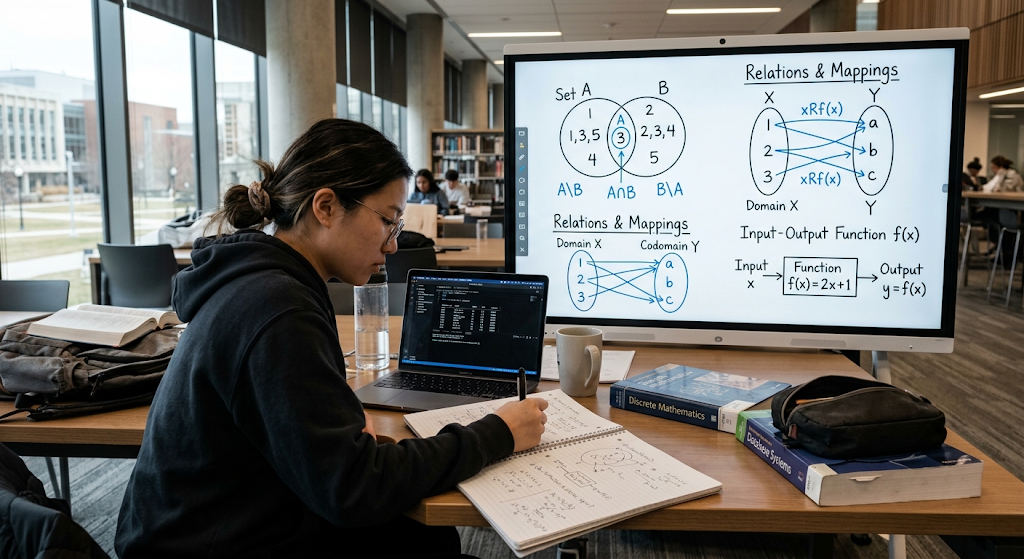
A set is a group of objects that are considered as a whole. The components of a set are known as elements and they can be numbers, words, users, products, files, devices or just about anything else that can be identified. For instance, a program could have a list of registered users, or a web store may have a list of products, customers and orders. Some of the basic operations on sets are union, intersection, difference and complement. Such operations are useful because they enable computer scientists to compare sets of information and identify information in certain categories. Users who belong to both sets are the intersection of the two sets, for example, if one set includes users who bought a product and the other set includes users who subscribed to a newsletter, then the intersection of the two sets is users who purchased a product and also subscribed to a newsletter.
The sets are very significant in databases and programming, as numerous computing tasks involve grouping and filtering data. A database query can be used to determine a specific set of records that meet certain requirements. For search engines, set-based ideas can be understood when you search for something and then filter and combine your search results from those keywords and categories. In computer science, sets are often used when the programmer wants to store a collection of distinct values, and wants to know whether a specific value is in the set or not. For instance, a system could have a set to hold unique usernames, allowing for duplicate registrations to be discovered. Set is also the foundation for more advanced concepts, since relations, functions, probability spaces and many data structures are described using sets.
Relationships and their Importance in Databases and Systems.
A relation is a relationship between elements. In discrete mathematics, relations can be used to indicate whether one element is related to another by a certain relationship. A relation can have, for instance, the relation between students and courses for a school, the relation between customers and orders for a shop, the relation between employees and departments for an office. Relationships are critical because most often, computer systems don’t deal with individual bits of data. Instead, information is typically related to other information which must be represented and queried. For example, a database might include a customers table and an orders table, and have a relationship between each order and the customer who placed it. These connections enable applications to access significant data from various sets of data.
Relations also help you to understand key concepts of the database like keys and relationships among tables. Relational databases store data in a structured format, such as tables, and establish relationships between data elements. Dependencies and connections in software systems, communication networks and access-control systems can also be described using relations. Reflexivity, symmetry and transitivity give a means of describing the behaviour of relationships. At first glance, these terms seem to be abstract, but they are useful for computer scientists to use when they try to think about how entities communicate. For instance, a developer creating a social network might be interested in the difference between a relationship where two users follow one another and a relationship where one user follows another user.
Functions and Their Use in Programming
A function is a relation that assigns exactly one output to each input. The idea that functions take in inputs, do some operations, and give out outputs is very similar to how programming functions work, which is why they are an integral part of computer science. For instance, a function might take the value of an item and the tax rate, and return the total price. Another function might return information related to a username as an argument. Programs can be thought of as functions, which enables programmers to comprehend the flow of data in software and the ways in which different parts can be constructed to carry out specific functions.
Functions are also good for understanding the behavior of software components. A good function should have unambiguous input and output parameters, thus simplifying the function’s testing, reuse and maintenance. Many functions may collaborate to transform data and give an end result in bigger applications. Mathematical functions can also be used to infer whether given different inputs, the same output is created, whether multiple inputs may yield the same output, and whether there is a way to reverse a function. These concepts are applicable in various fields like artificial intelligence, data processing, database operations, and encryption. The study of functions as discrete structures helps students to better understand the relationship between mathematical rules and computational procedures.
How to Use Logical Operators and Boolean Logic.
Logic gives a formal way to decide if statements are true or false or to make conclusions from statements. Logical thinking is crucial to computer systems as programs are continually making decisions based on conditions. Boolean logic involves the use of true and false values and operations like AND, OR, NOT. For instance, if a user has an active application and has typed in the right password, the application can be accessed. A different system may show a message if one of the conditions is true OR another condition is true. These are simple logical operations that are the basis of many more complex decision-making in software.
Besides digital circuits, digital databases, cyber security, programming languages, and artificial intelligence, logic is also used in digital circuits. Conditional statements like if, else, etc., are examples of using logic. Database queries use logical conditions to select the records that should be returned, and access-control systems use a logical rule to determine if a user can take a specific action. Logical reasoning techniques can be used to describe security policies and check for any unexpected access when combinations of permissions are used in cybersecurity. Being able to know the logic helps programmers create clearer conditions and find out any mistake in making decisions. It also serves as the basis of formal methods with which to prove properties of software and hardware systems.
Algorithms and Discrete Problem Solving
An algorithm is a series of steps to solve a problem or perform a task that is finite and well defined. Algorithms are vital to computer science because computers cannot be given descriptions. A simple real-life problem is sorting a list of names alphabetically, and a more complicated one is an algorithm to find the shortest route between two points in a network. Algorithms may be written in steps, flowcharts, pseudocode or actual programming languages. Discrete structures are used by computer scientists to represent the objects that are being manipulated, the operations that can be performed, and to consider problems about the output of an algorithm.
Efficiency is also studied as part of the study of algorithms. There can be two algorithms for a problem that run in vastly different times and memory usage. This difference could be very significant on large data sets. In discrete mathematics, algorithms can be analysed and understood in terms of the number of operations that they execute, and how the number varies with the size of the input. This is related closely with concepts like algorithmic complexity. Effective algorithms are used in sorting, searching, routing, encryption, compression and data processing. Understanding algorithms mathematically enables programmers to go beyond getting the program to run and into designing reliable, scalable and efficient solutions.
Graphs and Networks
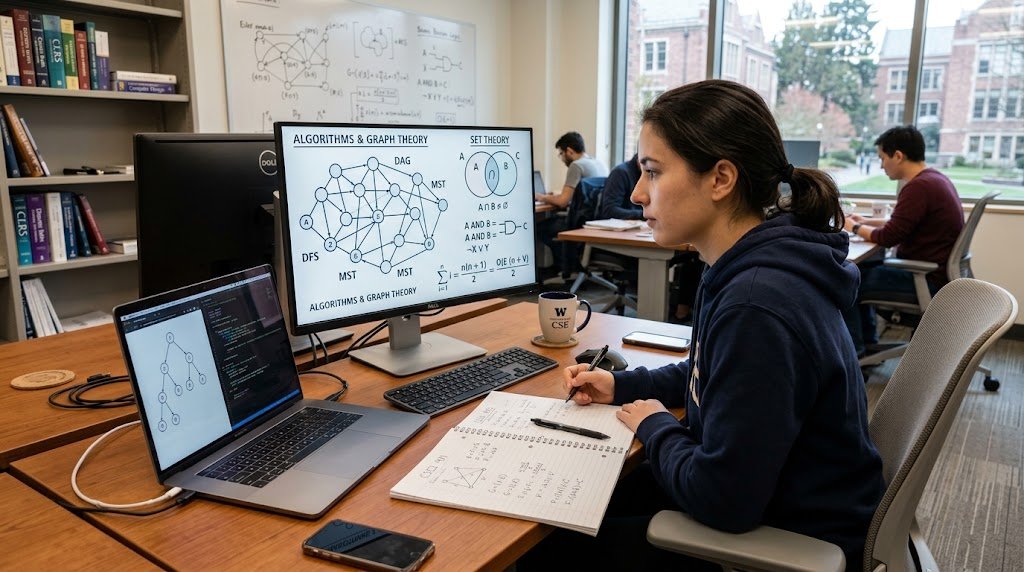
Graphs are discrete structures made up of vertices (also called nodes) and edges (links) that connect the vertices. Graphs are one of the most useful data structures in computer science since many real world systems can be naturally modeled as graphs. Relations can be represented as edges, users as vertices, in a social media platform. Devices can be considered as vertices of a computer network and communication links as its edges. Locations can be represented by vertices, and roads/route by edges. Having the problem structured in a graph allows algorithms to be used to explore connections, discover paths, uncover important nodes, and determine optimum ways to move through the graph.
Graphs are used in many technological applications. Graphs can be used to represent relationships between web pages in search engines, and to find routes for data in networking systems. Cyber security experts can use communication patterns and relationships between systems to find unusual patterns. Graphs can be used to model relationships between things, and software engineers can use dependency graphs to understand how parts depend on each other. Some problems, like shortest paths, connectivity, and network traversal, can be solved with graph algorithms. This makes graph theory a tool that can be used in practice and not just a mathematical subject.
Trees and Hierarchical Data
A tree is a type of graph that is used to model hierarchical relationships. It starts with a root and extends to other nodes with branches, forming a hierarchy or levels of organization. Many kinds of data are inherently hierarchical, and this structure is used many times in computing. For instance, the file system of a computer can be considered as a tree structure, with files and nested folders. The organization’s management structure can also be drawn as a tree, with the departments and employees arranged in the same hierarchy that they report to. Hierarchical navigation structures are commonly found on websites and programming languages can model expressions and program structures as trees.
Trees are also used in data structures and algorithms. When appropriately structured, binary search trees can be used to organize data that facilitate efficient search, insert and delete operations. Decision trees can be used to model a chain of decisions and are common in machine learning. The syntax tree provides a way to represent the structure of expressions in a programming language in such a way that a compiler or interpreter can use it to process the expression. Another index structure that can be employed is a tree structure to get rapid search of large collections of records. The study of trees thus allows students to understand that computers store information hierarchically and that special structures can lead to better computer processing.

Using combinations and counting problems.
Combinatorics is the area of mathematics that deals with counting, arrangement, selection and combination. This is of importance whenever a computer scientist wants to calculate the number of possible outcomes or configurations. Suppose that you have a system for users to generate passwords from a set of characters. The number of passwords that can be generated depends on the number of characters and the length of the password. Likewise, an application might require reviewing potential schedules, routes, configurations or arrangements. Using combinatorial methods, developers and researchers can now calculate and/or estimate these possibilities instead of looking at every situation blindly.
In cyber security, artificial intelligence, optimization and software testing, combinatorics plays an important role. Counting principles are used by security experts to grasp the size of possible key spaces and why sufficiently complicated credentials make it harder to guess. Combinations can be used by software testers to identify sets of input conditions for which to test software. For instance, in the field of artificial intelligence and optimization, the number of potential solutions to a given problem can rapidly grow large, and methods have to be devised to explore promising solutions efficiently. Computer scientists should grasp the concept of combinatorics to understand that some problems have a tremendous search space and to motivate them to devise algorithms which do not unnecessarily compute.
Discrete Probability in Computer Science
A discrete probability is a probability that applies to a scenario where there are distinct and countable outcomes. It offers mathematical techniques for quantifying uncertainty and for assessing the probability of various events. Uncertainty manifests itself in a variety of ways in computing. A network connection could fail, a security system could detect a suspicious activity, a random algorithm might select one of multiple options, or an artificial intelligence model may have to predict the possibility of a specific result. Computer scientists can use these tools to reason about these situations and make decisions when the outcome is not certain, which is the topic of discrete probability.
Probability is a tool that is especially useful in cybersecurity, artificial intelligence, networking, and algorithms. Probability can be used in cybersecurity systems to detect abnormal patterns, which could be signs of suspicious activity. Probability is frequently computed in machine learning models for classification of information and prediction. Randomized algorithms are algorithms that rely on random input to achieve efficient solution of a problem or to prevent predictable behavior. Probability can also be used to model failures, traffic patterns or reliability in a network. Discrete probability introduces students to the idea that a computer system is not always contained in a completely predictable environment and that, when uncertainty exists, the use of mathematical learning models can help them make decisions.

Discrete Structures in Programming
Discrete structures are used in programming at virtually every level. Values are stored in variables, elements are collected in arrays, conditional statements allow for logical reasoning, functions only transform one thing into another and algorithms are a sequence of operations used to solve a problem. Sets, trees, graphs, stacks, queues and hash tables are examples of data structures that are based on discrete concepts.
Another aspect of reasoning that the programmer must consider, is what states and conditions may exist inside the program. By knowing these tools and the mathematical models behind them, it’s easier for a developer to choose the right representation for a problem and he or she can predict the behavior of a program as its data gets more complicated.
Discrete Structures in Databases
Sets and relations are crucial in databases for structuring large amounts of data and linking related records together. Relationships and users, orders, products, payments, etc. can be customers, in a database. Logical conditions can be used in database queries to narrow down and combine data, and an index might be a tree-based structure to help with search operations.
Set operations can be used to explain why certain records are included or not included in the results of a query. These concepts are crucial for understanding how to design a well-structured database and ensure that developers can write queries to efficiently and accurately retrieve information.
Discrete mathematics is applied in cybersecurity to help comprehend authentication, access control, encryption, network relationships and potential attacks. Logic can be used to define security rules, sets can be used to model users or permissions, and combinations can be used to calculate the number of possible password or cryptographic keys.
Graphs can be used to represent relationships between systems and devices to derive an understanding of how an attacker may traverse an environment. Another way to use probability is that it can be used to detect suspicious behavior by determining how likely certain events are when they are “normal.” As digital systems are more vulnerable to more sophisticated attacks, these applications underscore the importance of mathematical reasoning for the security of them.
Discrete Structures in Artificial Intelligence
There are a number of discrete structures in AI that represent information and make decisions. Relationships between objects can be represented using graphs, decision processes can be represented using trees, the uncertainty of a situation can be expressed using probability, and the rules that a reasoning system can follow can be expressed using logic. These representations are then used in algorithms to detect patterns, to find solutions, or to predict.
Although AI systems have made incredible progress with high-level statistical and machine-learning algorithms, discrete concepts can still be valuable for structuring data and comprehending computational processes. Students learning discrete structures have a foundation to the understanding of how problems are represented in AI systems and how they are searched for possible solutions.
Discrete Structures in Computer Networking.
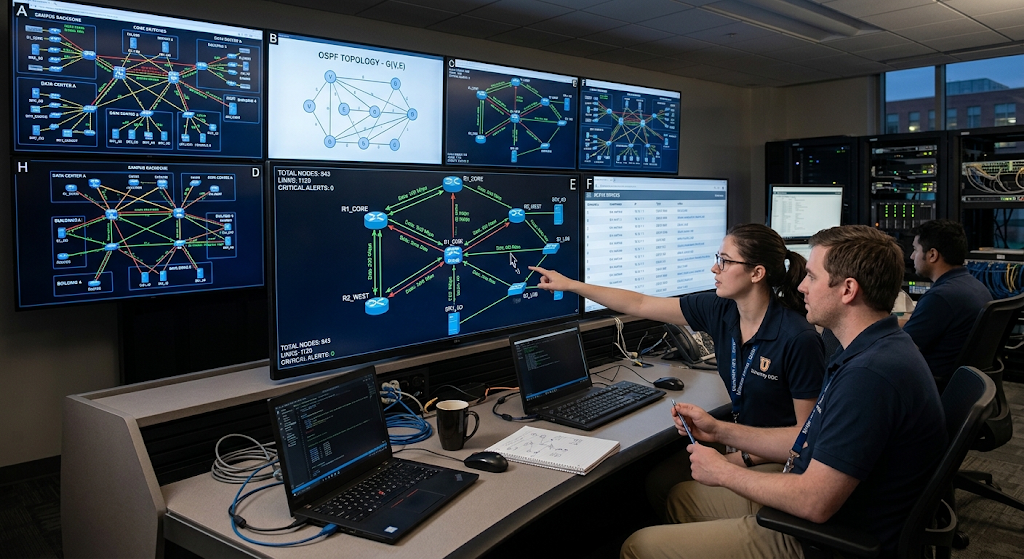
The devices in a computer network can be represented as nodes and the links between them can be represented as edges. Pathways between devices, connectivity and how information flows can then be determined by network algorithms. Probability can be used to model reliability, congestion and potential failures, and trees can be used in network organization and routing structures.
Logic’s used to set up network rules and access policies. Using discrete structures, network engineers are able to reason about complex networks with thousands or millions of devices that are interconnected. These mathematical models enable networks to be more efficient, reliable, secure and simpler to manage.
Discrete Structures in Software Engineering
The discrete structures are used in software engineering for requirements analysis, system design, testing, algorithms, architecture and verification. Logical statements can be used to specify requirements and establish if a system meets them. Dependencies between software components can be expressed graphically, trees can be used to represent hierarchical structures, and program syntax can be represented graphically.
Depending on the case, combinatorics can be helpful in figuring out combinations of conditions that must be explored and algorithms can be used to define the procedures that must be applied to implement the functionality of a system. These ideas let engineers not just trial and error, but also a systematic approach to writing software. In an era of more and more complex software systems, mathematical reasoning plays an increasing role in controlling complexity.

How Discrete Structures Develop Mathematical Thinking
The most valuable aspect of learning about discrete structures is that it teaches a structured approach to problem solving. Students are taught to first recognize what objects are in the problem, write a description of how they relate, create rules, think about what cases will happen and what methods will yield a correct solution to the problem. This process can be applied to other subjects as well as mathematics. For instance, in a programming problem, the developer can first figure out what data needs to be represented and the relationship of the data to one another. They can then choose an appropriate structure, devise an algorithm, consider potential edge cases, and test the outcome. This method helps to handle complex problems more easily and promotes precision, clarity, and logical thinking.
Recognizing patterns and abstractions are also a discrete skill taught in discrete structures. Though a graph of a computer network and a graph of friendships might appear to be different, they could have the same mathematical structure. Students should realize that there is a common structure, and then they can use some previous algorithm or technique to solve a new problem. This skill of recognizing similarities between problems which appear unrelated is a valuable skill in computer science. It enables developers to re-invent ideas, to develop more general solutions and to know why some algorithms or data structures work in a number of applications. Mathematical thinking is then an applied problem-solving ability, for use in learning and in software development.
Conclusion
Discrete structures are an indispensable aspect of computer science because they enable the mathematical modeling and solution of problems involving discrete objects, relationships, choices and logical conditions. Sets are used to structure information, relations are used to connect things, functions are used to model transformations, logic are used to think about decisions, algorithms are used to find systematic solutions, graphs are used to represent networks, trees are used to structure information, combinatorics are used to count and consider possible arrangements, and discrete probability are used to reason about uncertainty. These are not standalone mathematical disciplines, but are seen all across programming, databases, cyber security, artificial intelligence, networking, and software engineering. Discrete structures will enable beginners to build up a better awareness of how computer systems represent and solve problems.
The usefulness of these concepts is not just in relation to individual programming tasks. Discrete structures can be used to help computer scientists examine efficiency, to organise complex information, to identify relationships, to reason about security, to model networks and to ensure that software programs act as desired. They also promote a systematic method of problem solving which involves decomposing complex problems into simpler, easier-to-understand parts. While the concepts of discrete structures can seem abstract to students just starting their computer science course, their uses become more prevalent as students take other technical courses and learn more about programming. A good grasp of these foundations ultimately provides learners with mathematical thinking skills, and problem solving skills, which are essential to understanding the technologies currently in place and to their contributing to the development of new computing solutions.



For the reason that the admin of this site is working, no uncertainty very quickly it will be renowned, due to its quality contents.
Good post! We will be linking to this particularly great post on our site. Keep up the great writing
very informative articles or reviews at this time.
Pretty! This has been a really wonderful post. Many thanks for providing these details.