Introduction
AI for automobiles has evolved from the science fiction vision to a reality in the present-day automotive domain. Vehicles today are equipped with cameras, radar, sensors, software, and machine learning for a better understanding of their environment, to identify objects, anticipate issues, and support the driver. Modern vehicles need to be able to process vast quantities of information quickly to react to the changing conditions on the road and driver behaviour, and AI is up to the task. It is currently used in driver assistance, autonomous driving, vehicle diagnostics, navigation, voice assistants, vehicle personalization, predictive maintenance, and manufacturing.
Today’s vehicles are also transitioning into a type of computing platform. The use of AI in cars illustrates how AI technologies such as machine learning and computer vision are transforming driving. AI in Cars: The practical applications of AI in automobiles demonstrate the impact of machine learning and computer vision on everyday driving. These technologies can enhance the convenience, safety, maintenance, and vehicle performance, as well as help develop future transportation. As automakers increasingly introduce intelligent features, AI is increasingly playing a role in the design, operation, service, and production of automobiles.
The use of AI in today’s vehicles.
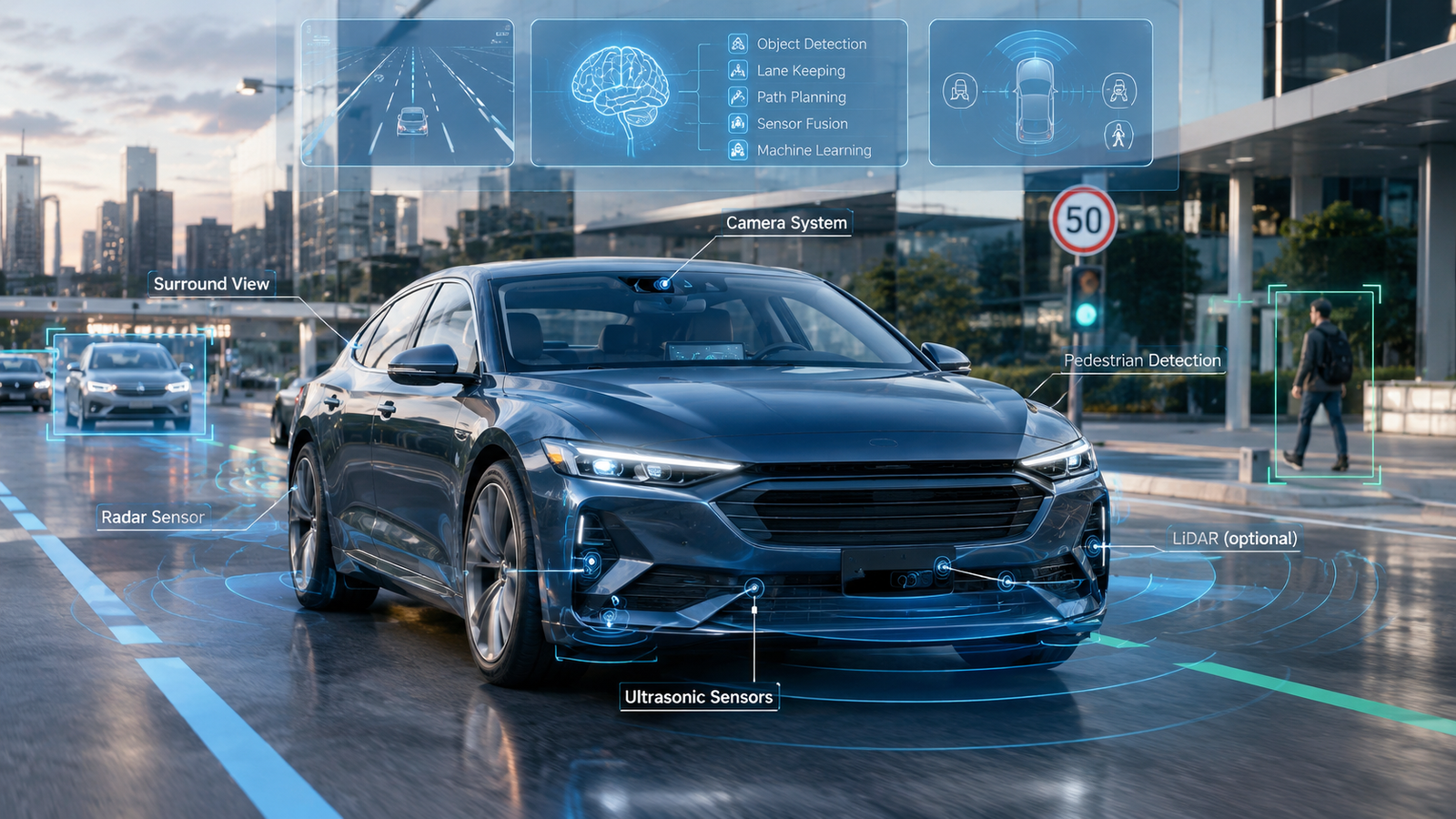
Some of the key technologies for artificial intelligence in the automotive industry involve: AI in cars depends on multiple technologies, including: A variety of cameras are used to record data on lanes, vehicles, walkers, signs, and traffic lights, and radar and ultrasonic sensors are used to detect objects and to measure distances. The information is fed into the vehicle’s computers, which use AI algorithms to detect patterns and recognize various road conditions. These systems use machine learning to interpret data, and computer vision to interpret data from cameras.
Information from multiple sensors can be fused together using AI to make inferences. This provides a greater knowledge of the environment surrounding the vehicle than would be offered by a single sensor. A camera and radar, for instance, can be combined in an intelligent vehicle to keep track of the traffic around the car, as well as to read the road markings and traffic. The information can then be utilized by safety, driver-assistance, navigation, and automated-driving capabilities. The hardware and software of modern vehicles is what enables them to interpret information to act on it rather than merely obeying mechanical commands.
AI-Powered Driver Assistance

Advanced driver assistance systems (ADAS) are another one of the most frequently used aspects of AI in the modern-day vehicle. Some of these systems are automatic emergency braking, lane-keeping assistance, adaptive cruise control, blind-spot monitoring, forward collision warnings, and traffic-sign recognition. Information is gathered from the road using cameras and sensors, and the AI software is used to identify vehicles, pedestrians, lane markings, and any other objects.
Another possible avenue for the use of AI in these systems is to help them adapt to different weather conditions. Input from sensors can be used by adaptive cruise control to adjust speed to keep the following distance, for instance, if a vehicle in front is detected. The Lane assistance system can help with steering assistance based on detecting road markings via cameras. The systems are designed to support the driver, not replace the driver, and drivers must be mindful of the limitations of the technology in their use. However, with AI support, there is a potential additional support during daily driving.
AI and Autonomous Driving
The application of artificial intelligence in the automotive sector is one of the most advanced applications. To reach these goals, an AV must be able to perceive, recognize, anticipate, and navigate to a safe destination and manage steering, acceleration, and braking. AI and machine learning are essential because roads are flooded with a wealth of situations which can’t be simply predetermined by fixed instructions.
The recognition of vehicles, pedestrians, traffic lights, road signs, and lane boundaries are some of the problems that computer vision can solve for autonomous systems. But, the ability to recognize objects is just one aspect of autonomous driving. The vehicle will also have to foresee what other road users will do and what it may do that could impact the environment. This has led to autonomous driving being a mix of Artificial Intelligence, sensors, road and vehicle-control system, high-performance computing, and thorough testing. The technology is still developing, but completely driverless driving in all situations is still far from a reality.
Events that can be predicted and diagnosed
AI can be used to detect potential issues that might lead to vehicle failures—before they happen. The sensors can be used to track the engine, transmission, battery, brakes, tires, and electrical systems. This data can be fed into AI algorithms which can detect abnormal patterns that could indicate the need for a component inspection or maintenance. This can take vehicle maintenance off the beaten path of just service at regular intervals.
In addition, AI can enhance the diagnostic capabilities of vehicles by using multiple data points to determine the fault, instead of just one fault code. However, if a technician is contacted with information regarding unusual behavior of a vehicle before the vehicle’s arrival at a repair shop, he or she may be better able to determine the starting point of the inspection. AI is not intended to replace professional technicians but to enable them to better process large amounts of diagnostic data. These systems might be useful in the future to help minimise unexpected breakdowns and the overall maintenance experience for vehicle owners.
AI Voice Assistants
Voice Assistant in modern Vehicles is becoming commonplace. Voice commands allow drivers to navigate, adjust music, make phone calls, set the climate controls, and more without having to push through several menus. With the help of NLP, AI systems can interpret the requests of users and convert them into commands. It can make certain features of the vehicle more convenient to use and minimize engagement with a touch screen.
Voice assistants are getting better at understanding normal conversation with the improvement of voice technology. Newer systems can understand various requests for the same function, rather than drivers having to use precise commands. For instance, a driver may ask, “how do I get to the hospital,” or “take another route,” or “what are the traffic conditions?” With the rise in capabilities of AI-driven assistants, voice command will be playing a greater role in the connected-car experience.
Predicting traffic and navigating around it using AI
AI can process traffic data via GPS, road networks, historical trends, connected traffic, accidents, and construction to analyze traffic information. Machine-learning systems can detect patterns and forecast the traffic conditions that are likely to occur throughout a trip. These predictions can then be used by the navigation systems to suggest other routes.
This technology can help plan more intelligent routes as it does not only take into account the current traffic. It can also predict potential congestion and suggest routes with the environment of travel time consideration. If the car is equipped with artificial intelligence, for instance, that maps system can determine when a route is typically fast, but has now become congested and give the driver an alternative route to take before entering the clogged zone. The accuracy of the predictions, however, is dependent on the quality, availability, and timeliness of the data that is being analyzed.
Personalized vehicles of the 21st century
By analysing driver preferences and repetitive driving patterns, AI can customise vehicles to become more personalised. Advanced cars can remember seat settings, climate controls, infotainment preferences, navigation patterns, and so much more. This can be used by AI to ensure a more seamless driving experience for various drivers. If several persons use the same vehicle, intelligent systems are able to recognise individual profiles, and then use the appropriate settings.
Personalisation can also be directed towards navigation and entertainment. A connected vehicle can learn those destinations that are visited often, or the features that are used often, and make appropriate suggestions. But these features also pose security concerns as the more personal the service, the more personal data it requires to be customized. To ensure convenient data access, automakers have to weigh convenience against responsible data protection and offer transparency regarding data collection and utilization.
The Role of AI in Automobile Manufacturing
AI is also revolutionizing the processes of car production. Robots, cameras and sensors and computer systems are being used in automotive factories to assemble and inspect cars. Computer vision with AI can detect manufacturing flaws and quality issues, which aids in ensuring high-quality production in manufacturing. With intelligent systems, components can be quickly inspected for patterns, not only manually, that might need further attention.
AI can be employed in the field of predictive maintenance within factories. Vibration data, temperature, pressure, and other data can be collected from manufacturing equipment with the help of sensors. AI can detect unexpected trends that could signal equipment issues, enabling manufacturers to proactively maintain equipment without disruptions to production. From supply-chain management through to inventory planning, production scheduling, and the efficiency of factories, AI can be used throughout the vehicle manufacturing process.
Advantages and disadvantages of AI in vehicles.
AI can offer valuable gains throughout the auto industry. It can be used to assist drivers with safety systems, anticipate maintenance issues, enhance navigation capabilities, offer voice-controlled controls, and optimize production. Even if the car itself wasn’t totally autonomous, these applications show that AI can still be of great value. AI can analyze vast amounts of data in real time and detect patterns to enable vehicles and manufacturers to adapt more effectively to dynamic conditions.
But AI has its drawbacks and difficulties. Automated systems can be less reliable due to weather, inadequate road markings, atypical traffic conditions, sensor limitations, and unexpected human behavior. The connected car raises cyber security and privacy concerns, as it has the capability to gather and share vast amounts of data. Drivers should realize that driver-assistance technology doesn’t imply that a vehicle can drive itself. Appropriate testing, instructions, cyber security, continual software updates, and human attention are still relevant.
The future of AI in cars

AI’s role in the future of cars will likely be more tightly coupled with greater connectivity between vehicles, cloud services, mobile devices, road infrastructure, and more. Wider vehicle capabilities can be improved, such as their ability to understand their surroundings, anticipate traffic, know when maintenance is required, and adjust to individual drivers. Autonomous driving will also progress with continued enhancements by automotive and technology manufacturers in the areas of AI perception, prediction, and decision making.
Today, AI is influencing the auto from being a transportation vehicle to a connected and smart system. The use of machine learning and computer vision in driver assistance, diagnostics, navigation, personalization, manufacturing, and autonomous driving. With continued development, AI technology has the potential to enhance the safety, ease, efficiency, and responsiveness of vehicles, as well as to open up new opportunities for the future of transportation. The biggest impact could be in the integration of several intelligent systems within the current vehicle, rather than any individual AI system.