
Introduction
Big data and artificial intelligence have caused a revolution in how financial institutions now credit score applicants. Traditionally, credit scoring will focus on limited financial data relating to the applicant such as previous credit history, income, debt and previous loan repayments. However, AI credit scoring now has the opportunity to take in far more data such as transaction history, spending patterns, account balances, employment information and other financial data, this has helped speed up credit scoring processes, help highlight potential risks and has helped to provide credit to those with limited credit history. However with the introduction of this technology there are several challenges to be faced.
With banks increasingly relying on AI to make lending decisions there are concerns around fairness, data privacy, transparency and accountability. If there is poor quality data or bias in the algorithm this can cause inaccurate credit scoring and disqualify worthy applicants. To overcome these issues it is important for financial institutions to understand the challenges of using AI for credit scoring. This can be done by having effective AI governance processes, accurate data, regular model reviews and human oversight.
1. Bias in the Algorithm
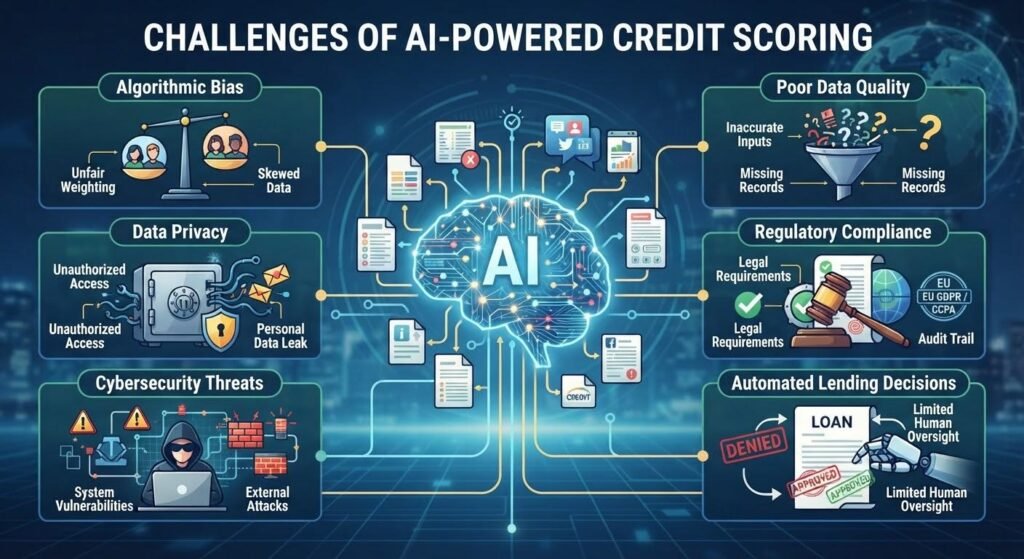
A major issue with using AI for credit scoring is the risk of bias in the algorithm. Machine learning algorithms look at patterns within historical financial data to predict how likely an applicant is to repay loans. However if there is bias in the data then this will cause bias in the algorithm and create unfair lending decisions. This could see people within certain communities receiving a lower credit score as historically they had limited access to financial services. Even if bias is not directly included within the algorithm, indicators may be used which cause similar issues. Financial institutions should regularly review their models and look at lending patterns within different customer segments. Corrective actions should be put in place to ensure fairness.
2. Poor Quality Data
AI credit scoring relies on accurate and complete data. Unfortunately there may be issues with the data such as old data, duplication, incorrect customer information, missing repayment information and inconsistent income. This can cause inaccurate predictions from the algorithm and cause confusion for lenders. For example, someone may have fully repaid their loan however their credit data has not been updated so they appear to have debt. Irregular income information may also cause the algorithm to give self-employed people a lower repayment ability. Financial institutions should have strict data handling processes in place, ensure data comes from reliable sources, remove duplicates and regularly update customer information.
3. Data Privacy
Big data analytics means lenders can look at a vast amount of personal data. Some credit scoring systems will look at a customer’s spending patterns, purchase habits, transaction history, location and other personal data to give an indication of how reliable they are financially. Whilst this may help increase accuracy in predicting risk, there is a risk of breaching data privacy. Customers may also not know how their data is being collected. Financial institutions should have clear data collection policies, have the correct consent where needed, ensure they are only using the data for legitimate purposes and provide clear privacy information. They should also make sure they are following any relevant data protection regulations.
4. Cyber Security Risks
As financial institutions are becoming more reliant on digital lending platforms there are more opportunities for cyber criminals to target them. Credit scoring systems using AI contain valuable data such as personal information, account information, income and transaction history. If there are not strong protections in place attackers may exploit vulnerabilities in the software, steal customer data, manipulate financial information and gain access to the lending platform. This can mean borrowers are vulnerable to identity theft and financial fraud. Financial institutions should have strong encryption, multi-factor authentication, secure access, constant monitoring and regular vulnerability checks. They should also have good processes in place for dealing with incidents.
5. Lack of Transparency
Many advanced AI systems use complex machine learning algorithms to help make decisions. Deep learning algorithms can look at thousands of variables to find links. Whilst this may provide accurate predictions it can be difficult for financial institutions to explain why an applicant has received a low credit score. This causes issues for customers, regulators and lending officers. Financial institutions should use explainable AI to identify key factors that impact credit scoring.
6. Lack of Reason for Rejection
Automated lending systems can make decisions very quickly however there may not be enough explanation provided for rejected applicants. Customers may be rejected due to irregular income, high debt, limited credit history or due to patterns picked up by the algorithm. This can cause frustration for the customer as they will not know what impacted their rejection the most. They may also struggle to correct incorrect information and improve their financial position. There may also be regulatory and reputational risks if there are rules in place that require meaningful explanations. Banks should provide clear reasons for adverse lending decisions, have an easy complaints process and enable customers to request a review.
7. Over Reliance on Automation
Whilst automation can improve the efficiency of lending decisions there is a risk of becoming too reliant on AI. Algorithms may struggle to pick up on unique situations such as a period of unemployment, unexpected medical costs, seasonal income and recent changes in financial position. This can cause worthy applicants to be rejected as they do not fit the patterns found in historical data. There can also be errors with automated systems however these may go unnoticed as employees just follow the recommendations. Financial institutions should include human oversight for sensitive or complex lending decisions. Including human judgment can improve the quality of decisions.
8. Regulatory Issues
Big data and AI must be used within the regulation of financial, consumer and data protection. Different countries have different regulations making it difficult for financial institutions to follow. Financial organizations should be aware of the regulations around customer consent, discrimination, automation, data retention, credit reporting and responsible lending. Regulations may also lag behind AI technology causing uncertainty. If financial institutions do not follow regulations they may face financial penalties, legal issues, limitations and reputational damage. They should have clear processes in place for compliance, keep up to date with regulations, have the right documentation and include legal and risk professionals when implementing new credit scoring systems using AI.
9. High Costs
There are high costs involved in setting up and maintaining credit scoring systems using AI. Banks may need advanced computing, secure data storage, specialist software, experienced data scientists, cyber security professionals and technical support. Smaller financial institutions may struggle to afford this causing a difference in technology between large banks and smaller lenders. There can also be high costs when implementing. Algorithms will need regular updating, monitoring, improvement and training. Financial institutions should consider the financial benefits of implementing this technology. With careful budgeting, scalable technology and partnerships they can introduce AI without causing unsustainable costs.
10. Model Errors
AI credit scoring models are based on historical data. However there can be major changes in financial situations and borrower behavior. This could be due to a downturn in the economy, inflation, unemployment, interest rate changes and disruption to industries. This can impact how likely someone is to repay their loan. If a model worked well in previous economic situations it may not be as reliable now. This is known as model drift and can cause inaccurate predictions, incorrect loan approvals and unnecessary rejections. Financial institutions should constantly monitor models to ensure they are working correctly. They should also compare predictions to actual results and update algorithms where needed. Stress testing can also help lenders understand how their credit scoring system would work in uncertain economic times.
11. Excluding People
Whilst big data and AI can help provide credit to those with limited credit history there is a risk of excluding people. Those living in rural areas, casual workers, small business owners and those who mainly pay in cash may not have much information to help with automated credit scoring. Algorithms may see them as high risk due to limited information. This can mean those who would be worthy of getting credit cannot get loans. Lenders should include other reliable financial information, consider different income patterns and not automatically assume those with limited digital activity will have poor repayment ability.
12. Poor AI Governance
To responsibly implement AI there should be clear governance in place. This will ensure everyone knows who is responsible for creating, approving, monitoring and correcting automated lending decisions. Without proper oversight financial institutions may struggle to know who is responsible for bias, inaccurate predictions and negative lending decisions. Employees may also lack the technical knowledge to question recommendations and identify potential issues. Banks should have responsible AI policies in place, clearly define who is responsible for what, independently audit models and keep records of any key changes to algorithms. Training employees on AI ethics, data protection and model risk management can also help. Good governance will ensure innovations are in line with the institutions responsibilities and customers.
How Financial Institutions Can Overcome These Challenges
To overcome these challenges financial institutions should ensure they have responsible AI governance in place. This will ensure they have guidelines in place for how models can be used, who is responsible and how risks can be managed. Regular independent audits should be carried out to ensure models are accurate, not causing bias, data is of a good quality and models are working well for different customer segments.
Data protection should be a priority. Banks should ensure they have encryption, restricted access, secure data storage and appropriate data retention in place. Improving data quality by verifying, standardizing and regularly updating can reduce errors. Explainable AI should be used to ensure the institution can explain what factors are impacting lending decisions. Complex applications and disputed rejections should be reviewed by humans. This will help ensure automation is reliable.
Conclusion
Big data and artificial intelligence provide many opportunities to improve credit scoring, risk assessment and increase efficiency of lending decisions. However there are several challenges to overcome such as bias in algorithms, poor quality data, data privacy issues, cyber security risks, lack of transparency, regulatory issues and over reliance on automation. Financial institutions should realize that having accurate predictions is not enough. The technology should also ensure customer’s rights are protected, they are treated fairly and meaningful explanations are given for important financial decisions.
Constant monitoring of models, responsible AI governance, strong data protection, independent audits and the correct human oversight will help build trust with the public. Financial institutions that prioritize transparency, accountability, regulation and inclusion will be best placed to manage new risks. Successful implementation of AI should help banks make quicker lending decisions and ensure worthy applicants have fair opportunities.
Get more well researched information about AI credit scoring and automated lending here.