I had been sitting in the same patch of road for 34 minutes.
The drive from Kotor to Perast is supposed to take twenty. It’s eleven kilometres of coastal road that hugs the inside curve of the bay, past the village of Dobrota and then Prčanj, and it’s the kind of drive that fills the Montenegro Instagram feeds every July. What the feeds don’t show you is the queue of rental cars, the cruise-ship coaches, and the locals trying to get to work — all funnelled through a single two-lane road that wasn’t designed for any of this.
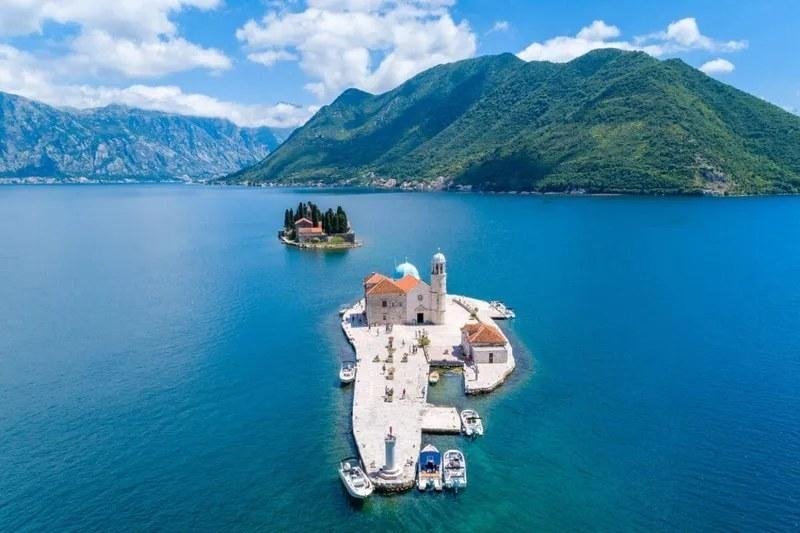
Speedboat cruising through the Bay of Kotor with mountain views in Montenegro
At minute 35, I pulled into a widened section of shoulder, called my wife, and told her I was leaving the car at the hotel and we were doing this differently. By 9 the next morning I was standing on the Kotor City Park pier with a coffee in one hand and a phone in the other, trying to figure out which of the speedboats tied up along the quay was ours.
This is the story of that morning. Skip to the end if you want the practical recommendation. Stay with me if you want to know what it’s actually like.
Why I Finally Booked a Boat
I’ve been travelling the Balkans on and off for the better part of a decade—first as a foreign correspondent, now mostly on my own time, which is my way of saying I’ve spent more time in this region than most tourists and I still somehow thought I could drive Montenegro in high season. I could not. What I could do, apparently, was book a half-day speedboat tour from my hotel bed the night before for less than I’d spent on one sit-down dinner that week.
I looked at three operators. I picked one based on a combination of response speed—the guy messaged back in six minutes at 10 PM—and the fact that the boat in the photos was small enough to feel like an experience rather than a bus. Serious Kotor boat tours tend to cap at six to eight guests per boat, which is what you want. Anything larger and you’re essentially on a ferry with a playlist.
The total for a half-day private charter for the two of us, with a stop at Perast, Our Lady of the Rocks, the Submarine Tunnels at Rose, and a swim at the Blue Cave, was €320. Divide by two and you’re looking at the cost of a decent day ticket at a Croatian national park. I mention the number because travel writing tends to go soft on prices. This was the number.
Leaving the Pier
The captain’s name was Milan. He was maybe 35, grew up in Dobrota, and had the sort of sunburn that suggests he hadn’t spent much of the summer indoors. He handed me a cold bottle of water without being asked, which is the kind of small gesture that tells you how the morning is going to go.
| Key Takeaways“First rule on this boat,” he said, gesturing at the open bow. “Sit wherever you want. Move around. Tell me if you want to go slower, faster, stop for a swim. This is your morning.” |
We left the pier at 9:12 AM. I remember the time because I looked at my phone to check whether the weather app was right about the wind (it was not; there was almost no wind at all), and because the first thing that happens when you leave Kotor’s inner harbour is that the town you thought you knew rearranges itself completely.
You’ve walked the walls. You’ve seen the photos taken from the fortress up at 260 meters. What you haven’t seen is Kotor from the angle the Venetian galleys saw it in 1420—the whole old town tucked inside its triangular stone pocket, the limestone behind it so sheer that the town looks painted onto the bottom edge of the mountain. We’d been in Kotor for three days. It was the first time I’d understood what the town actually was.
The Light Over Perast
Twenty minutes later we were off Perast.
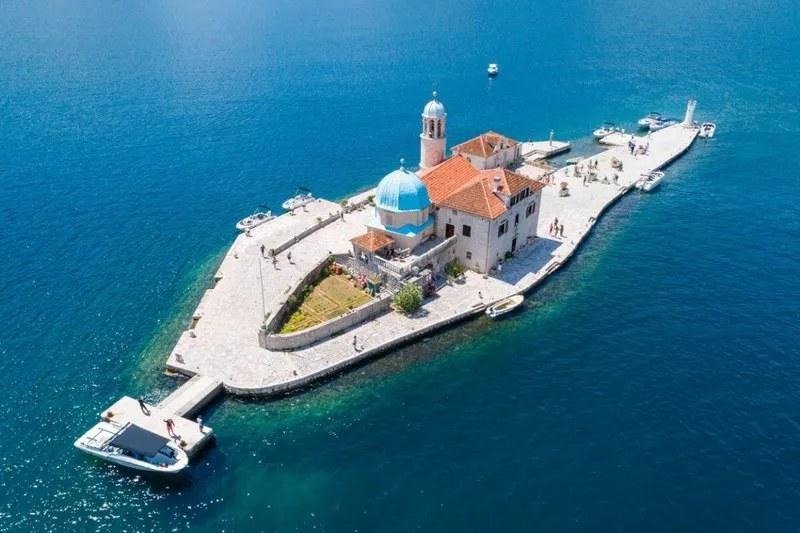
Our Lady of the Rocks island with its church dome in the Bay of Kotor
I need to try to describe this properly and I know I’m going to fail. Perast at 9:45 AM in late June has a particular quality of light—a pale gold that comes off the limestone houses, catches the water, and gets thrown back up at the bell tower so that everything seems to be glowing faintly from below. The photographs I took that morning look, frankly, a little unreal. They are not edited. The light was doing it, not me.
Milan cut the engines about three hundred metres out. We drifted. The only sounds were the church bell across the water and the occasional slap of a small wave against the hull. He pointed out the house his grandmother grew up in—third from the end, blue shutters—and told me about the Fašinada, the tradition where every 22nd of July, boats from Perast sail out at sunset and drop stones around Our Lady of the Rocks to keep the artificial island from eroding. He had done it himself, every year, since he was eight.
This is the part they don’t put in the brochures. You go for the islands. What you remember is the twenty minutes you spent drifting with a stranger whose family has been on this water since before your country existed.
The Submarine Tunnels and an Unexpected Swim
We kept south. The bay opens up after Perast, narrows again through the Verige strait, and then opens for good into the Tivat basin. Milan pushed the throttle. The boat climbed onto plane, the wind picked up, and the whole experience shifted gears. Calm drifting through a baroque village in the morning, full speed across open water by 11.
I’d written down a list of stops before we left—the kind of list travel writers make and then pretend they improvised. The Submarine Tunnels at Rose were on it. What wasn’t on the list was Milan noticing, from the steering console, that a pod of dolphins had shown up about four hundred metres off the starboard side. He cut the engines again. We sat there for ten minutes watching four dolphins surface, arc, and disappear. Then we kept going.
The tunnels themselves, when we got there, are exactly what you think they are: cavernous, slightly cold, and genuinely strange. The Yugoslav Navy cut them into the cliff face in the late 1950s to hide submarines from U-2 reconnaissance flights. You glide in under low rock. Your voice echoes weirdly. The water underneath is forty metres deep and impossibly clear. You can see the boat’s shadow on the sea floor.
This is the part of the tour where most guests go quiet for a minute. We did too.
The Blue Cave, the Cold Water, and the Reason You Come
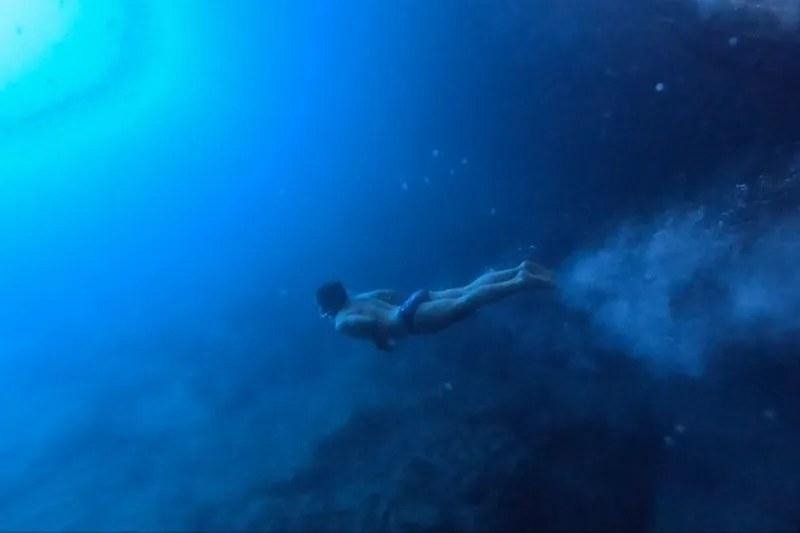
Private speedboat anchored near the Blue Cave in Montenegro
By 12:30 we were anchored off the Blue Cave on the outside of the Lustica peninsula.
I had read about the Blue Cave. I had seen the photos. I had been warned by at least one internet commenter that it was overrated. I will now say, for the record, that the internet commenter was wrong. At noon on a clear day, sunlight comes through an underwater opening in the cave wall and turns the interior a shade of blue that the English language does not really have a word for. The closest I can come is if you took a swimming pool, lit it from underneath, and then made that light glow.
Milan killed the engine outside the cave mouth. “Go in,” he said, pointing to the water. “It will be cold for twenty seconds. Then you will not care.”
He was right on both counts. The sea temperature in late June was about 21°C, which, when you’ve been warming on a bow cushion in 28-degree sun, feels briefly like plunging into a mountain lake. The cold lasts about the time it takes you to remember where you are and why. Then you’re swimming inside a cave lit from underneath by a light source that makes everything in you seem faintly luminous too.
This is what people are talking about when they talk about Montenegro Submarine-style private trips and why they rave about them afterwards. It is not, it turns out, the itinerary. It’s the unhurried way a good captain runs a good boat. You stop when you want to stop. You swim when you want to swim. You drift for ten minutes watching dolphins because that is what the water offered you that morning.
What I’d Tell a Friend Who Asked
We got back to the Kotor pier at 2:05 PM. I’d been on the water just under five hours. I’d swum in three different places, drifted off a baroque village, learned more about the local stone-dropping tradition than I expected to learn about anything that day, and eaten the bag of local figs Milan had handed me on the way out of the cave.
A few practical notes I would pass to the next person who asked me:
Book the first morning slot. 8 or 9 AM departures catch Perast at its best light, the Blue Cave while the refraction is peaking, and the open-water crossings before afternoon wind picks up.
Go private if you’re more than two people. The per-head math flips around four guests. Four adults on a €400 private charter is €100 each, which is within €25 of a shared tour, and you get your own itinerary.
Don’t overpack. I brought a dry bag I didn’t need, a second pair of shoes I didn’t need, and a book I didn’t open. You need sunscreen, a hat, a swimsuit under your clothes, and a light layer for the ride back.
Tip the captain. In local terms €20–€30 in cash for a good half-day is both appropriate and noticed. Milan had taken three hours of his Friday morning to show me the house his grandmother grew up in. Twenty euros is nothing.
Skip the car for the bay day. You are giving yourself back the four hours you would have spent looking for parking in Perast, and you’re experiencing the coastline the way it was built to be experienced—from a boat, approaching the dock.
Frequently Asked Questions
Is a Kotor boat tour worth it if you only have one day in Montenegro?
Yes, more than any other single half-day activity. The bay is the main event in this part of the country, and a half-day tour from Kotor’s port covers what would otherwise take a full day of driving, parking, and queuing — Perast, Our Lady of the Rocks, and at least one swim stop on the Lustica side.
What time of year is best?
Late May, early June, and all of September. Water is warm enough to swim (20–24°C), cruise-ship traffic into Kotor is lighter, and boat charter prices are typically 20–30% below peak August rates.
Is it safe for people who get seasick?
The inner bay is extremely calm on most summer days—closer to a lake than open sea. Open-water sections near Mamula and the Blue Cave can have a slight chop in the afternoon. Morning departures minimise motion. A light breakfast and one dose of OTC motion medication before you board handles most cases.
Can you bring kids?
Most captains welcome children on half-day private charters, and dedicated family boats (including semi-submarine tours with glass viewing) exist specifically for younger kids. Under-5s do better on the calmer inner-bay route; older kids handle the full Blue Cave itinerary without issues.
One More Thing
I drove the Kotor–Perast road twice more before we left Montenegro. Both times, predictably, in traffic. Both times I thought about the forty minutes it had taken us from the pier to the same stretch of coastline, the light over the bell tower, the fact that a stranger had handed me a bag of figs on the way out of a cave.
If you’re heading to Montenegro this year and you’re debating whether to put a boat day on the itinerary, this is me, from a former traffic jam: put it on the itinerary. The bay is not a thing you see from the road. Booking a half-day on the water is the cheapest, easiest decision in your entire trip—and almost certainly the one you’ll keep telling people about afterwards.
This piece was written on assignment and reflects the author’s own paid booking and first-hand experience. Editorial use welcome; please preserve author-supplied outbound links.