Introduction
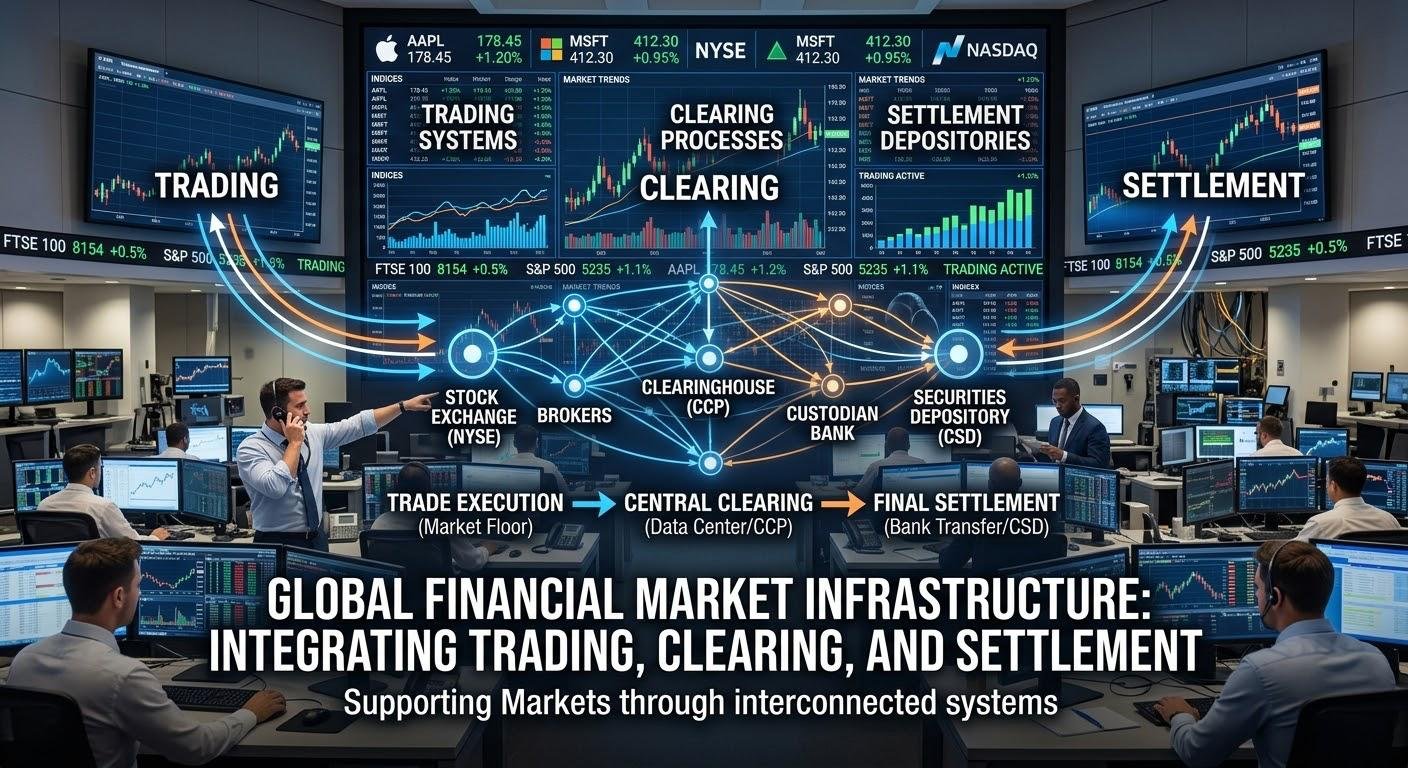
Financial markets enable people, firms and governments to borrow funds, invest their wealth and sell and buy financial instruments. These activities, however, demand more than the agreement between the buyers and the sellers regarding the price. For every successful securities transaction there is a series of institutions, systems and procedures that keep track of securities transactions, verify obligations, convey ownership and carry out the movement of money between two parties. Such a network is referred to as financial market infrastructure (FMI). It consists of stock exchanges, payment systems, clearinghouses, custodians, settlement networks and central securities depositories, who keep records of securities held under account and facilitate their transfer between accounts. All of these factors contribute to the efficiency of financial markets, minimization of risks of transactions and investor confidence in financial markets, banks, brokers and investors.
Financial Market Infrastructure
Financial market infrastructure is the infrastructure and institutional arrangements that enable financial transactions from initiation of trades to the ultimate settlement of cash and securities. It lays the groundwork for markets trading in shares, bonds, government securities and other financial products. If the infrastructure was not reliable, the participants wouldn’t be able to verify transactions, verify ownership, calculate payments, and make proper transfers. Financial market infrastructure also adopts standard procedures which enable the financial institutions to communicate and coordinate their activities. A trading app or brokerage platform might appear to be one system, but a number of separate systems can be involved in executing an order. They must operate reliably as a system, as a failure, delay or incorrect operation in one system can impact other members of the network and their financial activity.
Key Components of Financial Market Infrastructure
1. Stock Exchanges and Trading Platforms
Stock exchanges are organized marketplaces in which those willing to buy and sell securities that are listed on the exchange are able to do so under predetermined rules and regulations. This can include Nigeria’s Nigerian Exchange (NGX), the London Stock Exchange, or the New York Stock Exchange. Exchanges facilitate the aggregation of orders from market participants, and engage in trading activities to connect suitable bid and ask. Trading platforms are designed to be modern and work with electronic trading, responding to orders, offering up prices, and transmitting execution details quickly. They also serve as a facilitator for transparency in the market, giving information on prices and trading activities. But trading does not necessarily imply that the buyer has purchased securities and the seller have received the funds. Trade execution is what creates the trade and separate clearing and settlement transactions complete the obligations in the trade. This is why exchanges are but one component of the infrastructure that is necessary to facilitate securities transactions.
2. Clearinghouses and Central Counterparts
After trades are made the clearinghouses assist in calculating what the buyer and seller owes one another. They gather the transaction data, work out obligations and assist in the management of the risks involved in the trading-settlement process. Some clearinghouses are set up as central counterparties (CCPs) that is, they are the seller and the buyer to all other parties by contract. This procedure can simplify the operations of obligations in between various market players. Typically, the CCP will control exposures by implementing margin requirements, collateral and default procedures. These safeguards are intended to help ensure that the clearing system is not negatively impacted by a participant’s failure to fulfill its obligations. However, the financial risk can’t be reduced to zero in clearinghouses. This requires good risk controls, adequate financial resources, robust technology and proper oversight. Failure of a clearinghouse could impact more than one investor or transaction, since it is a bridge between various institutions.
3. Central Securities Depositories and Custodians
Central securities depositories (CSDs) keep records of securities and transfer securities between the accounts of participants. They can be in electronic book-entry form, facilitate processes of issuance and redemption, and keep the records necessary to create ownership positions, depending on the market and the way in which it operates. By doing so, electronic records eliminate the need to transport paper securities certificates, and allow for easier securities transfers. Custodians are also a similar but distinct type of entity that stores financial assets for their clients and keeps record of the account. They can also be used to handle corporate activities like dividend payments, interest distributions, and stock splits. A custodian may hold, or transfer, assets through a CSD or other securities settlement system. While in some set-ups, the functions may overlap, the CSDs typically handle the holding and transferring of the securities held in the market, and the custodians provide services to the individual securities and accounts of their clients.
4. Payment Systems and Settlement Networks.
Payment systems facilitate the transfer of money among banks, financial institutions and other qualified participants. They have systems that allow money to be moved from one account to another, make high dollar payments, and resolve payment obligations between financial institutions. The settlement networks link the institutions providing cash and securities settlement services with each other, ensuring that cash and securities settlement are carried out in accordance with the settlement rules on both sides of the transaction. Some systems make payments effective on an individual-by-individual basis as payments are made, while others netting payments to and from one another in groups. This will be dependent on the design of the system, the importance and timeliness of the transactions, and the level of risk. The ability to make payments reliably is crucial as securities transaction cannot be properly completed if the cash leg cannot make payments. Payment system delays or disruptions may have a negative impact on settlement of securities, liquidity, and financial institutions’ obligations.
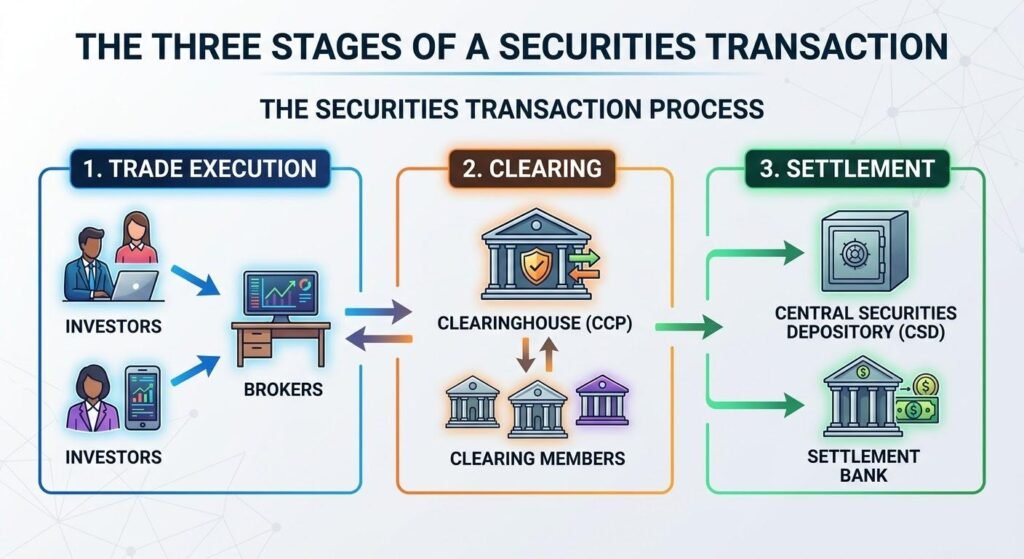
How a Securities Transaction Works.
Step 1: Order Placement and Execution.
A securities transaction starts with an order from the investor placed via a broker or trading platform. The order includes the security to be traded, quantity and price/conditions of execution. The broker then forwards the order to the exchange or any other trade venue that is acceptable for trading and the order might be matched with another order that matches the order. When a match happens, the trade is processed and the appropriate parties get confirmation including the security, quantity, price and date of the trade. In this point, the buyer has agreed to acquire the securities and the seller has agreed to deliver the securities. But the actual exchange of cash and securities cannot be complete. The information about the transaction should be passed on to the appropriate clearing and settlement systems for the purpose of calculating, verifying and fulfilling obligations of the participants.
Step 2: Clearing and Calculation of Obligations
Once executed, the transaction goes into the clearing process. The terms of the trade are examined and the buyer and the seller’s duties are determined. In the event that a clearinghouse or central counterparty exists, it determines the amounts that are to be paid by the participants and/or the securities to be delivered by them. Netting can involve the fewer or more than remuneration deliveries, respectively, to shareholders or obligations, but can also combine remuneration obligations into fewer deliveries of cash or securities. For instance, let’s consider a broker that makes multiple trades in securities during the day. They might have multiple trades that they can offset under the system as per the rules. The clearing and settlement process may also include margin and collateral requirements to mitigate risk of the failure of a participant to meet its obligations. A crucial factor is the accuracy of the clearing as settlement systems rely on trustworthy information on what each party needs to provide and accept.
3. Settlement and Transfer of Assets
Settlement is the time period when the contractual obligations that occur with the trade of a security are completed. The necessary amount of money is supplied by the buyer and the securities are supplied by the seller via the relevant financial infrastructure. Delivery versus payment (DvP) are an agreement found in a number of markets, which provide a mechanism that enables the transference of securities to be coupled with the corresponding payment, thereby mitigating the risk of delivery without the payment of the agreed consideration. The settlement can be done immediately or on the next business day subject to the market rules and the securities involved. A number of large equity markets have switched to T+1 or T+2 settlement cycle. T signifies the trade date and the n denotes the number of business days after the trade date for settlement. The securities and funds are transferred to the other party and the necessary records are updated as a result of the settlement.
How Digital Technology Improves Market Infrastructure.
The use of digital technology has revolutionized the way financial market infrastructure handles transactions. Institutions can trade information more quickly than paper transactions, through electronic trading, automated clearing systems, and electronic securities records. Automation can eliminate repetitive manual tasks, minimize some data entry mistakes and enhance consistency in the management of transactions. The use of standardized electronic messages also facilitates the communication of agreed format between the brokers, banks, custodians and settlement institutions. Furthermore, digital record-keeping allows for better access to transaction history, easier account balancing and investigation of discrepancies. In markets with high volume transactions, these capabilities are of special interest. But automation does not make things 100% accurate and never ending. It is still essential to get the design, testing, maintenance and human supervision right in systems to prevent spread of incorrect data or system failures over connected institutions.
Risk Management, Cyber Security and Financial Stability
Financial stability is ensured by financial market infrastructure which regulates the risks involved in trading, clearing, payments and settlement. Transaction monitoring, reconciliation, collaterals, access controls and contingencies are used by institutions to detect issues and mitigate their impact. Cyber security is also critical as the financial infrastructure could be attacked to obtain information, disrupt operations, or manipulate transactions for such transactions. It can be helpful to use strong authentication, encryption, constant monitoring, frequent security testing, and limited access to systems to secure sensitive data and services. Backup facilities, disaster recovery plans, and contingencies to get operations up and running again after an outage are also essential for operational resiliency. In addition, the regulations and the operators set governance, risk management, and reporting guidelines. Many institutions rely on interconnected systems and require effective supervision and collaboration to avoid a problem in one place impacting multiple institutions.
The Future of Financial Market Infrastructure (FMI) and Challenges
Financial market infrastructure continues to have challenges, despite the improvements in technology. Expensive legacy systems and significant investment and coordination are needed to integrate different platforms. Cyberattacks, technology issues, human error and the lack of liquidity continue to be major concerns. The cross-border transactions can become more complex as countries can have different legal structures, different currencies, different time for execution and different settlement process. New technologies such as distributed ledger technology and tokenization could provide alternative methods of recording ownership, automate certain processes and enable the coordination of transfers. But there are also regulatory, cybersecurity, interoperability, legal ownership, and fault recovery issues with these too. They are based on real-world use and not just the novelty of technology. Improvements going forward will thus need institutions that are innovative, with effective governance, strong control mechanisms, a reliable infrastructure, and a degree of inter-market cooperation.
Conclusion
The financial market infrastructure, which underpins the safe and effective operation of securities markets, is vital. Stock exchanges make the trades, clearinghouses perform the calculations and risk management, central securities depositories hold the securities records, custodians secure the assets of the clients and payment systems move payments. These works together to facilitate the entire transaction process, from order processing to clearing and settlement. Despite operational and cybersecurity risks, digital technology has benefited in the processing speed, recordkeeping, coordination, and risk monitoring. The quality of infrastructure is crucial, and investors and financial institutions should not be hesitant to invest unless they are certain that there is an accurate record of the trades, obligations will be met, and assets will get to their rightful owners. Financial markets can facilitate investment, capital formation, and economic activity and minimize the risk of failure affecting the financial system as a whole through their systems’ reliability and safeguards.
Get more well researched information about Financial Market Infrastructure here.