Introduction
Capital markets have been critical in linking businesses, governments and other organizations which require funds, to those who provide them with financial returns. In the past, these markets have been based on stock exchanges, brokers, custodians, clearinghouses and central securities depositories to issue, trade, record and settle financial assets. While these institutions are vital services, they can include many intermediaries, multiple databases, reconciliation and settlement time. Blockchain technology provides an alternative way, in which everyone shares out-of-sync transaction records through a distributed network. The tokens streamline the process and enhance transparency, efficiency, and accessibility by representing financial assets digitally. Smart contracts can also automate pre-defined transaction conditions, such as technologies. Technologies like smart contracts can also automate pre-defined transaction conditions. Yet financial risk and regulatory responsibilities is not an automatic by-product of blockchain. It is reliant on the right governance, safe infrastructure, strong rights to ownership and connections to existing financial market systems.
Blockchain Technology in the Capital Markets
Blockchain is a kind of distributed ledger technology that keeps a record of transactions among the various participants of the network. Each of the computers that participate maintains a copy of a “shared” record based on the rules agreed to by the other computers rather than relying on a single central database. Validations are done using a pre-selected consensus mechanism and records are grouped into blocks connected by cryptographic methods. Records can be made available to anyone or only those authorized. In capital markets, this technology can facilitate the recording of securities ownership, securities history, and changes in securities ownership. A shared ledger could help to minimize discrepancies between institutions by utilizing common data. But blockchain is not necessarily faster or less costly than all existing, traditional databases. The performance is impacted by the number of transactions, network architecture, governance processes, privacy expectations, and the number of parties.
Tokenization of Financial Securities
The process of tokenization is the creation of an asset’s digital representation on a blockchain. In capital markets, tokenized securities can be issued with a token as a representation of a share, bond, fund interest or any other investment product. Each token can have specific ownership rights, transferability limitations and contractual obligations. For instance, a company that is offering tokenized shares might have a blockchain system that logs the transfer of the tokens from one qualified investor to another, as well as information as to the user’s holdings. Another potential advantage of tokenization is the ability to fractionalize ownership, which means that investors can hold a smaller stake in an asset that may require a large investment. Creating digital units of an asset, however, doesn’t necessarily render it affordable, liquid, or accessible to the law.
One key difference between a traditional security and its tokenized counterpart is that the former is used to represent real world securities, while the latter serves as the security itself. Traditional share can be recorded in a company’s share register, central securities depository or through an intermediary’s system. The information of ownership or transfer of a tokenized share can be recorded on a distributed ledger. It is determined by the jurisdiction, structure of its issuance and rights being created in the governing documents. There are some tokens which are legal security and others that only contain a digital claim on a security not traded on the token’s exchange. Investors should therefore understand what is entitled to be owned, whether or not the rights are enforceable and how the rights would be protected in the event of failure by the issuer or service provider.
Digital Bonds and New Issuance Methods
Blockchain technology has a wide range of potential applications within capital markets, and digital bonds are one of them. Bonds are issued by governments, financial institutions or corporations for investors to buy and get their money back according to a certain plan. The relevant information such as the amount of the bond, maturity, interest pay schedule, transfer terms etc. can be stored as digital records and programmed instructions in a blockchain issuance. The arrangement, issuance, allocation of investors, processing of payments and updates on ownership of the issuance can be coordinated on a common platform, depending on the arrangement. This can lessen the amount of paperwork, make administrative processes easier and make it simpler to access transaction data.
Digital bonds can also enable more flexible issuance structures, such as offering smaller bonds, or customized payment arrangements. The advantages will however rely on the demand of investors, upkeep of platforms, legal documents and availability of appropriate payment facilities. The investment risks inherent in a digital bond are the same as those for a traditional bond, including the risk of default, interest rate sensitivity and changes in market prices. An issuer can’t ensure that it will pay back a debt and an investor won’t be able to liquidate holdings without a hassle. As with traditional bond markets, therefore, paying careful attention to creditworthiness, pricing, disclosure, and investor protection are essential to success in the bond market.
Smart Contracts and Securities Trading
Smart contracts are any computer program that performs a set of instructions under certain conditions. They can be used in capital markets to automate the transferring of securities, interest distribution, transfer restrictions and to handle some corporate actions. A bond contract in a digital form, for instance, could be written to determine the timing of payments and trigger the distribution of those payments when the conditions that trigger the bond payment are met and the payment systems are in place. Likewise, if the security token platform has security protocols to ensure that transfers are not made to wallets that have not gone through the required eligibility processes, then that could be possible.
Automation can help to minimize manual task, repetitive administrative task, and opportunities for human error. Can help increase uniformity in the rules of transactions for participating institutions. Smart contracts, however, can’t always know if each of the actual conditions is true. They can rely on external information sources, called oracles, to obtain information like market prices or events. Wrong information, coding mistakes, inadequate user rights, and other issues can have significant financial implications. Smart contracts also can’t ensure that an automatic transaction will be legally valid in all jurisdictions. Independent code review, testing, monitoring, dispute resolution and legally binding contractual agreements continue to be crucial.
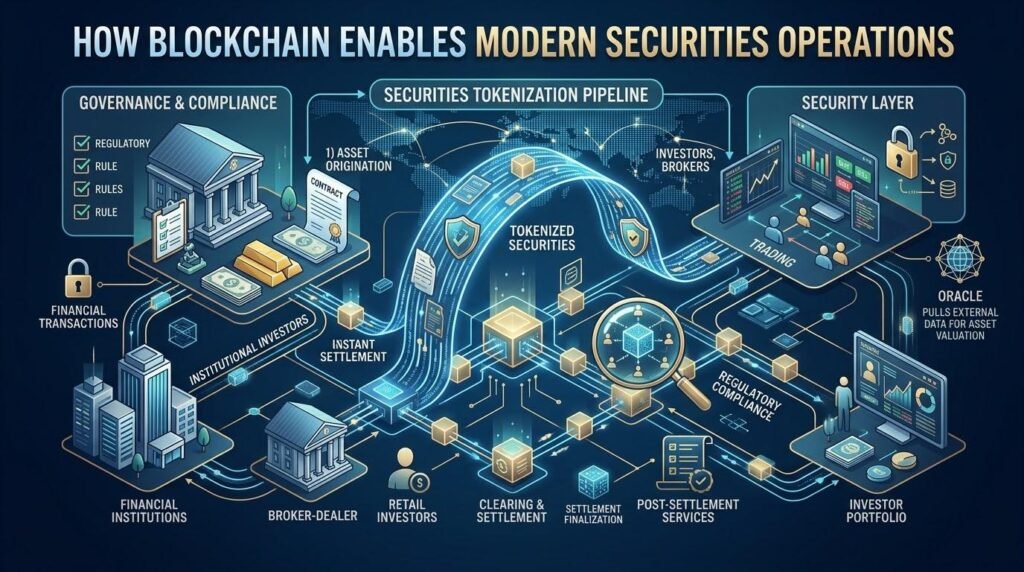
Clearing & Settlement, Trading
Typical securities trading are often a series of different steps. The first step is for the investor to make an order through the broker or trading platform. The order is executed when there is an interest in buying and selling that is appropriate. Once the clearance is obtained, the obligations of the parties are to be determined, such as what securities are to be delivered, and what is to be paid. The final step in the transaction is carried out by settlement, which involves transferring the securities and the necessary funds. Such activities can include clearinghouses, custodians, payment systems and central securities depositories, depending on the market and security.
Some of these steps can be managed in a shared ledger through the use of blockchain-based infrastructure. With the use of blockchain-based infrastructure, it will be possible to coordinate some of these steps in a shared ledger. If the necessary systems and parties are in place, delivery-versus-payment systems can help coordinate the transfer of securities in exchange for the payment of the funds that cover the cost of the securities. This helps to reduce the risk that one party will deliver the security without receiving payment. In some transactions, the time required to complete the transaction won’t be as long, as there is not so much need to reconcile with separate records. But a blockchain transaction does not necessarily constitute a final and binding securities transaction. There also needs to be a suitable method for cash settlements and the appropriate settlement rules must be met. The network may become congested or systems may be incompatible, etc., even then, causing delays. The benefits really are not just dependent on the ledger, but on the complete deal procedure.
Secure and Transparent Market Data & Transaction Records
A possible benefit of distributed ledgers is to keep an authorized list of transactions. The traditional markets are likely to have their own separate systems that need to be reconciled to ascertain ownership, whether there are any transactions, and whether there are outstanding obligations. A well-managed blockchain network can offer a unified log of the activities of each of the institutions participating in the network, which may help to cut down on the amount of duplicated work and make it easier to identify discrepancies in the early stages. Authorized participants can also have more transparency on the progress of transactions, transfers of assets and other relevant transactions of ownership. These enhancements may facilitate a more effective reporting, auditing and operational risk control.
However, there needs to be an appropriate balance between transparency, confidentiality and privacy. Financial institutions may not be able to show client identities, account information, trading strategies, and/or commercially sensitive transactions to all the network participants. Permissioned blockchains can be permissioned and more privacy can be provided using other privacy techniques to limit the information that different users can see. Even if it would be inappropriate to have public access to certain records, regulators may need to have access to those records. Furthermore, merely having a record on a blockchain doesn’t certify the reality and completeness of the authentic info. Therefore, effective controls need to be in place for the entry of data, checking of identity, access to data, the retention and the corrections of data.
Regulatory Needs, Custody and Cybersecurity Requirements.
One of the most significant factors to consider in the adoption of the blockchain is the regulation. Existing securities laws (related to issuance and registration, disclosure, trading, market abuse and investor protection) may cover tokenized securities. Platforms can also be subject to authorization as an exchange, broker, custodian, or as a regulated financial service provider in the relevant jurisdiction, depending on the specific regulation and structure. Investors and/or transactions may be subject to anti-money laundering and customer identification. Before launching products and/or allowing secondary trading, institutions should make sure they know how traditional legal responsibilities manifest themselves in the digital space.
There are other issues related to custody and cyber security. Private keys can be the key to owning digital assets and it’s important that there are arrangements in place to safeguard access to those private keys. A key can go missing, be exposed to an attacker or be given to a fraudster and result in substantial losses. Secure storage, multiple approvals, separate accounts and a well-managed recovery process could be employed in institutional custody arrangements. Platforms should also defend itself against software vulnerabilities, phishing, insider threats, as well as critical infrastructure disruptions. There is a need for definite legal accountability where an asset is stolen, there is a dispute on the transaction or a service provider becomes insolvent. While blockchain can enhance record keeping, there is no need to eliminate good operational controls or investor protections.
Liquidity and Interoperable with Existing Systems
More people can be reached by tokenization, because it enables smaller amounts of investment and makes it easy to access via digital channels. It could also be used to allow for trading outside of normal business hours in some cases, or be used for transfer among approved participants. But, liquidity relies on the willingness of the buyers and sellers, the market making process, price transparency and investor confidence. But even though a token will be easily transferred digitally, this does not make it liquid. Some platforms do not allow investors to trade on the platform, some investors are not eligible for trading on the platform, and some trading platforms have restrictions on transfers and do not know when to expect redemption.
The other critical aspect is interoperability. There are already well-developed capital markets exchanges, banking networks, custodians and settlement systems and a reporting regulatory infrastructure in place. Without communication between the blockchain platforms and these, institutions could be incurring extra costs, not increased efficiency. Additionally, some blockchain networks may have different technical requirements, or the format of the assets they can accept and process might not be compatible, which can cause problems when transferring assets. To integrate systems, it is crucial to have a reliable identity management, consistent data standards, legal agreements and secure linkages between digital tokens and payment mechanisms. Key to the success of tokenized goods will be the cooperation of industry as a whole, to guarantee that these products can be used in conjunction with current financial systems without causing fragmentation or new risks for the industry.
Conclusion
The potential for blockchain technology to impact the securities issuance, trading, recording and settlement process could evolve, over time. Seeking to alleviate administrative overhead and coordinate market participants, the opportunities include tokenized shares, digital bonds, programmable investment products and shared transaction records. These developments could in the future also help to create more flexible investment structures and improved integration of the financial services sector. The benefits of this will, however, have to be demonstrated as being achievable in a reliable, economically feasible and legal framework to achieve widespread adoption.
However, blockchain is not going to take the place of all the traditional institutions, it can be used as an addition in ad hoc ways and in hybrid systems. The benefits and risks of such solutions will have to be considered by financial institutions, regulators, technology vendors, and investors, alongside the limitations of liquidity and the costs of implementation, and the governance and cybersecurity issues that may arise. Distributed ledgers can be useful in certain areas over traditional databases, and pilot projects and controlled production systems are effective in pinpointing these areas. The endgame of blockchain in its role in capital markets will go beyond its novelty, it needs to provide secure ownership records, reliable settlement, investor rights and the provision of financial services all of which are efficient and reliable.
Get more well researched information about Blockchain technology in capital markets here.