Introduction
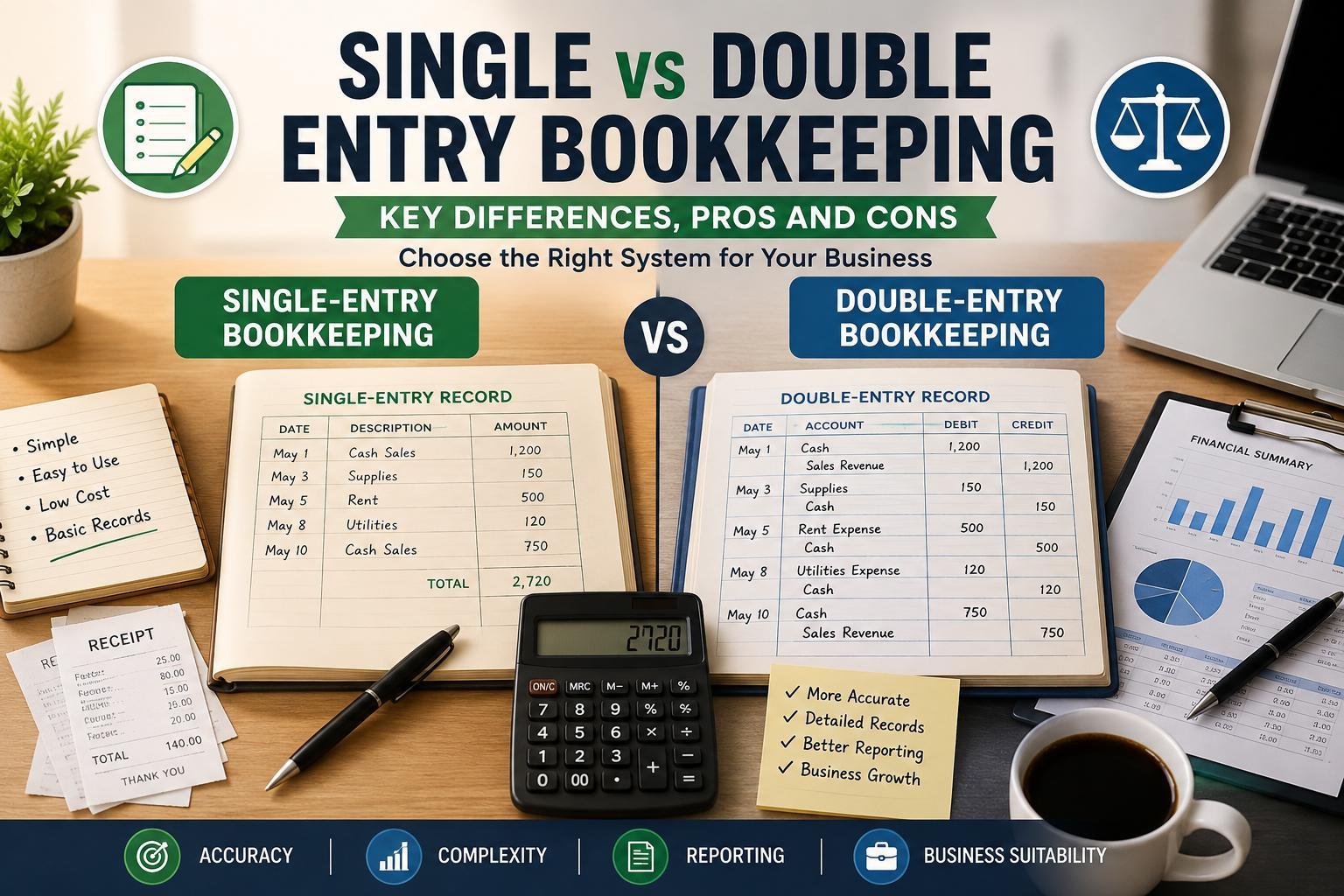
Bookkeeping is one of the key financial operations for any business and is essential in providing an account of the finances that flow into and out of the business. But not all businesses require a precisely the same sort of accounting methods. There are two types of bookkeeping methods namely single entry and double entry bookkeeping. While they both deal with financial transactions, there are many differences between the two in terms of detail, accuracy, complexity, reporting ability, and applicability to various business types. It’s important to note these differences for solopreneurs, freelancers, start-ups and small business owners who might be considering the best way to set up their financial documents without allocating too much time and money. A proper bookkeeping system can help with financial management, better decision making and will offer valuable information for tax filing and loan applications. The incorrect system, on the other hand, can make it hard to comprehend the actual monetary status of a business enterprise.
Single-Entry Bookkeeping Explained
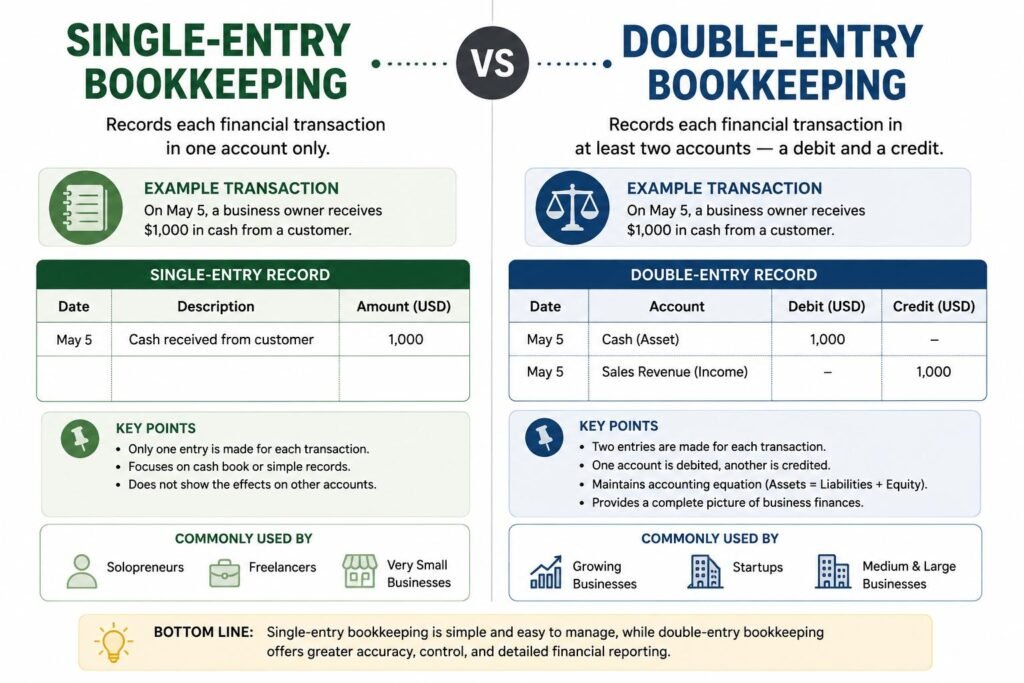
A relatively simple method of keeping business records, called single-entry bookkeeping, is the type of bookkeeping used in the majority of small businesses and is the bookkeeping approach that is most commonly employed. The owner of the business will normally only be documenting the data relating to the two sides of each individual transaction, rather than tracking both sides of the transaction. For instance, a freelance designer takes in ₦100,000 from a customer, and the transaction could just be a credit of ₦100,000 as an income. In a similar manner, if the designer buys internet services worth of ₦20,000, the amount can be accounted for as an expense. This method is simple to understand since it does not involve the business owner understanding accounting terms like debits, credits and balancing entries. Single entry is therefore often appealing to those that run very small businesses, particularly if their transactions are simple and they don’t really need to make any detailed financial statements.
Single-entry bookkeeping is often a great benefit to companies that don’t have intricate financial transactions. For a small business with a single owner like a service provider, the only things important may be the amounts of cash received from customers and the amounts spent on business expenses, and the amount of cash remaining. Under such conditions, an undetailed income and expenditure record might be sufficient for daily operations. The business owner can record transactions in a spreadsheet, in a notebook, or (on their computer) using a basic bookkeeping program. But simplicity is also a lack of information about the business, as the system gives a limited overview. It might not fully record assets, liabilities, owner’s equity, accounts payable, inventory, etc. that are more significant as a business expands. So single entry bookkeeping might be helpful for very small businesses, but may not be sufficient if the finances of the business are growing more complex.
Double Entry Bookkeeping
Double entry bookkeeping is a more complex form of bookkeeping, wherein each financial transaction impacts on more than one account. The basic accounting rule is that each debit must have a credit, in order to keep the accounting records in balance. For instance, when office equipment is bought in cash, ₦200,000 will be transferred from the cash account to the office equipment account and represented by ₦200,000. Though only one payment was made there were 2 sides to this transaction. This is a better way of depicting the financial transactions of a business. Double entry bookkeeping is the basis of modern accounting because it helps in the preparation of important financial statements like the income statement, balance sheet and cash flow statement. It also facilitates the detection of some of the errors as the records are mathematically balanced.
It helps to compare the two systems of bookkeeping to understand their differences in the way they process transactions, provide financial reports and support business growth, if you are a business owner looking to learn more about single vs double entry bookkeeping. The double entry bookkeeping principles take more knowledge and discipline than single entry bookkeeping but its additional knowledge offers a lot of benefits. Since the transactions are posted in linked accounts, the business will not only be able to monitor cash, but also monitor assets, liabilities, revenue, expenses and equity. This data can be useful to owners to determine profitability, track debts, and evaluate financial status and to make better decisions. Double entry bookkeeping is better suited than a simple single entry bookkeeping for a business that plans on expanding, looking for investment, providing major loans, holding inventory and employing more than one person.
The Difference between Single Entry and Double Entry Bookkeeping
The biggest difference between single entry bookkeeping and double entry bookkeeping is the amount of financial information that’s being captured by each of these types of bookkeeping. Single-entry bookkeeping methods are typically used for each of the financial transactions including income and expenses, whereas double entry bookkeeping records the impact of the transaction on two accounts. In a single entry system, the business owner could write off receipts from customers as ₦500, 000, but not necessarily write off the corresponding amount of the accounts receivable or any other related account. The transaction would be entered in such a way that both the debit and credit side are entered in a double entry system to record the transaction. The difference has an impact on the amount of financial information the business owner has. Single entry may be adequate for cash transactions, double entry is used to give a wider picture of the financial position and performance of an organization.
One other key difference is the capacity to create in-depth financial reports. Single entry bookkeeping usually will not give enough detail to prepare a balance sheet, but it will usually give the information needed to prepare simple statements of income and expenses. The double entry accounting on the other hand is designed with a specific focus on formal financial reporting. Systematic tracking of assets, liabilities, equity, revenue and expenses allows the business to prepare financial statements that give a more comprehensive view of the financial condition of the business. This difference can be more significant as a company expands. A small freelancer might be able to live on a list of monthly income and expenses, and a business with employees, equipment, loans, inventory, suppliers, and investors will need a lot more information than that to know what it owns, what it owes, and how much value is in the business for the owners.
The Accuracy of the Solution and the Error Detection
The other pivotal difference between the two bookkeeping systems is accuracy. Single-entry bookkeeping is simpler to keep up, however it can be more difficult to spot errors because the framework is not as extensive. When a transaction is forgotten, mistakenly included in an incorrect category or entered incorrectly, there might not be a mechanism to find the error. For instance, a business owner who mistakenly adds ₦50,000 to the “expenses” column when he or she had meant to add ₦5,000 may not notice anything amiss until he or she looks at the receipts or bank statements. Thus, extensive manual verification is crucial to the system. Single entry bookkeeping is not necessarily an incorrect system, it’s just that there are less controls in the system to catch the error.
Double entry bookkeeping has better systems of cross-referencing the consistency of financial records since each transaction comes with both a debit and credit impact. When the accounts do not balance, it indicates that there is a problem with the recordation or omission of some accounting transactions. Trial balance, Reconciliations and Ledger review are some of the tools which accountants can utilize to look for discrepancies. This does not remove the possibility of errors being made entirely from double entry bookkeeping. But an incorrect transaction could be made on both sides of the accounting system, and lead to balanced but wrong records. However, certain errors can be more easily identified and a better financial base created in the structure. The double entry bookkeeping method can thus add value to businesses, especially the ones where money matters are of vital importance.
Complexity and Ease of Use
The single entry bookkeeping has a distinct benefit on simplicity. It is not essential to the business owner to have a lot of accounting knowledge in order to record the receipts and payments of a business. This ensures that the system appeals to those who are beginning their first business venture or someone with a very small-scale business with simple transactions. A sole trader could keep a basic spreadsheet, including columns for date, description, income, expense and balance. This can be fairly easy to keep up with and could minimize the requirement for expert bookkeeping assistance. It can also allow a business owner to concentrate more on his/her customers, products and services as opposed to getting too bogged down in technical accounting procedures.
The double entry bookkeeping is more complicated and involves knowledge of accounts, debits and credits, journals, ledgers and the connection between the various financial statements. This learning curve might be difficult to start at first, especially for the entrepreneurs who have no knowledge of accounting. But, much of the manual work in the accounting system has been minimized with modern accounting software. Many accounting platforms automatically add entry for the corresponding debit and credit when users record sales, expenses, invoices, payments and more. Thus, business owners don’t always have to run the numbers of all bookkeeping entries. It is definitely more complex than single-entry bookkeeping, but software and/or professional bookkeeping services can help make it quite easy to manage.
Financial Statements and Reporting
One of the best reasons for using a double entry bookkeeping process is financial reporting. A sound double entry system will allow businesses to create detailed financial statements, which will enable owners, managers, lenders, investors and others to examine the business’ performance. The income statement can provide information about the revenues, expenses, and profitability during a specific period. The balance sheet can report assets, liabilities and equity at a particular time. The cash flow statement may be used to give information on the cash generated or utilized by the operating, investing and financing activities. These reports are very valuable when taken together than a straight from the cash register income and expenditure report.
Single Entry Bookkeeping can only be used to provide limited reporting. The records may not be sufficient to allow a sophisticated financial analysis, but a business owner may be able to tell if the business is making more money than it is spending. For example, if the owner is not able to keep additional records, he may not know exactly what the value of the business assets is, what the total is of what he has owed the supplier or how much he has been owed by his customers. While this restriction might not be significant for a very small operation, it can become an issue with growing business. Other stakeholders, such as banks, investors, accountants could also need detailed financial statements. If it is a business that has only been using single entry books, it may be necessary to move to double entry accounting at some point.
Single Entry Bookkeeping is a different Method of Bookkeeping.
The primary benefit of the single entry bookkeeping is the simplicity. It costs little, is easily understood and is fairly easy to keep up. It’s especially beneficial for freelancers, self-employed, very small sole proprietorships and businesses with simple transactions. Owners will not have to juggle a lot of accounting accounts when they are able to focus on the income and expenses. The system also can be adequate for simple budgeting and cash-flow monitoring in case the business does not have significant assets, liabilities, inventory, or credit transactions. As the business expands however, its drawbacks start to show. It offers less detailed financial information, less robust error detection and may be unable to provide all financial reporting. It may also complicate the keeping of track of outstanding debts, receivables, asset values and owner’s equity. As a result, single entry bookkeeping may be suitable for a small business, but business owners should be aware of the limitations of such an accounting system before using it for an extended period of time.
Pros and Cons of Double Entry Bookkeeping
The first and most important benefit of double entry books is that they are complete. The system records the two-facet of transactions giving a more detailed financial performance and financial position. It assists in preparing financial statements, aiding financial analysis and creating enhanced opportunities to identify some of the errors in the recording process. It’s also more appropriate for businesses that have employees, inventory, loans, equipment, accounts receivable and accounts payable, investors, or multiple sources of income. Another advantage is the scalability. The double entry system can be used by a business without the need to switch to a more advanced bookkeeping system when the business expands. The negative side effects are more complexity, time and cost. The business owner might need to know some accounting or require the help of a professional, and the system may need a more careful organization. However, small businesses can make use of accounting software to do double entry bookkeeping more conveniently.
What Is the Best Bookkeeping System for a Small Business?
Single entry and double entry bookkeeping needs both are utilized for the most part contingent upon the scale, structure and monetary intricacy of the business. If you have a very small business with simple transactions and little or no inventory, loans, employees or credit sales, single-entry bookkeeping might be adequate for simple record keeping. For instance, if you are a freelancer and do not have many recurring expenses and you are receiving payments directly from your clients, you might not need all the intricacies of a double entry bookkeeping system. The owner should still have a good bookkeeping system, and retain receipts and invoices, compare bank statements, and be aware of tax responsibilities, however. Simplicity doesn’t mean that there’s poor recordkeeping. Any basic system must be consistent and organized for it to be useful in providing financial information.
Double entry bookkeeping is more likely to be the preferred system for larger businesses or for businesses that are expanding or have more complex financial needs. Even a business that has inventory, staff, business loans, equipment, suppliers, customer credit, and many bank accounts and is considering attracting investors will benefit greatly with the extra detail. It would also make a good choice for business owners who anticipate that they will create lots of additional value in their company in the years to come. The first time it could be structured accounting system to avoid the hard transition later. While the business owner may not be familiar with all the accounting aspects, the software can do a lot of the technical accounting, or a qualified bookkeeper can. The key issue is not so much that double-entry bookkeeping is more complex, but it is whether the added information and control gained by double-entry bookkeeping are valuable to the business.
How to Convert a Single Entry Bookkeeping into Double Entry Book keeping in a Business
Yes, changing the needs of a business can cause it to switch over from single entry to double entry bookkeeping. Indeed, it’s possible for small companies to start off with basic records and evolve into more complex accounting methods as they develop. This could include reviewing existing records, identifying assets and liabilities, setting up a chart of accounts, inputting opening balances and transactions to be properly classified. This may require professional help, depending on the quality of the records available. Don’t wait until the books are completely chaotic to upgrade your bookkeeping system, as business owners should. Having a plan for the transition in place ahead of time will help to keep information up-to-date and prevent holes in the accounting timeline.
Switching to double entry bookkeeping can be used to enhance the entire financial management process, too. As the transition occurs the business owner can set up processes to record sales, expenses, invoices, bills from suppliers, payroll, asset buying, loan repayments and bank transactions. This can then be used to automate many of the repetitive tasks and create financial reports on a regular basis in accounting software. The intent is not just to produce more records but useful financial information which will assist in improved decision making. After the business knows how much money it is bringing in, how much money it is spending, how much money it has, how much money it needs to pay back, and how profitable it is, the owner will be able to make better decisions about prices, expenses, employee decisions, expansion and financing.
Conclusion
Both single entry bookkeeping and double entry bookkeeping have their role to play in business financial management, but are for different levels of requirements. Single entry bookkeeping is a basic bookkeeping method that is very easy to learn, inexpensive, and simple to maintain, which may be appropriate for freelancers, solopreneurs and very small businesses with simple transactions. Its primary drawbacks are that it does not report as much as other testers do, contains less financial detail and has weaker error detection tools. Double entry bookkeeping is more complicated as each transaction is recorded with both a debit and a credit, however, it is more accurate, offers increased financial control, increases the level of detail and allows for greater scalability. It’s especially useful for businesses that have employees, inventory, assets and liabilities, credit operations, and/or substantial expansion plans.
The most desirable book keeping system is the one that supplies the firm with adequate financial info for the company to run with no unnecessary complexity. Some of the factors that a small business owner should take into account when selecting a system include the number and type of transactions, reporting requirements, business structure, planning for growth, financing requirements, and the level of accounting knowledge. Single entry bookkeeping may be a good place to begin if you’re starting out with a very simple operation. Double entry bookkeeping is typically more viable for a business that is expanding or has a complex financial situation. Having the knowledge of the difference between both can enable enterprise owners to make a conscious choice instead of just picking a system because it seems easier. The bookkeeping system of a business must grow along with the business, the more the business expands the more vital information it becomes for planning, compliance, financial control and long-term decision making.
Get more well researched information about single vs double entry bookkeeping here.