
Introduction
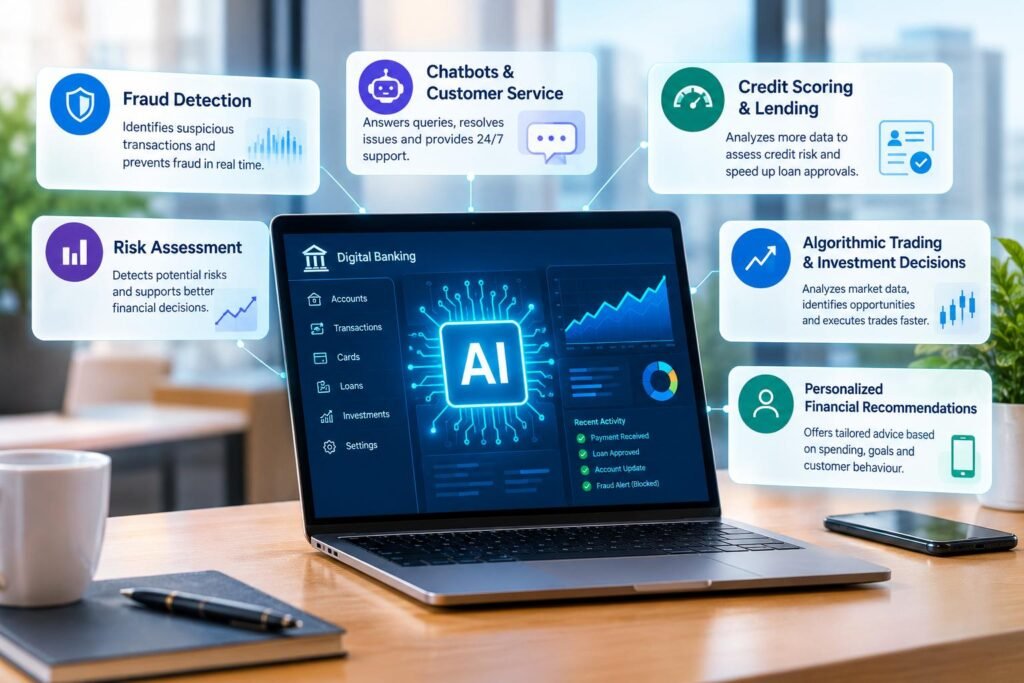
One of the top technologies used today in financial and banking services is Artificial Intelligence (AI). Financial institutions need to move a massive number of transactions, customer information, market data and risk related decisions each day, and the need for speed and accuracy in information processing is even greater. Financial institutions such as banks, insurance companies and investment firms can use AI to sift through massive amounts of data and uncover patterns, automate repetitive tasks, and support human decision-making in their functions. The technology of AI powered fraud detection is one of the most critical applications as it helps financial institutions identify suspicious transaction patterns and possible fraudulent activities more effectively than rule-based systems can. With ongoing advancements in AI technology, its potential applications are growing rapidly, with the possibilities of using AI in customer service, credit scoring, risk management, algorithmic trading, and personalized financial recommendations.
In an era where AI is gaining ground, it doesn’t mean that humans are becoming redundant. Rather, AI systems are now playing more of a supporting role to augment employees, automating repetitive tasks and offering knowledge that would otherwise be hard to get manually. In the banking industry, for example, an automated model could alert risk teams to potential problems before an employee even has a chance to use AI-generated data to gain a deeper understanding of a customer’s financial patterns and suggest a service. AI can also improve the quickness and effectiveness of financial institutions’ response to their clients, as smart systems are not limited by the regular working hours. However, the technology also has several issues related to data privacy, cyber security, bias, transparency and regulatory compliance, as well as human oversight. It’s essential, therefore, for anyone with an interest in the future of financial services to know of the opportunities as well as the constraints of artificial intelligence.
Impact of Artificial Intelligence on Banking
AI is transforming the banking sector by shifting procedures and processes from human to automated, data-informed decision-making. In traditional banking, a lot of the processes rely on employees reading documents, performing checks, providing standard information and evaluating data with standard procedures. Some of these activities can be accomplished much quicker by an AI system, analyzing the structured and unstructured data and finding the patterns within it. For instance, machine learning algorithms can analyze transaction logs to identify patterns of suspicious activity, and NLP systems can interpret customer queries and respond accordingly. Moreover, AI has the potential to assist institutions in predicting demand, pinpointing operational inefficiencies, and aiding in financial planning. The outcome is a banking environment which enables the use of technology that helps employees at various points of the customer and operational journey, but not just in one department.
AI-Powered Fraud Detection
Financial fraud prevention is one of the most useful ways to use AI, as financial institutions conduct millions of transactions that are in need of monitoring for potentially suspicious activity. Typical fraud detection techniques rely on fixed rules, like refusing a transaction that exceeds a certain limit or one that comes from an unusual location. While still practical, criminals are able to evolve their tactics rapidly, making it hard for fixed systems to catch all new tactics. Transaction characteristics, account behavior, device data, location, and other signals can be analyzed by AI to detect activities that are inconsistent with a user’s typical behavior. As the machine learning models ingest more data, they can better detect the suspicious transactions, aiding the financial institution to investigate the transactions more rapidly. Thus, AI can help in fraud prevention and decrease manual efforts of fraud investigation teams.
AI Chatbots and Automated Customer Service
Chatbots with AI capabilities are revolutionizing financial institutions’ interactions with their clients. Chatbots can serve to address common questions on banking websites, mobile apps and other digital channels without the customer having to go to a branch or wait for a human representative to respond. These systems can be used by the customer to inquire about account services, the procedure for transactions, card-related issues, payment information, or banking products in general. With NLP, the best chatbots can understand users’ questions and answer them even if the phrasing differs from the exact keyword. This can lead to a quicker and easier customer service, especially when dealing with non-complex requests, where human evaluations are not needed. Chatbots can also assist employees by processing repetitive questions, and freeing up time for customer service representatives to focus on more complex issues. In some cases, though, if the customer needs to know more about the situation requires help in some disputes or is making a decision with a large financial impact, there could be sensitive situations that need human intervention.
The Role of AI in Credit Scoring and Lending
Another domain where artificial intelligence can shape financial decisions is credit scoring. Credit scoring is yet another domain where AI can impact financial decision making. Lenders have to determine if a borrower is likely to pay back the money on a loan, according to the terms of the loan. This could be heavily based on credit history, income, debts, etc. that are used for traditional credit assessment. AI models have the ability to analyze more data and reveal patterns and correlations among variables that could be useful for credit risk assessment for lenders. This can help to streamline the loan approval process and make the decision quicker. AI can also aid in automated lending platforms by assisting in decision making on whether an application needs to be manually reviewed. However, with any AI-driven credit scoring model, it is essential to monitor and verify the data to ensure it is complete, unbiased, and representative to prevent unfair results. Financial institutions thus have to test their models regularly and ensure that the automated decisions are explainable, responsible and that it meets the applicable regulations.
Risk Assessment and Financial Security.
Financial services are primarily about risk management, and banks and other financial services providers need to be ready for events that may lead to a loss of funds or disruption of operations. AI can bolster risk assessment with the analysis of vast amounts of historical and real-time information. AI models can be used to recognize patterns that are linked to credit risk, market risk, operational risk, and more. For instance, a bank can employ predictive systems to detect alterations in customer repayment behaviors that could signal higher risk of credit. The risk teams can then investigate the situation and take suitable action. AI can also assist with scenario analysis by modeling various assumptions and calculating the impact that changes in economic or financial situations may have on an institution. While AI can enhance the pace and scope of risk analysis, it cannot do this without the oversight of humans. Financial markets and customer behavior can alter unexpectedly, which can cause models to produce unreliable results if the conditions that have occurred since the models were developed are very different from those in the data that the model was trained on.
The Algorithmic Approach to Trading and Investment Decisions
In investment management and algorithmic trading, where speed and the capability to analyze information can make a big difference in determining decisions, AI is also being utilized. Large amounts of information flow into the financial markets from prices, trading volumes, economic indicators, company statements and more. Some of this information can be analyzed by an AI system in a quick time frame and patterns may be missed by an individual analyst if doing so manually. Predefined strategies can then be used to make trades in algorithmic trading systems based on specific conditions. AI can also help investment managers by analyzing investment portfolios, analyzing market trends, and identifying potential investment opportunities or risks. But, algorithmic trading is not always a profit making venture. The whims of investors, the unexpected, the development of the economy and sudden shifts in sentiment all affect financial markets. There can also be a ‘boomerang effect’ as the poor design of the model can exacerbate losses during abnormal market conditions, necessitating controls, testing, monitoring and human oversight.
Personalized Financial Recommendations
Personalized financial advice is one of the most customer-centric uses of AI. Banks and financial service providers can obtain data on the transactions, spending, saving, and usage of financial services by their customers. AI can be used to analyze this data and give more personalized suggestions if privacy protection and consent are implemented. For example, a smart banking app can detect the customer’s purchasing habits and offer pointers on budgeting; it could nudge him/her into saving more or alert him/her to various financial products that might be pertinent. Personalization can be useful as it allows for customers not to have to wade through vast product offerings to potentially get the right products they want. Meanwhile financial institutions have to be able to ensure that recommendations are clear and that they are actually helpful. Customers need to be aware of when automatic recommendations are generated and meaningful control over the collection and use of their personal financial data.
Importance of AI in the Financial Services Industry
There are a number of ways in which AI can benefit the financial sector. The benefit is efficiency, as automated systems are able to perform repetitive tasks at a faster rate than manual systems. This can help to improve processing times, and enable staff to concentrate on tasks that require judgment, communication and specialist knowledge. AI can also help to ensure consistency by analyzing a vast amount of information in the same way each time. The other advantage is the fact that patterns can be detected in the information that might not have been noticed. This can help to prevent fraud, manage risk, provide the basis for lending, analyze investments and serve customer service. Furthermore, AI can be used to streamline banking, providing customers with digital support options and quick responses to common inquiries, even after hours. These enhancements can positively lower operating costs for financial institutions and boost capacity of services. For customers, they can lead to faster decision-making and more personalized experiences, as well as greater convenience in accessing financial services via digital mediums.
Challenges and Risks of Using AI in Banking
While AI has a number of advantages, there are also significant risks that financial institutions can’t afford to overlook. One issue is data quality, since AI models rely significantly on the data they are trained on and run with. Another issue is data quality, as AI models are dependent on the quality of the data they are trained on and run with. The decisions that are made can also be unreliable or unfair if that information is incorrect, incomplete, out of date or biased. Another major concern is privacy as financial institutions deal with extremely sensitive information regarding clients. To avoid the possibility of unauthorized access, misuse or exposure of data, strong security controls are needed. The question of transparency is also one of the challenges. AI models can be complicated and complex, making it challenging to explain them to customers or regulators when they need to understand the decision-making process. Another way that cybercriminals can exploit AI is by trying to trick it. Cybercriminals can also try to trick or exploit the weaknesses of the AI. Governance policies, regular model testing, cybersecurity, regulatory compliance and human oversight are vital for these reasons in financial institutions.
The Future of AI in Banking and Finance
As banks and financial services gain access to more sophisticated technologies and copious amounts of digital data, the contribution of AI in finance is likely to keep growing. The next applications could be even more advanced virtual assistants, better fraud protection, smarter risk models and even more personal financial services. AI could also complement other technologies such as cloud computing, automation, biometric authentication, and sophisticated data analytics, to build more interconnected financial systems. But just buying sophisticated software will not lead to a successful adoption. Skilled, knowledgeable staff who not only grasp financial concepts but also financial technology will be required in the financial sector, and managers will have to set clear guidelines when using AI responsibly. Regulators will also remain integral to the protection of consumer, fairness, security and financial stability in the context of innovation. Institutions that would benefit the most from AI would certainly be those that have technological ability and have high levels of governance and human judgment.
Conclusion
In the banking and financial services sector, AI is transforming the industry by assisting banks with information processing, automating tasks, risk identification, and providing more responsive services. It is used in various applications today like fraud detection, Chatbots, credit scoring, risk assessment, algorithmic trading, customer service, and personalized financial recommendations. These technologies can make things more efficient, help to make better and faster decisions and enable a greater reach for digital financial services to the customer. But AI should not supplant the use of judgment by humans in making responsible decisions. The issues of privacy, cybersecurity, fairness, transparency and regulatory adherence highlight the need for careful design and oversight of intelligent systems. The key to AI’s most valuable role in financial institutions’ digital transformation is to leverage it as a tool to support rather than supplant human decision making. If used responsibly, AI can play a role in developing faster, more efficient, more personalised and more responsive financial services to customers’ evolving needs.
Get more well researched information about AI in banking and financial services here.