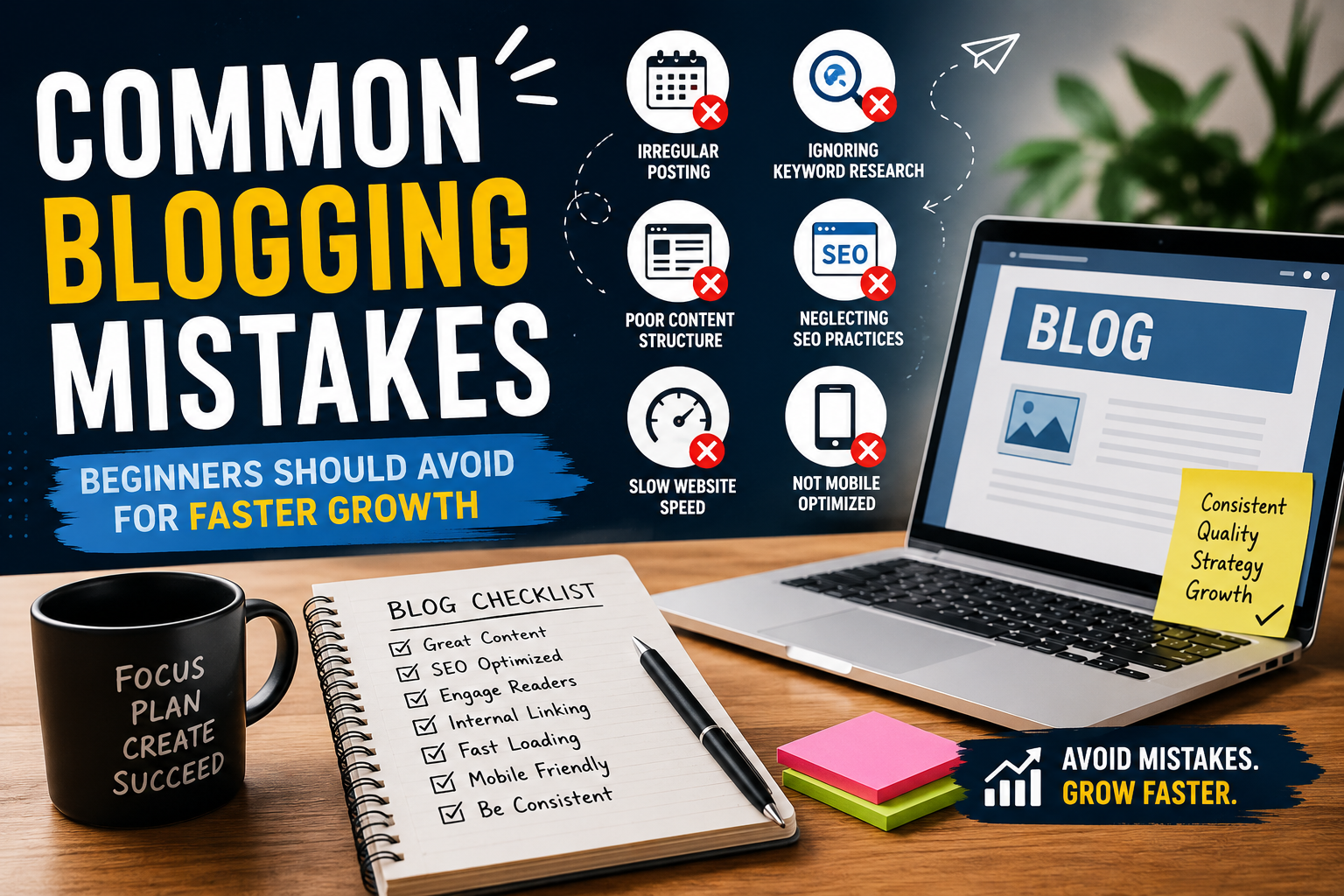
Creating a blog is a thrilling beginning to establish an online presence and to share knowledge and expertise with the goal of making some money. However, many new bloggers start off without a plan in place, which results in unnecessary setbacks that can hinder growth and results. Blogging can be a wonderful tool for drawing readers to your blog and gaining authority, but it is not always easy to achieve the desired outcomes. It needs to be consistent, planned, optimized for search engines, and have a solid grasp of audience needs.
Many people who start their new business go astray without realizing it and end up making a series of errors that hinder their content from achieving its full potential. These can include a lack of a publishing schedule, lack of keyword research, neglect of website performance, and poor user experience. The positive side of the story is that most of these challenges can be addressed once they have been identified.
Understanding the most common blogging errors can help new bloggers save time, enhance their content strategy and speed up blog growth. Bloggers who have a solid understanding of what to avoid and what they can do to improve their chances for success will be able to build a better foundation.
The Importance of Avoiding Blogging Mistakes
Blogging is a more competitive medium than ever. There are millions of articles published every day, and it’s hard for new websites to get noticed. Consistently valuable, relevant, and structured content places websites high in search engine rankings. Readers also want a user-friendly experience along with informative articles that meet their needs and provide answers.
These are some critical mistakes that beginners make while blogging, and if they make these mistakes, they tend to have lower traffic, engagement rates, search rankings, and audience retention. These problems can be fixed early and thereby optimize performance, allowing bloggers to reach their goals faster.
The best way to strengthen your blogging strategy is to know what blogging mistakes are common among blogs that do not achieve successful growth. Understanding blogging mistakes is an effective way to improve your blogging strategy. These lessons will help you create better content, gain more readers, and build credibility in your niche.
Mistake 1: Publishing Content at Irregular Intervals
The most frequent problem with blogs not gaining momentum is a lack of consistency in posting. A lot of novices get going with a lot of enthusiasm and publish articles in short order. This period following the initial postings is, however, marked by less frequent or even nonexistent posting. But this is not consistent, and it undermines readers and search engines as well.
If visitors cannot tell when a website will be updated with new content, they may not return again and again, and search engines are more likely to favor websites that show they are active and that new content is added frequently.
Over a period of time, consistency leads to trust and helps create authority. Having a consistent schedule helps people build up their expectations and makes them come back. Also, search engines are more likely to index sites regularly if they have new articles appearing regularly.
How to Fix It
- Make a logical content plan.
- Make reasonable publishing objectives.
- Queue up material beforehand.
- Do not over-produce; stick to quality and consistency.
- Make use of scheduling tools to automate publication.
It’s much better to post regularly and not take breaks for a long period of time than to post around once a month and then disappear for a month or more.
Mistake 2: Ignoring Keyword Research
The keyword research strategy can be incredibly useful in a blogger’s journey, but it is one of the most commonly made mistakes. It is one of the most common things that bloggers do wrong in blogging.
Obviously, it’s important to have passion; however, blogging success can depend on the content matching the needs of searchers. Even if the articles are well written, they might not be able to generate any traffic because they are written on topics that have either low or no search volume.
Keyword research is used to find out what keywords people use when searching for information. It also uncovers competition levels and opportunities to market to particular audiences. Not doing keyword research can lead to content that does not appear in search results.
How to Fix It
- Use keyword research tools.
- Target keywords that have low competition and reasonable search volume.
- Analyze competitor content.
- Know the search volume and how difficult it is to rank for individual keywords.
- Use keywords in the content in a natural way.
A well-targeted keyword will improve the chances of ranking for it in search engines and bring in targeted traffic.
Mistake 3: Building a Weak Content Structure or Poor Content Organization
If an article is not structured well, readers may become frustrated and not engage with the content. Often, beginner writers write paragraphs without any headings, subheadings, bullet points, or logical structure. Thus, readers struggle to read and comprehend the material.
Most online readers nowadays tend to scan through content and make a judgment as to whether to read it or not. Organized articles allow readers to easily find the information they are looking for and make articles easier to read. Headings also help search engines grasp the content and context of a page.
How to Fix It
- Use clear and accurate H1, H2, and H3 headings.
- Partition content into meaningful parts.
- Use bullets as needed.
- Organize concepts and ideas clearly and concisely.
- Avoid long transitions between sections.
Content structure enhances the user experience and makes articles easier for search engines to understand.
Mistake 4: Lack of Basic SEO Practices
Newcomers to SEO frequently have a misunderstanding about what SEO is. Others think that SEO is too complicated, and some bloggers restrict their SEO strategy to keywords and pass over other aspects. There may be a great amount of traffic that can be diverted to the site, but if the SEO basics are overlooked, the potential for organic traffic will be greatly reduced.
SEO encompasses optimization of content, web structure, page speed, meta tags, internal linking, and user experience. These factors can be the difference between good content that doesn’t rank and great content that does.
How to Fix It
- Make title tags and meta descriptions more effective.
- Use descriptive URLs.
- Add internal links to relevant and similar items.
- Add appropriate image alternative text.
- Enhance the loading time of a page.
- Ensure mobile responsiveness.
With a few simple measures, bloggers can optimize their blogs for search engines and generate more exposure and organic growth opportunities.
Mistake 5: Writing for Search Engines Instead of Readers
There are some beginning bloggers who start to concentrate on ranking more than the humans who read their blog posts. Articles may be difficult to read if they are too wordy, are not written in a natural conversational style, or have repeated wording. Search engines are increasingly favoring content that is valuable and offers a good user experience.
Profitable blogging involves a combination of SEO needs and readership. The content should be able to provide answers to the questions asked, give valuable information, and flow naturally throughout the article.
How to Fix It
- Prioritize reader needs.
- Communicate in an informal, natural, and conversational style.
- Avoid keyword stuffing.
- Concentrate on problem-solving.
- Deliver actionable information.
If readers enjoy your content, engagement rates, as measured by likes, comments, and shares, will go up, which in turn will have a positive impact on search results.
Mistake 6: Not Understanding User Intent
User intent is a searcher’s purpose when searching. There are many bloggers who write on keywords but are unaware of what people are searching for. This can result in inadequate rankings and high bounce rates.
When someone looks up the term “best blogging platforms,” he or she may be looking for comparisons and recommendations, but if he or she looks up “how to start a blog,” he or she probably wants a step-by-step process.
How to Fix It
- Analyze top-ranking pages.
- Identify informational, navigational, and/or transactional intent.
- Provide a format that corresponds to search expectations.
- Provide comprehensive answers.
- Keep content up-to-date to stay relevant.
Knowing what users are looking for allows you to develop content that will meet their expectations as well as search engine requirements.
Mistake 7: Not Considering the Opportunity for Internal Linking
Internal links aid visitors in navigating around a website and spread the website’s authority among its pages. A frequent mistake is not linking content, causing great pieces of content to be lost.
Internal linking helps build website structure, boost page views, and helps search engines find pages.
How to Fix It
- Link naturally to related articles.
- Use descriptive anchor text.
- Create topic clusters.
- Check previously published posts for link opportunities.
- Avoid excessive linking.
Creating links between different pages of a website that are relevant to the content can boost the relevance of a website for its visitors as well as for search engines, which can improve the likelihood of higher rankings.
Mistake 8: Usage of Low-Quality Images or No Images at All
Using visual content makes it easier to read and more engaging to users. Blogs that are not illustrated may not be as engaging and may find it difficult to hold the attention of readers. However, poor visuals can negatively affect credibility.
Images are used where relevant to aid in the illustration of concepts, break up text, and make reading more engaging.
How to Fix It
- If possible, use good-quality original illustrations.
- Compress images.
- Add descriptive alternative text.
- Choose pictures that are relevant to the topic of the article.
- Ensure mobile compatibility.
The use of visual content enhances user experience and search engine optimization.
Mistake 9: Neglecting Website Speed & Mobile Optimization
User satisfaction and search rankings are heavily dependent upon the performance of the website. Users tend to abandon websites if they take too long to load, contributing to this issue. This is because users do not like to wait for content to load, which can lead them to leave the page if it takes too long.
It is also crucial to ensure that the website is mobile-friendly, as many users access it from their smartphones and tablets. Unfortunately, if your website is not mobile-friendly, it can lose users and negatively impact your search visibility.
How to Fix It
- Compress images.
- Use reliable hosting.
- Minimize unnecessary plugins.
- Enable caching.
- Regularly test for mobile responsiveness.
Fast and mobile-friendly websites provide a better user experience and help sustain business growth.
Mistake 10: Quitting Too Soon
The worst blogging error is to think that it will pay off right away. However, many new bloggers give up after a couple of months of low traffic and fail to keep going because they are not seeing results.
Blogs can take anywhere from months to years to make a noteworthy difference and become successful. Organic growth requires time because search engines need to assess the quality, authority, and relevance of the content.
How to Fix It
- Set realistic expectations.
- Concentrate on long-term growth.
- Monitor progress with analytics.
- Celebrate small milestones.
- Ensure that content is continually enhanced.
Successful bloggers are those who persevere and do not give up before they make a success of their blog.
Many bloggers will persist only until their blogging efforts become successful.
Establishing a Solid Foundation for Blogging
There is no recipe for overnight success, but these are some common pitfalls to avoid that will help you increase the odds. Regular posting, targeting the right keywords, optimizing your site, structuring your blog posts, and writing with your audience in mind will lay the groundwork for long-term blogging success.
All successful bloggers make mistakes at some point. The distinction lies in the ability to identify these errors in a timely fashion and to put measures in place to correct them. With an emphasis on continuous improvement and a continuous commitment to delivering value, new bloggers can rise above the typical hurdles and create websites that will draw in readers, drive traffic, and gain value over time.
Frequently Asked Questions
What do you think is the worst thing new bloggers do?
The worst thing you can do is have inconsistent publishing. If you do not update your page’s content regularly, it is hard to gain the trust of your audience and stay visible in search engine results.
Is keyword research crucial in blogging?
Keyword research is vital since it can help you understand what sort of search queries people are entering, which enables you to produce material that will draw appropriate visitors to your blog.
Is it possible to have a blog without SEO?
Some blogs attract visitors from social media or existing users, but SEO is one of the best ways to get sustainable organic traffic to your blog.
How many blog posts should beginners post?
The best frequency comes down to resources, so it is important to have a regular schedule rather than publishing too much.
What is the average length of time it takes a blog to get going?
Blogs can take some time to see noticeable traffic, anywhere from a few months to a year.