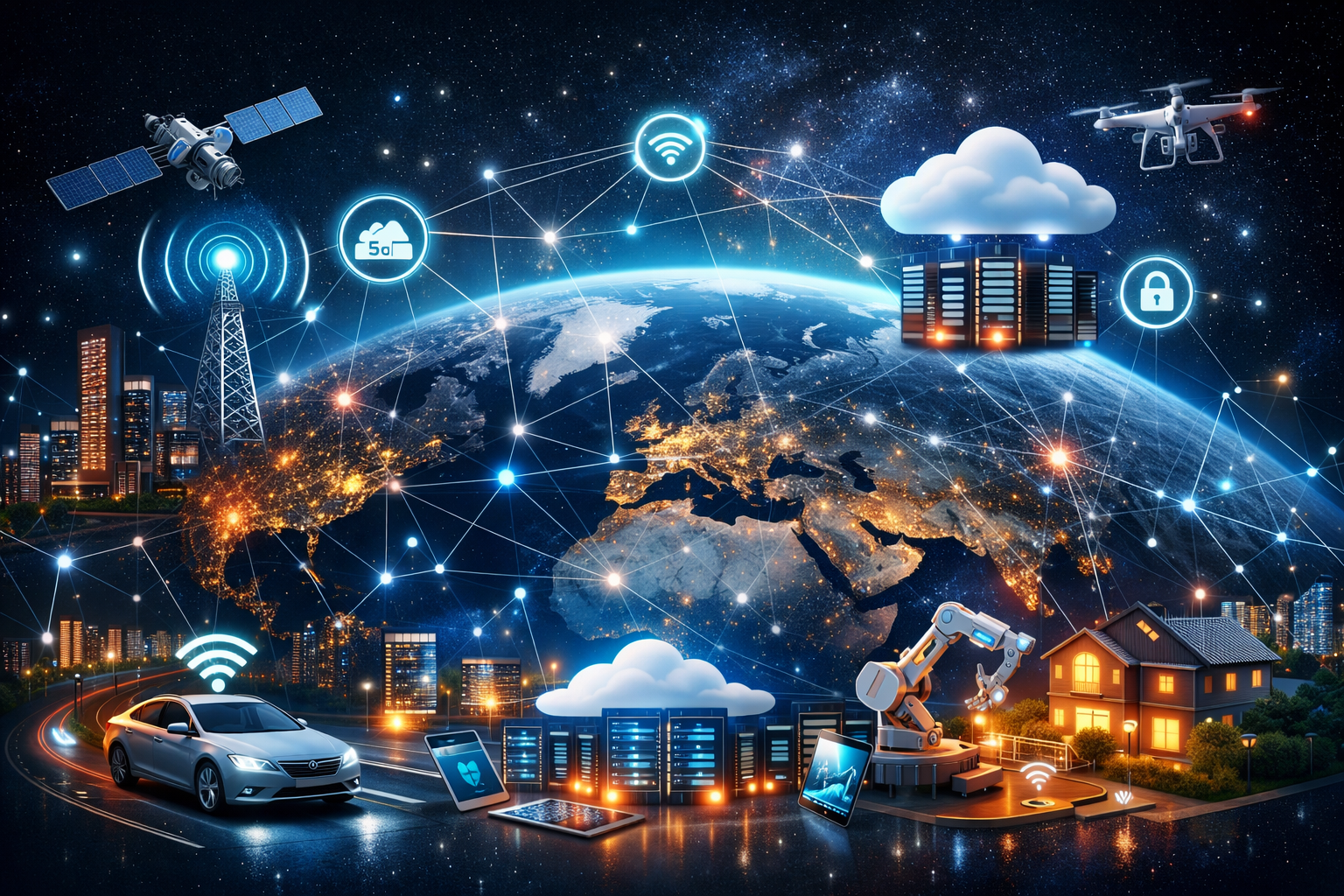
Internet has become not just a network of computers but a complex network of devices, people, and services, which have become interconnected upon the planet. It has transformed communication, trading, education and entertainment in the last few decades. In the future, with new technologies coming to the scene, the experience of the digital world is likely to change. Recent innovations such as 5G networks, Internet of Things, cloud computing, and edge computing will also increase the speed of connectivity, improve service delivery, and create more immersive digital experiences. It is in the light of these trends that we come to understand how the digital life will change in the coming decade given the original concepts of the Internet, which include, decentralization, interoperability, scalability, and accessibility.
5G Networks: Driving Superfast Connectivity
The implementation of the 5G technology is a big breakthrough in the Internet infrastructure. Contrary to the past generations, 5G is not only capable of providing faster download speeds, but it is also capable of being ultra-reliable and low-latency communication. The network is essential to applications where nearly real-time data transfer is necessary (e.g. autonomous vehicles, telemedicine, smart factories, and augmented reality experiences).
This is accomplished by 5G because of three main features: improved mobile broadband, massive machine-type communication and ultra-reliable-low-latency communication. Improved broadband provides higher download and upload speeds, and a type of massive machine-based communication can support millions of IoT devices per square kilometer. The communication is ultra-reliable and low-latency, which minimizes delay to 1 milliseconds, and thus real-time applications are possible.
Effects on Business and Everyday Life
In the case of businesses, 5G will make it possible to have smarter manufacturing due to connected machinery, predictive maintenance, and automated quality control. Real-time monitoring of inventory and one-on-one customer experience will be beneficial to retail industries. Consumers, in their turn, will experience smooth streaming, interactive gaming and more realistic virtual reality experiences.
Healthcare, to a greater extent than any other sector, will benefit significantly. Robotic systems and the use of 5G to connect remotely to the surgery could make remote surgeries more reliable and accessible. The rural zones, which were often poorly served by the older generations of the network, will have easier access to high-quality medical consultations and educational services.
The Internet of Things: Bridging the Physical and the Digital World

The Internet of Things is a method of interconnecting physical devices with the Internet, which can gather, distribute and act on data. IoT devices are transforming the world into a networked space whereby ordinary objects communicate with each other smoothly since smart homes to industrial sensors. This is achieved through standardization of communication protocols, interoperability, and decentralization which are the pillars of the Internet.
The IoT applications are almost in every sector. The sensors are used in smart cities to track the traffic, pollution, and energy consumption to streamline the urban design and enhance the quality of life. The related devices in agriculture monitor the state of the soil and the amount of water applied to it as well as the health of the crops, and farmers are able to make data-driving decisions. Within the healthcare sector, wearables are used to track the heart rates, glucose, and sleep habits and notify relevant medical practitioners when they are required.
The Opportunities and Data Challenge
The IoT devices create huge amounts of data that need to be processed, stored and analyzed. When well utilized, this information will offer actionable data, innovation, and efficiency. Nevertheless, such issues as privacy of data, security and standardization also pose a big problem. Absence of proper protection may leave sensitive data susceptible to cyber-attacks and inconsistent standards may not ensure effective communication between devices.
It is expected that the future will bring more IoT and AI-based analytics development, where a system can foresee trends, automatically respond to them, and allocate resources efficiently with minimum human effort.
Cloud Computing: Infrastructure Economies of Scale in the Networked Age
Cloud computing has emerged as the foundation of the contemporary digital services which provides scalable storage, processing and software platforms in the Internet. With the spread of IoT devices, as well as the production of vast quantities of data, the cloud platform gives the infrastructures to store and analyze it effectively.
Cloud Computing has been Influenced by Innovations
New cloud technologies are serverless computing, hybrid cloud computing, and AI-based cloud computing. Serverless computing enables developers to write without having to be concerned with the infrastructure, and scaling resources up automatically. Hybrid cloud systems are a combination of both public and private cloud, which are flexible, secure, and cost-effective. With the integration of AI, cloud platforms have the capacity to carry out sophisticated analytics, forecast trends, and automate decision-making products, and therefore, data-driven strategies are more readily available to both small and large companies.
Also, cloud computing fosters teamwork due to the ability of employees to access resources anywhere in the world. This has been regarded as more significant as virtual work and remote work become more popular. The companies are also able to roll out global applications in a shorter period of time and can ensure that users can perform uniformly across the world.
Edge Computing: Network Edge Intelligence
Edge computing is a complement of cloud computing because it processes data nearer to their origin. This method minimizes latency, is less bandwidth intensive and allows quicker and safer decision making. Edge computing is especially important to real time applications like autonomous vehicles, industrial automation and remote healthcare.
An example is autonomous cars that use edge computing, which is capable of individualizing sensor data in real-time, creating driving decisions in split-secs without having to wait until cloud servers can reply. Likewise, IoT networks in industrial setting utilize edge devices to track equipment and identify anomalies before they escalate into serious issues and decreases downtimes and operational expenses.
Combining Edge and 5G and IoT
Edge computing can be used together with 5G networks and IoT devices to create very responsive and intelligent systems. The traffic lights will be smart enough to adapt to the conditions of the traffic to minimize the congestion and emissions. Medical devices that are worn can notify in real-time in case of some life-threatening incidences and enhance patient outcomes. This balance of speed, scalability and cost efficiency is provided by processing data locally and analysing it on large scale using the cloud.
Cybersecurity and Privacy: Digital Future Safety
The problem of cybersecurity and privacy is paramount as Internet technologies are becoming more widespread. The spread of IoT devices, cloud solutions, edge computing nodes, and so on raises the vulnerable spots. To ensure that digital ecosystems are trusted, data on transit and at rest must be protected.
New Security Solutions
Zero-trust models, threat detection systems with the application of AI, and blockchain-based data integrity systems are the trends in cybersecurity in the future. Zero-trust networks involve persistent authentication of devices and users on the assumption that there is no automatic trust. AI-based technologies have the ability to spot anomalies in real time and automatically react to threats. Blockchain is a decentralized and inalterable way of enforcing integrity of data, and it is especially relevant to IoT networks with numerous actors involved.
Data protection regulations, including the General Data Protection Regulation (GDPR) in Europe, will still be very influential in safeguarding the data of the user, as well as ethical use of sensitive information.
Thinking about the Next Wave of Digital Experiences
Combinations of spheres 5G, IoT, cloud computing, and edge computing will change the way we experience digital services:
• Hyper-Personalization: AI will be able to analyze IoT data to give highly personalized recommendations, services and experiences.
• Immersive Digital Worlds: Virtual reality and augmented reality applications will be more interactive and have low latency networks and edge processing.
• Smart Environments: Homes, offices, and cities will be made dynamic to meet the needs of human beings in a way that maximizes energy consumption, safety, and convenience.
• Autonomous Systems: Drones, vehicles, and robots will operate on real-time data and be efficient and safe to facilitate new services and logistics models.
The developments will address the physical-digital boundary, which will provide smooth, responsive, and smart life and business space.
Issues and Difficulties
Notwithstanding tremendous opportunities, issues have to be solved:
• Interoperability and Standards: It is necessary to make sure that devices, networks, and platforms are compatible.
• Ethics and Privacy: The gathering of huge data volumes begs such ethical issues that should be handled with care.
• Infrastructure Costs: 5G networks, cloud, and edge node construction, and upkeep are costly to develop.
• Sustainability: Data centers and network infrastructure are high-energy consuming facilities hence environmental impact is one of the main factors to be considered.
Prevention will be important to the achievement of full potential of these technologies as proactive steps, which will include intensified cybersecurity, ethical AI design and sustainable energy sources.
Conclusion: A Revolutionary 10 Years to Come
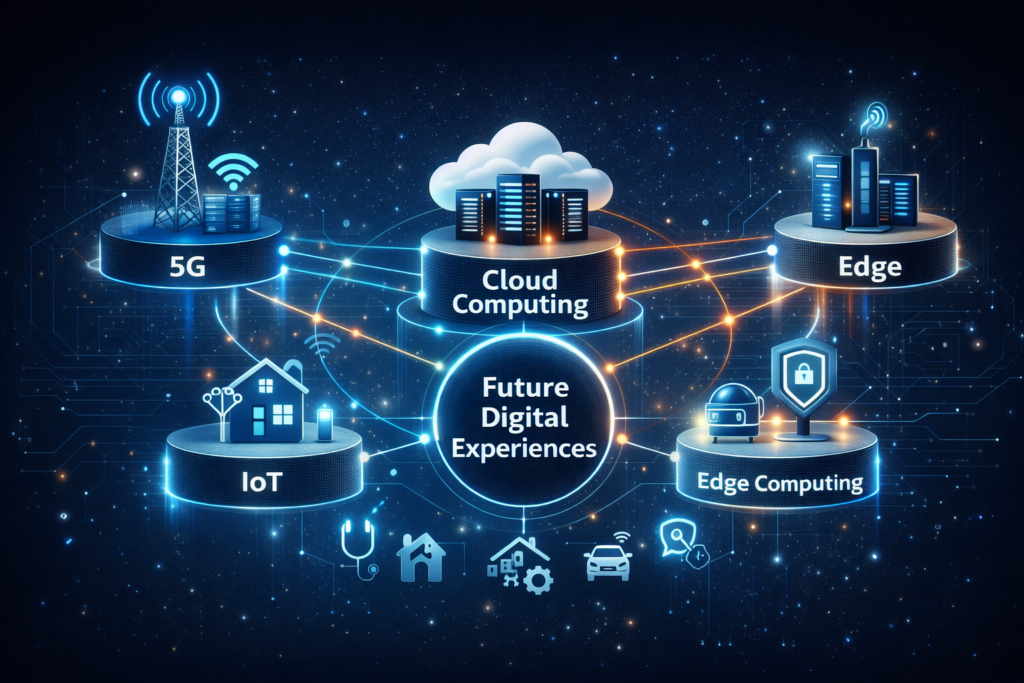
The upcoming decade is set to be the one of the radical changes in the Internet technologies. The 5G networks will be able to provide the speed and reliability required to have real-time connection. The IoT devices will increase the scope of the connected world. Cloud computing will offer scalable data storage and analysis infrastructure, whereas edge computing will put intelligence nearer to the source to make operations quicker and more efficient.
Combined, the technologies, which are based on the principles of the Internet, will transform connectivity, services, and digital experiences. Those individuals, business entities and governments that embrace and know these innovations will be at the forefront in a smarter, faster and more connected world. With planning of the opportunities and challenges, the society will be certain that technology gains improve lives, provide innovations, and designate new dimensions in the digital environment.



Your blog is a constant source of inspiration for me. Your passion for your subject matter shines through in every post, and it’s clear that you genuinely care about making a positive impact on your readers.
Your writing has a way of resonating with me on a deep level. It’s clear that you put a lot of thought and effort into each piece, and it certainly doesn’t go unnoticed.