Picture getting up each morning and seeing your smart blinds automatically roll up with the sun. When you get out of bed, the coffee maker is ready and brews your favourite coffee, and the bathroom is already at a nice, pre-heated temperature. It is not a science fiction film but it is the reality of the Internet of Things (IoT) in everyday life. The Internet has grown beyond the reach of computers and smartphones over the last 10 years—it’s become a part of our real environment. Today, billions of devices are engineered with software, electronics, and network connectivity to gather, share, and manipulate data without the involvement of any humans. This vast array of interconnected objects is reshaping our interactions with our worlds, from household tasks to intricate industrial processes.
To understand this dramatic technological transformation, one must first grasp the basic architecture on which it depends. The system is based on a constant cycle of data gathering, sharing, analysis and response. With a grasp of the fundamentals of IoT, now we can start to imagine how regular items such as refrigerators, street lights, and factory valves can be equipped with a digital voice. This technology is most valuable not in the single smart devices themselves, but in how they can be linked together to create a vast, integrated system that streamlines and automates processes. This network continues to expand at an exponential rate, changing the way we live, live in towns and cities, and even how industries work throughout the world. But the same amount of hyper connectivity also presents unprecedented challenges that society needs to thoughtfully traverse to ensure a safe and efficient digital future.
1. The Core Architecture: How IoT Works
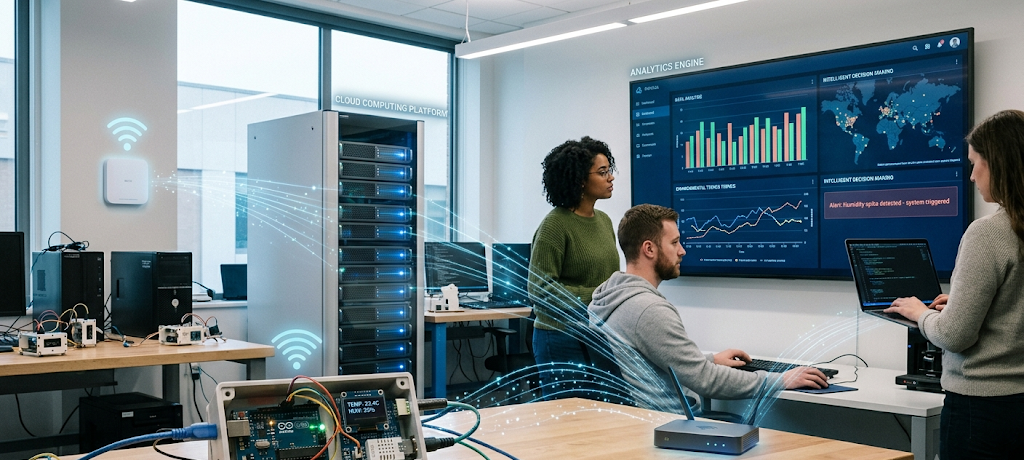
The brilliance of the IoT is based around a four-level highly structured architecture that converts a physical action into a digital insight. In this continuous process, inanimate objects can sense their surroundings, report what they learn, process the information they receive, and then take a desired action based on what they’ve learned. This built-in pipeline is what allows a smart device to communicate with the broader digital ecosystem; without it, it would be an isolated hardware component with no ability to communicate with the rest of the digital world.
Sensors and Actuators (The Perception Layer)
Everything starts on the physical level with sensors and actuators – the sensory organs of the system. Sensors are used to sense and detect physical characteristics from the environment around them such as light intensity, temperature, moisture, pressure, and/or movement. For example, smart thermostats use a temperature sensor to determine when a room is becoming too hot, and autonomous vehicles use LiDAR sensors to map the road ahead. Actuators, on the other hand, are devices which move or control a mechanism or system according to digital signals. If the system decides to act, that can be a switch closure to a water valve or a light bulb being turned dimmer, etc., that’s when the actuator takes the system’s command and performs the physical action.
The Network Layer (Connectivity)
After a sensor gathers data, the information has to be sent to a central system or cloud-based platform for processing, analysis and decision making. The network layer is where this comes in, using a variety of communication protocols that are appropriate for the situation. Technology is commonly used within a home or office for short-range communications, with data transfer rates or low power consumption being the most popular for short-range communications. Cellular networks (4G, 5G) or Low-Power Wide-Area Networks (LPWAN) like LoRaWAN are used for long-range applications, such as tracking shipping containers across an ocean or monitoring agricultural fields. The type of connectivity protocol used will largely be influenced by the range of connectivity required, the amount of bandwidth needed, the cost of the equipment, and available power.
Data Processing (The Middleware Layer)
Once the data has been transmitted over the network, it reaches the processing layer, which is usually located in large cloud data centers or on edge computing units. Raw data from millions of sensors can be huge, unstructured and often messy, necessitating significant computing power to sort, filter and interpret the data. Cloud computing also enables you to analyze data in great depth and retain it for years, which is perfect for uncovering complex trends over time. In other cases, edge computing is employed when there is no time to wait for the cloud. Edge computing moves data processing near the source, either directly on the device, or on a local gateway, to drastically cut latency. This split-second processing is key for time-sensitive applications like turning on the brakes for an autonomous car or closing an overheating industrial boiler.
The Application Layer is part of User Interface (UI)
The last leg of the trip brings the information ready for the end-user via an easy-to-use application layer. It is the part that can be seen, typically in the form of a mobile smartphone application, a web-based dashboard or an automated alerting system. These user interfaces can be used to review live data, receive alerts and manually override automated processes. For instance, a house owner could see a live view of their front porch on their smart phone and a manager at a factory could monitor the working condition of the fabrication line machinery on their desktop dashboards. The application layer is responsible for converting complex data from the backend system into valuable information for human decision-making.
2. The Smart Home: Lifting Everyday Convenience and Comfort

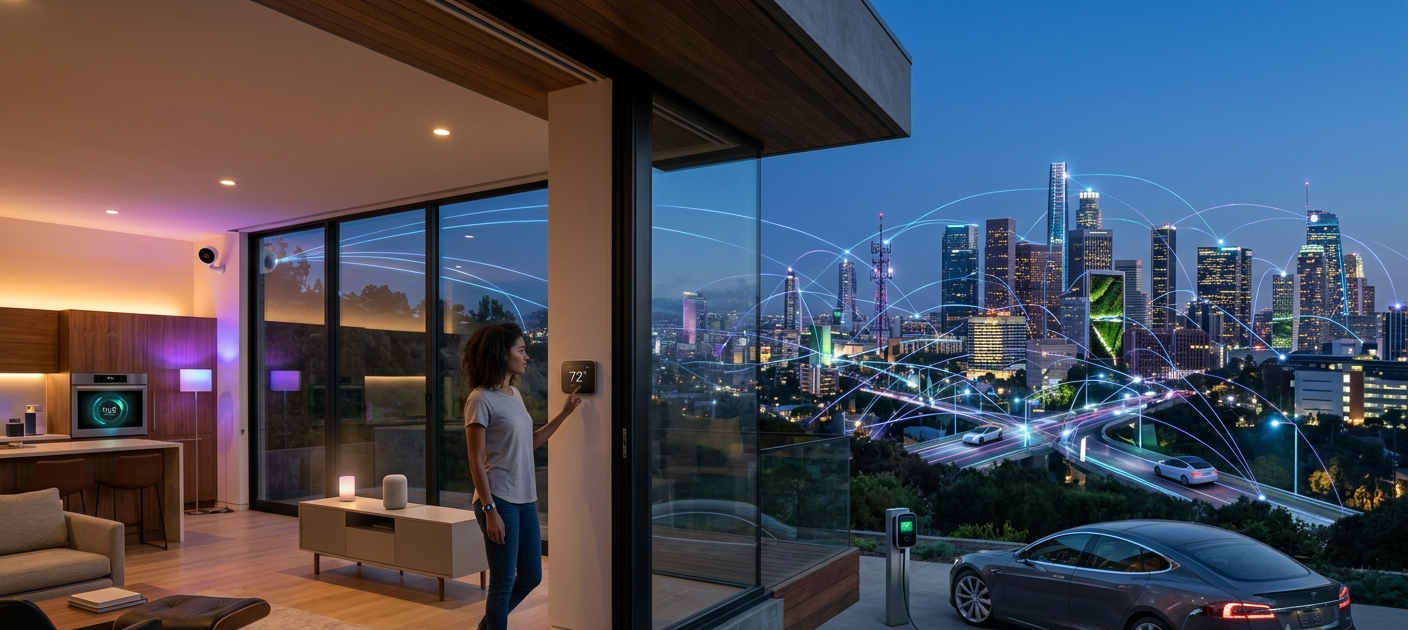
The first and most obvious, and certainly most personal, effect of this hyper-connected revolution will be in our own homes. The traditional home is quickly transforming into a smart home ecosystem where appliances and systems are connected and communicate to optimize comfort, convenience and energy efficiencies. These devices don’t function on their own, but instead learn the habits of their users and adapt their actions to fit the day-to-day life of the residents.
The biggest immediate advantage of a smart home is the significant decrease in home energy loss. Conventional heating and cooling systems operate on a fixed schedule and can cool an empty home, wasting environmental and financial resources. Smart thermostats overcome this with motion detection sensors and geofencing, which can tell when people are gone, and automatically reduce energy usage. Over time these systems learn your behaviour and set the temperature just right when you open the front door. Likewise, smart lighting systems can determine the amount of sunlight available outdoors, and reflect that light into the interior of the building, thereby lowering the light level in the building if there is no one inside to save energy.
In addition to resource efficiency, the use of connected devices can also enhance home security and peace of mind. Today’s home security systems are so much more than just a burglar alarm and include smart locks, video doorbells, and ambient environmental sensors. Homeowners can share temporary digital keys with delivery drivers or guests and be able to check in on high-definition video footage from anywhere in the world. Also, these systems are capable of detecting threats from within: If a gas leak or a burst water pipe were to occur, for example, the integrated smoke and moisture detectors would alert the homeowner’s smartphone immediately, allowing the homeowner to call emergency services right away before the leak or burst water pipe causes serious damage.
3. Smart Cities: Urban Planning and Public Management

The population of cities and urban areas is growing at a rapid pace and is increasingly calling upon the implementation of connected infrastructure to ensure resource management, limit environmental impacts and enhance the quality of life of the inhabitants. A smart city is a city that is equipped with thousands of sensors that are embedded in the city’s public infrastructure, and use the data gathered by these sensors to dynamically adapt to the real-time demands of the city.
Traffic congestion is a chronic problem in cities all around the world, and a problem that comes with a high cost to both economies and wasted fossil fuels. Smart cities address this by deploying sensors directly into roadways and applying intelligent cameras that are used to track the density of vehicles in real-time. This data can be used by adaptive traffic management systems to adjust traffic light durations dynamically to avoid congestion and activate preferential timings for public transit vehicles. Also, integrated parking systems can direct car owners directly to non-occupied parking spaces through a mobile application, saving a huge amount of the time spent circling city blocks, a major traffic problem in urban areas.
4. Industrial IoT (IIoT): Revolutionizing Global Enterprise
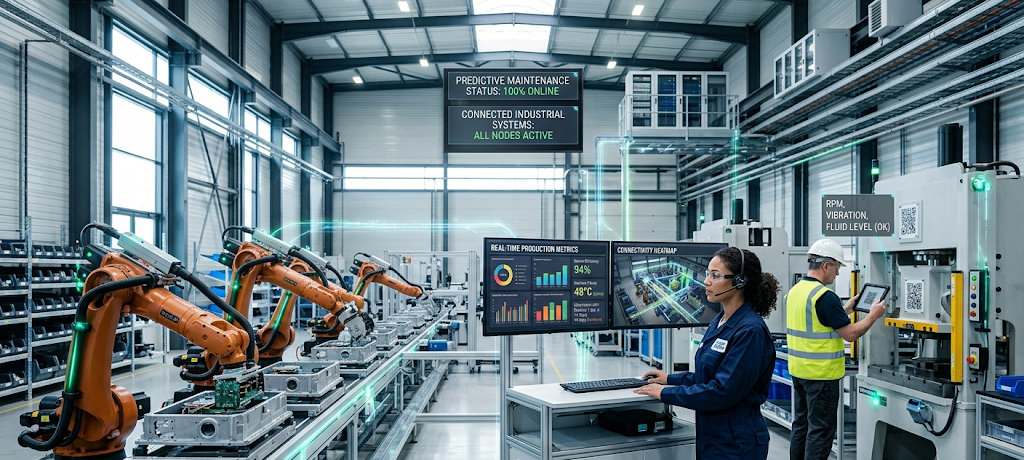
Smart homes and smart cities are obvious in their applications to the public, but some of the most significant changes are going on behind the scenes in the Industrial sector. Known as Industry 4.0, the Industrial Internet of Things (IIoT) is the term used to describe the fusion of today’s cutting edge digital analytics with heavy equipment, supply chains and manufacturing plants to create an unprecedented level of operational efficiency.
In the conventional manufacturing setting, maintenance schedules are reactive or are based solely on calendar cycles, both of which are very inefficient. Reactive maintenance is simply waiting for a critical machine part to fail causing unscheduled downtime and production lines to halt, at an expensive cost. In the case of IIoT, these sensors are embedded directly into industrial machines and equipment, allowing for predictive maintenance. These sensors constantly monitor the condition of the machine, and can sense minute differences between normal operating conditions and operating conditions that are beginning to experience wear and tear, well before the machine fails. This enables the factory managers to arrange factory shutdowns for maintenance, thus avoiding the cost of emergency repairs and lost production of millions of dollars.
5. How to Handle the Challenges of Being in a Connected World
While the explosion of connected technology has unquestionably powerful benefits, it also presents a complex set of challenges that need to be overcome in order to safeguard consumer privacy and the resilience of the system. Unlike software products, these devices are meant to interface directly with the physical world, so the impact of software bugs or design vulnerabilities or cyber attacks is not limited to data breaches, but can pose physical threat to users.
Cybersecurity and Privacy Risks
The greatest threat to the ecosystem in this day and age is cyber security. A number of consumer smart gadgets don’t have any built-in safety measures, contain hardcoded factory passwords, use out-of-date firmware which can be difficult to patch, and transmit data via unencrypted protocols. Cybercriminals can be using these vulnerabilities to break into personal networks, make devices into botnets for big cyberattacks or to spy on private areas by using compromised security cameras. The walls of privacy are thin, and the more that microphones, cameras, and tracking sensors are added to people’s homes and workplaces, the greater the need for strict security measures, such as end-to-end encryption and mandatory multi-factor authentication, from the manufacturers.
The Interoperability Crisis
One of the other key challenges to the full realization of connected technology is the absence of universal interoperability. Currently, there are multiple competing proprietary ecosystems built by different tech giants in the marketplace. A smart bulb from one brand could not communicate natively with another hub’s brand, resulting in a frustrating web of individual applications and bridges for consumers. Seamless plug-and-play interoperability between brands, industry and legacy hardware systems is a challenge, as well as cross-industry standards such as Matter are making gains in harmonizing smart home protocols.
Handling Large Quantities of Data and Storage
The amount of data that can be generated from billions of devices that are continuously transmitting is massive and poses a significant infrastructure challenge. To store, process and analyze these petabytes of data generated every day, a tremendous amount of computing power and storage space is needed, which increases the cost of operation and energy consumption in data centers. Efficient filtering out of irrelevant sensor data and only extracting the relevant data insights from the sensor readings requires the use of advanced artificial intelligence algorithms. As the network scales out globally, creating sustainable data pipelines where the maximum value is obtained with minimal strain on network infrastructure is one of the biggest challenges that engineers will face.
Discussion: Progress and Security
The hype around IoT has since died down and the technology has become one of the basic components of today’s global infrastructure. It has created an unprecedented new way to connect the physical with the digital, resulting in endless possibilities to enhance personal convenience, optimize municipal resources and streamline complex industrial processes. Whether in the home or in the factory, the power of connected data is indisputably making our world smarter, more automated and more responsive to the needs of the human being.
But, the path to a fully connected future involves careful and deliberate balance between speedy advancement of technology and strong digital security. With the physical world increasingly connecting to the web, cybersecurity, interoperability, and data privacy are vital concerns for manufacturers and policymakers alike. Setting security requirements and creating open and cooperative environments will enable society to confidently participate in this technological revolution without compromising private data and infrastructure.