
Introduction
Artificial intelligence is having a big impact on the banking and financial services industry, helping banks and financial institutions to process and analyse information faster, automate repetitive tasks, enhance customer experience, and make informed financial decisions. A lot of financial transactions used to be manually reviewed, had rules applied and were handled in a very cumbersome way. In this day and age of technology, for banks and insurance companies, fintech companies, investment companies and payment providers, the processing of a large volume of data, identification of trends and adaptation to the evolution of customer needs is much faster than what AI can do for humans. By using predictive analytics, financial institutions can make predictions based on the data from the past and present to anticipate potential threats and make more informed decisions. With the high competition in the market and the demand for easy digital services, AI can be used to enhance business operations, boost security, and create new financial products.
Utilizing AI in the Financial Sector
AI is a kind of computer systems that can perform many functions normally human beings can do, like pattern recognition, understanding of language, reasoning and learning. Not all of the AI technologies are the same, or do the same thing, but are part of the transformation of financial services. By using machine learning, systems can learn from previous data to make better predictions, without having to program for all the possible scenarios. In customer service, NLP can be applied to crafting chatbots that are able to read and understand a customer’s question to communicate with customers. With the help of NLP, Chatbots can understand and understand customer language, helping to address customer questions. Predictive analytics involves using statistical techniques and historical data to predict future events, like loan defaults or customer actions, and fraudulent transactions. The Generative AI can generate text, summaries, explanations and more that can be utilized for tasks such as generating reports, answering customer questions etc. If implemented properly, these can help financial institutions transform complex data into a simple-to-understand entity and minimize repetitive tasks and decision making.
Transformations with AI in different Financial Services
In the banking industry, AI is revolutionizing the everyday work of both the institutions and their clients by improving their personalized services and daily operations. By implementing AI chatbots and virtual assistants, users can receive responses to their banking inquiries, such as checking their account balance, viewing their transaction history, getting details on how to make payments, and banking services without having to wait for a human representative. This saves human agents time to attend to more intricate customer questions. Machine learning systems can likewise review paying routines to discover odd activities, suggest proper sparing techniques, and also offer customized economic insights. Within the banking sector, AI can be used to handle paperwork, classify transactions, screen applications, and facilitate regulatory reporting. For example, automatic systems can capture information from the documents submitted, and highlight missing information before someone has completed the review. These applications can help to cut down administrative costs and enhance services’ speed. However, banks have to ensure that the automated answers are accurate, that the information for their customers is protected and that customers have the ability to contact a human representative when it is necessary for them to do so.
Insurance Companies and AI
AI is used by insurance companies to enhance underwriting, claims processing, customer service, and fraud detection. The role of underwriting is to measure the risks of an insurance policy and set the premium, which can be achieved by assistance from AI systems that can analyze relevant data and make more accurate predictions about the risk. AI can also accelerate claims processing by extracting data from forms and organizing the documents for claims, and identifying claims needing to be opened for additional investigation. For instance, if you do have a photograph of the damage to the vehicles submitted, then image recognition can be utilized to evaluate the damage, however, other more complex cases can still require a hands on inspection. Another way AI can help identify fraudulent claims is by spotting inconsistencies in the information that is submitted, such as discrepancies in the number of incidents reported, historical data, and other factors. These abilities enable insurance firms to control spending and make speedy choices for their customers. Insurers however should not discriminate, especially when relying on algorithms that are derived from older data – which could have some type of bias. Human intervention in the application, a transparent decision making process, and a clear coverage decision process are important, so customers can be confident in the coverage decisions made.
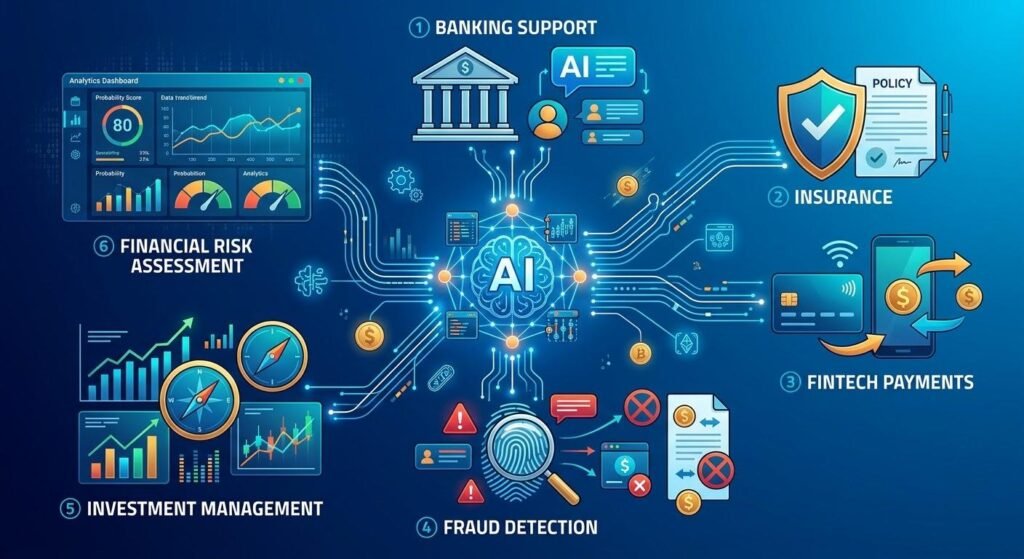
How AI is reshaping the Fintech and Payment Sector.
AI is being leveraged by fintech companies to create digital financial products, streamline processes, and enhance access to financial services. Digital lenders could use allowed financial data to aid credit evaluations, and personal finance applications could classify expenditures and educate users about their financial behaviors. AI is deployed by payment providers to monitor the transactions, identify unusual buying patterns and identify potentially fraudulent payments. These can process the amount of each transaction, where it’s being used, how often and other signals and set up to trigger additional verification. Machine learning models are not rule-based and can learn from the data and identify more complex patterns. This can help enhance fraud consciousness and lessen application disruptions. Occasionally the predictions are incorrect, causing disapproved transactions, and incorrect flagging of customers. Financial technology companies thus need to constantly review their business models, ensure that there are appropriate dispute resolution processes and safeguarding for personal data obtained via their platforms.
AI in Investment and Wealth Management
AI is helping investment firms to interpret market data, assess financial assets, analyze investment risks and make investment decisions. Historical prices, company data including financial statements, economic indicators and more can be fed into machine learning models to recognize patterns that could affect the investment performance. Market movements can be estimated through predictive analytics, but this isn’t done with a certainty. AI-powered investment platforms can also help with portfolio management by detecting asset allocation shifts and alerting investors to possible related risks. These technologies can be employed by wealth management providers to make recommendations to a customer that are based on their financial goals, investment time horizon, and risk tolerance. Furthermore, generative AI can be used for summarizing research reports and earnings announcements, aiding professionals in efficiently reviewing extensive data. While these benefits exist, AI cannot remove uncertainty from the markets or take the place of good investment decisions. Human expertise is still needed because of the unpredictable nature of market conditions, as they can rapidly shift due to economic shocks, political changes and unforeseen events.
Advantages of Artificial Intelligence in the Financial Sector
AI helps to boost efficiency one of the significant advantages. By automating repetitive tasks, financial institutions can speed up the application processing, document review, handling of frequent customer queries, and transaction monitoring. This can help save administrative expenses, and let employees concentrate on more complicated cases that call for professional judgment. One of the benefits is enhanced fraud detection. AI systems can constantly monitor transactions and detect suspicious activity that may not be spotted by traditional methods. Personalization is also gaining importance as financial institutions have access to data from the individual that can be utilized for making relevant recommendations, alerts and services. Additionally, AI can assist in risk management by providing institutions with an accurate prediction of credit risk, tracking financial exposure, and identifying new risks. A reliable, well-supervised system can provide these benefits and enhance customer satisfaction and business performance. But that isn’t the end of it – the results are contingent on the quality of the data, the right technology, and effective implementation and monitoring.
Limits to the Use of AI in Finance
While AI has its advantages, there are significant challenges it poses to financial institutions. Privacy is a significant issue as AI algorithms can access sensitive data, such as transaction records, identification documents, and financial transactions. It is vital that organizations secure this information by implementing the proper security measures, access permissions and good data management practices. Algorithmic bias is another challenge. Automated decisions can result in discriminatory outcomes if the training data is biased or lacks certain groups. Lending, insurance and investment services, for example, may have discriminatory outcomes if the training data is biased or lacks certain groups. AI systems can also be prone to mistakes or misinformation, and underperform under shifting financial conditions. Implementation costs can be high, as skills are required in the institutions, reliable infrastructure, integration of the system and continued model evaluation. The financial organizations are also subject to data protection, consumer protection and financial regulations. Good governance, impartial testing, human oversight and transparency over the responsibilities are therefore essential to ensure that AI applications are safe, fair, and reliable.
The Future of AI in the Banking and Financial Services Sector
More financial services in the future will be digital, automated, predictive and generative AI will be integrated. AI assistants could be used more frequently to enable customers to interpret spending habits, research financial products, arrange their budgets and finish routine tasks that have been approved. More complex systems would be able to orchestrate multiple actions of a financial transaction, obtaining information, processing a payment, or asking for approval from the customer before taking the action. Financial institutions can also use transaction monitoring and enhanced digital identity verification to enhance their real time fraud detection. In the interim, generative AI may assist with summarizing lengthy documents, creating reports and finding pertinent information within the organization. But for wider use, there will need to be robust cybersecurity, effective human oversight, unambiguous policies and regulations on automated decision making. Institutions that have the mix of technological innovation and responsible governance will be more likely to provide greater service quality while not hurting customer trust. The goal should be to augment, not supplant, human ability with AI, not to take human accountability away from critical financial decisions.
Conclusion
AI is changing the way the financial sector and the banking industry works, making it more efficient, customer-friendly, fraud-proof, risk-assessment accurate, insurance more effective, payment safer, and investing more intelligent. In the era of machine learning, NLP, predictive analytics, and generative AI, financial institutions can now efficiently handle the vast amounts of information data and create more responsive services. Despite this, privacy issues, algorithmic bias, adoption costs, cybersecurity risks, and regulatory obligations must be taken into account to achieve a successful adoption. The role of the human element is especially significant in the process of credit access, insurance coverage, investments or other critical financial services. With the emergence of newer and advanced AI technology, financial institutions have a balance to strike between efficiency and innovation, fairness, transparency, and accountability. By being mindful of AI usage and rigorously testing its effectiveness, banks and other financial service providers can create financial systems that are more secure, accessible, and customer-centric, adapting to the changing economic climate and customer needs.
Get more well researched information about Artificial Intelligence in Banking and Financial Services here.