Introduction
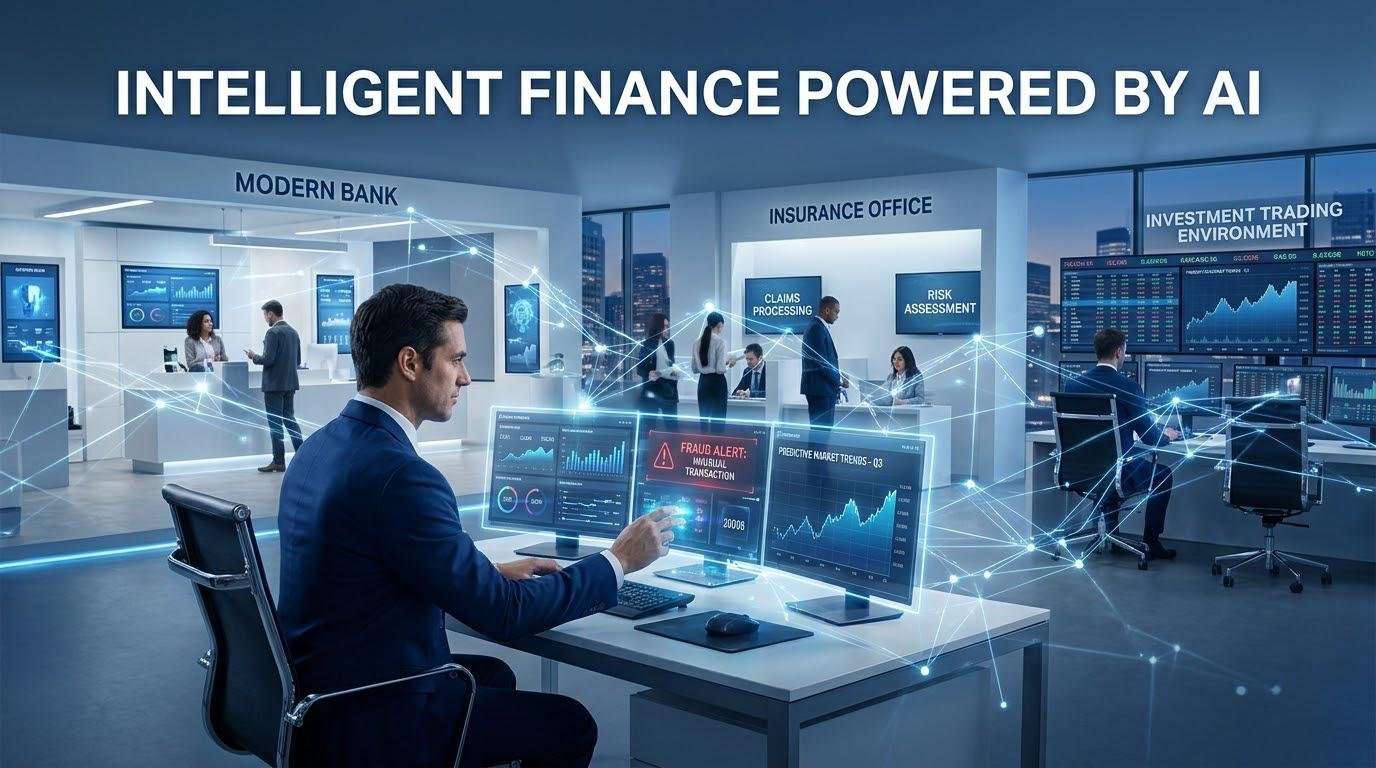
In the financial services industry, AI is proving to be a key factor in creating new ways to manage accounts, manage insurance claims, and navigate the financial markets. Many Finance processes are routinely manual, with standardized processes and lots of staff required to gather data and make decisions. The use of AI technology brings in systems which can deal with vast amounts of data, recognize patterns, automate repetitive duties and facilitate quicker decision making. As financial institutions strive to meet the challenges and opportunities of digital transformation, the adoption of AI in finance becomes increasingly significant as a crucial element of this journey. AI is putting the tools to work for real-world problems in industry, from fraud detection to assisting investment analysts. But for it to be implemented effectively, there needs to be reliable data, responsible governance, appropriate security measures, and human oversight to ensure that decisions that are made automatically remain accurate, fair and accountable.
Artificial Intelligence and its Applications within the Financial Industry
AI is the ability of a computer system to carry out tasks which usually need human intelligence, such as learning, reasoning, recognizing patterns, understanding language and creating content. In the financial industry, there are a number of relevant AI technologies. Using machine learning, computer systems can predict things that they learn from previous information, and improve as they get more data. Predictive Analytics: Using statistics and data from previous periods to forecast what is likely to happen in the future, such as predicting customers’ behavior or defaulting on loans, or forecasting market trends. Generative AI can create copy, generate a summary of financial information, clarify complex information and assist employees in locating and documenting information. AI agents have the capability to perform these capabilities in a series of steps, such as gathering information, checking, and generating a report, towards a set objective. These technologies may work together, but they are different in their application and controls are needed to make sure that the outputs are reliable.
The Effects of AI in Banking
Fraud Detection & Financial Security
The number of transactions processed through banks by mobile and payment cards, Internet banking and electronic transfer systems is enormous. It is becoming harder to manually detect fraud due to the rising amounts of fraud and fraudster sophistication. The transaction data, location, transaction history, and device data and spending patterns can be analyzed by machine learning systems to identify unusual activity. For example, if you buy a significant quantity of cash from a spot you don’t know and the device you’re utilizing is not familiar, you may need to be verified again. Predictive models can also aid banks in detecting new fraud trends in advance of losses resulting from them. These properties could help to accelerate the fraud monitoring process and help security teams prioritize suspicious activity. However, AI systems have the capability to trigger false alarms or miss new types of fraud. Banks must have automated detection of transactions that require more attention, have secure authentication of these transactions, test them periodically and investigate the transactions by humans when the transactions are called for closer scrutiny.
Evaluate Credit Risk and Determine Credit Decisions for Loans.
The purpose of a credit risk assessment is to help a bank determine if its borrowers will be able to repay their loan. Some of the common considerations include your income, debts, work history, payment history, and credit history. These and other legally permissible and relevant data, if provided to AI, can then reveal patterns that can be used to predict repayment problems. Predictive analytics will only give lenders a best guess on the likelihood of default, and machine learning can help identify relationships between variables that standard assessment methods aren’t able to. These tools can enhance the efficiency and uniformity of loan evaluations, which can help financial institutions evaluate loans more quickly. However, for credit decisions, models must be carefully crafted as faulty or biased models can unfairly discriminate against some customers. Historical data may show inequalities that already are in place and seemingly unproblematic variables may be an indirect indicator of a protected characteristic. Banks should use models to identify unfair outcome, articulate the reasons why a person may have received an adverse outcome and implement a human review process to allow customers to appeal where a model has identified that an error has been made.
Customer Service and Intelligent Chatbots
The role of the customer is transforming with the use of AI chatbots and virtual assistants in banks. Customers need not wait when they need to get information, simply because a representative is available, but can utilize digital assistants to check their account information, understand the status of their transactions, request information regarding banking products, and get information about procedures to perform as a routine. These systems can understand common queries using natural language processing and generate conversational responses using generative AI, based on approved content. These services can be offered after hours, helping to minimize customer service personnel workload and wait times in banks. More sophisticated systems can route more complex inquiries to the right person if it is not possible to help with an automated system. But, if the safeguards are lacking, chatbots can misinterpret questions, provide incorrect responses, or mishandle sensitive information. Financial institutions should ensure that automated assistants are clearly identified, that customer information is adequately protected, that crucial information is verified, and that there are easy ways to access human assistance, particularly in case of complaints, disputed transactions or complex financial decisions.

AI in the Insurance Industry
Help in Preventing Fraud and Process Claims
These are cases of auto accidents, property damage, medical costs, travel disruptions, etc. that pertain to insurance events. These claims could necessitate the review of forms, photos, invoices, policy documents, and other evidence by employees. AI can automate this process, pulling information from documents, verifying the claims against the policy conditions, ensuring there’s not missing data, and routing simple cases to the existing workflow. AI can also be used for image recognition, which could help in evaluating vehicle damage from images and predictive models that could alert claims that need to be investigated. The applications can minimize administrative bureaucracy and improve insurers’ resource allocation. Generative AI can also summarize claim histories and preliminary communicate to workers for review. However, an algorithm should not be a barrier to claiming a system that rejects a claim because of an unusual pattern. Misinterpreting documents, not having the proper evidence or strong signals of fraud may result in an unfair decision.
Making Better use of Risk Assessment and Customer Service
In order to ensure the financial stability of insurance providers and to determine premiums, they need to evaluate the risk of future claims and how much they could be worth. Historical claims, relevant environmental data and other data that is permitted and relevant can be analyzed using predictive analytics, to help understand the changing pattern of risk in insurance. For instance, weather data can be utilized by property insurers for flood and storm exposure and weather, driving and other relevant data can be used by motor insurers, if permitted in law. In addition, AI can be used to identify customers that could benefit from a policy review, provide answers to frequently asked questions, and sort policy documentation. These are all applications that can facilitate better operations and enable insurers to respond to customers sooner. But gathering such personal data raises privacy issues, and less-than-sound pricing structures can lead to inequities among customers.
AI’s Role in Investment Firms and Financial Markets
Provide Investment Research and Portfolio Management Services.
The price of the economy, financial statements for companies, earnings announcements, industry news and economic prices are some of the key factors that investment firms have to consider before making an investment decision. By analyzing these various information sources, AI can help analysts identify trends, make comparisons among companies, and research investment opportunities faster than they can manually analyze and process the data. Historical market data can be analyzed by machine learning models to predict future price changes or to find patterns in financial data. Generative AI can provide an analysis summary of long reports, pull out significant numbers, and generate initial research briefs for analysts to review. Predictive tools can also be used by the portfolio manager to evaluate the risk exposures and to compare the possible investment strategies. But, there are risks in financial markets, from unexpected events, investor sentiment change and economic conditions that the history data can’t fully predict. AI predictions are thus not predictions but only probabilities. Prior to any investment decision, or any product recommendations to any client, investment professionals are required to verify information, evaluate the limitations of models, and perform basic analyses.
Algorithmic Trading and Risk Management
Algorithmic trading involves using computer programs to trade based on a set of rules that have been developed prior to the trade and specific market conditions or quantitative strategies. AI can assist these systems by interpreting various factors such as price movements, liquidity, trading volumes, and more to aid in spotting opportunities or adjusting execution strategies. Automated systems might react quicker to market shifts than manual systems, which can enhance the effectiveness of trades. Automated systems can react faster to market changes than manual systems, which can enhance the efficiency of trades. AI can also help investment firms track portfolio concentration ratios, assess potential losses, and detect abnormal trading patterns. But swift automated decisions can escalate losses in the event of a model failure, data inaccuracies or sudden shifts in market conditions. A number of systems responding to the same signals can also help drive the volatility in the market. Investment companies need to set trading limits, have emergency shutdown protocols, keep an eye on the performance all the time, and test strategies in various market scenarios. Market volatility increases or automated decisions result in unanticipated exposures, and human supervision matters even more.
Artificial Intelligence in Regulatory Compliance and Financial Reporting
Financial institutions are regulated by regulations to guard against money laundering, consumer protection, proper record keeping and to ensure financial stability. Compliance departments look through customer records, transactions, correspondence and regulatory documents to see if there are any violations. AI can help in tracking transactions for any unusual activity, managing massive volumes of documentation, flagging inconsistencies and summarizing regulatory changes. Employees can leverage data from internal reports or search through approved collections of documents using Generative AI. AI agents can streamline multiple tasks, including gathering information, verifying the availability of necessary documents, and even setting up cases with compliance officers. These can help to minimize repetitive administrative tasks and shift focus to higher-risk activities. However, an AI-generated alert will not automatically constitute an instance of wrong-doing and an AI summary might not include significant information. Institutions need to keep audit trails, validate audit results, keep confidential information secure, and have qualified staff making meaningful compliance determinations and completing reporting requirements.
The Hurdles and Dangers of AI use in Finance.
While the benefits are apparent, there are also risks that financial institutions need to take seriously with the implementation of AI. Risks associated with data privacy are significant as AI systems can be dealing with sensitive information such as account records, identification documents, transaction records, and financial conditions. Failure to properly manage access to the data or sharing the data improperly can make the customer vulnerable to security incidents. Another challenge is inaccurate outputs, especially if generative AI generates believable, non-backed up answers or provides false financial data. Incompleteness in training data or historical discrimination may lead to bias, such as in the case of lending, insurance pricing and customer treatment. AI systems can also be complex and can be hard to explain, making it difficult for the customer and regulators to understand how some decisions were made. Furthermore, AI systems could have vulnerabilities that could be exploited by cybercriminals. Also, cybercriminals might be able to manipulate information provided to automated systems. To mitigate these risks, financial institutions must have strong cybersecurity measures, practices of data minimization, independent testing, accountability, and regular performance monitoring and evaluation. They should also make sure that their workers are aware of the situations where they need to verify AI outputs, but not take them at face value.
Human Oversight and Responsible Implementation
The deployment of AI is not just about acquiring software or automating tasks, it’s about making it a reality. Financial institutions have to develop clear policies designating tasks so AI can perform independently, tasks that require approval by a financial employee, and those that should be supervised by a financial employee. Some of the administrative tasks may be automated more, whereas other tasks such as loan disputes, significant investment decisions and insurance claims may be better suited to a more detailed assessment by a professional. Staffs are to be trained on interpreting AI output, spotting mistakes, safeguarding confidential information, and spotting bias. Additionally, institutions need to assess vendors, test models before implementing them, track changes in performance over time and have processes in place to address errors in the models. Responsible implementation means keeping track of actual results, and not simply assuming that automation equates to better results for every process. The opportunities for innovation are shared with the ability to balance the tech with professional judgment, transparency in governance and robust customer protections.
Conclusion
AI is reshaping financial services, with its ability to identify fraud in banks, credit risk evaluation in financial institutions, and customer support in banks; it’s also boosting the efficiency of insurance claims processing and boosting financial markets analysis for investment firms. Different capabilities of machine learning, predictive analytics, generative AI and AI agents can enhance information handling, automate repetitive tasks and help to make informed decisions. The use of these technologies, if applied correctly, can help to decrease administrative burden and improve risk monitoring. Misaligned outputs, biased decision making, privacy concerns, cyber security issues and over-leveraging automation, however, are still very much an issue. To make the most of AI innovation, financial institutions need to integrate with robust data, robust governance, clear processes, and human oversight. As organizations continue to explore and implement AI technologies, the future of finance will rely on the responsible and effective use of AI to enhance services, safeguard customer information, and foster trust within the financial sector.
Get more well researched information about AI adoption in finance here.



I appreciate that your post includes context instead of jumping straight to conclusions. Thanks for sharing it; I will be checking out more of your posts.
I enjoyed the calm and conversational style you used to discuss these ideas. Keep publishing content like this because it really helps curious readers.
I enjoyed the calm and conversational style you used to discuss these ideas. I hope you continue adding posts with this level of care and detail.
This was one of the more useful explanations I have found on this subject. I am glad I found this website and will stop by again.
Your introduction caught my attention and the rest of the post kept me reading. I am glad I found this website and will stop by again.