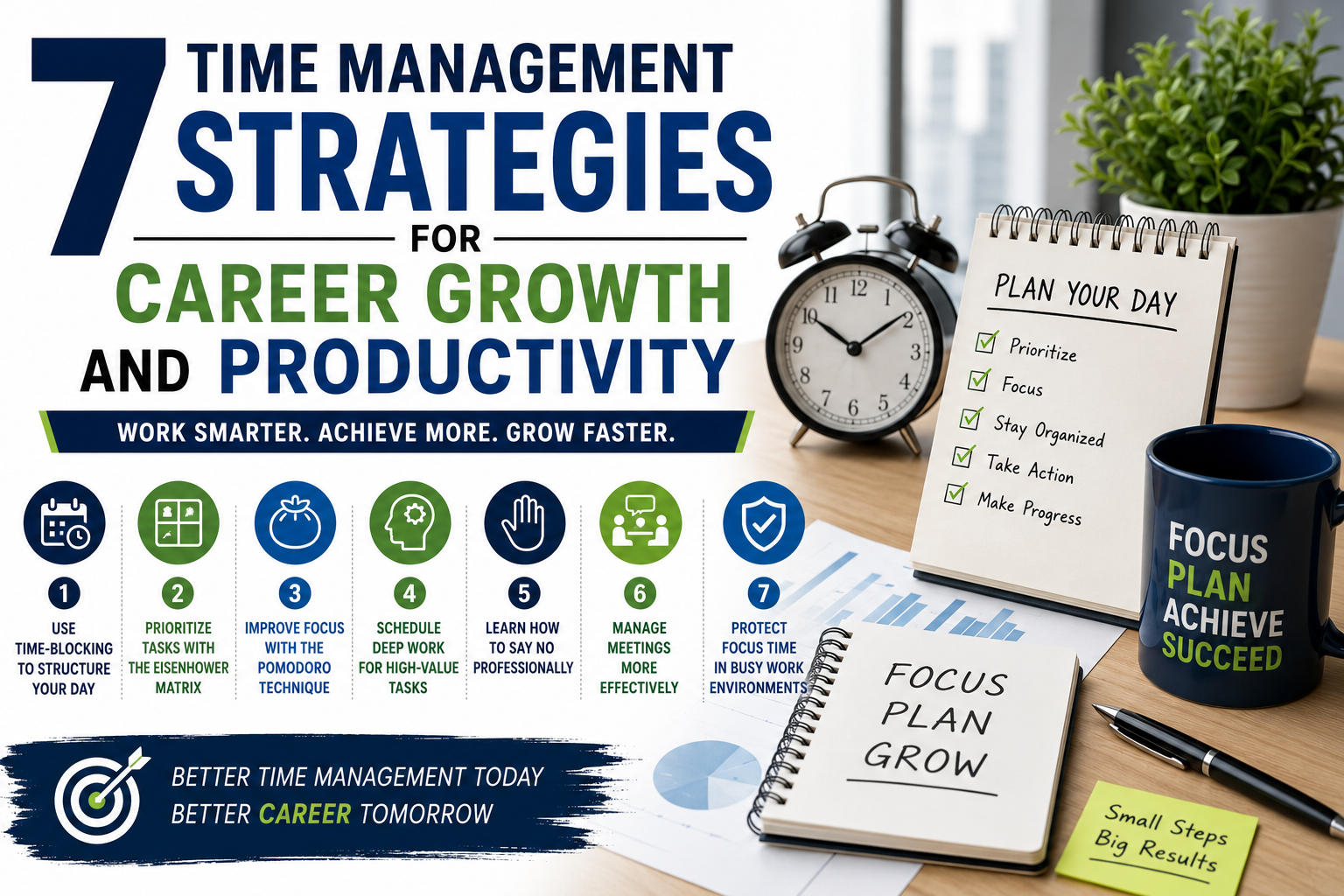
Being busy is often equated with being productive in today’s work environment. Most people spend hours of their day answering emails, meeting with clients, and responding to urgent requests, only to realize at the end of the day that the most important piece of work is not completed. The importance of effective time management has emerged as one of the most sought-after skills in the workplace, as employers will always give credit to anyone who is able to provide quality results on time. Effective time management strategies can lead to greater productivity, reliability, less stress, and career progression.
Knowledge workers, in particular, are plagued by distractions. Notifications, meetings, and unexpected tasks can easily consume an entire workday. If you don’t prioritize your tasks well, it can be hard to concentrate on worthwhile work that will help you be successful in your career. Fortunately, there are a few tried-and-tested frameworks that can help professionals get back on track and achieve more in less time.
Why Time Management Matters for Career Growth
Time management is more than checking items off a to-do list. It directly affects the quality of work, decision-making, and professional reputation. Employees who are frequently on time and reliable are seen as dependable team players and good prospects for promotion and leadership.
Improved time management also affords opportunities for learning, improving skills, and further development. Rather than responding to a constant stream of demands, professionals can set aside time for their professional development, building relationships, and strategic work. These activities can help advance your career and eventually help you succeed.
Poor time management can lead to missed deadlines, a lack of productivity, and higher levels of stress. These problems can have a negative impact on performance evaluations and affect career progression. Practical productivity strategies enable professionals to stay on top of their workloads and consistently produce high-quality results.
1. Use Time-Blocking to Structure Your Day
One of the best ways to manage a full and hectic schedule is by using time-blocking. Time-blocking is not a task list; it’s the process of dedicating certain times in the day to specific tasks. This ensures that there’s a clear idea of what needs to be done and makes it less likely that distractions will take over.
For instance, maybe the first two hours of the morning are spent on project work, the remainder of the morning on emails, and the afternoon on meetings. It can be easier to maintain focus if there are specific times for tasks and no need to constantly switch between activities.
Time-blocking also helps increase planning accuracy. When people estimate the time required for tasks and schedule them on a calendar, they gain a clearer understanding of their workload. This helps avoid overcommitting and ensures that important tasks receive due attention.
How to Get Started with Time-Blocking
- Do tasks that require a lot of energy during your peak energy hours.
- Set aside special time slots for emails and communication.
- Add buffer time between tasks.
- Re-evaluate and revisit your plan daily.
2. Prioritize Tasks with the Eisenhower Matrix
The Eisenhower Matrix is one of the best prioritization tools. It’s a process that assists professionals in determining between tasks that are urgent and those that are important. Most people spend too much time on what they think are important things today and forget about the things that are important in the long run.
The matrix breaks work into four quadrants: Urgent and Important, Important but Not Urgent, Urgent but Not Important, and Neither Urgent nor Important. These classifications help professionals make informed decisions regarding their time and energy.
Important but not urgent tasks may be the most meaningful for a career. They often include skill development, strategic planning, and relationship-building. Understanding how to prioritize these activities can have a profound impact on productivity and professional development over time.
Applying the Framework Effectively
Check your task list every morning and organize tasks by category. Prioritize important tasks rather than getting distracted by less significant ones. This framework supports proactive work rather than reactive work.
3. Improve Focus with the Pomodoro Technique
The Pomodoro Technique is an easy yet effective productivity tool that helps improve concentration and avoid mental fatigue. It consists of work intervals (usually twenty-five minutes), followed by a brief break. After several cycles, a longer break is taken.
This technique works because it creates a structured period of focus and reduces the mental barriers people often face when approaching large tasks. Rather than worrying about completing an entire project, workers focus on making progress for a short, manageable period.
Taking frequent breaks is also a good way to prevent burnout and keep your mind fresh throughout the day. The Pomodoro Technique helps many knowledge workers increase both productivity and work quality due to its systematic approach to work and rest.
How to Do Pomodoro Sessions
- Eliminate distractions before starting a session.
- Focus on one task during each interval.
- Remember to take breaks to refresh yourself.
- Record the number of sessions completed for progress monitoring.
4. Schedule Deep Work for High-Value Tasks
Deep work is time spent in a state of focused attention on cognitively challenging tasks. In many workplaces, workers spend the majority of their time answering emails and attending meetings, leaving limited time for meaningful work.
Deep work sessions enable professionals to dedicate their focus to creative, analytical, and problem-solving projects. These activities frequently add the greatest value to an organization and can be key to career growth.
Creating Effective Deep-Work Sessions
Deep work sessions should be treated as appointments. Limit communication and eliminate distractions during these periods whenever possible. A few hours of concentrated work can be far more valuable than hours of scattered thinking.
5. Learn How to Say No Professionally
One skill that many people struggle with is saying no to things that don’t fit within their priorities. Many people accept every assignment, meeting invitation, and favor because they want to appear helpful. However, constantly saying yes can result in overloaded schedules and reduced performance.
You don’t have to be confrontational to say no. Rather, professionals can respectfully explain what they are currently working on and suggest alternatives when appropriate. Protecting time for high-priority work is a sign of good judgment and responsibility, not a lack of teamwork.
Evaluating requests carefully and declining those that do not align with critical objectives is vital to productivity and performance. People who manage their responsibilities effectively and avoid overpromising and underdelivering are viewed as more reliable.
6. Manage Meetings More Effectively
Meetings can help you get things done—or prevent you from getting things done. Many professionals spend hours each week in discussions that have no clear focus or goal. Meetings must be designed effectively to maximize their value.
Before accepting an invitation, make sure your attendance is necessary. If the meeting doesn’t have a specific agenda or purpose, consider asking for more details. During meetings, focus discussions on decisions, actions, and outcomes rather than lengthy reports.
When you limit the number of unnecessary meetings, you create more time for meaningful work and reduce disruptions to your schedule. More efficient meetings can lead to increased productivity and job satisfaction by maximizing the value of time spent.
Meeting Management Tips
- Ask for an agenda beforehand.
- Stick to the point during meetings.
- Close meetings with definite action items.
- Say no to meetings that you do not need to attend.
7. Protect Focus Time in Busy Work Environments
Focused work can be a challenge in open offices, instant messaging environments, and workplaces filled with constant notifications. Although some interruptions are inevitable, strategies can help professionals protect their focus and remain productive.
Practical strategies such as setting focus periods, using status indicators, and letting colleagues know when you are available can help minimize interruptions. Noise-canceling tools, notification management, and quiet spaces can also create an environment that supports concentration.
It is especially important to protect focus time for tasks that demand critical thinking and creativity. The brain’s efficiency and accuracy decrease when it must switch between contexts too frequently. Professionals who actively protect their attention can accomplish more work in less time and achieve better results.
Conclusion
One of the most valuable skills for anyone looking to build a successful career and boost productivity is time management. Useful tools for managing responsibilities effectively include time-blocking, the Eisenhower Matrix, the Pomodoro Technique, and deep-work scheduling. In addition to saying no, strategically managing meetings, and protecting focus time, these strategies enable professionals to create more valuable work with fewer stressors.
The goal is to work smarter, not harder. These seven strategies can help professionals enhance their performance, establish a reputation for reliability, and pave the way for sustainable career growth. Improvements in time management today can have a major impact on your professional future.