Introduction to Computer Architecture Models
Computer Architecture is the organization of the various components of a computer system and the manner in which they communicate with each other to carry out programs. A design approach is at the heart of every computing device that dictates the interactions between instructions, data, memory and processing units. The Von Neumann architecture and the Harvard architecture are among the most significant ones. These models have influenced the evolution of processors, embedded systems, micro-controllers and modern computing for decades.
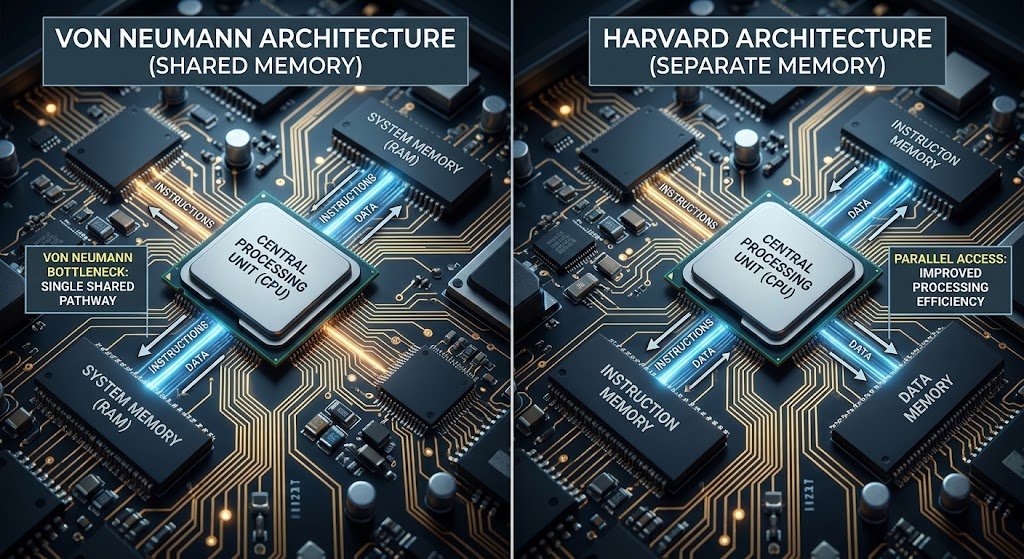
Though the modern processors have been much more sophisticated, much of the underlying theory remains the same in these two architectures. The primary difference between them is the method of their memory handling: Von Neumann architecture has only one memory that is used for both instructions and data; Harvard architecture has a separation of instruction memory and data memory. The selection of this design impacts workload processor, complexity, performance and cost.
These two architectures are thought to be two of the most influential foundational models of computer design in computer design, as they helped set up two distinct methods of organizing computing systems. Knowing these models can give you an indication as to why some processors might choose simplicity and flexibility, while others choose speed and efficiency.
What is Von Neumann Architecture?
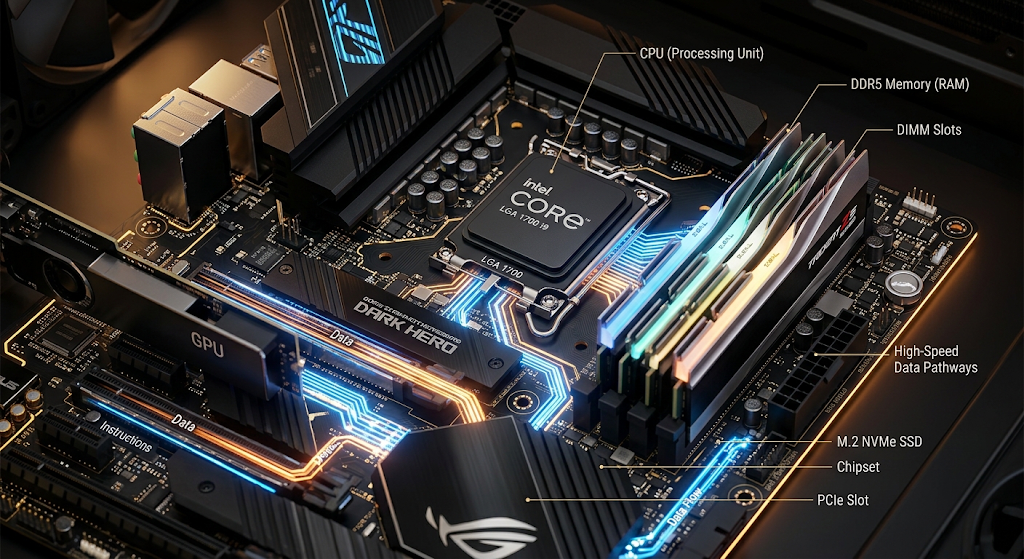
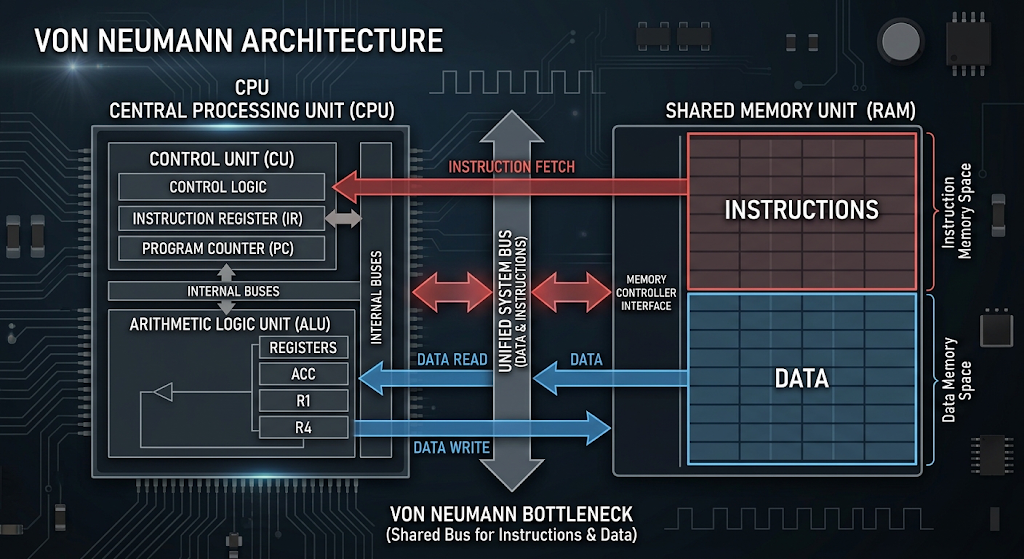
In the 1940s, mathematician and physicist John von Neumann proposed the Von Neumann architecture, a design for computers. It was one of the first feasible ways to assemble general purpose computers. The main concept of this architecture is that the program instructions are stored in the same memory system as the data. A processor fetches instructions from the memory, runs them, manipulates the data, and saves the data to the same common memory.
With this method computer design was simplified because it only needed one memory system. Engineers could have a single memory system in which instructions and data were stored in the same physical location, making it simpler to construct and maintain. It was this simplicity that made Von Neumann-based systems popular for early computers and many general purpose computing devices which followed.
The Von Neumann computer has a number of basic parts, such as the central processing unit (CPU), the memory, the input devices, and the output devices. The ALU, CU and registers are located within the CPU itself. The control unit coordinates the flow of instructions and data to and from memory to the processor and the ALU makes mathematical and logical decisions.
The Von Neumann Bottleneck
The Von Neumann architecture has one of the most significant problems, called the Von Neumann bottleneck. Because instructions and data are stored in the same memory and bus system, usually only one type of information can move from memory to the CPU at a time. This will cause some restriction in data transfer rates as the processor might have to wait for data to be transferred through the common path.
For instance, a processor wants to read a program instruction from memory and load the data for that instruction, both operations requiring the same memory channel. This became more apparent as processors started to become faster and the increase in CPU speed was much greater than the increase in memory access speed. That led to a performance hole – the processor could use valuable time to wait for information rather than doing calculations.
This issue has been mitigated using multiple memory levels, faster memory technologies, instruction prefetching and advanced processor designs by modern computers. Nevertheless, the basic challenge is still an important overarching point of consideration in computer architecture.
Pros of Von Neumann Architecture
The von Neumann architecture is still widely used for its significant benefits. The first big advantage is that it’s so simple. A single memory system decreases the complexity of the hardware and makes the development and manufacture of processor designs easier. This simplicity also reduces cost, making this architecture appropriate for a variety of computing devices.
Flexibility is another benefit. All programs and data are stored in the same memory, so they can be easily loaded, modified, and run without the need to allocate separate memory spaces. This allows Von Neumann systems to be highly flexible, and to be used for general-purpose computing, including the execution of operating systems, applications and productivity software.
Another advantage of von Neumann is that the memory model is simple to program, too. No separate Instruction and Data Space to keep track of for software developers, streamlining programming and memory management. Because of these benefits, many processors for desktop computers, laptops, and servers are based on the Von Neumann model, which has been modified.
What is Harvard Architecture?
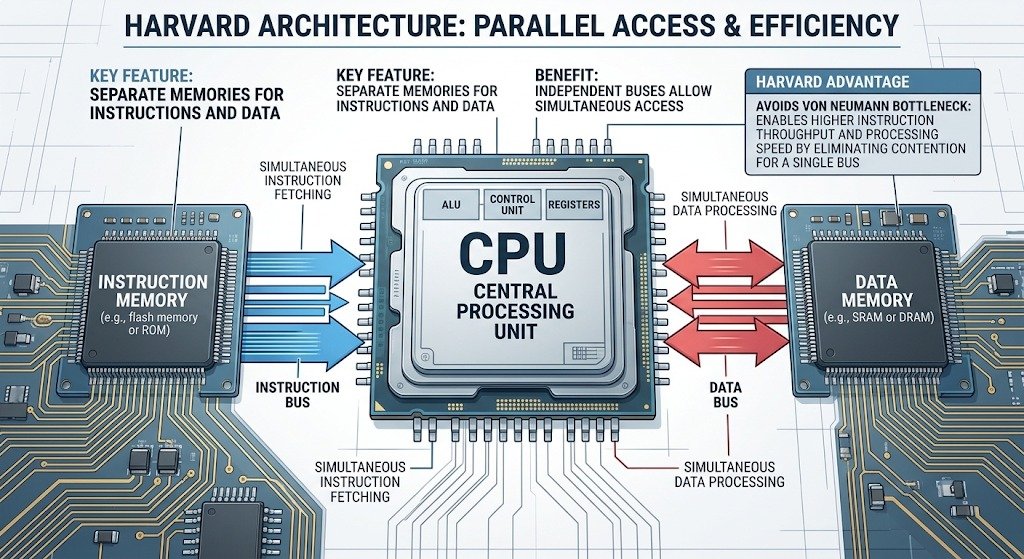
The Harvard architecture is a computer architecture that separates data and program storage in separate memories. In the Harvard architecture, programs and data are stored in separate memory, with their own dedicated pathways. In contrast to Von Neumann architecture, which requires that both programs and data are stored in a shared memory, the Harvard architecture has dedicated pathways for program storage and separate pathways for data storage.
The architecture was first designed for special computers in which speed and efficiency took precedence over simplicity. This allows the processor to read and write the instructions and data simultaneously. This removes one of the primary drawbacks of Von Neumann systems, and enables higher speeds of instruction processing.
A Harvard based system has the program stored in the instruction memory, and variables, temporary values, and processing information are stored in the data memory. So each memory type operates on its own bus, so they can work simultaneously. For instance, the CPU may be accessing data memory to read or write data while the next instruction is being retrieved from instruction memory.
Advantages of Harvard Architecture
Harvard architecture has the main benefit of increased performance. The memory instructions and data both reside in separate memory spaces and buses, allowing the processor to carry out multiple memory operations concurrently. This can make instructions run faster and help avoid delays resulting from memory access contention.
Another benefit is that in some applications it offers more security and reliability. Program instructions and data are separated so that it is more difficult to accidentally over write program instructions. This feature can be useful in embedded systems, industrial controllers and for devices with stable operation.
Specialized processors also make use of Harvard architecture. Often separate memory structures can offer predictable performance which is important for digital signal processors (DSPs), microcontrollers, and real-time computing systems. Harvard designs are common in applications like communication devices, robotics, medical equipment, and automobile electronics.
Comparison of Von Neumann vs Harvard Architecture
The two architectures differ in how memory is organized – Von Neumann architecture vs. Harvard architecture. In von Neumann architecture, instructions and data are stored in the same memory system, and in Harvard architecture, they’re stored in different memory systems.
| Feature | Von Neumann Architecture | Harvard Architecture |
| Memory design | Single Memory: memory used to store instructions and data. | Each instruction and each data memory comes in a separate memory block. |
| Data transfer | Shared bus | Separate buses |
| Speed | Generally slower due to bottlenecks | Accessed faster because of parallel access |
| Complexity | Simpler design | More complex hardware |
| Cost | Usually lower | Usually higher |
| Flexibility | The ability to accept general computing loads to a high degree. | Designed for particular functions |
| Common uses | Computers, servers, and other general-purpose systems. | Embedded systems, microcontrollers and dsp. |
The von Neumann architecture is simple and flexible, while the Harvard architecture is designed to boost performance and efficiency. Not all of these models are superior since they are useful for different engineering problems.
Modern Hybrid Architectures
Despite the fact that Von Neumann and Harvard architectures are two different architectures, modern processors often use elements of both of them. They are frequently referred to as “modified Harvard” architectures due to the separate instruction and data path they employ internally but share a common memory model externally.
Typically, modern CPUs have separate instruction-level and data-level caches. In the case of a processor, it could be that one cache is used for instructions that are used often, while another cache stores data. This design is flexible, like Von Neumann, and has numerous performance advantages of Harvard architecture.
These hybrid designs are often employed in advanced embedded devices, computers and smartphones. They enable manufacturers to produce a high performance product while maintaining compatibility with existing software environments. The combination of fast and flexible has led to hybrid architectures becoming the predominant choice in many contemporary computing systems.
Applications of Von Neumann Architecture
In the general purpose computing environment, von Neumann-based designs are widely used. Because desktop computers, laptops and many servers must process a variety of tasks, they use processors based on modified Von Neumann principles.
Whether it’s operating systems, the web browser, office applications, databases, or AI software, all of these programs need flexible memory management. These systems can more easily allocate resources dynamically and execute multiple programs efficiently using a shared memory model.
Architecture is also relevant to education as a simple way to comprehend how computers execute instructions. The Von Neumann architecture is the building block of many beginning computer science textbooks to explain the workings of the CPU, memory, and program execution.
Applications of Harvard Architecture
Harvard architecture is widely used in embedded processors, where performance, reliability, and efficiency are paramount concerns. Appliances, vehicles, and electronic devices typically employ microcontrollers with a Harvard design to ensure reliable performance under constrained conditions.
Another important field of use is digital signal processors. These processors are used for audio processing, image processing and telecommunications etc. Compared to other chips, DSPs can access instructions and data simultaneously, which enables them to execute repetitive calculations efficiently.
The Harvard architecture is also used in robotics systems, industrial automation equipment, and real-time control systems. In such situations, the delays can influence the performance, and efficient memory access is crucial.
Conclusion
There are two basic designs of computers – von Neumann and Harvard. Shared memory architecture is simple, flexible and makes the hardware simpler, and is used by von Neumann architecture, in which both instructions and data are stored in the same memory. Yet because it is a shared communication path, it can cause the Von Neumann bottleneck (VNB), which can slow it down.
Harvard architecture addresses this by partitioning the memory into instruction memory and data memory, enabling parallel access and faster processing times. It performs better, but is more difficult to implement in hardware, and may not be as flexible as von Neumann designs.
In many modern computing systems, a mixture of both is used by employing some variation of a Harvard architecture. Modern processors use multiple caches and optimised memory paths to give high performance without sacrificing flexibility in general computing operations. These two architectures give you a good idea of how computers work, and why various architectures are chosen for various purposes and requirements.