Introduction
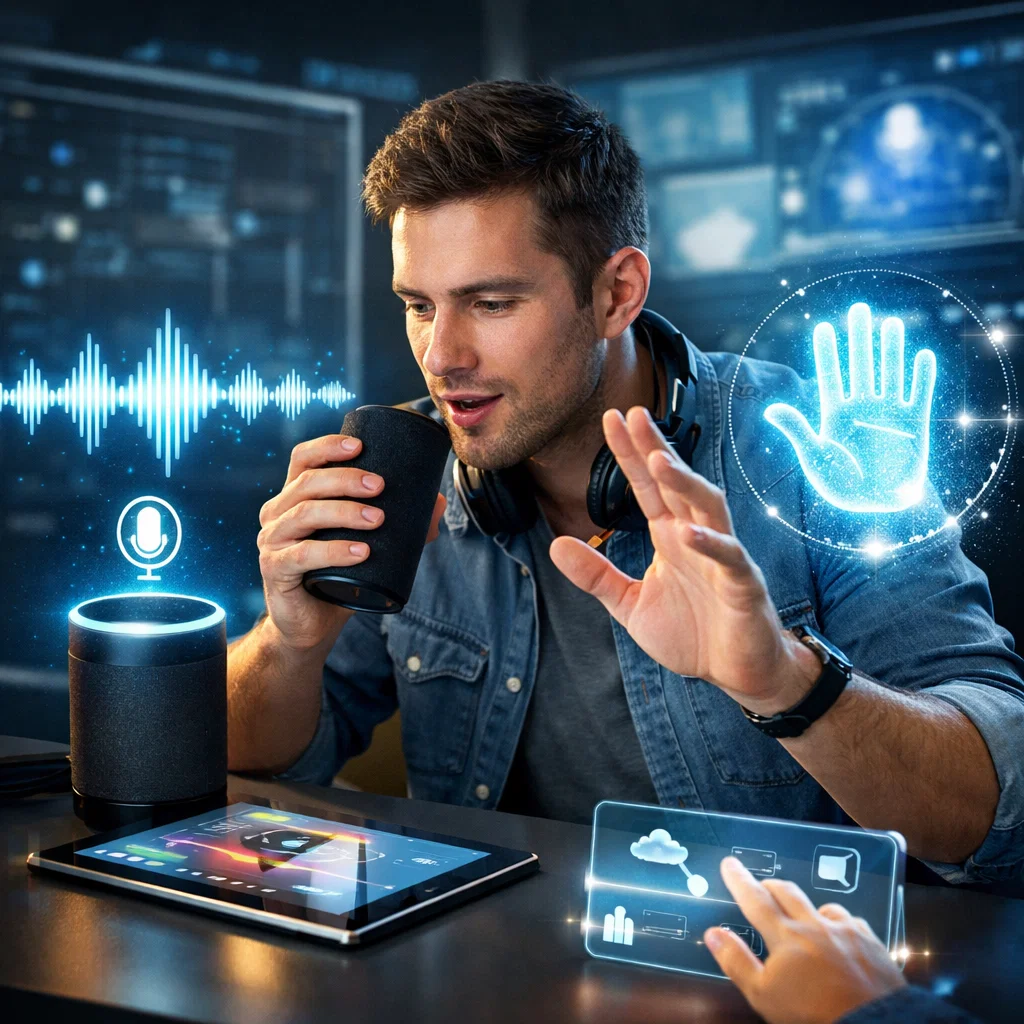
In the modern digital and dynamic world, the relationship between technology and human beings has been changed significantly. We observe that more dynamic, complex, and context-sensitive systems now require more than just the use of more traditional input tools such as keyboards and mice. What we get instead is that users are requiring natural, smooth and intuitive user interfaces which in many aspects are a reflection of real life communication. This has consequently led to development of multimodal interaction, a system involving a mixture of input and output modes, which can be voice, gesture, touch, as well as visual and haptic feedback.
The idea of multimodal interaction is the one that perceives technology with which the user can interact with by using one or more senses or forms of communication simultaneously. This is evident in a broad variety of contexts, such as healthcare systems, smartphones and smart home devices, which deliver information in a huge number of modalities that interact with each other.
In this article, what comprises multimodal interaction is reported. We consider design problems, integration problems and even raise to prominence usability problems. We conclude with the changing nature of multimodal systems in current computing environments to make them more adaptive, inclusive, and efficient.
Understanding Multimodal Interaction
What Does Multimodal Interaction Mean?
Multimodal interaction is where we use most of the human forms of communication to interact with the computer system. These forms include:
- Voice (speech recognition and synthesis)
- Body tracking, hand movements.
- Touch (haptic, screens)
- Visual (face recognition, eye tracking)
- Text (on screen typing, typing)
Multimodal systems combine these simultaneously to create an easier and more natural experience, instead of just one mode of interaction, which is used at a time.
The Appropriateness of Multimodal Interaction
The importance of multimodal interaction is that it:
- Makes users more adaptable: There is a range of interaction options available to the user to choose, which would best suit the situation.
- Increases access: The disabled are also accommodated in other media.
- Improves efficiency: Inputs that complement each other help in completing tasks faster.
- Minimizes cognitive load: Natural action sequences are easier to remember.
An example is when a user would request to open a file pointing to it on the screen. The gesture along with the voice command is recognized by the system, which in turn improves the interaction.
Critical Multimodal Systems Modalities
Voice Interfaces
Voice interaction is also a very noticeable channel which has increased significantly with the concept of virtual assistants.
Key Features:
- Speech recognition (input)
- Text-to-speech synthesis (output)
- Natural language understanding
Advantages:
- Hands-free operation
- Quick entry of complicated instructions
- Available to the visually impaired
Challenges:
- Noise interference
- Various accents and languages
- Privacy concerns
Gesture Interfaces
The meaning of physical gestures as commands is called gestural interaction.
Types of Gestures:
- Swipe, pinch (hand gestures)
- Body movements
- Facial expressions
Advantages:
- Natural and expressive
- Applicable to immersive systems (e.g., VR/AR).
- No physical contact was required.
Challenges:
- Accuracy in detection
- Lighting, space (environmental constraints)
- User fatigue (gorilla arm effect)
Touch Interfaces
The mode of touch is one of the major means of interaction.
Features:
- Direct touch (tap, swipe, pinch)
- Multi-touch support
- Haptic feedback
Advantages:
- Intuitive and familiar
- Precise control
- Supported on a wide basis
Challenges:
- Limited to complex inputs.
- Not appropriate under any conditions (e.g. dirty, wet)
- Not readily available to all users.
Multimodal Interaction Design Problems
It is also true that we are not very comfortable with the process of designing effective multimodal systems, which in turn compels us to be extremely attentive to the interaction and complement of the various modalities.
Fusion of Modalities
It is a mixture of information of numerous different sources that we call fusion. This is what the system needs to take in the input and then identify the correlation between them.
Challenges:
- Exactness on the correct time of entry (e.g., voice and gesture on the correct time)
- Resolving ambiguities
- Handling conflicting inputs
As an example, a user can select a couple of items and instruct the system to move this, and we are supposed to know what item they are referring to.
Polarity Fission
Fission is an output modality, in which a system employs numerous forms to introduce information.
Example:
A navigation system will give out instructions via:
- Voice instructions
- Visual maps
- Haptic vibrations
Challenges:
- Avoiding information overload
- Having consistency in outputs.
- Contextualizing output modality
Awareness of Context
Multimodal systems can be adjusted to the environment and situation of the user.
Factors:
- Location (home, office, public space)
- Device type
- User preferences
- Lighting (noise, light)
Challenge:
Creating adaptive systems that are easy to use and display content in various formats.
Bug Reporting
The multimodal systems cannot but fail.
Common Issues:
- Misinterpreted speech
- Incorrect gesture recognition
- Accidental touch inputs
Design Considerations:
- Provide clear feedback
- Allow easy correction
- Provide an alternative way of input
Consistency and Adaptability
Do not show users excessive choices.
Key Goals:
- Be consistent in modalities.
- Ensure intuitive interactions
- Provide training and onboarding.
Multimodal Systems Integration Strategies
Strong integration schemes are required in multimodal interaction design and development.
Complementing Modalities
Various modalities are meant to support each other instead of competing.
Example:
- Voice for commands
- Touch for precision
It is more efficient and improved.
Redundant Features
It is a do-it-yourself approach.
Example:
- Saying “Play music”
- Pressing a play button.
This will ensure that the users are free to interact in a manner that suits them and what they love doing.
Contextually Based Modality
Modalities will be selected by the system based on the situation.
Example:
- Voice in hands-free (e.g., driving) scenarios.
- Hands in silent places.
Switching of Modalities by the user
It is up to the user to decide which one to use.
Benefits:
- Greater flexibility
- Personalized experience
- Reduced frustration
Multi-modal Feedback Loops
The channels of feedback should be enhanced with a great number of channels.
Example:
By pressing a button on activates:
- Visual change
- Sound effect
- Haptic vibration
Usability Considerations
Multimodal systems rely on usability.
Accessibility
The multimodal interaction, which involves a large number of input/output channels, is quite useful in terms of access.
Examples:
- Impairment of User mobility (Voice input).
- Auditory feedback to the hearing-impaired.
- Control speechless user actions.
A broad scope of users should be incorporated by the designers.
Cognitive Workload
Too many choices of interaction can be confusing.
Solutions:
- Simplify interfaces
- Give priority to popular modalities.
- Provide contextual guidance
Response and Relevance
One should be able to have immediate and concrete feedback.
Best Practices:
- Confirm user actions
- Indicate system status
- Give solutions to error messages
Confidentiality and Security
Multimodal systems which collect private data.
Concerns:
- Voice recordings
- Facial recognition data
- Behavioral patterns
Solutions:
- Transparent data policies
- User consent mechanisms
- Secure data storage
Environmental Performance
Systems will be used in diverse environments.
Examples:
- Voice recognition noise recognition.
- Monitoring gestures in dark conditions.
Multimodal Interaction Applications
Intelligent Technology and Help
The current smart devices are founded on multimodal interaction.
Features:
- Voice commands
- Touch controls
- Visual displays
Healthcare Providers
Multimodal systems enhance the quality of patient care.
Examples:
- Gesture-controlled surgical tools
- Voice-enabled medical records
Online Learning and Education
Multimodality is an advantage in interactive learning in most situations.
Benefits:
- Engaging content
- Adaptive learning experiences
- Accessibility to different learners.
Vehicle Systems
The systems operate through voice, touch and gestures.
Goal:
Minimal distraction and maximal functionality.
Virtual and Augmented Realities.
There are a lot of various types of input in immersive environments.
Examples:
- Hand tracking
- Voice commands
- Haptic feedback
The Future of Multimodal Interaction
AI-based Personalization
AI will make systems more personalised to an individual.
Features:
- Learning user preferences
- Predicting actions
- Customizing interactions
Cross-Device Interaction
Easy communication will be experienced among users on all devices.
Example:
Start a job on your phone and continue on a laptop or smart screen.
Emotional Analysis
The feelings of the users are identified and addressed.
Potential:
- Improved user experience
- Adaptive responses
Brain-Computer Interfaces
The brain and the computers will be connected by the use of the new tech.
Improved Accessibility
People with disabilities will be incorporated in future systems.
Conclusion
Multimodal interaction has caused a tremendous change in the way human beings interact with technology. These systems are natural, efficient and inclusive with elements of voice, gesture and touch. Another factor that should also be noted is that in designing such systems, the problem of modality integration, context awareness and usability also need to be taken into consideration.
The multimodal systems present us with much of what can be done in the present world of technology, which we do well by designing and putting in consideration the requirements of the users. Multimodal interaction will be a significant aspect in the future since the technology is never static, but rather it will become more intuitive, adaptive and inclusive to everyone.