
Introduction
AI is revolutionizing investment and financial market analysis by empowering investors to analyze massive amounts of data, identify patterns, evaluate risk, and automate certain components of decision-making processes. Today, investment teams have to deal with large volumes of prices, trading volumes, company reports, economic indicators, news, and alternative data. These sources can be analyzed and relationships can be found with machine learning in a short time that can be further investigated. This isn’t to say that algorithms can be able to make accurate predictions about all market movements or that they can completely eliminate the role of experienced analysts. Rather, AI is emerging as an analytical tool which assists the professionals to dig through information, test ideas, track portfolios and react to evolving conditions. As AI is becoming part of investment research, investors should be able to recognize the benefits that these technologies can provide and the measures that are necessary to responsibly use them.
AI’s Approach to Financial Data Processing
There is a tremendous amount of structured data created in financial markets, such as share prices, bond yields, exchange rates, trading volumes, earnings data, interest rates and economic statistics, among others. These datasets can be gathered, organized, compared and analyzed with the help of AI systems much quicker than manual systems. Machine learning models can analyze the vast number of variables simultaneously and establish relationships that may not be apparent by traditional spreadsheet analysis. An investment system may, for instance, analyze historical price trends and correlations of various price trends with changing company earnings, interest rates, and/or the performance of a particular sector of the economy or commodity prices, in order to determine trends that repeat. This can help to save analysts time in preparing information, and help to make research more efficient. But, the utility of an AI model heavily relies on accurate and relevant data, and hence data preparation is still a significant aspect of the process.
The Concepts of NLP and Unstructured Information
AI also can interpret data, like information that’s not presented in numbers. The annual-report, regulatory filings, transcripts of earnings calls, news articles, management statements or economic announcements are important investment evidence. NLP can be used to analyze this written content, categorize topics, identify shifts in language and identify information that may warrant human attention. Sentiment analysis can help determine if a financial report or a company’s statement contains positive, negative or neutral sentiment. One investment research platform, for instance, could analyze over a number of years, and identify a significant shift in how the business talks about revenue, costs, competition or expectations. While these systems can’t automatically determine whether or not a security should be purchased or sold, they can help save time to find the evidence and assist analysts with examining a much larger amount of information.
The Process of Identifying Market Patterns and Signals
A top machine learning application in finance is the ability to recognize market trends. Models can learn the prices, returns, volatility, trading activity, and other factors in the past to find relationships with specific market conditions. AI can assist with any of the following: momentum analysis, anomaly detection, volatility prediction, security screening, or probability estimation. A model can also be used to sort securities by a specific attribute and to pare down a vast universe of securities to a smaller number to study. This may be useful in situations where investment professionals have to review thousands of securities, and can’t go into a lot of detail with each one. However, past performance is no indicator of future performance. Interest rates, regulations, investor behavior, technology, and economic conditions change all the time in markets; models need to be tested over time but cannot be assumed to be accurate because they worked well in the past.
Predictive Analysis and Investment Decisions
AI can assist in investment decisions by generating forecasts, ranking and alerting and scenario estimates, which are incorporated into a larger investment process. A model is one approach that a portfolio team could employ to find companies that have certain financial attributes, to gauge the likelihood of volatility, or to discover shifts in asset relationships. Automated systems can also be programmed to keep a constant track of market information and to issue alerts to the analysts when prices or risk levels stray from their usual bounds. The primary value is frequently not in predicting precisely, but in providing assistance in decision making. AI can filter out the possibilities, show up unusual things, and calculate it the same way every time; and it’s up to analysts to determine if it is economically and investment wise. The division of responsibilities is crucial because there are times when the model isn’t able to fully comprehend the goals that may be involved in financial decisions such as the need for liquidity, client preferences, tax considerations, regulatory obligations, etc. or a long term investment plan.
The Automation of Investment and Market Processes
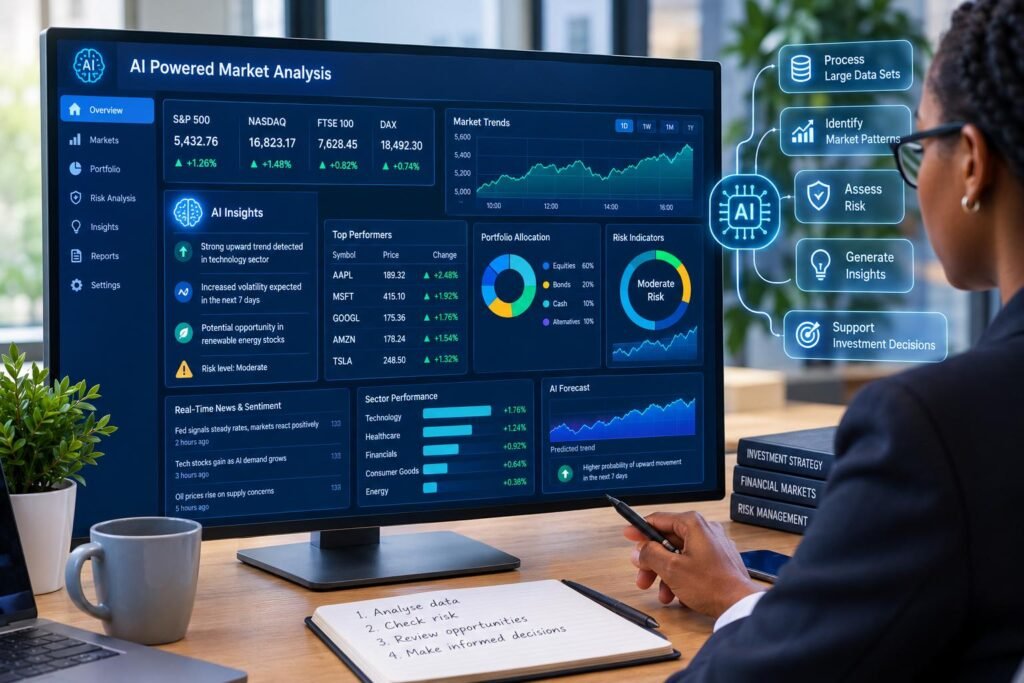
AI is reshaping financial markets in yet another significant way: automation. Automation is another critically important aspect of the way AI is impacting financial markets. Investment organizations undertake a lot of repetitive tasks including that of monitoring, classification, reporting, data entry, document checking and initial analysis. AI can help with these tasks and save time for employees from repetitive tasks. In a trading market, an automatic system may also be able to analyze market details and accomplish pre-programmed instructions considerably quicker compared to the person could manually respond. This will help the institutions to be faster and efficient in their operations and act on market events on time. But as with anything else, controls become more critical with automation; if a mistake is made in an automated process, it could be repeated very fast and have a significant impact on many transactions. Therefore, systems must be tested, monitored, undergo approval procedures, have access controls, and have clear responsibilities, with a focus on operational safety without compromising the efficiency of the system.
AI in Risk Assessment
Another use of great importance is risk management. Financial institutions need to be aware of the various risks that can cause losses, such as market fluctuations, credit risks, liquidity risks, operational risks, etc. AI models can sift through extensive data sets to look for patterns that differ from the norm, calculate risk scores, and recognize shifts in behavior that might warrant further investigation. Machine learning can also be used in portfolio management to evaluate the relationships between asset classes, look for concentration risks, and track volatility shifts. Models can contribute to the credit analysis by reviewing borrowers and transaction data, and can be used to evaluate the repayment risk. One of the other ways AI can help is by detecting transactions that are unusual or fraudulent. However, during unusual circumstances risk models may fail. A system that has been trained to a large extent on past stable data may not make the best use of a financial crisis and stress-testing and human reviews are necessary.
AI and Real Time Financial Market Analysis
In markets where information can fluctuate in seconds, real time analysis provides another edge to AI. There is a constant flow of data from price moves, trading volumes, corporate releases, economic data and investor activity. AI systems can be used to monitor these sources and note events that may need to be addressed right away. A model could for example, identify a price change that it doesn’t think is usual and compare it to the performance of the sector, market conditions, historical data, and news. This enables analysts to research potential causes without having to read each of the sources themselves. Another advantage of continuous monitoring in portfolio management is that systems can alert you when risk levels, exposures, and/or market conditions change. The benefit of AI in this instance is not just its speed, but that it can keep your eye on a lot of securities and information sources, while giving human professionals enough time to concentrate on the more significant of them.
Restrictions of AI in Financial Analysis
Although these are the advantages, there are significant drawbacks to AI. One of the main concerns is data quality, as data models are trained by what is fed into them. Even the most advanced algorithm can give wrong results if there are missing observations, figures that may be wrong, inconsistent definitions, old data or a biased sample. Another issue is overfitting, that is, when a model learns noise in the past instead of a pattern that holds true in the future. So a successful strategy in tests can be very unsuccessful in the market. These issues can be minimized through robust data governance, careful data validation, out of sample testing and continuous monitoring of performance in financial institutions. The analyst also needs to ask himself whether the variables included in a model have a logical economic correlation and not take every statistical correlation as a reliable investment opportunity.
The Lack of Explainability and Model Risk
There are extra challenges when it comes to modeling risk and cybersecurity. When the output is generated by an advanced AI system, it might be hard to explain, as it is influenced by multiple and complex factors. Investment professionals should be informed of the purpose of a model, its available data, how it was tested and under which circumstances it might fail. This is especially the case when there is a significant capital or major client decision that must be made. Security is also crucial, as financial systems hold valuable market data, customer info, trading strategies and exclusive research. The potential for disruption, the exposure of confidential information, and the ability to manipulate data used by an AI system are all scenarios for cyberattacks. Thus, financial organizations must have robust access controls, secure data usage, monitoring and incident response mechanisms as well as tight management of third party technology providers.
The Role of a Human Factor in the System
Don’t forget that economic, political, regulatory and social events that are not adequately captured in historical data still have an impact on financial markets, and therefore human oversight is necessary. An algorithm can recognize a pattern, but an experienced analyst may doubt whether a new event could have occurred disrupting the pattern. Human professionals can examine unexpected outputs, check the AI signals against fundamental research, question assumptions and determine if an automated recommendation should be accepted or not. The best investment processes, however, are those that have a blend of machine efficiency and a human factor. The use of AI in search, classification, calculation, monitoring, and comparison of information on a large scale is well suited, but humans are responsible for context, accountability, ethical considerations, and for making important decisions. With the increasing adoption of AI, financial institutions must also have guidelines and protocols for model validation, data management, cybersecurity, performance monitoring, and human oversight.
Conclusion
Leveraging AI is emerging as a critical component in investment research and financial market infrastructure, as it enhances the speed, scale, and consistency of financial analysis. It is capable of handling complex and unstructured data, detecting potential market signals, automating repetitive operations, real-time portfolio tracking, and risk assessment. However, AI should not be considered the ultimate predicting machine. It may not be as effective as it would be if data is poor, the model is overfitted, it is not easily explained, cybersecurity is compromised and market conditions have shifted. However, the future of AI in finance is likely to be one of collaboration, not replacement, as technology and human expertise work together to create a more efficient and effective financial landscape. AI’s power is that it can augment the ability of investment professionals to analyze more data, act more quickly, and make more well-informed decisions, all while they remain held accountable for the end product.
Get more well researched information about AI in investment and financial market analysis here.


