Introduction
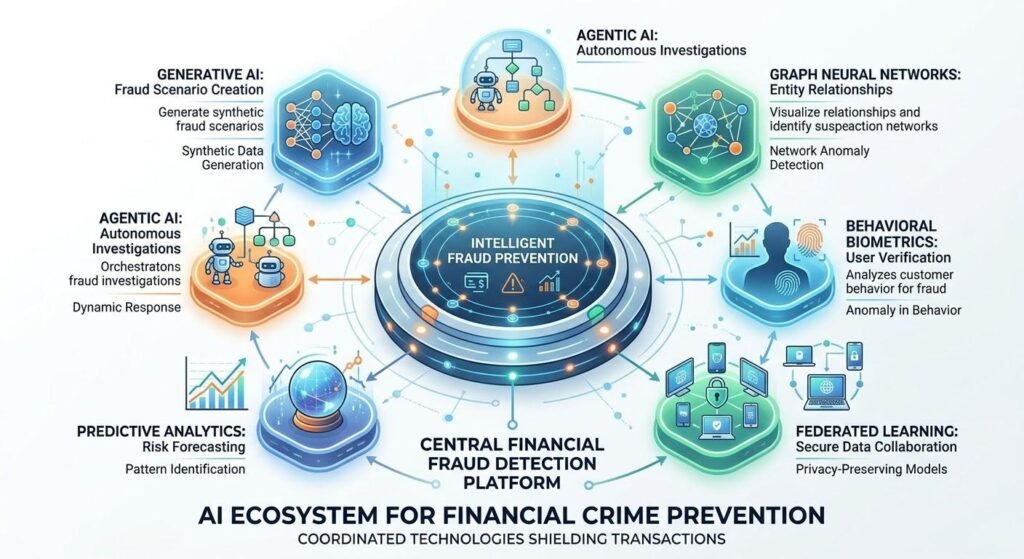
As there are more banks, payment providers and financial institutions providing digital solutions, financial crime is becoming more complex. With individuals using mobile banking, digital wallets, online payments and international transfers, fraudsters are looking to exploit these weaknesses. However, traditional fraud detection methods are struggling to keep up. Financial institutions are discovering that AI driven fraud detection can be used to utilize large amounts of data to identify suspicious behavior. As technology develops, new technologies such as generative AI, agentic AI, graph neural networks, behavioral biometrics and predictive analytics will play a major role in the future of fraud detection.
Moving to More Advanced Fraud Detection
Traditional fraud detection systems only analyze transactional behavior. For example, if a transaction seems unusual in relation to the amount withdrawn, unknown location or multiple payment attempts, a bank may flag this transaction. Whilst these systems are useful, the more complex frauds are difficult to detect. Fraudsters are now using identities, fake accounts and coordinated transactions to avoid detection. Financial institutions are attempting to offer risk assessments to give them a wider view of the customer. This will see them analyze the customer’s identity, how they will interact digitally, activity on their account and payments. This will give financial institutions a wider view of what the customer is doing and identify any suspicious changes. They will also be able to identify potential threats faster to reduce any false rejection of transactions.
Emerging Technologies
1. Generative AI
This technology will be a key part of preventing financial crime. It can analyze data, identify patterns and provide useful insights. Unlike traditional systems, generative AI will help investigators by analyzing suspicious activity, providing a summary of transactions and identifying connections. Fraud investigation teams could use an AI assistant to look at activity on the account, compare customer information and provide a summary of suspicious transactions. This can also help financial institutions understand new fraud techniques by analyzing reports, suspicious communications and known criminal patterns. However, they must be carefully monitored to prevent any inaccuracies (hallucinations). This means they would be most helpful for supporting decision making.
2. Agentic AI
Agentic AI is another key development. This allows AI to complete tasks, make decisions within certain parameters and work together to accomplish a goal. For fraud prevention, this can analyze transactions, analyze suspicious activity on an account, request further verification and suggest actions. If a payment looks suspicious, the AI can look at the customer’s transaction history, device and compare it to known fraud indicators. It can then suggest whether the payment should be approved or temporarily blocked. This can be done with multiple agents looking at different aspects of the account. One agent could look at identity risk whilst another looks at payment patterns. This may help reduce any delays to investigations. However, financial institutions must ensure there are strict permissions, approvals and monitoring in place to ensure they do not cause any inappropriate actions.
3. Graph Neural Networks
This type of technology can help detect any financial crime through connected accounts. Unlike traditional machine learning, this looks at the relationships between different entities. This could include looking at connections between customers, accounts, devices, phone numbers, merchants and recipients. This can help identify suspicious networks, if there are multiple accounts which seem genuine but are connected to the same device, passing through the same intermediaries or sending multiple payments to a suspicious recipient. Graph neural networks can analyze this data to identify organized fraud, money laundering and coordinated payment schemes. As criminals are now using more complex financial networks, this will help financial institutions move away from analyzing individual transactions.
4. Behavioral Biometrics
This looks at identifying customers based on how they interact with their devices. This could include how fast they type, how they move their mouse, how they interact with their touch screen, how they browse and how they interact with their mobile banking. Unlike traditional methods for confirming a customer’s identity, this can help continuously confirm that the person using the account looks like the account holder. For example, if an account holder typically interacts with the application in a certain way but suddenly behaves unusually, this could indicate an account takeover is attempted. Financial institutions can request further verification or temporarily block sensitive actions. This can help increase security with digital banking but can also reduce the need for frequent password entries. However, financial institutions must ensure this information is protected and not block accounts due to genuine changes in behavior.
5. Predictive Analytics
This uses historical data, statistical methods and machine learning to predict the likelihood of an event. This can help financial institutions identify any red flags to prevent large losses from fraudulent transactions. By analyzing past fraud, customer behavior, frequency of transactions, where payments are being sent and other relevant information, risk scores can be calculated. If there has been a sudden change in frequency of transactions, unusual device activity and payments being sent to unknown recipients this could indicate an increased risk of compromise. Financial institutions can add additional security checks. This can help identify new fraud patterns and make investigations more efficient. However, this relies on accurate data and frequent updates to ensure they can identify evolving criminal tactics and not unfairly impact genuine customers.
6. Federated Learning
This is an exciting technology which can help improve fraud detection without having to share customer information. This means financial institutions can train their machine learning systems with their own data. They will not need to share full customer data but will share model update. This can help improve the industry’s ability to detect fraud patterns which are affecting multiple banks, payment providers and financial platforms. For example, multiple institutions may have seen transactions relating to the same fraudulent network. Federated learning can help improve detection without sharing all of their customers’ personal information. However, strong encryption must be in place along with secure collaboration. There must be protections in place to ensure any malicious or misleading model updates are not used. There should also be clear agreements in place regarding data ownership, regulation and intelligence management.
7. Cloud Based Fraud Detection
As technology continues to develop, cloud computing will play a larger role in developing fraud detection systems. This provides financial institutions with scalable computing power. This means they can analyze large volumes of transactions and digital interactions. This will help them respond to changes in volume of payments, new threats and requirements. These platforms can also help integrate artificial intelligence, machine learning, data analytics and investigative tools. For example, a payment provider could identify suspicious transactions across multiple digital channels and update their risk assessments. However, there are concerns around this. This can cause issues with cybersecurity, availability, third parties and data residency. Financial institutions must ensure there are strong security measures, encryption, monitoring and reliable recovery options.
8. Automated Financial Crime Investigation
This will help financial institutions manage the large volumes of alerts generated by advanced monitoring systems. Traditionally, investigators will spend a lot of time looking at transaction history, collecting evidence, comparing customer details and creating reports. By automating this, it can streamline the process. Evidence can be collected, suspicious transactions can be organized, connections can be identified and initial investigation summaries can be created. AI can also help prioritise alerts based on the potential risk. This will help investigators focus on more serious cases. For example, an automated investigation platform could identify multiple transactions relating to a suspicious recipient. It could then collect evidence relating to the account and produce a case file. This can speed up investigations and make them more consistent and efficient. However, this should not be used for complex cases. Investigators must still use their knowledge to assess evidence, confirm suspicious activity and make decisions relating to regulation/legislation.
Creating Ongoing Risk Assessments
Overall, these developments mean financial institutions have a better understanding of fraud risks. Modern detection systems are focusing on risk based on customer identity, devices, digital activity and payments. This is because suspicious activity could occur before a financial transaction. If there has been an unusual login attempt, change in device or multiple failed authorizations this could indicate an account compromise. By using identity verification, behavioral biometrics, predictive analytics and transaction monitoring, financial institutions can create a more complete risk profile for their customers. This can be continually updated to make security more responsive. They will understand if the customer is acting suspiciously.
Opportunities and Risks
Using advanced AI technologies can provide many opportunities for financial institutions. This can help reduce financial loss through quicker analysis, improved pattern recognition and automated investigations. This can help fraud teams manage large volumes of suspicious activity. This can also help improve the customer experience by reducing false transaction rejections and targeted verification. However, there are risks around cybersecurity. Fraudsters may use generative AI to create realistic phishing messages, impersonate customers, manipulate identities and create complex scams. Criminals may also attempt to exploit weaknesses in the AI models. This may be done through data poisoning, adversarial attacks or credential theft. Financial institutions must ensure that both traditional and AI systems are secure. Strong cybersecurity measures, regular vulnerability testing, secure model creation and monitoring will be key to ensuring they can trust their fraud detection technologies.
Regulation and data protection will also play a role in how financial institutions use this technology. AI systems will often require large amounts of customer data. Financial institutions must ensure they collect, process, store and share this data in accordance with relevant privacy and financial regulations. Whilst federated learning may help reduce some of the risks around data sharing, there are still privacy concerns. It is important to ensure that the algorithms are transparent. Financial institutions must understand how risk scores are calculated and why certain transactions/customers are being flagged. If models are not well designed there could be bias from historical data, unfair impacts on certain customer groups and inaccurate results. Financial institutions should regularly test models, record key decisions, assess for bias and have clear accountability. Compliance teams must also ensure automated systems can support current anti-money laundering, know your customer and financial reporting requirements.
Human Oversight
Despite AI becoming more advanced, human oversight will still be needed to effectively prevent financial crime. Whilst AI can analyze data faster, it does not always fully understand the customer’s financial activity. Transactions may be flagged as suspicious but could have a genuine reason such as an emergency payment, business related payment or unusual personal expenditure. Having an investigator means they can consider these factors, question any findings from automated systems and decide if any further action is needed. Financial institutions should take a collaborative approach to ensure that AI can manage large scale monitoring, pattern recognition and basic investigations. However, important decisions should be made by trained professionals. This also gives investigators the opportunity to identify any issues with automated systems and provide feedback to improve future performance. Ensuring there is human accountability will be key when making decisions to freeze accounts, report suspected crimes and limit access to financial services.
Conclusion
The future of preventing financial crime will be driven by the integration of increasingly advanced AI technologies. Generative AI, agentic AI, graph neural networks, behavioral biometrics, predictive analytics, federated learning and cloud based systems will help financial institutions detect suspicious activity in a more advanced way. Automating investigations and providing ongoing risk assessments will help improve speed and extent of fraud prevention. However, strong cybersecurity must be in place to ensure they can trust their technology. Regulation, data protection, transparency and human oversight must all be considered. Financial institutions who use intelligent automation and have responsible governance in place will be in the best position to protect their customers. Ultimately, how responsibly they implement this technology will determine the success of AI powered fraud detection.
Get more well researched information about AI-driven fraud detection here.