The contemporary enterprise landscape is totally connected to digital infrastructure. Whether it’s cloud-based apps or legacy on-premise databases, organizations have a complex array of applications to handle routine tasks, process proprietary telemetry and to provide customer value. But there are enormous complexities in orchestrating this digital fabric. Enterprise IT environments are not centralized networks anymore, they’re decentralized, hybrid systems that can have architectural conflicts, get attacked by bad guys, and suffer operational fragmentation. For chief information officers, system administrators and technology stakeholders, the challenge is to keep their infrastructure agile and secure from technical debt and operational inertia.
Organizations need to pay attention to strategic governance to ensure uninterrupted uptime and strong security. Managing software management is no longer a technical, back-office job performed by a small group of people sitting in a corner office. Rather, it has become an essential business field which directly impacts competitiveness in the market, regulations, and fiscal sustainability. Without regular monitoring or an engineering guideline, companies have systemic weaknesses in the application portfolios. This article addresses the most common challenges that are threatening modern application ecosystems: compatibility challenges, changing security risks, legacy issues, and user inertia, and offers battle-tested solutions to optimize your digital architecture.
Software Incompatibility and Integration

The Core Challenge
If the technology was perfect, information would flow freely among the apps, operating in synchronicity. The truth of enterprise IT, however, is much more complex. Departments within the corporation independently buy off-the-shelf Software-as-a-Service (SaaS) vendors, tailor-made tools, and local database solutions. This decentralized purchasing process leads to a fragmented operating landscape with siloed data and workflows.
Compatibility issues usually emerge when there are significant system changes or when merging data infrastructures, such as in the case of corporate acquisitions. If the underlying Customer Relationship Management (CRM) database is upgraded in version, it could cause custom webhooks to stop working when running an automated accounting system. Those integration failures result in engineers entering into reactive cycles, where they waste precious time in writing temporary and fragile code patches to maintain basic pipelines. Moreover, the data held within incompatible systems must be manually inserted, which opens the door for human error, increases systems costs, and has significant data quality implications for the organization.
Strategic Solutions and Best Practices
The solution to compatibility challenges is to leave the piecemeal patching behind and think architecturally with an API-first mindset. Organizations need to require that all software applications they investigate offer strong, well-documented and secure Application Programming Interfaces (APIs). Using RESTful or GraphQL APIs, enterprises create a common language of sorts for the contracts between independent systems, eliminating the need for any catastrophic failures in adjacent systems as a result of code changes within enterprise systems.
Essentially, this is a business rule between two enterprise services, with a message passing from Legacy App to Modern SaaS. Also, IT departments need to implement middleware solutions and Enterprise Service Buses (ESBs) to act as a universal translator in the network. Systems connect to the central middleware layer and the connections between each individual tool are simple. The centralized node performs data transformation, routing and protocol conversions in real-time.
Adopting a middleware approach and leveraging container technologies such as Docker and Kubernetes provides a consistent application environment for running on a variety of infrastructure. Instead of the typical “it works on my machine” problem, containerization bundles an application with all its critical run time variables, libraries, and configuration files.
Increasing Cybersecurity Threats and Vulnerability Patching

The Core Challenge
Today’s attack surface is much larger than just the perimeter firewall. Each time a company integrates a third party into its software, deploys a cloud-based service or introduces an open source library, it opens an opportunity for malicious actors to exploit. Ransomware syndicates, state sponsored espionage groups and opportunistic hackers exploit unpatched vulnerabilities in corporate networks known as Common Vulnerabilities and Exposures (CVEs) on a regular basis. The problem is made more difficult by the speed of software development, in which developers regularly download open-source software from public software repositories, typically without examining deep-seated dependency relationships.
This never-ending flow of software updates presents an IT team with a complex challenge. The failure to implement critical security patches in organization’s networks exposes them to zero-day attacks and complex data breaches. On the other hand, a premature release of a patch could lead to serious system instability issues, resulting in unexpected breaking of the neighboring critical software components, and thus cause costly operational downtime. This stressful setting can result in patch fatigue, a situation where IT staffs delay critical patches because of potential disruption to critical business processes, which increases the risk of disastrous security events.
Strategies for Solutions and Best Practices
To achieve a complex software footprint, the first step is to move from manual to automated Vulnerability Management Systems (VMS) that can be embedded within an overall Patch Management Policy. Organizations need to deploy automated tools that actively scan the whole network topology and immediately alert them on any software version that is outdated and point out important CVEs according to the threat level.
To lessen the impact of patches breaking the operational workflow, IT departments need to have isolated staging environments in place that reflect the live production landscape. In these “sandboxes”, all software should be carefully tested before general release.
In addition, development teams should integrate Automated Software Composition Analysis (SCA) tools into their continuous deployment and continuous integration (CI/CD) workflows. These SCA tools automatically scan code repositories and binary dependencies before compilation to make sure that there is no access to an insecure library that is open source. Finally, a strict Zero-Trust Network Access (ZTNA) model puts in place perimeter defenses that will ensure even if a single application is breached, the attack will be contained and will not be able to spread laterally throughout the wider corporate network.
Legacy Systems and Technical Debt

The Core Challenge
Almost all mature businesses depend on legacy software to operate the essential aspects of their business. Many legacy systems are still in place, spanning from decades-old mainframe systems to heavily customized desktop databases that are still performing mission-critical functions in a reliable manner. However, as time goes on, these aging systems turn into serious liabilities, tying organizations to inefficient processes and consuming IT budgets. Legacy systems are very expensive to maintain, demanding the use of a highly specialized and scarce engineering workforce and expensive custom hardware support contracts.
As the underlying code base gets older, it gets more and more technically “dirty” due to lack of structural modernization. The technical debt accumulates in case developers have been finding the quick and dirty solutions again and again instead of the way to clean and sustainable redesign of the architecture. After a while, the software becomes so fragile that you have to be careful not to make any minor changes or the whole platform could collapse.
Smart Strategies and Best Practices
To overcome the stagnation of legacy systems, it is important to have a structured approach to software modernization that paves the way from the high-risk “rip and replace” tactics to incremental and calculated refactoring. To assess the legacy portfolio, IT leaders need to have a clear assessment framework and to classify applications in terms of business value and technical health.
If the systems still have a significant business value, but the architecture is fragile, organizations should use the Strangler Fig Application pattern. This pattern entails the gradual replacement of some of the functional modules of a legacy monolithic system with newer microservices. These new cloud-native services will safely catch all incoming traffic over time, which will free up the old system without any major operational impact.
Encapsulation is a viable solution when refactoring is not possible for certain applications, but the system must still be used. Organizations can integrate the legacy software into modern cloud-based systems by running it in containers and by providing its services via secure and up-to-date APIs. This shields the legacy infrastructure from external elements and extends its life, while allowing the organisation time to plan a comprehensive digital transformation.
Poor User Adoption and Resistance to Change

The Core Challenge
A sophisticated, well-designed computer program can be of no use if the users aren’t willing to use it. In the process of implementing enterprise platforms, IT teams often face a lot of resistance from users. Staff who are used to the same software may not see the need for a change, as it can seem like it is causing a problem rather than solving one. The friction is typically aggravated by a lack of communication on the part of the IT leadership, during which tools are introduced without being discussed in a strategic context, or without sufficient training of the users.
If there are confusing user interfaces or workflow is unnecessarily complex, then employees lose patience. Employees frequently go around the back door and use unauthorized outside apps to get jobs done. It is a risky method, known as Shadow IT. Employees using unvetted cloud applications to store company data or use consumer messaging applications for business communication circumvent the company’s security measures. That leaves the company open for extreme data leakage risks and regulatory issues, essentially screwdiving their IT department’s security issues.
Strategic Solutions and Best Practices
To overcome user resistance, the technology-centric implementation models need to be transformed to user-centric change management models. It is important for the organizations to engage end-user stakeholders at the outset of the software procurement process as active partners and not as passive recipients. Incorporating comprehensive user-experience (UX) feedback into product assessments guarantees that tools chosen are user-friendly, accessible, and reflective of genuine workflows.
For a seamless transition, companies need to develop a well-defined training program, with more emphasis on practical work experience than rigid instruction manuals. Using Interactive Digital Adoption Platforms (DAPs) offers users context-appropriate support, step-by-step, within the app itself.
Also, the training of department “Super Users” to create a responsive peer-led support network in the department. These technical advocates help their peers solve problems fast, creating confidence within their team and ensuring there is broad adoption without compromising on data security and staying on approved channels.
Software Asset Management (SAM) and License Compliance

The Core Challenge
The complexity of software license management in hybrid operating models is extremely challenging for corporations as they adopt new approaches in managing software licenses across cloud, on-premise and mobile deployments. Organizations often don’t have a consolidated inventory of their software assets, creating a disjointed software procurement environment. Individual departments often purchase duplicate SaaS licenses without IT’s knowledge, which can be a significant expense for data centers. This opacity results in significant monetary losses from “shelfware,” or expensive licenses that are not assigned to any project.
However under-licensing can create a significant financial and legal risk to organisations. Compliance audits are a regular part of the practice for major software vendors and are used to defend their IP rights. When an audit uncovers an enterprise’s deployment of more software instances than its agreement permits, it incurs severe financial penalties and may be required to pay licensing fees for the software it installed in the past.
Strategic Solutions and Best Practices
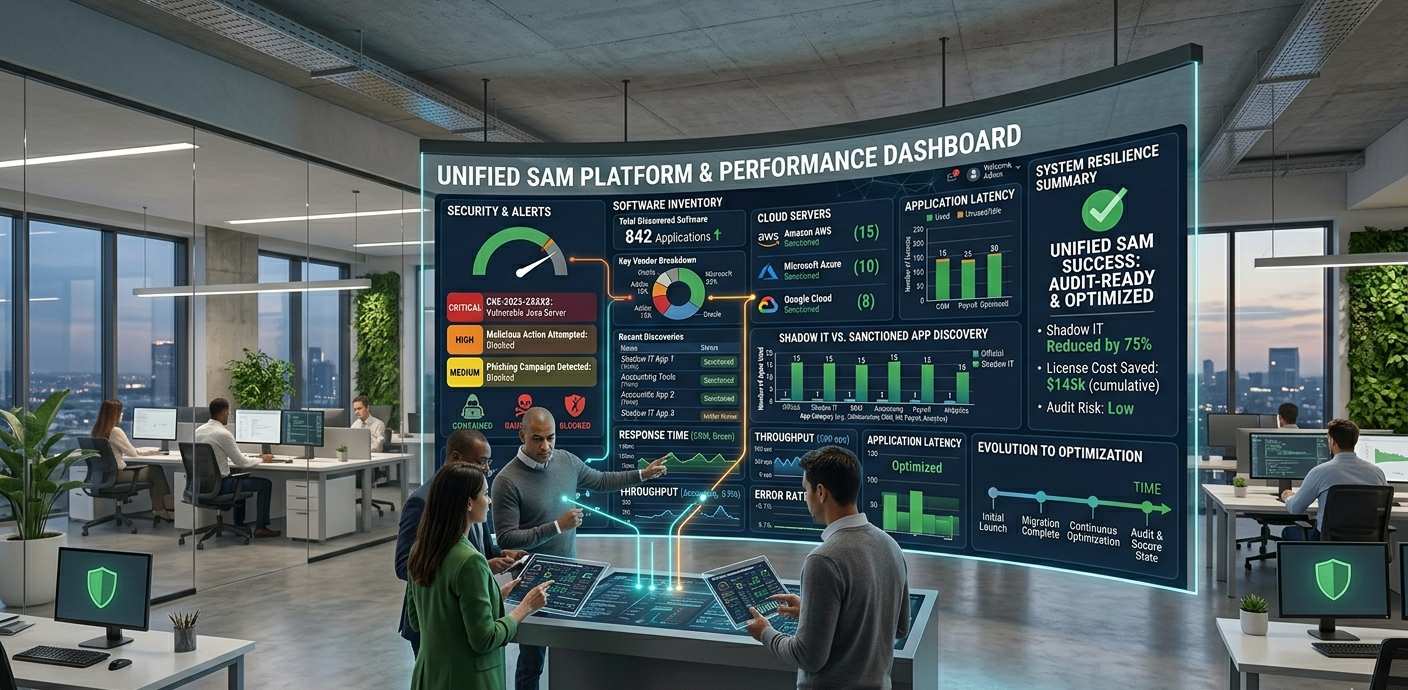
To remove financial waste and avoid compliance fines, organizations need a comprehensive Software Asset Management (SAM) program that is backed by automated discovery tools. These SAM platforms continuously monitor the network architecture and report all installed programs, active cloud subscription and user access token into a Single Source of Truth (SSOT).
When license allocation metrics are linked to usage information, it’s easy for IT managers to determine which assets are being underutilized and move free licenses to wherever they are needed. Furthermore, companies need to have a centralized software procurement process, where all software purchase requests are submitted to a single IT governance committee. This organized review avoids multiple purchases of the same tools across different departments, enables the company to leverage volume discounts with the vendor, and ensures that all vendor agreements include terms that are favorable and scalable for future expansion of the business.
Performance Optimization and Scaling

The Core Challenge
As the volume of data increases and users grow, it becomes more difficult to keep software running smoothly. Small-scale applications that work like a dream in a small cluster can break down badly under the load of enterprise production numbers. Typically these performance problems manifest themselves in the form of slow page loads, timeout on the Database and failures at the system level which involve the microservices during periods of high traffic.
When IT teams lack visibility into system performance, they tend to solve one problem by provisioning more resources in the system such as CPU cores and cloud memory. This solution may be a short-term bandage to the problem, but it quickly adds up the cost of cloud infrastructure. It results in a vicious cycle of organizations buying too much cloud hardware at high costs in order to support under-specified code and sub-optimal database queries.
Strategies and Best Practices
To obtain sustainable software performance, it’s important to shift from a reactive troubleshooting approach to an observability approach backed by automated Application Performance Monitoring (APM). These solutions, such as New Relic, Dynatrace and Datadog, give engineers real-time visibility across the entire software stack, letting them pinpoint slow database queries, memory leaks and other architectural bottlenecks before they affect end users.
Auto-scaling features in modern cloud environments should also be exploited in IT architectures. Infrastructure automatically scales up during peak traffic times to ensure performance, and down when traffic is lower to keep cloud costs efficient, thanks to the automated scaling policies.
Moreover, the development teams need to integrate automated performance testing (such as load and stress testing) into their CI/CD pipelines. High-concurrency stress tests can be performed prior to deployment to discover and fine-tune inefficient code paths and ensure that the software continues to respond well and remain stable under any business workload.
Conclusion
For enterprise software, the challenges of security, cost-effectiveness, and flexibility are always in play. These challenges discussed in this article – ranging from integration friction to the problem of cyber security, legacy systems’ tech debt, low adoption rates, licensing compliance and performance scaling – are a series of related challenges that demand a structured and proactive approach. If these problematic areas are dismissed as minor, isolated technical issues, then there is a risk of exposing flaws in operations and increasing infrastructure expenses.
Adopting a structured software management framework can help organizations move their IT infrastructure from a cost center to a key enabler of innovation. By doing so, enterprises can neutralize the operational risks before they affect the bottom line, with automated patch schedules, API-first integration patterns, incremental modernization of legacy systems and user-friendly onboarding programs. As a business environment becomes more digital, having an optimized, secure, and resilient software environment is a key part of long-term business growth and competitive advantage.