Academic life is rapidly changing, and pupils’ workloads are greater now than ever before. Being busy with lectures, reading a lot, a complex research project, and extra-curricular projects can be overwhelming. Fortunately, AI has entered the scene to even things up providing innovative solutions to improve studying, understanding, and time management. This could change how you learn and manage difficult projects on a daily basis by incorporating these cutting-edge applications into your work.
Identifying the BEST AI apps to boost your studies isn’t about shortcuts but identifying platforms that truly enhance learning and understanding. The proper technology is a tutor that is available at any time of the day and night, loves to help you with a confusing concept, can correct your academic papers, and can add up loads of books into readable summaries. Now, this comprehensive guide is going to share 10 of the best free AI tools around that can help you to produce sharper papers, study faster, research better, and be more productive overall.

AI Writing and Editing Tools
1. Grammarly
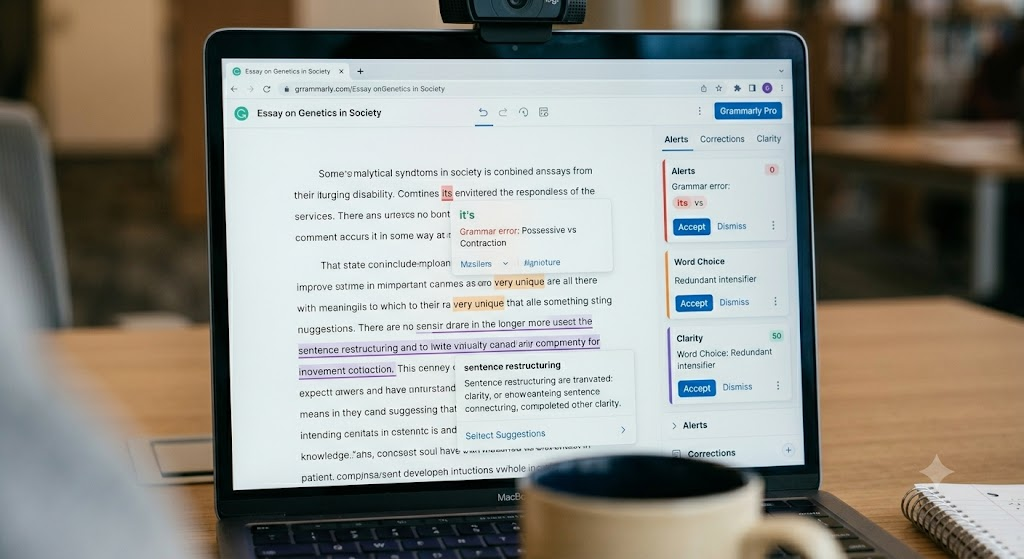
From a simple spell checker to a powerful AI-powered writing companion, Grammarly has come a long way and is an essential tool for students. The free version will make use of sophisticated NLP to fix grammatical, punctuation, and contextual spelling errors in your essays, reports, and e-mail messages. It does more than that and it gives you information about your writing style and your word choice to make sure your arguments are succinct and persuasive, eliminate passive voice and get rid of wordiness. It is a silent co-editor for both teenagers and university students which never spoils the hard labor compiled into a big academic paper due to careless typing.
The platform is easily embedded into different media platforms, including Web browser, Google Docs, or dedicated desktop application, which results in real-time monitoring and enhancement of your writing. What Grammarly offers is more than just correcting errors; it offers an explanation for why the grammar correction is recommended, and over time, teaches you to improve your writing. Regular use will enable you to develop structural habits that will enable you to produce your assignments to the stylistic expectations of your teachers and professors.
2. Hemingway Editor
A writing program designed specifically to make your writing bold and clear is in the form of a “Hemingway Editor”. It is called the Ernest Hemingway app, after the famous short-text author Ernest Hemingway, because the program aims to correct the following common errors: complex sentences, adverbs, and passive voice. Once you paste your essay in the editor, the essay will get color coded to indicate the areas of issues in your essay. For example, sentences that are clear are displayed in the normal color, but if one is overly hard to read, that’s marked in red and if it is simply difficult, that will be highlighted in yellow, which makes it easy to see where your writing slows down.
Similarly, Hemingway computes a “grade level” score to help students adjust their vocabulary to fit their audience. It helps you to break up large walls of words, to add and to simplify your vocabulary, and to present your arguments as effectively as possible. It’s a final, but useful, language checklist to be used before sending in any written assignment, especially when writing argumentative essays or scientific reports since clarity and precision are key successes to gaining a high grade on your assignment.
AI Tools for Summarization and Reading Comprehension
3. QuillBot
QuillBot is a very versatile AI tool that has garnered an exceptionally large user base among students for its state-of-the-art paraphrasing and summarizing features. One of the best features of the free version is its ability to use the “Summarizer” to condense lengthy research papers, news articles, or dense sections from books or other sources into bite-sized snippets of a few sentences or bullet points. Use it to get the gist of a text without spending a lot of time on filler material, and it will be an amazing tool when you’re going through a lot of reading for your term paper or upcoming exam.
Apart from summarizing, QuillBot’s paraphrasing feature also aids students in rewording sentences to enhance the flow and prevent unintentional plagiarism. It offers a number of modes, including “Standard” and “Fluency”, which change the meaning of the text without changing its mood. This will enable you to express complicated ideas in a way that makes the most of your own individual voice, and enhance your reading understanding and self-assurance in discussing difficult academic issues.

4. ChatPDF
Having to go through several lengthy PDF files in order to complete a research project can be tedious and time-consuming. ChatPDF takes this dynamic by enabling every PDF file to be converted into an interactive conversation. Students can upload textbooks, scientific journal articles, or historical documents, and the AI will analyze the entire document within a matter of seconds. After processing, you can even ask the tool specific questions about a text, like “What was the methodology for carrying out this experiment?” or “State the main conclusion of the author.”
A great academic writing tool is that, for every answer outputted by ChatPDF, it will offer direct citations and page numbers. This gives you the ability to easily see what it is and have something to refer to when you write the bibliography. It serves as a remarkably effective ‘virtual research assistant’, extracting all of the important facts, definitions, and arguments from gigantic documents without the need to skim hundreds of pages manually, thereby saving precious research hours during often laboratory-intensive study sessions.
AI Applications in Research & Fact Checking
5. Perplexity AI
Unlike regular search engines that may display numerous links and advertisements, Perplexity AI is essentially a sophisticated version of a conversation or answer engine that delivers succinct and synthesized responses to complex queries. This is an absolute boon to students who are doing in-depth research, as it will search, in real-time, the active internet to give you an overall view of your subject. Either it’s the economic factors behind the Industrial Revolution or the proof for a calculus theorem, Perplexity provides a step-by-step explanation with embedded citations.
Each piece of information presented by the tool is connected directly to the source (www, academic paper, news article); the origin of every piece of information is emphasized to ensure transparency. This will enable students to be able to cross-reference the information, check its accuracy and research reputable sources to quote in their own work’s bibliographies. The interface also brings up relevant follow-up questions, which helps you go deeper into your research topic while allowing you to discover angles and perspectives that you hadn’t thought about, ensuring that you conduct thorough and academically sound research.

6. Consensus
AI driven, this specific AI search engine is known as Consensus and is dedicated to academic and scientific research. It gives pupils the opportunity to pose questions for which they will only be given answers based on peer-reviewed science papers. Whereas conventional search engines may be biased toward the more popular blog posts, or opinion pieces, Consensus searches a database of millions of journals, for what the scientific community actually says on a topic and gives you an instant consensus meter on whether it’s a “yes,” “no,” or “possibly.”
This exercise is extremely useful to high school and college students who must present their points with firm factual information. It summarizes pertinent literature and summarizes the findings in a convenient format, saving time in reading through very technical abstracts. Use Consensus to make sure that your science papers, psychology essays, and socioeconomic reports have quality data, so that the assignments sound authoritative and are academically sound.
Learn How to Use AI Tools for Studying and Test Preparation
7. Quizlet (using Quizlet AI tools)
As a go-to online tool for students to showcase vocabulary and memorize important concepts, Quizlet has always done its job well, but it’s added some new AI tools to its stable. Students can now easily create flashcards, practice quizzes, and personalized study plans automatically from their lecture notes or book chapters with the help of AI. The grading system on the platform is “smart” in that it not only compares the exact words that students type, it also assesses their understanding of the concept that underlies the key words and informs the students if they hit the right path.
As students go through the various sets of cards, the adaptive learning algorithms keep tabs on their progress; when they sense they are not learning what they need to be, they will recognize which cards are the most important to recall and refresh those cards on their list more frequently. This is a selective method so that you don’t have to spend time reading something that you already know and will save a lot of time in studying. It is beneficial to those who are getting ready for a biology quiz in high school, as well as for those who are studying for an entire college course exam. These personalized study tools allow students to ensure that the information reaches them quickly and easily, while building confidence on test day.
8. AnkiApp
AnkiApp is an incredible flashcard program that adheres to the principle of delayed rehash, likewise called the spaced rehash principle, which is scientifically affirmed as the best technique for supporting long-term retention of information. The app will use the intelligent AI algorithm to gauge your recollection of every card again based on your feedback following the card review. If the card is hard to recall, the student will see the card more often; if it’s easy to understand, the student will delay seeing it again by a very long time, which ensures that the learner studies the material just before he or she is about to forget it.
It is a very useful systematic approach for a student who has to recall a lot of information, for example, medical terminology, foreign language vocabulary, or information concerning historical events. Create your own decks with images and audio, or download pre-made decks contributed by a world-wide community of learners in AnkiApp. The AI interfaces with your calendar to automatically schedule review sessions, stopping you from guessing on that studying process and placing information firmly in long-term memory well before you take the test.
Use of AI Tools for Organization and Productivity
9. Notion AI
Students’ organization offers one of the best notes-to-workspaces apps available, and usage of Notion AI transforms it into one of the top tools. The AI can help you brainstorm essay ideas, draft detailed essay plans, and even neatly arrange confusing notes from lectures into bullet points or tables within your personalized digital notebook. When you’ve emerged from a high-energy lecture with a jumble of ideas, the AI can help you distill it to to-do lists, actionable items, and learning summary.
Notion AI also streamlines the task of organized students by creating personalized study plans, assignment timelines, and organizing schedules. It can provide translation to other languages, rewrite sentences with various voices, as well as have unclear jargon explained in the moment in your workspace page. The deep integration in the same place as your homework planner and lecture notes reduces the need to jump between multiple apps, offering a focused environment for learning, productivity, and efficient time management.

10. Goblin.tools
Goblin.tools is a curation of tiny, simple, and totally free single-task AI tools, designed specifically for students that are overwhelmed with big projects, procrastinate, or have trouble with executive dysfunction. It has an outstanding feature called the “Magic ToDo,” which transforms a seemingly intimidating and broadly worded task, such as “Write History Term Paper,” into a nitty-gritty, step-by-step checklist of small, achievable tasks. You can even fine-tune how “spicy” or “granular” you would like the broken-down steps.
With Goblin.tools, a huge and stressful task is broken down into small, manageable steps, eliminating the psychological hurdles that make people procrastinate. The suite also provides for the evaluation of an email’s tone before sending it to a teacher and provides an estimate as to the time it’ll take to complete a given task. It’s a very supportive and empathetic app to plan thinking, schedule time efficiently, and provide the motivation to get academic tasks done.
Conclusion: Maximum Academic Achievements Honestly
Using Artificial Intelligence as a student is not an attempt to get out of learning but certainly to use state-of-the-art technology to make oneself a deeper, more efficient, and more resourceful learner. The ten tools highlighted in this guide are entirely free and provide cutting-edge support for transforming complicated issues into manageable ideas, structuring jumbled calendars, and editing murky academic writing. These applications, used deliberately, can help ease the overwhelming stress of work and improve educational results.
While using these powerful and incredible platforms, it is crucial to uphold a high level of academic integrity. Even when obtaining these AI helpers to summarize unclear subject matter, correct mistakes in your initial draft, arrange your research, create study materials, and more, remember that your final product should demonstrate your own critical thinking, voice, and understanding. In the hands of smart, responsible users who leverage AI as a collaborative instrument, students can attain their true learning potential and look forward to achieving lasting educational success.