Introduction
Modern computing systems are no longer based on the notion of executing a single operation at a time. Computers are much more complex machines, and software has grown increasingly sophisticated and powerful, requiring quicker response times from the machine as users expect more from it. Modern machines, such as supercomputers, personal computers, smartphones, and cloud platforms, heavily utilise parallel processing techniques to speed up, enhance efficiency and reliability. Parallel processing is one of the most significant breakthroughs in computer organization, enabling computer systems to break down problems into smaller subproblems and solve them concurrently with multiple processing resources.
The advent of parallel computing has revolutionised the design of processors and the way applications are built. Rather than trying to improve the clock speed of a single processor, computer engineers are now concentrating on using more processors and improving the way that they communicate. This enables the computer to be used for tasks that are very challenging like artificial intelligence, scientific simulations, video processing, gaming, and analyzing large-scale data. Parallel processing in computer organization describes the organization of multiple operations and resources to gain increased performance. This approach has since formed the basis for modern processor architecture and is still having an impact on the evolution of future computing technologies.
What is Parallel Processing?
In parallel processing, more than one processing element is used to process more than one instruction or data simultaneously. Parallel systems break up tasks into smaller components, and then those components are performed simultaneously, unlike sequential where one instruction has to complete before another instruction can start. The processing elements can be a collection of multiple cores in a single CPU, multiple processors in a single computer system, graphics processing units (GPUs), or distributed computers that are linked together through a computer network.
The main aim of parallel processing is to speed up the computation, enhance the performance of the system and enable the computer to process a more complex problem efficiently. As an example, if you’re editing a high resolution video, you need to perform thousands of calculations on the pictures, audio, and visual effects. This is where parallel processing comes in: A computer with multiple cores can break these tasks into smaller ones and have multiple calculations occur simultaneously rather than requiring one processor to perform each one in succession.
Parallel processing is not simply a matter of putting more processors into a computer. Instructions, data, memory and communication between processing units need to be carefully organized to be effective in parallel computing. System architecture dictates the way tasks are split and how well various components work together. This is where Flynn’s Taxonomy is relevant since it classifies the various architectures of a computer by the way instructions and data are processed.
The FlyNN Taxonomy: A Classification of Computer Architectures
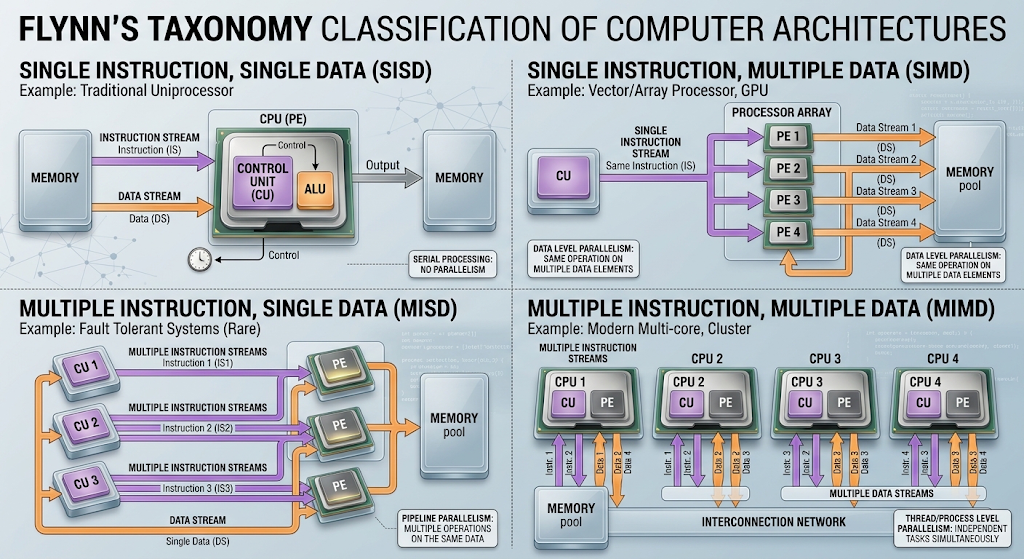
Flynn’s Taxonomy is one of the most popular ways to classify computer architectures that are parallel. The classification system was proposed by computer scientist Michael J. Flynn in 1966 to categorize computers by whether they have one instruction stream and one data stream or two, one instruction and two data streams. An instruction stream is the ordered sequence of instructions which are executed by a processor and a data stream is the sequence of data that is processed by the instructions.
According to Flynn’s Taxonomy, there are four basic types of computer architectures: Single Instruction Single Data (SISD), Single Instruction Multiple Data (SIMD), Multiple Instruction Single Data (MISD), and Multiple Instruction Multiple Data (MIMD). These categories enable engineers and computer engineers to comprehend the various mechanisms that enable parallel execution of different systems, and the way processors are designed to execute a specific workload.
While many modern computers have features of several of the types in this taxonomy, the concept of Flynn’s Taxonomy is still important in computer organization because of its ability to explain the evolution of computer systems from a single CPU to today’s multicore and very parallel systems.
Single Instruction Single Data (SISD)
Single Instruction Single Data (SISD) is the most basic of all the computer architecture. With a SISD system, the processor performs one instruction at a time and processes one stream of data. This architecture is based on the traditional sequential computing model in which tasks are executed sequentially. This design was used by early computers and in many basic processing systems, where the applications were not very complicated and could not be executed in parallel over many processors.
In SISD architecture, the processor takes an instruction, does the desired information processing on the data, saves the output, and goes to the next instruction. This method is simple and effective, but also has a drawback since it is a single processor based method. With the growth in the size and complexity of software applications, it became increasingly challenging to raise the performance of software systems using SISD systems as processors were no longer able to keep increasing clock speed indefinitely because of heat generation and power consumption issues.
The pure SISD types are not as common as they are in today’s high performance computing, but are important because they are the building blocks from which more sophisticated parallel architectures evolved. This is one of the reasons why computer engineers turned to architectures that could execute multiple instructions or process multiple data elements at once.
Single Instruction Multiple Data (SIMD)
Single Instruction Multiple Data (SIMD): increases performance by processing multiple pieces of data with one instruction. SIMD processors execute the same instruction on a block of data elements at the same time. This method is especially useful when performing operations on a large volume of data.
An example of SIMD processing is in multimedia applications. If a computer filters a digital image, then the computer has to carry out the same calculations for thousands or millions of pixels in the image. SIMD instructions allow a processor to affect several pixels at the same time rather than a single pixel at a time. This markedly optimizes the processing time and enhances efficiency.
Many modern CPUs also have SIMD capabilities in the form of instructions specifically created for graphics processing, scientific computing, AI processing, and video encoding. Graphics Processing Units (GPUs) are also used heavily, since they are designed to run many parallel sets of similar calculations. Therefore, SIMD architecture is a must for applications involving massive data processing.
Multiple Instruction Single Data (MISD)
Multiple Instruction Single Data (MISD) is an architecture in which multiple instructions are used to operate on the same data stream. In contrast to SISD and SIMD, MISD is not frequently used in general-purpose computing because most of the applications do not need to execute multiple instructions at the same time on the same data. But in some specific systems where reliability and fault tolerance are crucial, the architecture may be used.
In certain safety critical applications with several processing units reading the same data, MISD systems can be used. In the case of an aerospace and defense system, for instance, some systems might have redundant calculations, with multiple processors running various algorithms on the same data to cross-check results and identify errors.
MISD is one of the least common types outlined in Flynn’s Taxonomy, but shows that parallel processing is not just about doing more data at the same time. In systems with applications that have significant consequences if errors occur, parallel architectures can strive for reliability, accuracy and decision making.
Multiple Instruction Multiple Data (MIMD)
Multiple Instruction Multiple Data (MIMD) is the most popular parallel architecture used in today’s computers. MIMD systems have a number of processors or cores working on a number of different data sets, performing different instructions simultaneously. This enables many tasks to be carried out independently simultaneously on many computers and it makes MIMD very flexible and appropriate for general purpose computing.
MIMD is used by almost all modern desktop computers, laptops, servers and smartphones. An example of a MIMD system is a multicore processor, which is composed of multiple processors (called cores) that can process different instructions and perform different operations independently from one another. A single core can be used to run a web browser, a different core can be used to run a background process and a third core can be used to run a system process.
MIMD is a flexible architecture that can be used in a variety of applications and environments. MIMD principles are also used in larger systems like cloud computing platforms and supercomputers, where a large number of processors are interconnected to tackle highly complex computing tasks.
Multicore Architecture: Multiple Processing Units Within a Single Chip
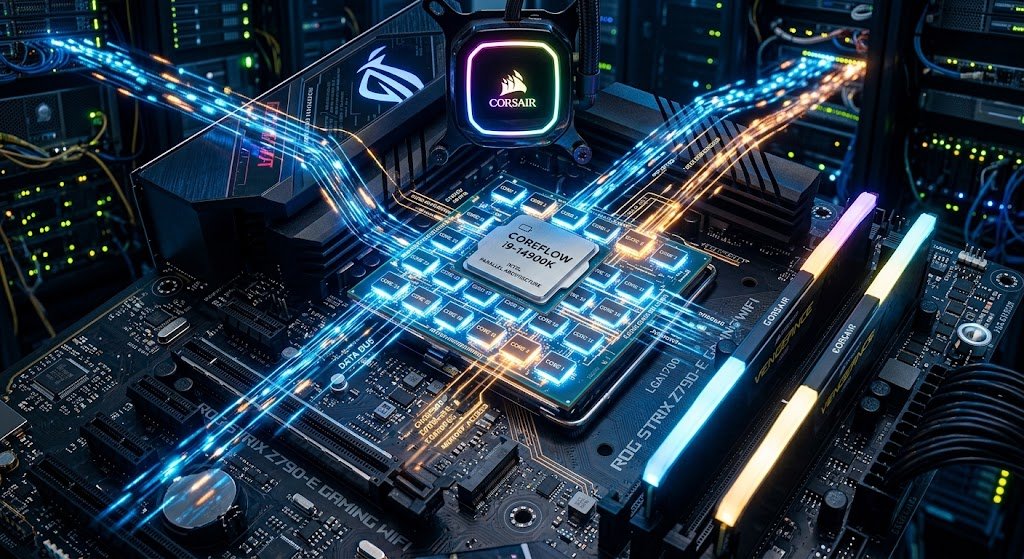
Multicore Architecture is the use of multiple processing units within a single chip. Multicore processors have two or more cores (or processors) built into a single CPU chip. Each core is a separate processor, and they can run instructions independently of each other. One reason for the widespread adoption of multicore technology was that boosting processor clock rates wasn’t an effective means of enhancing performance.
With more cores, computer systems can perform multiple tasks concurrently, and still be energy efficient. For instance, a contemporary laptop can be operating several cores for simultaneously handling activities in the operating system, application processing, background services and user commands. Multicore processors are now commonplace devices in personal computers, mobile devices, and professional workstations.
But with more cores does not necessarily mean more performance enhancements. Advances in software design, like multithreading and parallel programming, are required to be able to utilize multiple cores. If the work is not divided well, it might not gain much from extra cores of processing.
Multicore vs Multiprocessor Systems
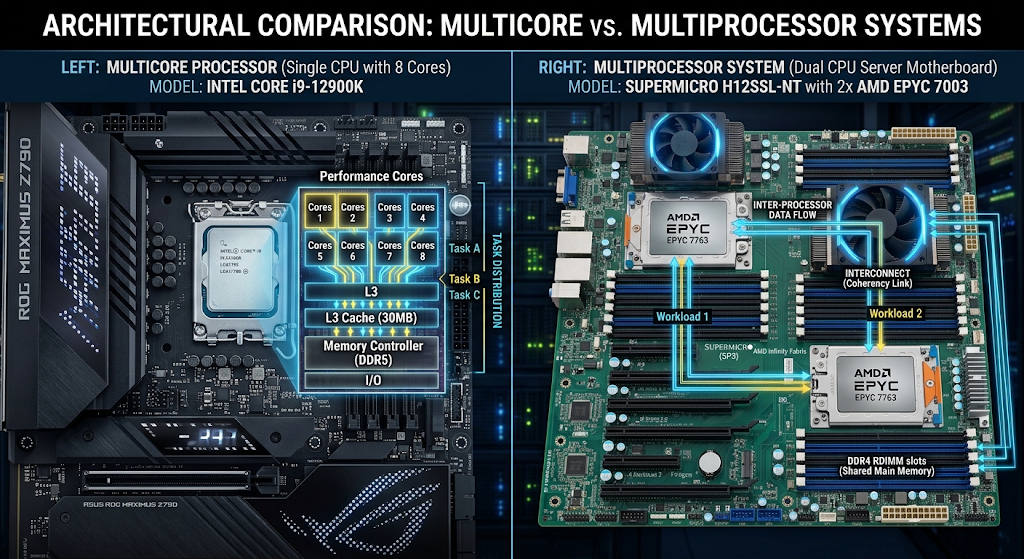
Multicore or multiprocessor systems are both systems of multiple processing units, but they differ in the way the processors are physically arranged. A multicore system is a system that has several processing cores on a single CPU chip, and a multiprocessor system consists of several individual CPUs that are housed within a single computer system.
Consumer products typically have multicore processors because they offer better performance at lower power consumption and reduced size. They enable computers to carry out several operations quickly and efficiently without the need for extra hardware.
Multiprocessor systems are typically employed in high-performance applications like enterprise servers, scientific research labs, and large data centers. These systems can be created by linking up a number of physical processors to generate an immense amount of computing power. They tend to be, however, more costly, and the communication system between processors is more complicated.
These are both ways of achieving parallel computing. Performance needs, cost, energy efficiency, and workload type are important considerations for choosing between multicore and multiprocessor architectures.
Computer Architecture – Pipelining in Computer Architecture
Another important technique to enhance the performance of the processor is called pipelining. It does so by splitting up the execution of instructions into a number of stages, so that different instructions can be executed at the same time in different stages. With pipelined processors, multiple instructions are executed simultaneously without waiting for one instruction to be finished before any other instruction is executed.
Instruction pipelines can consist of several stages, including instruction fetch, instruction decode, execute, memory access, and store result. One instruction could be executed, another could be decoded and another could be fetched from memory while this is happening. This helps to increase the number of instructions completed within a certain period of time.
Individual instructions may not be completed any faster by pipelining, but the overall efficiency of the processor increases due to increased throughput. Modern CPUs have pipelined, multicore CPUs and other optimizations to boost performance.
Why Parallel Processing is Needed in Modern Computers?
With the continuous growth of technology demands, modern computers have to be able to parallel process. Artificial Intelligence, machine learning, 3D graphics, virtual reality, scientific research, and cloud computing are just a few applications that demand tremendous amounts of computing power. These tasks would be too time consuming for one processor to complete sequentially.
In parallel processing, one or more processors break down complex problems into smaller subproblems, and then solve all subproblems concurrently. This enhances the speed, decreases processing time and enables larger volumes of data to be handled. In addition to its use in simulations involving weather forecasting, medical discoveries, and space exploration, parallel computing is used in businesses for data analysis, online services, and automation.
Another reason making parallel processing an essential is energy efficiency. Today, instead of increasing the speed and power usage of one processor, many systems partition the work among multiple processors that run at lower speeds. This method is more efficient and helps to manage heat production and electricity usage.
The Future of Parallel Computing
Improvements in parallel processing and processor organisation will remain important to the future of computing. Computers will need even more efficiency and computer processing power as artificial intelligence, robotics and data-driven technologies grow. The study of new architectures based on special processors, quantum computers and advanced distributed computing methods are being investigated.
Future processors are expected to take a few different parallel approaches; multicore designs, GPUs, AI processors, and better memory systems will all be utilized. Software development will also be more directed towards writing software that is capable of using parallel hardware.
Today, parallel processing is no longer an option for the performance of a modern computer, but a necessity for the performance needs of today’s digital world. Knowing the architectures like Flynn’s Taxonomy, Multi Core, Multi Processor and Pipelining can give insight into how the computer is evolving and how it is capable of dealing with more complex workloads.
Conclusion
The computer architecture of parallel processing and multicore has revolutionized the way instructions are executed and data is managed. Flynn’s Taxonomy offers a convenient classification of the various types of parallel computing: SISD, SIMD, MISD, and MIMD.
Multicore processors, multiprocessor systems, SIMD technologies and pipelining techniques are all used to enhance the performance and efficiency of computers. With the ever-evolving technology, parallel processing will continue to play a crucial role in computer innovation, empowering faster, smarter, and more powerful systems for the future.