Introduction
With the rise of the smartphone, people have begun to communicate with financial markets including the foreign exchange market worldwide in a different way. Rather than relying solely on desktop computers, traders can now access the market information and review the currency prices, analyze charts, manage accounts and submit trade trades from suitable cell phones and other gadgets using mobile forex applications. They are a complicated trading application, which links the smartphone with the technology and the brokers that run the forex market. What seems to be an easy-to-use mobile trading screen actually carries systems that help send prices, execute orders, secure accounts and keep data up-to-date on various devices. Mobile forex trading is more than just downloading an app and pressing a buy or sell button. Knowing the implications of connectivity, security, permissions, data synchronization and the limitations of a smartphone can allow users to appreciate what they are able to achieve when trading on the foreign exchange market.
How Mobile Forex Trading Apps Integrate with the Market.
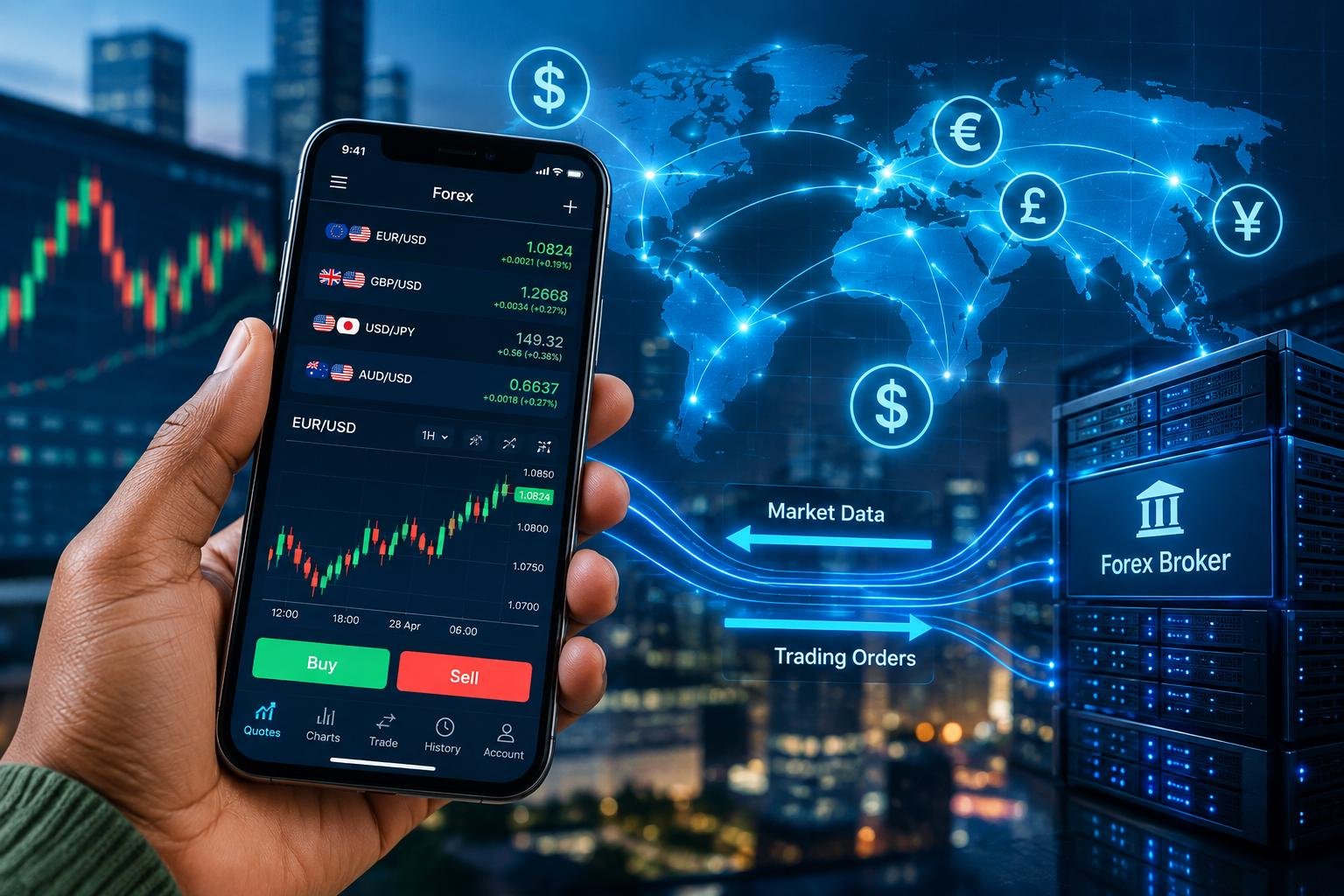
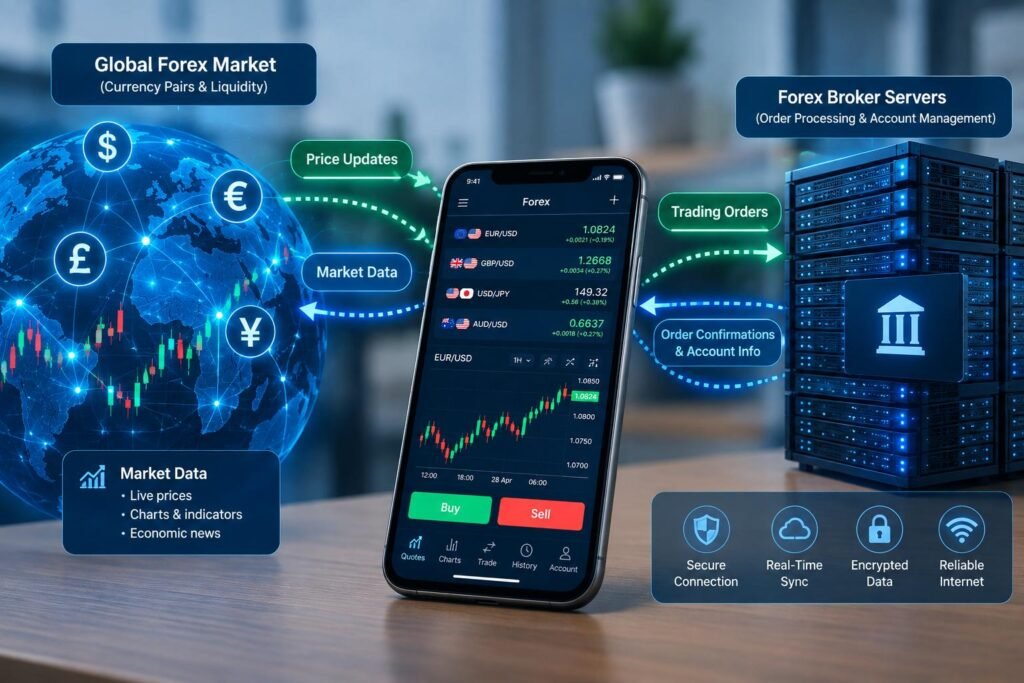
A mobile forex application is basically the interface between the trader and the forex broker’s trading framework. As soon as a trader logs in to the app, the smartphone transmits information to the broker’s servers via a connection to the Internet, and the information can be transferred either way. The market price and the account information can be sent from the broker to the application, while instructions can be sent from the smartphone to the broker for processing. There is no application that forms the foreign exchange market, nor is there one that sets prices for the currencies. Rather, it is a convenient method of communicating with the brokers provided services and linked market facilities. This type of architecture enables many operations to be performed remotely, but these will vary in quality and timeliness based on internet connectivity, availability of the servers, the performance of the application and the broker’s technology.
Internet Connection and Data Transfer
One of the most crucial factors for mobile forex trading is the internet connection as the application must be able to communicate with the relevant servers. The smartphone can be connected via mobile data or WiFi, and the app can exchange information with remote systems at all times while the user is watching live market data or is managing an account. Network disconnections can cause the new information to not be received or communication between the device and the broker to be delayed. This is especially true when users are trying to place or change orders. Foreign exchange markets are open and continuously trading during their trading hours and a displayed price can also change while a trade is being sent through these markets. However, mobile trading applications cannot remove the technical impact of weak signals, weak communications, or device issues or outages.
Live Forex Price Updates
One of the primary purposes of a mobile forex app is to deliver the latest forex prices to the user’s screen. Typically, price information is provided to the broker via the market data that the broker provides and displayed in an easy-to-read, user-friendly format within the application. Depending on the platform, traders can view various details such as currency pairs, bid/ask rates, price movements, and more. The rate of foreign exchange is subject to rapid fluctuations; therefore, the application should continually be able to get and process new information so as to keep the information displayed updated. The updates take place at different speeds, depending on the broker, data infrastructure, internet connection and application. Note that a price shown on a cell phone doesn’t always mean it’s going to be available when you place an order. Prices are subject to change from the time of making a quote to placing an order.
Interactive Charts on Smartphones
Mobile apps also offer charting tools, which help traders analyze past and present price trends. Interactive charts can often be expanded over a range of time, so the user can see short-term actions of the chart or larger trends. Retail traders can enjoy technical indicators, drawing tools, various chart types and customization of time frames, depending on the application. Zoom, scroll and adjust chart settings with your finger using touch screen controls. But smartphone screen is smaller and detailed technical analysis may be less convenient than on a desktop screen. It may be easier to analyze several charts, indicators and information panels on a larger display. Mobile charting can be helpful to track markets and do analysis while not at your computer, but users should know that the interface may not give you as much room as having a full desktop.
How Orders are Placed through Mobile Applications.
Another vital feature of a mobile forex trading app is order execution. Once a currency pair and trading orders have been selected, the application will send the orders to the broker’s system. With various platforms, users can choose order types, set quantity and set stop-loss and take-profit levels for risk management. After the order is placed, the infrastructure of the broker performs the process in the order depending on the market conditions and the model of their place. The application can then display the information about the resultant position or order status. Being able to trade orders from a mobile device can be convenient since there is no reason why traders should be physically close to their desktop computers to place trades. However, there are many cases where using mobile technology does not guarantee immediate execution. Factors such as network delays, market volatility, and server problems and liquidity conditions may impact the experience.
Orders and Positions are now Controllable.
Once the position has been opened, traders can monitor and manage it via the application. Order status, margin information, available funds, current values and open positions can be displayed on the account screens. Depending on the individual broker, changes and/or termination of positions can be made directly within the application. These functions also enable using the mobile phone as a portable account-management interface rather than just as a price source. The fact that users have these controls at their fingertips, though, means that they need to know what each button or order instruction does before confirming an action. Accidental selections may be possible when using touchscreen interfaces, especially if the display is small or there’s a distractive environment. It is therefore imperative to check the order details before submitting.
Checking and Viewing Portfolio Information and Progress of Account Capabilities
Mobile Forex sites may be able to offer real-time access to account info. A trader might be able to access balances, open positions, transaction history, available margin, and other details without logging into the trader’s desktop computer. This can be helpful when out of the office, on the go or even in the day to keep an eye on activity. It’s also possible for users to observe modifications that may need to be taken care of, for example, any new orders that have been executed or any funds changes. The information that the app displays is typically linked to the broker’s systems so if changes are made via one of the supported interfaces they will be visible in the other. Users should however make sure that the Application is linked to the proper account and that the account information is accurate before any decisions are made based on such information.
Push Notifications and Market Alerts
Push notifications are also a crucial link between mobile devices and trading platforms. Instead of users having to maintain a constant presence in the application, notifications can notify users when certain events happen. These can be price alerts, executions of purchases, messages regarding the accounts, or other market information. Notifications are helpful for raising awareness as information can be presented to the smartphone even if it is being used for some other purpose, such as viewing the trading interface. But, notifications are not a replacement for ongoing monitoring or real-time action. Network conditions, device settings, limitations on the operating system, and/or permissions for the applications could delay a notification. Users should also refrain from compromising with too many notifications which may result in an inability to distinguish important notifications from regular ones.
Economic News and Market Information
Numerous mobile forex software include trading capabilities along with economic news and market information. Events, like a central bank announcement, an inflation report, an employment report, or anything else that could affect the currency markets can be scheduled on an economic calendar. The news feeds can give more contexts to events that are likely to impact economies and financial markets. This can be integrated into a mobile platform, thus minimizing the need to jump between multiple apps to analyze the market. Traders need to differentiate between getting and understanding information, however. While some news releases will give a clue as to how a currency pair will perform, others may not. Market reaction can be influenced by expectations, previous releases, policy decisions and other market factors. The use of mobile applications facilitates access to information, but the user still has the responsibility for determining the reliability, timeliness and relevance of information received.
Biometric Security and Mobile Account Protection
Security is crucial for a mobile trading platform as it can give direct access to financial accounts. A lot of today’s smartphones have fingerprint or facial recognition as a method of authentication. Biometric authentication can provide an additional layer of security when combined with the application and the device, as it will require a biological trait before granting access. Other measures at the device level, such as a strong password, security software on the device, application updates, and account security can also help lower the risk of unauthorized access. Users should not share any authentication information or should be careful about neither using networks they don’t know nor installing applications from untrusted sources. Losing a smartphone or allowing it to be stolen can have more dire consequences when its applications allow access to money. It’s not only the application that needs to be secure, it’s also the user’s security of the smartphone and account details.
Application Permissions and User Privacy
Typically, the mobile apps ask permissions to do certain actions on the mobile device. Some permission can be used for notifications, biometric authentication, or more. The user should check out the permissions that a trading app is asking for and why they’re needed. If permissions are granted for no reason, it can present privacy/security risks. The caveat is that denying an essential permission could cause the use of some features to be hampered. It is better to use official application stores or official and legal broker sites to get trade software, since software that is downloaded from other sources may have greater security risks. It’s also important to ensure that the user’s operating system and trading application are up to date since software updates can contain security enhancements, bug fixes, and compatibility updates.
Smooth Integration and Coordination of Mobile and Desktop Platforms
A major benefit of emerging trading technology is that of being able to synchronize the mobile and desktop trading experiences. If a broker offers several interfaces that can be linked to the same account, most of the time, data on open jobs, account balance, orders and trading history is accessible on supported devices. This implies that a trader may analyze on his desktop computer and then keep track of his account via a cell phone. With synchronization, you don’t need to keep different account information on different devices. But there is still a need to synchronize and rely on the broker’s infrastructure and the internet connection. The data may not be immediately updated if the information is not received or if there is a temporary outage. It is therefore important that users are aware that communicating between the application, the broker servers and the particular trading systems is needed for information to be synchronized.
Limitations of Smartphone in Terms of Trading Capabilities
While mobile applications can offer a lot of flexibility, there are practical restrictions to smartphone trading. The screen size of a phone may be smaller than that of most desktop computers, and detailed chart analysis and monitoring of multiple instruments may be more difficult. Battery life can also be a factor when using for long periods and weak network coverage can affect the ability to connect with live information and account services. Mobile devices sometimes can be misplaced, broken or stolen. Besides, it can be difficult for the user to make decisions when trading from an appropriate environment and not even analyzing the situation. The use of mobile applications should thus be seen not as a risk management panacea, but as a powerful tool for accessing the planning process, research and risk management. Users should be aware of what their platform can do and have other plans in place if their device or connection goes down.
Conclusion
The Mobile forex trading application has actually revolutionized the way people can access forex trading, bringing the market details, charting, order management, account monitoring, notifications, security attributes and economic news into a mobile phone interface. The technology they’re underpinning brings mobile devices into contact with the broker servers and financial-market infrastructure, enabling the flow of information and trading directions from the mobile devices to remote systems, and vice versa. Mobile access can be easier, with biometric authentication and synchronization with desktop platforms; live prices and interactive charts enable traders to keep an eye on markets outside of their desktop environments. Meanwhile, for the smartphone, it still relies on the Internet, the performance of the device, app permissions, server availability, and security protocols. By knowing these pros and cons, users will be able to realize that mobile trading is a technological platform where they can access forex services and not a representation of the quality of execution and trading profits. Connectivity, account security, permissions, information quality and the limitations of operating through a mobile device, all require attention in a responsible use.
Get more well researched information about Mobile Forex Trading Apps here.