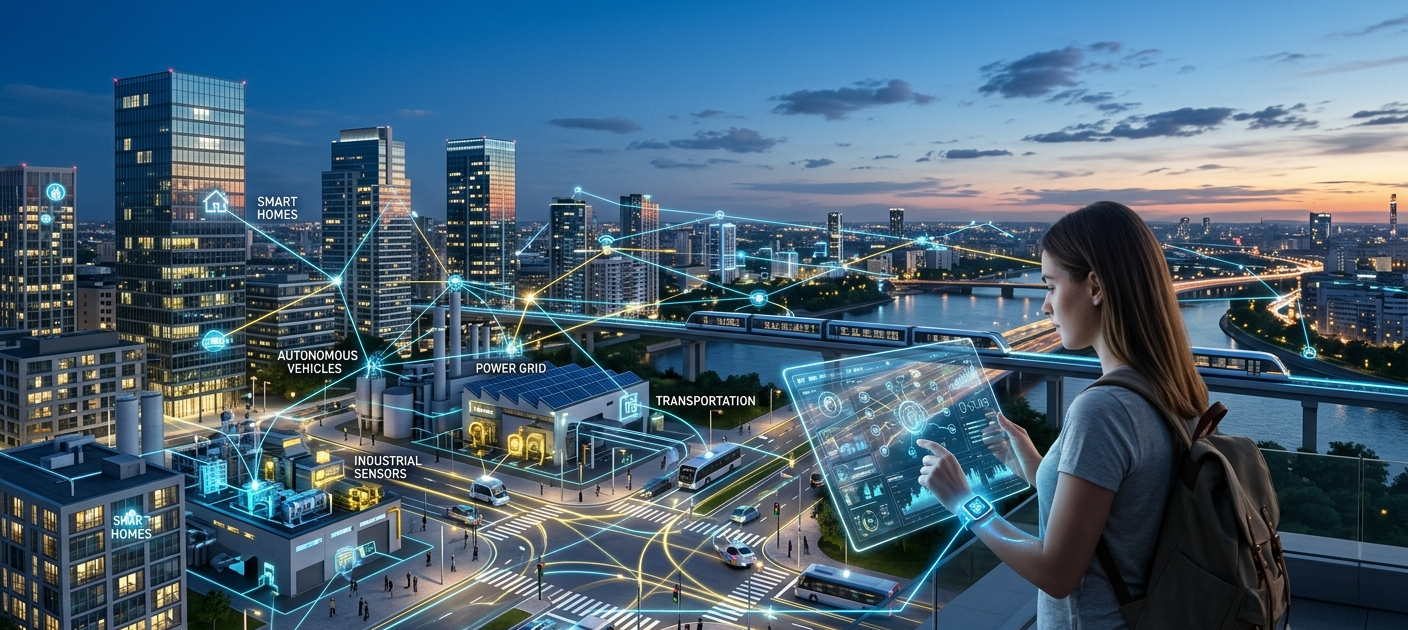
Previously, the world was a physical one, not a digital one. Objects were incapable of action, machines worked independently, and man was needed to connect the dots between data gathering and action. Nowadays this border is breached. The Internet of Things (IoT) is one of the biggest technological changes of the 21st century that turns everyday objects into intelligent and connected assets. IoT is the technology of integrating sensors, software, and network connectivity into everyday objects, which can collect, share, and respond to data with little or no human intervention. It is an interdependent environment that is changing the way industries conduct business, how cities function, and how people live their lives.
It’s important to see beyond the devices themselves and understand the architecture that allows them to work. The power of IoT is in the seamless flow of information, whether it’s in a home, or on a factory floor, where an IoT sensor predicts mechanical failures. These are increasingly becoming a part of critical infrastructure, and they offer unprecedented efficiencies, but also significant vulnerabilities. A thorough understanding of how these technologies communicate, their most effective use and what are the serious security and ethical issues that arise when the world is fully connected is essential for navigating this landscape.
How IoT Works: Connection, Communication and Data Flow
The Internet of Things is a multi-layered system that ultimately aims to transform the physical world into digital insights. This process is based on a four-stage architecture that includes perception, connectivity, data processing and application. The perception layer is a set of hardware (sensors and actuators in physical devices). An environmental variable, such as temperature, pressure, motion or chemical composition, is sensed and converted into a digital signal. Actuators do the opposite; they take digital input and output physical actions: turning off a water valve, moving a digital lens, etc. These Internet of Things devices act as the “sensory nervous system” of the network, continuously observing the physical world.
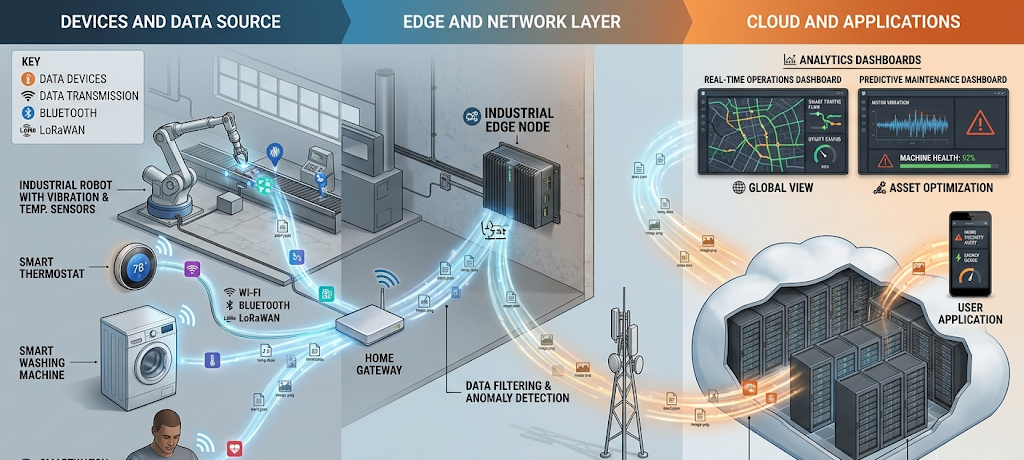
After data is received by the perception layer, it is needed to be sent through the network layer. This communication uses several protocols customized for the particular operational conditions of the device, e.g., how much power is available, how far the communication is supposed to travel, and how much bandwidth the communication requires. Low power, low range setups such as smart home wearables use protocols such as Bluetooth Low Energy (BLE) and Zigbee. For wider areas, such as smart agriculture or city-wide systems like utilities, Low Power Wide Area Networks (LPWANs) such as LoRaWAN can be used to send small amounts of data for many miles and with several years of battery life. For time-sensitive services such as autonomous driving, that requires very low latency and high bandwidth, cellular networks, especially 5G, will play a key role.
Once transmitted, the data moves to the processing layer which is in centralized cloud servers or at the edge of the network. Cloud computing provides a vast amount of storage space and enormous processing capabilities, perfect for powering complex machine learning models and analysing trends from millions of devices over time. But sending large amounts of raw data to far away cloud servers can cause latency and stress on network bandwidth resources. In response to this, edge computing is becoming more and more integral to modern-day IoT architecture. Local processing at the gateway or device itself can help remove noise, reduce bandwidth usage, and make split-second decisions in the locality prior to summarizing and sending a report to the cloud.
IoT Applications: Transforming Industries and Everyday Life
1. Smart Home and Consumer Automation
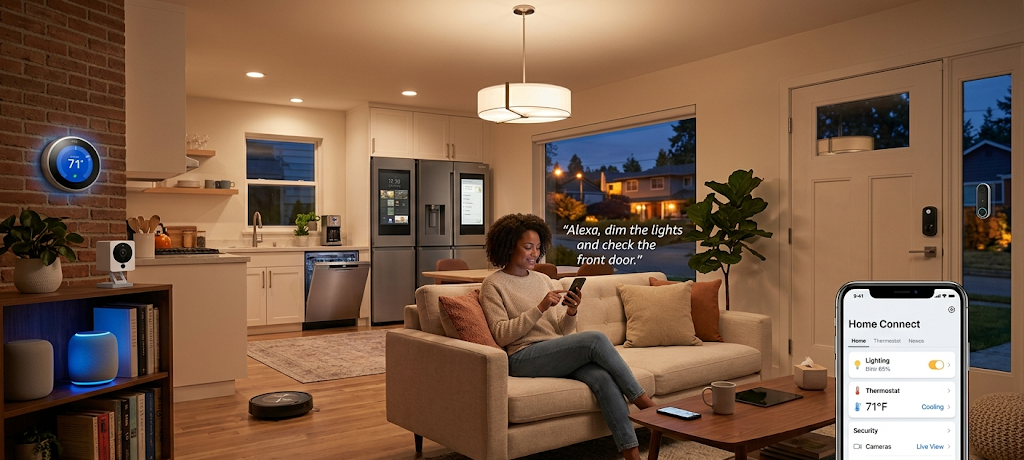
The most prominent example of IoT in the eyes of the common user is the smart home. The modern smart home is enveloped by platforms that bring together various appliances, connecting devices to create efficient and convenient living spaces, ensuring energy savings, and enhancing security. Smart thermostats are programmed to learn the occupancy pattern and preferences of the occupants, and can dynamically control the heating and cooling of zones as a way to reduce energy waste. Intelligent lighting systems work in coordination with ambient light sensors and geofencing to enable spaces to be lit up at exactly the right moment, greatly reducing residential carbon footprints.
Consumer IoT is becoming a vital part of a property management strategy and home security system, in addition to its convenience. Homeowners can use smart locks, video doorbells, and interior motion sensors to remotely check in on their home in real time, to open the door briefly for visitors and to get a warning message if there is any unusual activity. Smart environmental sensors can detect moisture changes in the tiniest amounts, and once set up they’ll alert homeowners to the start of a hidden plumbing leak before it causes significant water damage. The smart home is moving beyond the fragmented gadget ecosystem toward an interoperable, self-regulating network of devices, as these individual devices become increasingly interoperable thanks to open communication protocols such as Matter.
2. Healthcare and Remote Patient Monitoring
The Internet of Medical Things (IoMT) is changing healthcare from a reactive service to a continuous one in the medical sector. Vital signs like oxygen saturation, blood glucose, blood pressure, and heart rate are tracked in real time with wearable biosensors and implantable medical devices.
This constant flow of data can enable doctors to keep an eye on the people with chronic diseases from a distance, and notice that something is off when an individual hasn’t yet felt symptoms themselves for the disease. This helps to avoid unnecessary emergency room visits and dramatically cut the rate of hospital re-admission.
IoT Healthcare Application
| Primary Sensor Types | Benefits |
| Remote Patient Monitoring | Non-invasive glucose monitoring technologies such as Photoplethysmography (PPY), ECG, Continuous Glucose Monitors. Provides ongoing monitoring of chronic conditions and decreases readmissions to the hospital. |
| Smart Hospital Asset Tracking | RFID, Ultra-Wideband (UWB), Bluetooth Beacons. Efficiently manages stock and finds the most crucial life-support facilities in seconds. |
| Smart Medication Dispensers | Weight Sensors, Optical Sensors, Micro-Switches. Records compliance and notifies the caregiver automatically if the dose was not given. |
Impacts to asset management and patient flow in hospital settings. IoT infrastructure’s impact in the hospital environment. RTLS (Real-Time Location Systems) with Bluetooth beacons or radio-frequency identification (RFID) tags are used to enable critical, high-value equipment, such as ventilators, defibrillators, mobile X-ray units, etc. This makes it possible for the clinical staff to easily find life-saving equipment in a flash during emergency situations, which will save valuable minutes. In addition, smart drug dispensers can automatically record the time of the medicine dose dispensed, and inform family members or health care providers when the dose was missed, which significantly improves adherence to complex medication regimens.
3. Precision Agriculture and Environmental Management
Both the population increase and the diminishing natural resources are pressing factors for global agriculture. To solve these problems, IoT has the potential to offer precision agriculture, which aims to render uniform farming practices more highly targeted. Sensors for soil moisture, temperature and electrical conductivity are installed in large area cultivation fields to provide detailed information about the soil. This information can be seamlessly connected to automated irrigation systems, providing the precise amount of water needed for various areas of a field, thus conserving water resources and avoiding soil salinisation.
Environmental monitoring extensions provide the farmers with opportunities for a proactive response to fluctuation in weather and pest. Microclimate weather stations are strategically placed around fields and monitor local humidity, wind speed and solar radiation, and send the data back to predictive algorithms that alert farmers to a potential fungal outbreak or frost. In the fields of animal tracking and livestock management, collars and ear tags are used to track the movement of animals as well as their body temperature and rumination patterns. This enables the rancher to separate infected cattle in advance of the outbreak of a disease in the herd and makes it possible to determine the precise time of estrus cycles for optimum breeding efficiency.
Smart Manufacturing and Industry 4.0
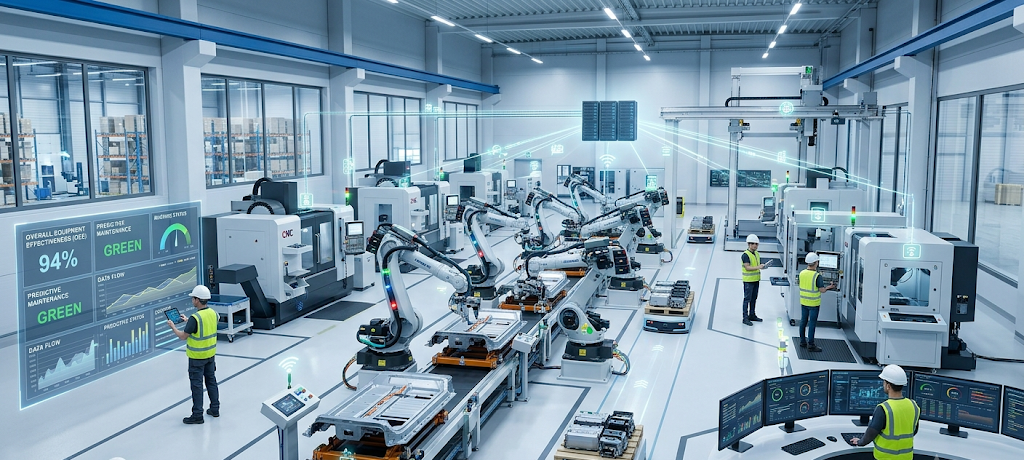
Connected technologies are also known as the Industrial Internet of Things (IIoT) and play the role of the backbone of Industry 4.0. Traditional manufacturing was based on a reactive maintenance model because machines ran until they broke down, triggering costly and unplanned downtime. But IIoT changes that by placing acoustic, vibration, and thermal sensors in machinery that’s used in a factory.
These constant vibration frequencies and temperature variations can be analyzed continuously by manufacturers with the help of predictive maintenance algorithms, and these algorithms can signal internal damage to bearings or mechanical misalignments before weeks of a breakdown, enabling manufacturers to schedule maintenance when they can be expected during natural downtimes.
In addition to maintenance, IIoT provides end-to-end visibility in complicated supply chains. Raw materials, subassemblies and finished products are monitored by sensors that accurately monitor their movement and condition during transport. These can be used to monitor pharmaceuticals or perishable food products in temperature-controlled supply chains, ensuring they are kept within safe temperature ranges during international transportation. On the factory floor, the AMRs interact with the central inventory databases and also with overhead cameras to move around the floors in a safe manner to pick parts and dynamically optimize the throughput of the assembly line based on real-time order quantities.
5. Connected Transportation and Smart Infrastructure
The Internet of Things (IoT) is reshaping the future of transportation by transforming vehicle safety, logistics efficiency, and urban planning. Today’s cars sport dozens of computers and sensors housed within them, tracking how the engine is running, how you’re braking, how aware you are, and more. Combined, these metrics can help fleet managers optimize routes, minimize fuel usage and monitor drivers’ safety ratings. On the macro level, the technology of Cellular Vehicle-to-Everything (C-V2X) communication enables bidirectional communication between vehicles, pedestrians and smart road infrastructure (RIs), and thus constitutes a prerequisite for mass autonomous driving.
This connectivity in the vehicle is leveraged by municipalities to build smart cities to help alleviate urban traffic congestion and carbon emissions. Smart traffic lights incorporate inductive loop sensors and overhead cameras to dynamically monitor traffic levels and modify light durations accordingly, thereby optimizing traffic flow and reducing congestion. Intelligent parking networks keep digital city signage and smartphone apps in sync with identifying empty parking spaces and directing drivers directly to them, avoiding the “churn” that accounts for a large proportion of metro emissions. Also, public buildings can be fitted with acoustic sensors to accurately identify where shots have been fired or cracks are occurring, aiding in emergency response and public safety.
Critical IoT Challenges: The Dark Side of Connectivity
As the IoT ecosystem has grown at an exponential rate, it has been difficult for security frameworks to keep up. The IoT ecosystem has grown at an exponential rate, and has presented an unprecedented level of attack surface for malicious actors. Several consumer IoT devices are built with very restricted computational power and memory, thus they cannot support the latest cryptographic protocols or their local firewalls. Also, many of these commercial products frequently come with default passwords which cannot be altered, and unencrypted firmware. This lack of basic security design enables the cybercriminals to find and compromise thousands of vulnerable devices at once with the help of simple and automated scanning scripts.
These are then easily combined into gigantic networks of infected computers known as botnets. The most well-known early example of this problem was the Mirai botnet that used hundreds of thousands of cameras and routers with weak authentication to stage megawatt-level Distributed Denial of Service (DDoS) attacks temporarily paralyzing large portions of the Internet infrastructure. In addition to their use in attacks from the outside, insecure IoT devices pose serious localized privacy risks. A hacker can exploit a compromised smart security camera, internet-connected baby monitor or a voice-controlled assistant to spy on someone’s life within their home and send their personal information right to the dark web.
Future Horizons: The Next Phase of IoT Development
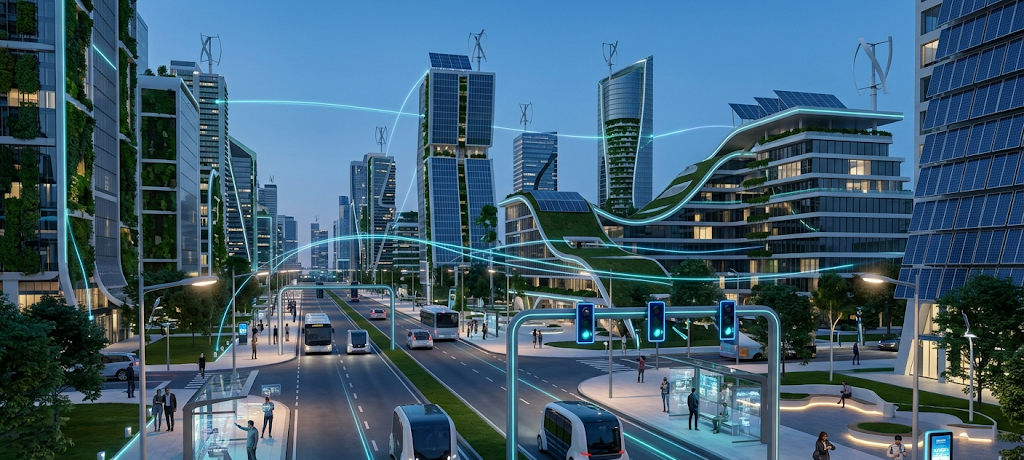
In the future, the development of IoT will be impacted by the convergence of Artificial Intelligence (AI) and the deployment of ultra-reliable Next-Generation Networks. The convergence typically referred to as the Artificial Intelligence of Things (AIoT), is shifting processing from mere data collection and programmed automation. Future IoT systems will have the cognitive ability to process complex data patterns locally and enable devices to adapt themselves to environmental changes without human involvement. An example would be an AIoT smart home, which would not only be able to adjust the thermostat according to a set time but could also use biometric data from a resident’s smartwatch to determine the level of stress or sleep stage in the room, and adjust the settings accordingly.
At the same time, new 6G architectures and advanced 5G networks will enable the catapulting of data transmission capacity to enable high-density deployment of devices. These networks have extremely high connection densities, up to one million devices in a 1 km² area. For complex smart city projects, such as water pipes, trash bins, street lights, and autonomous shuttles, this is the kind of scaling that is necessary to ensure that all of these components are able to share information with each other at the same time without impacting network performance. Advanced cryptographic methods, including post-quantum encryption and distributed blockchain ledgers, will complement this, ensuring the integrity and security of machine-to-machine transactions and data across the global supply chain.
Conclusion: Building a Connected Future With IoT
The Internet of Things is developing from an innovative technological high-end luxury to an invisible, omnipresent infrastructure. Where connectivity becomes a part of everything, the boundaries between a physical object and a digital system will be completely erased.
Humans can fully benefit this connected world by solving the essential issues of network security, device interoperability and data privacy. It will create a more sustainable, very efficient and highly responsive world ecosystem that will increase human capability and will be passed on to future generations while saving precious natural resources.