Introduction
Foreign exchange market is one of the busiest financial markets in the world with currencies being traded round the clock with the markets operating across various time zones and the foreign exchange market is influenced by economic data, interest rates, geopolitical news, investor sentiment and market expectations. As forex generates a vast amount of data daily, it’s increasingly becoming essential for traders and financial institutions to leverage technology for data analysis and trading decisions. AI systems can rapidly analyze vast amounts of data, identify patterns, categorize market conditions, and produce signals that human agents simply couldn’t manage. This speed is crucial for the development of AI-driven trading strategies. The ability of AI systems to process massive amounts of data, identify patterns, classify market conditions, and generate signals at a much faster rate than a manual trader is a key aspect of the evolution of AI-based trading strategies. The emergence of this has led to an increasing emergence of so-called AI-assisted trading, in which artificial intelligence is not used for autonomous trading decisions, but to complement analysis and trading.
AI in Forex Trading
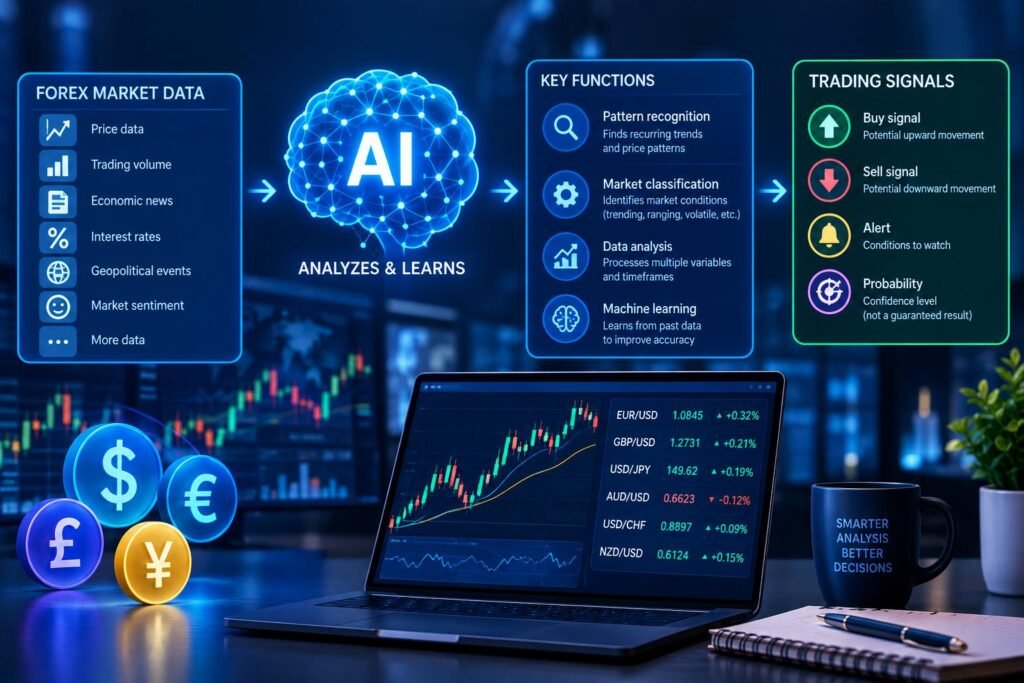
Forex AI trading involves employing computer systems designed to analyze data, recognize patterns, learn from past data, and generate analytical results that can assist traders in making decisions. Typical trading software usually operates based on explicit instructions which have been programmed by a developer or a trader in particular. For instance, if a rule-based system is given to purchase a currency pair whenever the short-term moving average is above the long-term moving average of the currency pair, there is no problem. By analyzing numerous variables and understanding of relationships from past examples, an AI system can take a different tack to solve the problem. Price movements, trading volume, volatility, economic information, technical indicators, and other available data can be analyzed by machine-learning tools to reveal patterns related to specific market conditions. The system does not necessarily have to be aware of the future but it can use past knowledge to make predictions about the future and to recognize scenarios that match patterns seen in the past.
Market Data Analysis by AI
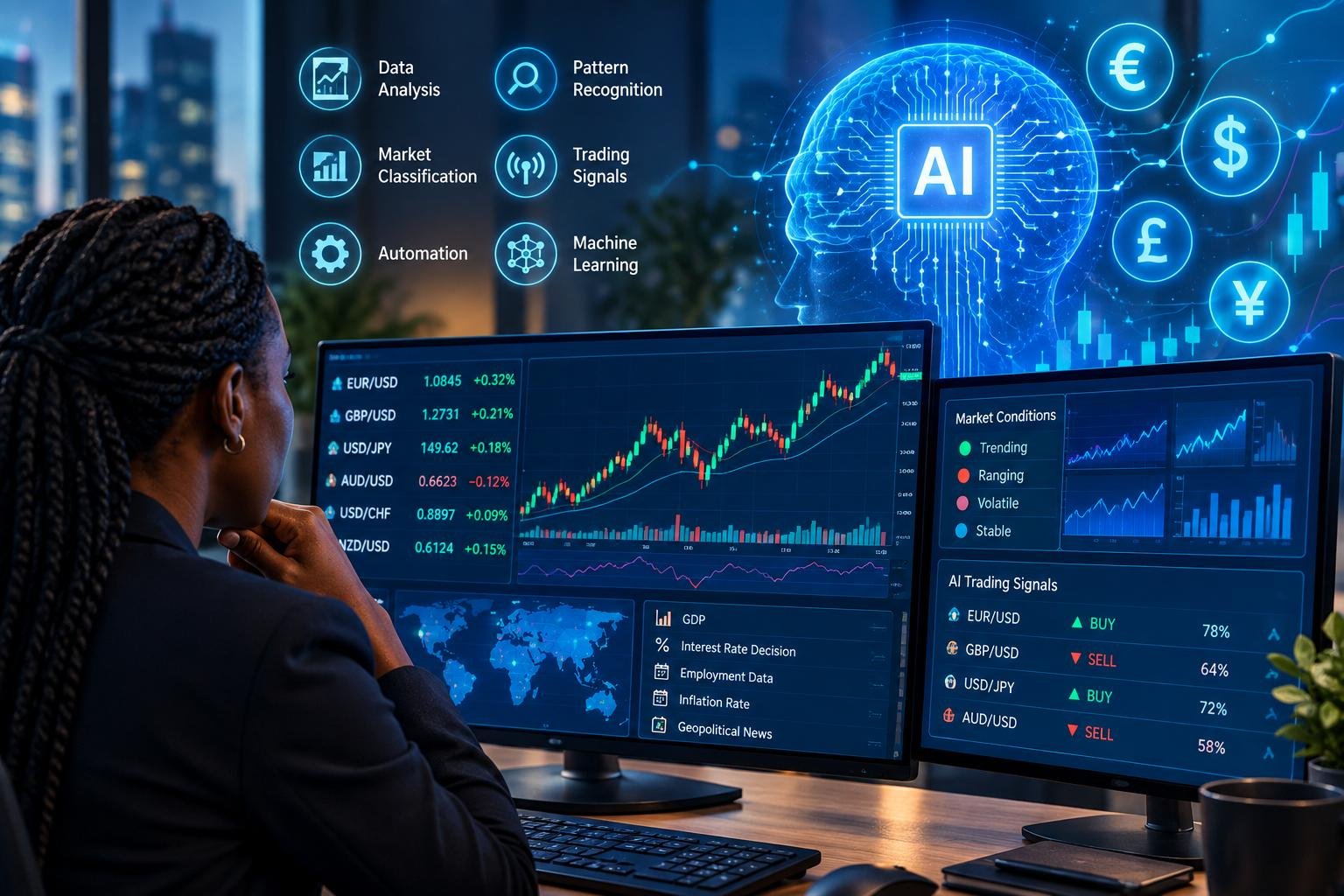
AI can analyze vast amounts of market data, a crucial function for any forex trader. The currency markets produce a flow of prices, trade information, economic releases, technical indicators and more information, which is not easy for humans to process simultaneously. These inputs can be organized by machine-learning systems and analyzed for relationships between different variables. Recurring price movements can be detected from historical prices and the volatility measurements can be used to differentiate between relatively calm and highly active periods. AI systems can also analyze data at various time frequencies, enabling them to analyze short-term price fluctuations and trends over a longer time horizon. This process will be very useful if the data is useful, accurate, and relevant. High quality data can create misleading patterns, so that sophisticated technology is not a substitute for the poor quality data.
Concepts of Market Analysis and Pattern Recognition
AI algorithms can also impact forex analysis in another significant way,: by recognizing patterns. Many traditional technical analysis strategies involve searching for known patterns or trends, or identifying key support and resistance areas, momentum shifts, or correlations between indicators. AIs can analyze such attributes in vast amounts of historical data and look for combinations that might not be obvious through human inspection. An algorithm, for instance, might analyze the frequency with which certain price-momentum, price-volatility, moving-average, and market activity patterns have preceded different types of price changes in the past. The relationships can then be used by the system to provide an analytical signal if similar conditions are observed. But because a pattern is observed in history does not imply that it will occur again. Relationships that were useful at one time and in one environment are not necessarily so another time and in another place, as the economy and politics change over time.
Classifying Market Conditions
AI can also be applied in distinguishing various market environments prior to making a trading choice. The Forex markets are not always the same. The periods can be characterized as having relatively strong trends, others as price action that goes sideways in the market, volatile periods or periods where the price reacts quickly to economic announcements. Machine-learning models can be trained to identify features linked with the various market regimes. For example, if a price has been moving upward or downward, or it is not making any significant moves, it could be classified as either a period of trending or a period of range-bound or extremely volatile or a period of relative stability depending on what moves came in the price in a given period and depending on which variables were used available. This classification can be used to decide which of the strategies is more suitable for the prevailing scenario. The trend based strategy could work differently if prices are not trending. AI systems can access the market conditions and potentially offer more context than a single fixed trading rule that reacts to the market in the same way all of the time.
AI-Generated Trading Signals
Another use of AI is in the field of creating analytical trading signals. The signal is a signal that some condition has been observed and a trading opportunity that is potentially interesting should be considered. AI models can analyze many factors and generate these signals, rather than just one indicator. For instance, price momentum, volatility, moving averages, past price action, and other factors could all be part of the system to determine if a pair of currencies is likely to trend in a specific direction. This may be a probability instead of a buy or sell order, a classification, a direction or an alert, depending on the system. This is significant because it sets apart an AI-generated signal from a market prediction, where the latter is an analytical estimate instead. Even though traders may have a model to rely on, they must still evaluate the risk, transaction costs, market conditions, and if the model’s assumptions are still valid.
Performance of AI-Assisted Trading in comparison to Traditional Algorithms.
AI trading and rule-based algorithmic trading are different but similar strategies. In a traditional algorithm, a few rules are established, and the algorithm performs in a predictable manner. The trader or developer states the conditions and the program performs them in the same manner every time. For instance, an algorithm could move out when a specific indicator hits a specific level and move in when another indicator hits another specific level. Machine-learning systems can be more adaptive, since they will be able to learn statistical relationships from data, as opposed to relying solely on manually written rules. Don’t mistake the absence of rules in AI systems. There are still well-thought out objectives, data, model structures, risk controls, and operating constraints that need to be developed. The big advantage is that machine-learning models can identify patterns and relationships that may not have been explicitly programmed, which can make them more flexible, but less interpretable.
Importance of Machine Learning
Many of the ultimate capabilities presented in the modern-day AI trading systems come from machine learning. Supervised learning would be able to train models on past examples with an expected outcome that is already known. The model is able to learn relationships between the input variables and those outcomes, and can make predictions on new observations later. Unsupervised Learning, on the other hand, can look for the structure or groups in data without being told what to search for. Reinforcement Learning (RL) is a set of techniques that learn decision making policies in specific scenarios based on the feedback of their actions and outcomes. These are all valid methods and can be different in their strengths and weaknesses. The approach used is based on the goal of the trade, data available, time frame and complexity. One advantage of machine learning is that it can be used to find relationships that might not be obvious using traditional analysis, but it also can be used to find relationships that may be just coincidental due to unusual historical circumstances.
Backtest and Develop a Model.
Developers can test the performance of an AI trading system by testing it with historical market data before it is used with real money. The process is called “back testing” and it enables the researchers to understand the performance of a strategy with respect to market conditions that have already occurred in the past. The backtest can provide valuable data on the number of signals, potential losses, trading expenses and performance under varying market conditions. But, proper testing of historical test is necessary as a good model may seem great only if it has been too well tuned to the data used to develop it. This issue is often referred to as overfitting, in which a model remembers past data which is not easily extrapolatable to new situations. Therefore, training and testing data must be separated and models tested over different time periods to get proper testing. Other costs of trading such as assuming a spread, execution and slippage are factors to consider as well.
Order Execution and Automation.
AI is not just useful for market analysis, but can also automate trading processes. A separate execution system may be able to convert the signal into an order, after an analytical model generates a signal. The system can identify the type, position size, entry and risk parameters of the order based on the pre-defined parameters. In fast-moving markets, automated execution can mean the difference between recognizing an opportunity and placing an order, as it can cut time from the opportunity identification to the execution of an order. There are also technical risks involved with automation, however. Execution may be impacted by any interruption of the Internet, software, incorrect configuration, data feed or communication to or from a broker. Therefore, automated systems used by professionals generally need to be monitored, protected, limited to a position and have established protocols to deal with unexpected events. Artificial intelligence can help make the analytical process more sophisticated, but it’s essential that we have the wider technological infrastructure to support the trading system to be able to execute that well.
Benefits of AI in Forex Trading
Forex analysis and trade could benefit from several advantages of the utilization of AI. The main benefit is the quickness as big data can be processed faster with computers than with humans. AI can also process a myriad of factors at once, assisting traders in analyzing information that they would not otherwise be able to work through. One more possible benefit is consistency. An automated system once set up can go through the analytical process without tiring, distracting or getting caught up in the emotional impact of individual trades. AI can also continuously track the markets, especially in the forex market where the markets are open throughout the world’s time zones. Furthermore, machine-learning methods could detect complicated links between variables which are not easily expressed as simple rules. The benefits drive the ongoing interest in AI-powered tools, particularly among banks, financial institutions, and individual traders.
Limitation of AI Trading
Artificial intelligence has the potential to bring a lot of benefits to Forex trading, but it cannot remove the uncertainties that are present on Forex markets. One of the biggest challenges is that events affecting financial markets may be very different from those in the past that are used to train the models. The model has never experienced market conditions that are caused by unexpected interest rate decisions, geopolitical events, economic shocks, policy changes or investor sentiment. The statistical relationships can also generate false signals as the relationship can change over time. Overfitting is also a significant concern especially when developers fine-tune a model until it is very accurate on past data. It is also critical to have good data quality – if the data is incomplete, inaccurate, delayed or biased, model outputs can be impacted. When automated systems are directly linked to trading accounts, there are some risks arising from the technical and execution issues that may occur.
Importance of Human Oversight
Even with the use of advanced AI tools, human judgment is still applicable. Financial professionals and traders can use this to analyze data that a model might not be able to interpret, especially when markets are volatile. Humans can also review and evaluate the behavior of an AI system to see if it is behaving within the bounds of its supposed parameters. The user may take into consideration an AI prediction as well as economic developments, limits on risk, market liquidity and other relevant information instead of blindly following an AI prediction as a command. Monitoring should be particularly important if a model has run for a long time as its assumptions in the past may, over time, become less effective. Thus, AI can be seen more as a tool that can help in analysis and decision-making, rather than a system that can predict currency rates.
The Future of AI in Forex Markets
AI is expected to continue to be a significant aspect of technological advancements in the world of forex trading. As computing power increases and more financial information is acquired, trading systems could become more sophisticated and adapt to market conditions based on a variety of information sources. The advancements in machine learning, natural-language processing, cloud computing and real-time data processing might allow automated systems to process more of the information. In the meantime, however, no more sophistication will take the basic ambiguity of financial markets away. The key factors that will influence the performance of the AI model will remain its design, training data, testing procedures, risk management techniques, and adaptability to evolving circumstances. The next step in the future will be to build even more capable models as well as to develop improved testing, monitoring, interpretation, and control procedures for them.
Conclusion
AI is transforming the forex trading landscape by offering innovative methods for analyzing market data, identifying patterns, categorizing market conditions, creating analytical signals, and assisting automated trading. In contrast to the traditional rule-based algorithm, which typically operates based on a set of programs that are written for the system, machine-learning algorithms can learn from the past by discovering statistical correlations in the data and then apply them to the analysis of new market information. These can enhance the pace and scope of market analysis, however, they aren’t guaranteed to generate a profitable trading outcome. Forex markets are unpredictable and models fail if changes in market conditions, lack of data, or past relationships do not apply. Realistic back-testing, quality data, sound risk management, technical safety measures, regular monitoring, and proper supervision are essential components of effective use of AI. While AI is increasingly playing a significant role in the forex market, it is essential to see this as a tool that enhances the capabilities of forex participants, not as a substitute for sound analysis and responsible decision-making.
Get more well researched information about AI in Forex Trading here.