It’s not what you say, but how you say it that counts in media communication. In a media-saturated environment, we are bombarded with thousands of messages every day in newspapers, on television, on the internet, and on social media, making visual presentation even more important. The design can organise information into an effective and attractive presentation to enhance the clarity of communication and make it more memorable. In a world of ever-changing media and shrinking attention spans, with more and more competing for attention, graphic design is becoming more critical.
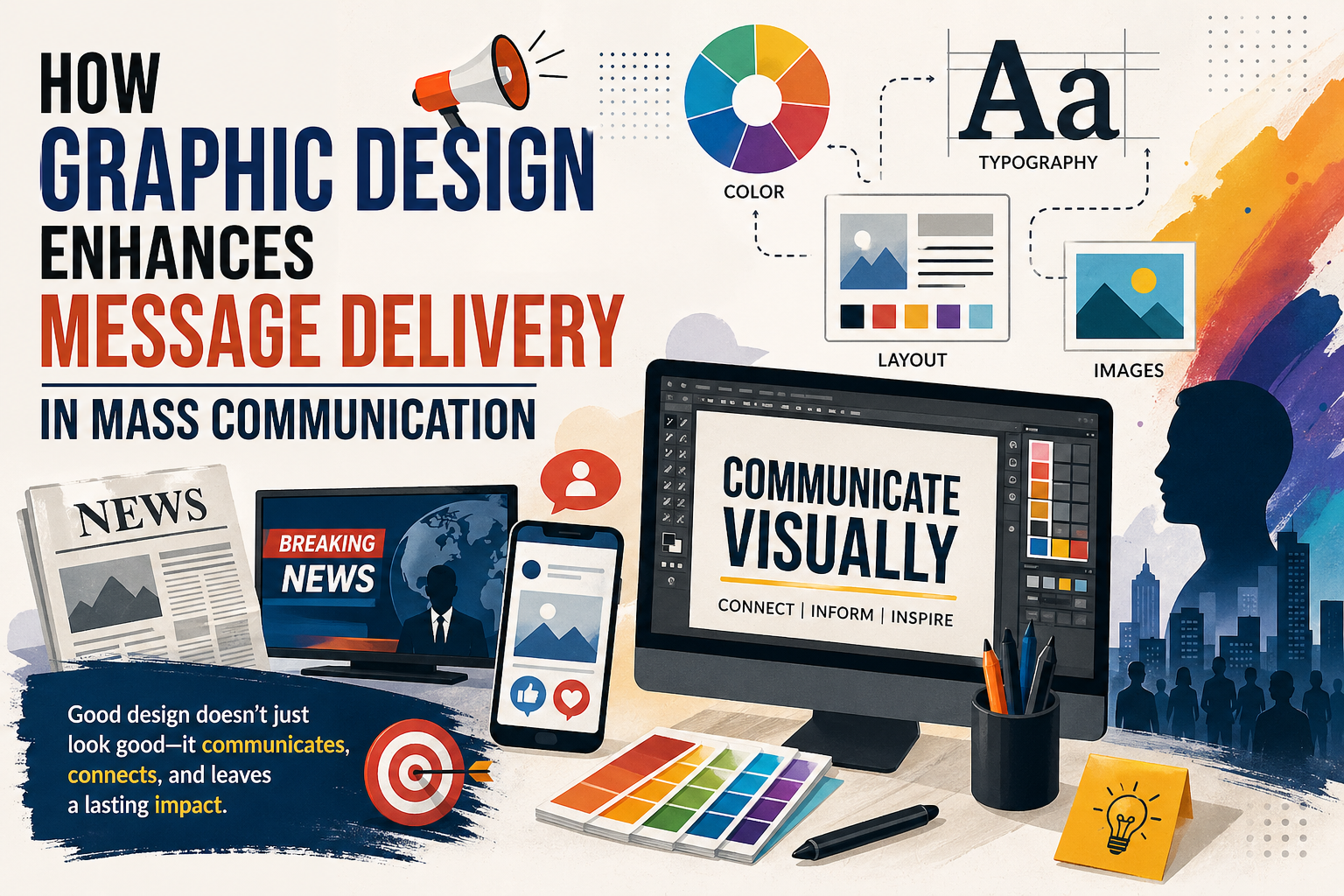
Through graphic design, typography, colour, layout and images are used to enhance communication. These elements improve legibility, maintain attention and assist memory. When graphic design elements are used, the product becomes a means of communication. When advertising, publishing news or even online marketing, the design choices affect the understanding and memory of the message. This connection between communication and graphic design is why it is important in today’s mass media.
Graphic Design for Effective Communication
Graphic design is a form of communication that presents information visually. Communication is achieved when the intended audience understands and reacts. Design helps to achieve this goal by creating clarity and legibility. Design organises information so that long blocks of text or other images are not thrown at the audience. It guides the reader through the content in the order they’re meant to process it. This not only aids understanding but also avoids misinterpretation, an essential characteristic of media, advertising, and education.
It also enhances the professionalism of an organisation. When communication is not well designed, it is considered untrustworthy, regardless of what’s at stake. Clean designs, consistent type, suitable colour, imagery, and so on, all add to the professional appearance that adds to credibility. In mass media communications, where credibility is vital, visuals are critical to the outcome in terms of attention and response.
Typography: Creating a Voice
Typography Shapes Readability
Typography is an important aspect of graphic design because it affects readability. It can change the way the reader reads the message depending on the type font, size, spacing, and justification. Poor typography can be confusing, dull, and ineffective. But typography can make the text easier to read, creating a flow. It enables an easy and continuous information flow, which is important in newspapers, magazines, books, blogs, and other media where time is limited.
Typography establishes hierarchy. The title needs to stand out, the subtitle needs to be direct, and the content needs to be easy to read. This helps the reader comprehend and understand the structure and key points. In digital media, typography must be flexible to adapt to different sizes of screens to enhance reading on mobile, tablet, and desktop. Typography is also about style. For example, serif fonts can be more traditional and elegant, whereas sans-serif fonts can be more modern and simple. This can influence how the audience responds to the content even before reading it.
How Color Influences Communication
Color is important in communication because it influences emotions and attitudes. Different colors trigger different emotions, and communicators can use this to add to the message of a communication. We often strategically use color in advertising, branding, and public information to evoke emotions and improve communication. Color can provide focus, build brand awareness, and engage the audience.
Also, color helps to communicate by creating contrasts and boundaries. It can be used to draw attention to the headline, to draw attention to key points, and to structure the message. In mass media, the use of colour can help to direct attention to the important points, making the message easier to understand. And color aids branding. The use of a series of colours by media outlets and brands on their websites, mobile applications, and in their printed products helps build recognition and trust in the audience.
Layout to Present Information
Layout is how information is communicated. An effective layout increases the information flow to make it easier to understand. In mass media, where reading is done by skimming and superficially, layout may affect reading time. Poor layouts are chaotic, whereas good layouts are unified. The placement of text, images, and white space affects the reader’s ability to comprehend the content.
Visual hierarchy is the hierarchy of elements. The headline is most important, followed by secondary information and then other elements. So the importance of the information can be read at a glance. Effective layouts result in better information flow, less fatigue, and increased reading speed. White space is also an important element of layout. It promotes legibility, attention, and information balance by eliminating clutter and helping the eye pick out important information.
Grid Systems and Structured Communication
Grid systems provide design balance and clarity. They help structure and align text and other visuals, and create more professional and effective communication. Grids improve balance and clarity in magazines, newspapers, and on the web. This improves the reading experience and attracts readers by offering better legibility and information structure.
Images: Context for Meaning
Images are an effective communication tool because they can provide information about context, meaning, and emotion. In many scenarios, images can be more efficient in information delivery. It is especially relevant to the news media, advertising, and storytelling. Relevant images help to augment text messages, making them more comprehensible. They can explain and convey information more effectively, and create greater emotional appeal, helping to add greater impact.
The quality and relevance of the imagery are also important. Irrelevant and bad-quality images can create distrust and confusion. Relevant and high-quality imagery enhances communication goals and builds trust. Images can increase interest, improve understanding, and improve memory. This is why images are still an effective communication tool in mass communication.
How Graphic Design Elements Can Keep Viewers’ Attention
The power of graphic design is in the combination of elements. Typography, color, layout, and imagery are four elements that make up the whole. Words are wonderful, but without regard to the visual layout, the message might not be heard. Typography is easier to read, colour evokes emotion, layout is organising, and imagery helps understanding.
When these are brought into balance, it improves retention. It makes it easier to process, more appealing to look at, and easier to remember. It assists in audience processing of the information and enhances the likelihood of appropriate interpretation and retention. In mass communication, with the amount of information, this combination of design qualities is a great asset.
Challenges in Graphic Design for Mass Communication
However, graphic design can be problematic. Designers must balance aesthetic and communicative considerations: the design should not overwhelm the content. Not enough design can result in boredom, and too much is distracting. The key to producing successful designs is to consider the design and user needs.
With digital communication, there are a few more considerations, as the content must be presented on multiple devices and platforms. It’s now essential that the communication is responsive to mobile devices, tablets, and computers. Legibility and accessibility are also important to ensure it can be read by people with different visual and cognitive impairments. This adds to the complexity of design, but also the importance of design in communication.
Future of Mass Communication and Graphic Design
Graphic design is changing through technology. Artificial intelligence, augmented reality, and interactive media help to change visual communication. Such tech makes messages more interactive and personalised, increasing engagement. As digital media increases, new and flexible approaches will be needed.
Technology may be changing, but the purpose of graphic design remains to communicate. The use of typography, colour, images, and layout will still be used to communicate. As we have more messages and visuals become more saturated, the role of graphic design will increasingly be needed to help communicate and filter through the noise.
Conclusion
Graphic design is both aesthetic and functional, improving communication processes. Typography, color, image, and layout influence the clarity, memorability, and efficiency of mass media messages. They are used to organize information, increase appeal, and increase the effectiveness of communication.
With the growth of communication channels, design will become a critical component. Design is essential for businesses, brands, and media to be noticed, trusted, and better communicate. Understanding the importance of graphic design in message communication helps communicators create a visually appealing, meaningful, and effective message.