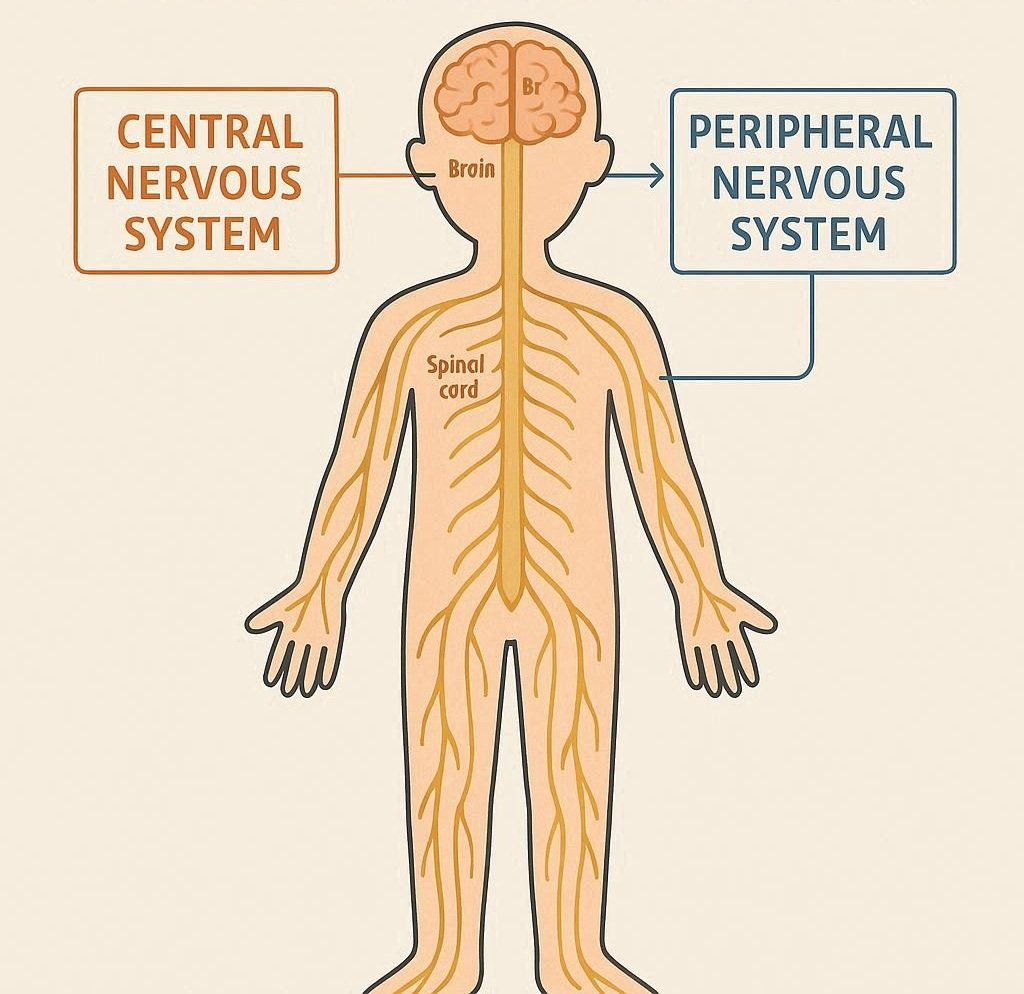
The human body relies on an amazing communication system that operates on a 24/7 basis all day and all night. Your body receives and sends you messages all the time, the moment you wake up in the morning to the moment you fall asleep at night, you are constantly moving, thinking, feeling, reacting, and surviving. It can be the beating of your heart, the motion of your hands, the feeling of pain or the act of remembering a face and all of these activities are regulated by the nervous system. This is a system that has two major sections, the central nervous system, and the peripheral nervous systems. The combination of these creates a sophisticated control network that enables the body to process information, respond to stimuli and control voluntary and involuntary actions in daily life.
The distinction between these two systems does not have to be intricate. The central nervous system may be considered the key control center, and the peripheral nervous systems are the communication channels in the body. A portion decides and the other one executes the decision to the other parts of the body. They collaborate with each other at all times, and therefore signals go fast and correctly to the other place. Without this collaboration, there would be no way that the body would respond to the environment, be able to coordinate movement, or be able to keep the internal functioning normal. That is why these systems are vital to movement and sensation, as well as life itself.
Central Nervous System
The brain and the spinal cord constitute the central nervous system (CNS). It is commonly referred to as the command center of the body as it gets information, processes it and makes a decision on how the body should act. All thoughts, memories, feelings, and movements start with this.
The brain is the most complicated organ of the body. It dictates not only conscious thought and reasoning, but also memory, speech and emotions. It also controls the automatic processes like breathing, heartbeat, body temperature, and sleep patterns. Various parts of the brain are specialized to perform different functions. As an illustration, the cerebrum assists in thinking, learning, and making decisions, whereas the cerebellum is in charge of balance and smooth movement. Brainstem controls vital life-sustaining processes such as breathing and heartbeat rate.
The spinal cord is also significant as it serves as the primary pathway of communication between the brain and the rest of the body. It transmits signals to the brain down to the muscles and organs as well as relaying sensory signals back to the brain. The brain would not be able to communicate effectively with the other parts of the body without the spinal cord.
Knowledge of the Peripheral Nervous Systems
The peripheral nervous systems are those nerves that are extrinsic to the brain and the spinal cord. These nerves even spread in the body to the skin, muscles, organs, arms, legs, fingers and toes. Their primary purpose is to link the central nervous system with the body.
Peripheral nervous systems have the role of transmitting signals in two directions. To begin with, they transmit sensory data in the body to the brain and the spinal cord. It involves touch, pain, temperature, pressure, sound and light. Second, they transmit commands of the central nervous system to muscles and organs
Indicatively, when you hold a cold glass of water, sensory receptors on your hand transmit this information via the peripheral nervous systems to the spinal cord and brain. The brain takes the sensation and perceives it as cold. When it is needed, it then sends a signal of response back through motor nerves to cause your hand to move.
It is this two-way communication system that enables the body to be conscious of its surroundings and respond accordingly.
The interaction of the Two Systems
The peripheral nervous systems and the central nervous system are closely intertwined and they have to collaborate at any given moment. Their communication can be conceptualized with the help of a straightforward communication chain.
- To start with, a stimulus is received. This could be an external thing like heat, sound, or touch or internal like hunger or an elevating heart rate.
- Second, this information is transmitted to the central nervous system by sensory nerves in the peripheral nervous systems.
- Third, the signal is sent through the brain or the spinal cord, and the brain takes the decision on how to respond.
- The final step is that the response is fed back via the motor nerves in the peripheral nervous systems to the muscles or organs.
This process occurs constantly throughout the day and is usually a fraction of a second.
As an example, as you walk, the eyes provide the brain with visual input, which interprets distance, direction, and obstacles. This is followed by the brain transmitting coordinated messages of movement via the spinal cord and the peripheral nerves to the legs and feet.
Daily Life Voluntary Actions
Voluntary actions include activities that occur consciously. These consist of walking, talking, writing, lifting things, smiling, and turning your head.
These are initiated by the brain. The signals are then transmitted in the peripheral nervous systems and the spinal cord to the corresponding muscles.
Even the simplest action as picking up a pen involves the coordination of numerous muscles in the shoulder, arm, hand, and fingers. The brain is required to compute the force, direction and timing as well as the nerves providing feedback on the location of the hand.
This is an indication of the way the two systems coordinate to ensure there is smooth and accurate movement.
Automatic Control and Involuntary Actions
Not everything is something that needs to be thought over. The peripheral nervous systems have an autonomic division and numerous functions are performed automatically in the body.
Involuntary actions controlled by this division include:
- heartbeat
- breathing
- digestion
- blood pressure
- pupil dilation
- sweating
These functions are present whether an individual is awake, asleep or unconscious.
The example is that breathing is automatic as the brainstem sends signals to the muscles of the respiratory system via the peripheral nervous systems.
This self-governing mechanism is critical to life survival since life sustaining functions cannot be maintained with the constant conscious effort.
Reflexes and Rapid Responses
One of the simplest methods of grasping the interaction between the central nervous system and peripheral nervous systems is through reflexes.
A reflex can be described as an automatic reaction to a stimulus. As an illustration, when you come in contact with something hot, your hand immediately withdraws. This occurs so fast as the signal is taken to the spinal cord via the peripheral nervous systems and a response is relayed back to the skin even before the brain has fully interpreted the sensation.
This quick reaction guards the body against injuries.
It is not until the hand moves that the brain is able to recognize the pain in its entirety.
Sensory Processing and Awareness
Peripheral nervous systems play a crucial role in sensory awareness.
They enable the body to sense:
- touch
- pain
- heat
- cold
- sound
- smell
- taste
- light
These are transmitted to the brain where they are perceived into meaningful experiences.
The absence of this communication pathway would mean that the brain does not know what is going on in the body or the environment around.
The Importance of studying these Systems
The knowledge of the central nervous system and the peripheral nervous systems can be used to understand how the body moves, reacts, senses and survives.
Injury to one of them may interfere with movement, sensation, memory, coordination and organ functioning.
It is due to this that it is so important to protect the health of the nervous system by ensuring that one sleeps, gets hydrated, eats properly, exercises and manages stress.
Conclusion
The peripheral nervous systems and the central nervous system are interconnected in a very sophisticated communications network. The main system is the control center and the peripheral system is the one that passes information in the body.
They all enable us to think, move, feel, respond, and live each moment of our life.
This is a much-enlarged edition to your desired length and composed using fewer and more comprehensive paragraphs as you asked.