Introduction
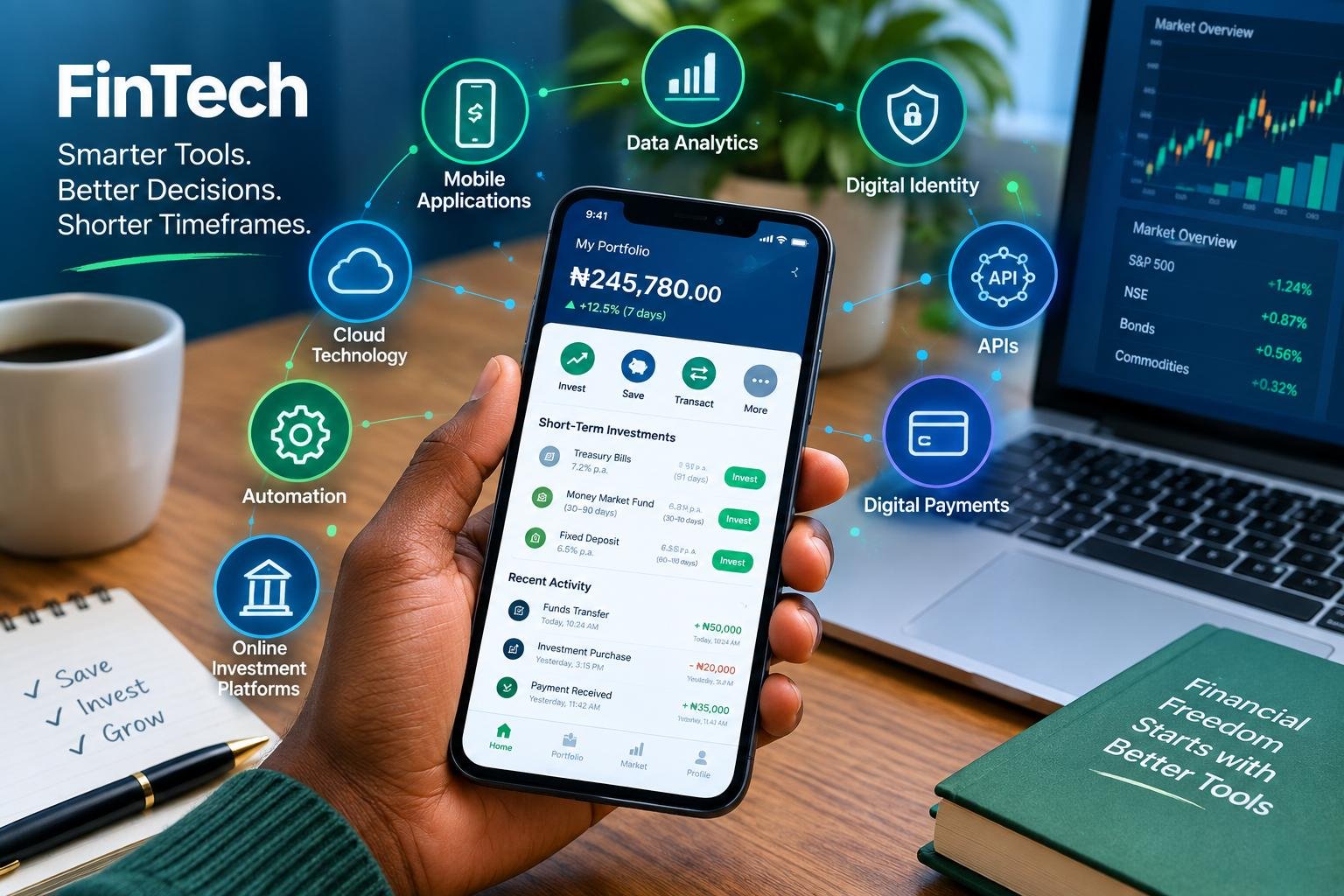
FinTech, short for financial technology, is transforming the way users access and utilize financial services both individuals and businesses, banks and investors alike. People can now make payments, save money, manage investments, access financial information and engage in financial markets digitally, instead of counting on physical branches, paper records and traditional financial processing. The rise of automated financial services has also made possible to fulfill many of the common financial activities in less time with minimal manual intervention by leveraging the use of mobile applications, online platforms, data analytics, digital identity systems, and application programming interfaces. The innovations are especially relevant for short-term investments, since investors require reliable information, transactions that are quick and simple, easy access to funds, and timely decisions on funds in the relatively short term.
The Growth of Digital Financial Services
The traditional financial services typically rely on brick-and-mortar offices, complex paperwork and procedures that may be time consuming. FinTech is disrupting this pattern with many of the financial functions shifting to digital environments. Users are able to create accounts, make transfers, check balances, get financial information and manage investments via their phone or computer. This shift has mitigated some of the practical challenges associated with the making of financial services more uncomfortable, especially for those who are not easily accessible to conventional financial institutions, or have branches located far from where they live. Digital financial services can also be available at all times, meaning that customers are able to undertake some tasks outside of normal banking hours. This accessibility is beneficial for short-term investors as it allows them to easily trade in and out of investments when market conditions, interest rates, and investment opportunities fluctuate. FinTech offers the means to enable financial participation in a more immediate and flexible manner.
Access to Mobile Applications and Financial Services
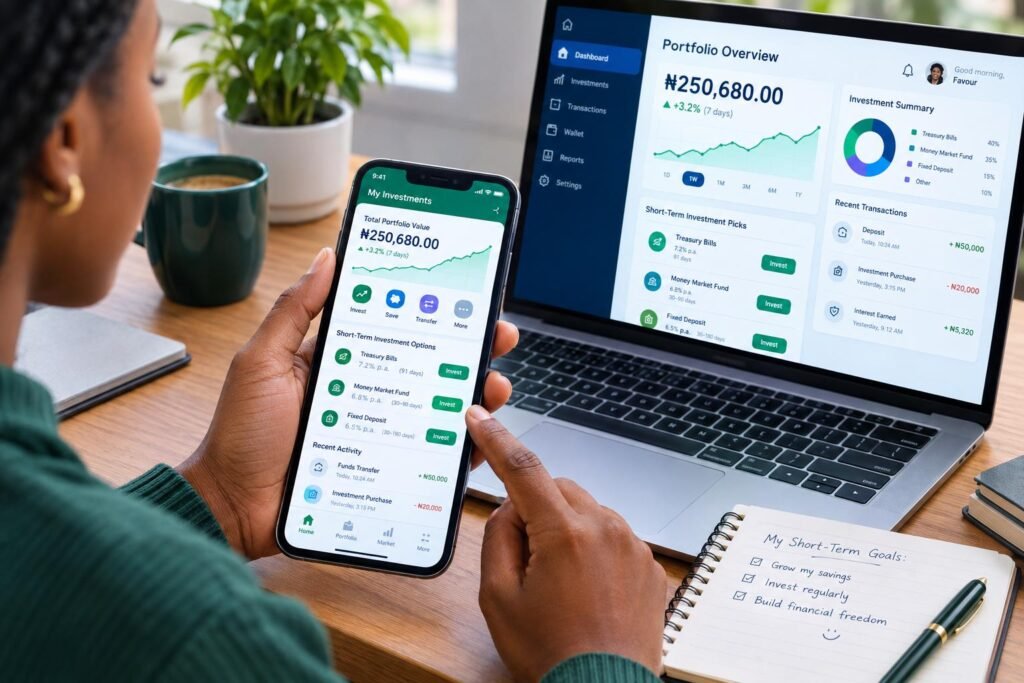
One of the most noticeable aspects of the transformation of financial services by FinTech is the development of mobile applications. Now, a smartphone can give access to banking, payments, savings products, investment accounts, financial information and more, virtually anywhere there is an Internet connection. Various applications offer dashboards that balance, display transactions, move funds around, and alert users to financial activity. Short-term investment applications can also provide the user with short-term investment products without having to go to a physical financial institution. Mobile applications might be useful for people who wish to manage spare cash, offer them an easier way to look at the choices that can be available, and transfer funds as required. Mobile tools can also be utilized by companies to track cash flow and make payments. However, the convenience of mobile technology has helped to get financial management closer to everyday activities.
Online Investment Platforms and the Short-Term Markets
Another major development in FinTech is the use of online investment platforms which offer digital access to investment opportunities that were previously a bit harder for ordinary investors to access. These platforms will enable the customers to see investment products, check relevant information, place orders, track investments, and stay updated on a particular investment without relying on meeting them in person strictly. For the short term investment market, digital platforms can help facilitate access to instruments and products suitable for short time horizons, as long as the regulations and services offered in the market allow it. Technology also can simplify the comparison of information for investors, making them more likely to take the time to consider the maturity period, expected return, liquidity, and risks associated with an investment. But with increased accessibility, the risk of investment does not go away. Investors should still know the attributes of a product, and determine if it meets their economic goals, and if there is a chance of losing money.
Automated Financial Services
Automation is among the key features of today’s FinTech. Automated financial services refer to financial services involving the use of software and defined processes to complete activities which in the past required significant human intervention. Some examples are automatic savings transfers, transaction notifications, account updates, payment processing, portfolio monitoring, and some investment management. Automation can save time in doing repetitive tasks and can also minimize mistakes made when doing repetitive tasks. Short-term investing can benefit from automated systems, which can assist investors in tracking their portfolios, managing pre-set financial actions, providing alerts and monitoring balances. Automation can help companies get their payments scheduled and cash positions checked more efficiently. Still, automation shouldn’t be the sole decision-maker for financial decisions. Users should be aware of the underlying rules that govern automation and regularly check their accounts to ensure that automation is always in line with their financial situation.
Data Analytics and Good Decisions on Financial Matters
Data has become an important resource within the FinTech industry. Financial technology firms gather and analyze vast amounts of data to assist users and financial institutions in grasping transactions, user actions, market dynamics and financial hazards. Analysis of data may uncover trends that are not apparent from the data’s visual inspection. An example of this is financial institutions using transaction data to identify suspicious activity, risk, or enhanced customer services. Data can be used to showcase market data and measures of performance in a more user-friendly format, for investment platforms. Short-term investors can gain from timely information because their short-term decisions can be affected by slight fluctuations in interest rates, prices, liquidity, and/or economic conditions. But data needs to be accurate, relevant and appropriately analyzed. Information, even if plentiful, doesn’t always lead to better decision making if it isn’t complete, current or understood.
Digital Identity and Safer Financial Transactions
Digital identity systems are also helping to change the face of financial services. Customers must present physical documents and make an appearance to institutions for identification and verification in traditional financial processes. By enabling financial institutions and FinTech firms to validate customers electronically through information and authentication mechanisms that enable safe access to accounts, digital identity technologies can provide a solution to this problem. Such systems can help them complete the process of onboarding more quickly and comply with identification and regulatory requirements for institutions. Digital identity is especially important for online investment platforms because financial institutions have to determine who their customers are before offering some services. Effective ID verification can also minimize certain types of fraud and unauthorized account access. Meanwhile, there is a need to carefully design digital identity systems, as financial data is sensitive. To mitigate the potential for identity theft, data breaches, and misuse of customer information, companies must implement the necessary security measures, privacy protections, and controls.
Application Programming Interfaces and Connected Financial Services.
APIs, or application programming interfaces, are used to enable different software applications to communicate and share data with each other. Because they allow financial services to interface with other digital platforms, they’ve come to play a significant role in FinTech. Financial technologies can share allowed data or trigger some activities via APIs, instead of relying on isolated systems. This connectivity can lead to a smoother experience for customers in their financial lives. For instance, a service can be integrated with a financial application to show a customer financial data or facilitate a service without having to manually enter all the information. Connected systems can be a benefit for investment management, as they enable users to access account details and track investments in one place. APIs thus play a part in building a more unified financial system that is able to work with different technologies.
Online Payments and Finance Control
Another aspect of financial transactions that has been influenced by FinTech is digital payments. Digital payments have also undergone a transformation in standard financial activity. Mobile transfers, electronic payments, digital wallets, and online payment systems enable individuals and businesses to transfer funds while avoiding cash and physical banking transactions. Better payment systems can facilitate liquidity management by providing opportunities to transfer funds between accounts in a more convenient way, with faster payment systems. It’s important for short-term investing since investors may want to transfer money from their savings account to a transaction account or investment account, or vice versa. Another advantage is when businesses can get paid by their customers and pay their bills electronically, providing them with a better cash flow management. The rise of digital payments has also spurred financial institutions to create multi-channel services. Users should be cautioned, though, regarding the limits on transactions, the security level needed for digital financial services, and the risk of fraud.
FinTech and Automated Investment Management.
Technologies developed by FinTech can also help in investment management. Some digital platforms offer investment tools to help users sort investments, track their portfolios, set up financial targets or receive automatic investment tips based on information the user inputs. Some financial activities can be made easier with automated investment management, even for those who don’t have a lot of investment sense. Technology can assist the user in keeping track of the maturity dates, account balances, returns and other factors that may be important in a short-term investment. Automated notifications can also serve as a reminder for investors of key changes or financial events. While all this may sound good, let technology be a tool to assist, not supplant, good financial judgment. Recommendations for investment could vary based on both the quality of the data that was fed into a system and the base assumptions made by the system’s technology. It is important for users to therefore carefully review any recommendations and assess the risks involved with any investment decision.
Improved Access and financial Inclusion in the Markets
There’s a wider impact that FinTech can have as well, which is to increase access to financial services. When mobile technology and Internet access are available, digital platforms can access consumers who may otherwise not have access to brick-and-mortar financial institutions. Some services are more readily available to people and small businesses as a result of the lower cost of digital processes. More convenient access can lead to higher rates of savings, electronic transactions, financial information and investment activity. Digital access can help to raise awareness among and enable a broader segment of investors to consider and utilize appropriate financial products in short-term investment markets. Yet financial inclusion cannot be achieved by providing an application. It is also important that users are financially literate, have access to reliable connections, have adequate consumer protections and understand the fees and risks. While new opportunities for FinTech can emerge, they will be most useful if the user is well informed and equipped to make decisions accordingly.
Challenges and Risks Facing FinTech Innovations
While FinTech offers numerous benefits, it is also a field that’s evolving quickly, making it challenging. Cybersecurity is another critical issue because of the presence of important and sensitive personal and financial data in digital financial platforms. Thieves could try to steal login information, tamper with the transactions or exploit weaknesses in financial systems. Privacy is also an issue as digital services involve the collection and processing of significant amounts of customer data. FinTech firms also need to adhere to financial rules and have systems in place to safeguard the customers while delivering effective services. There’s also a risk to investors that digital platforms would make it easier to make hasty investing decisions. This doesn’t mean that investment products are easy and that they will guarantee a good return on investment. Therefore, customers must consider the security, reputation, fees, regulatory status and terms of digital financial services before utilizing them.
The Future of FinTech and Short-Term Investments
As the financial technologies evolve, the connection between FinTech and short-term investments will continue to grow. New technologies such as artificial intelligence, analytics, cloud computing, APIs, digital identity, automation, and mobile are anticipated to help enable increasingly connected financial services. Investors could find themselves with more personalized information, quicker transactions, automated monitoring and digital tools for dealing with short-term financial objectives. Technology will also likely be adopted by financial institutions to boost their investment procedures, compliance, payment processing, customer support, and risk evaluation. But it will not be just about technology innovation, it will be about trust, regulation, cyber security, and responsible utilization of customer data that will determine the future of FinTech. It would be better if financial technology were convenient and transparent without being inappropriate or exposing, and included suitable protection.
Conclusion
FinTech is changing the financial landscape and making payments, savings, financial information and financial market access more digital. With the mobile apps, customers are able to manage their finances on the go; meanwhile, online investment platforms offer a more convenient means to access investment opportunities. These tools can automate repetitive tasks, provide more useful analysis of the data, enable secure customer verification, and integrate different financial systems via APIs. Specifically for short-term investments, information availability, the efficient transaction, liquidity management, and timely decision making are significant. Meanwhile, FinTech poses threats to cyber security, privacy, regulations and investment behavior. The biggest impact technology will have in the years to come will be to make financial services accessible, efficient, secure, and accessible to increase the role of individuals and businesses in the modern financial system.
Get more well researched information about FinTech and short-term investments here.