Programming is more than writing lines of code that make a computer perform a task. Software grows in size and complexity and programmers require structured approaches to problem solving, task decomposition, information management and code organization. Such organized solutions are called paradigms of programming. A programming paradigm is a generic approach or design method used to create a program. The three paradigms that are usually met by beginners are procedural programming, object-oriented, and functional programming.
While there are a number of paradigms, each offers different concepts to organize code and solve problems; it is possible, however, for a modern programming language to integrate paradigms within the same program. Knowing about these methods provides a solid base for those new to programming to learn that there are other methods to designing software. It also provides insight into why programmers select specific structures for creating apps, websites, games, business systems, and other digital products.

What is a Programming Paradigm?
Programming paradigm is a specific way of structuring a program and presenting a solution to a problem. A paradigm asks the programmer to consider the organization of the commands, data and operations that a computer must execute rather than just thinking about the commands themselves. For instance, procedural programming focuses on procedures and step-by-step instructions, while object-oriented programming is based on software objects that include data and actions. The emphasis in functional programming is on functions, transformations and avoiding data modification as much as possible. These are not necessarily mutually exclusive strategies. There are different styles of programming and a programming language like Python, JavaScript, or C++ can accommodate all of them, so that the various techniques can be chosen depending on the problem being solved. Learning these paradigms, then, will help the new programmer understand how to structure software programs and how two similar problems may have vastly different solutions in programming.
The reason for the usefulness of programming paradigms is that, if the logic of the software is not organized, it can become hard to manage. Suppose you have a small program to calculate the price of a single product. The programmer might require only a couple of variables and instructions. Now imagine that program is scaled up to an online store that sells thousands of products, supports thousands of customers, shopping carts, payments, discounts, orders and delivery information. Data grows and logic grows… organization is important! Programming paradigms are ways of splitting that complexity into manageable pieces. They can assist the programmers in defining where the information should be stored, how operations should be carried out, and how various portions of an application should communicate with each other. Instead, if a program is sufficiently large, it can be subdivided into smaller components that are more easily understood, tested, modified, and reused, by using an appropriate paradigm.
Procedural Programming
One of the most basic programming ways for beginners in programming is procedural programming, which deals with a series of instructions or procedures. A procedure is a collection of instructions that is used to accomplish a specific task. The program proceeds normally in a sequence of operations, with some of them occurring after each other, and others are used to control the flow of the program, such as conditions, loops, variables, and reusable procedures. Other languages, including C or Pascal, have a strong procedural connection, but procedural techniques can also be applied in languages that have other paradigms. For instance, a basic program to work out the total cost of multiple items might hold the costs of the items in variables, sum the variables, reduce the total by a discount and print the value. The programmer is mainly concerned with the operations the computer must execute and the sequence of operations.

One good way to grasp procedural programming is to think of it similar to a recipe. A recipe is a set of instructions including instructions for preparing ingredients, mixing ingredients, heating the dish, and serving the dish. Likewise, a procedure program may have instructions to gather data and to manipulate and output the data. Procedures or functions may be developed to achieve a repetitive task so that the programmer does not need to write the same instructions repeatedly. For instance, a banking program might include its own rules and regulations for depositing, withdrawing, computing balances and showing information about an account. Each procedure does a particular operation and the overall program determines when procedures are called. This might be suitable for small and medium sized programs in which operations are not too complicated.
Pros and Cons of Procedural Programming
The benefits of procedural programming are easy to come by. For beginners, a program that follows a procedure may be easy to follow, from the beginning to the end, and can be useful when learning the basic concepts of programming. Variables, conditions, loops, procedures, and input and output operations can be used without having to learn too much about objects or complex data structures. Additionally, procedural programming can be efficient since the programmer is able to control the flow of operations.
However, issues can occur when the Program grows too large. When a lot of procedures share and manipulate the same information, finding out about how a single part of the program impacts on another part can be challenging. Modifications in a single location can have unintentional impact in other parts of the application. Larger software systems are therefore often developed using an object-oriented, functional or mixed design, to offer more options to manage complexity.
Object-Oriented Programming
OOP is also known as object-oriented programming, because it is programming that deals with objects and not mainly with a sequence of procedures. An object is an entity that contains data and behaviour. In a school management application, for instance, the Student object could include the student’s name, identification number, and Course. The object may also have behaviors like registering for a course and/or displaying student information.
Object-oriented programming is an effort to bundle data and operations together, facilitating the organization of software as it becomes larger. The programmer is not just concerned with what the program should do in the sequence of steps, but also with the entities (people, animals, or things) in the problem and the responsibilities those entities have. It is a common method in software development and is followed by programming languages like Java, C++, C, Python and more.

Classes and Objects
A class is a blue print or template that can be used to generate objects. It specifies the type of data that can be stored in the object and the operations that the object can execute. An object is actually an instance created from that class. For example, the Car class is a simple class. The class could include properties like car brand, car model, speed and methods like start(), accelerate(), and stop(). Each time the program creates a specific type of Toyota car from the Car class, the car is an object. The same class can be used to build a second instance of a vehicle with different values. The key difference is that the class is a description of structure and behaviour, whereas the object is an instance of the structure. Using this approach, programs that create numerous similar objects can be programmed without using a different design for every object.
Methods are functions that are associated with an object or class. They describe actions that an object can perform. For instance, the BankAccount class may be used to add to or take money from a bank account, such as a deposit() and withdraw() method. The account could also include information about the account holder, such as name and current balance. The balance of a program object can be adjusted in accordance with the rules specified in its class when the deposit() method is called by the program. This allows related behaviour to be near the data used by that behaviour. It also helps to make the programs more comprehensible, since the programmer can figure out what purpose an object serves and what operations it has. In a program with a lot of unrelated procedures that are distributed across the code, object-oriented programming asks the programmer to collect related procedures into classes and objects.
Encapsulation
Another key idea of object-oriented programming is encapsulation. It means to link data and operations that manipulate the data together, and to regulate access and modification of the data. Consider a bank account. It is not advisable for a program to alter a balance of an account in an uncontrolled manner. Rather, the BankAccount object may have a method (e.g. deposit()) that could test if the operation is valid before updating the balance with the amount, and a method (e.g. withdraw()) that could test whether the operation is valid before updating the balance with the amount.
This makes it so that there is an area of control between the object and the rest of the program. Encapsulation can keep the internal state of an object safe, and minimize the possibility of accidental change. It also means that programmers can change the internal implementation of a class without having to change the code that uses the class, as long as there is no change to the public interface of the class.
Inheritance
The Inheritance mechanism enables one class to inherit properties and actions of another class. For instance, a program may include a Vehicle class that has properties and methods common to various types of vehicles. A Car class can inherit from Vehicle and Motorcycle class can inherit from Vehicle. The child classes may inherit attributes from the parent class and may also provide a particular function. This can help to save duplication of code when multiple classes have similar properties.
The use of inheritance, however, must be taken care of since too many or too complex inheritance relationships can make software more difficult to understand. Inheritance is often used with other approaches in modern software development, such as composition, interface, and reusable components. The basic concept is that inheritance allows classes that are related to each other to share common functionality while retaining some unique functionality.
Functional Programming
In functional programming, computation is viewed primarily as function evaluation and function composition. A function takes in input and returns output, and functional programming teaches you to write functions that are predictable and do one thing. Functional programs typically use mutation to change values of existing variables, rather than using shared variables. Languages like Haskell are particularly linked to functional programming and languages like JavaScript, Python, Scala, and Kotlin offer functional programming support along with other programming styles.
A simple function might be a function that takes a list of prices and returns a new list of prices that are discounted. The function doesn’t modify the list itself, but it can produce a modified list. This style might make some programs easier to understand, as the input-output relation is obvious.

Uses as Building Blocks
One of the main reasons why functions play a crucial role in functional programming is that they can be used as significant components of a program. A function may have one or more arguments, and produce a value. For instance, calculateTax can take in a price and a tax rate, and return the taxed price. That result can be passed to another function where the final price can be computed.
Functions also can be composed to form larger more complex functions from smaller ones. This helps the programmer to develop small units of logic which are more easily tested and reused. It is easier to understand what functions will produce, if they don’t rely on hidden changes in other parts of the program. This is particularly valuable when there are numerous calculations or data conversions within the applications that must be carried out in the same way.
Immutable Data
Immutable data is an important idea associated with functional programming. When data cannot be modified after it has been created it is immutable. A program does not change an existing value, but creates a new value with the desired modification. An immutable approach would result in the creation of a new list with all four names if, for instance, a program had a list of three student names and wanted to add another name.
This may not seem as convenient at first, but there are advantages. If the data is not supposed to be modified unexpectedly by the original data, then the programmers will be assured that another section of the application will not have the chance to modify the data incorrectly. Sometimes, even programs can be easier to reason about when some of the components use immutable data, and some problems involving multiple components of a program changing the same data simultaneously can be diminished.
Three Programming Paradigms: A comparison
The major difference between procedural, object-oriented, and functional programming lies in the way they urge programmers to structure problems and manipulate data. Procedural Programming: These are programming that concentrate on the procedures and the sequence of operations to be performed to complete a task. Object-oriented programming emphasizes the use of objects to bundle data and associated operations, such as classes, methods, encapsulation, and inheritance. Immutable data, predictable operations, functional programming and transformations are all key concepts of functional programming. While these differences do not necessarily imply the complete elimination of the other paradigms, they indicate that each paradigm has its own areas of application. A programmer, for a modern application, might program in a procedural way for simple functions, an object-oriented way for large components, and a functional way for collections of data to be processed. The selection of the appropriate choice will vary based on the programming language, the needs of the project, team preferences, performance requirements, and the type of problem being addressed.
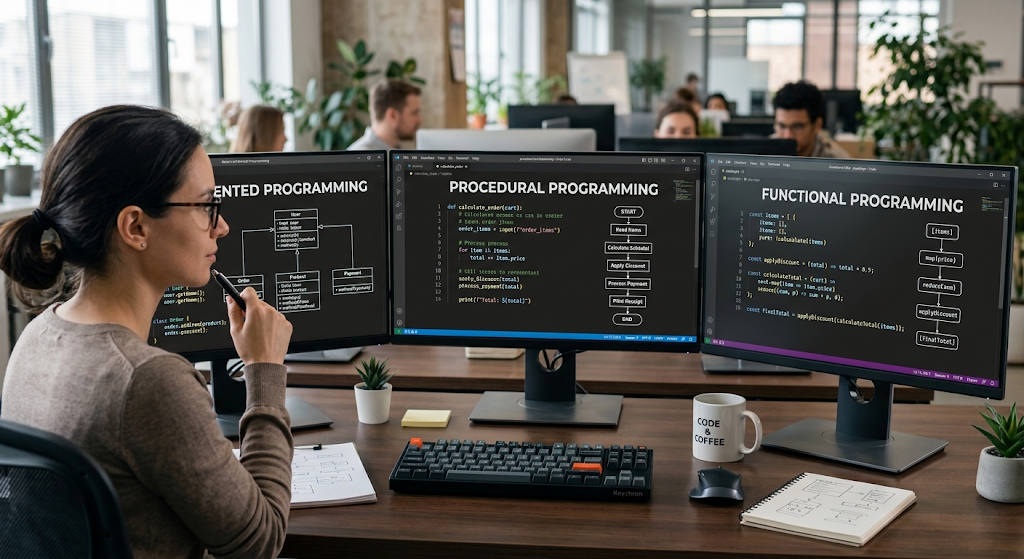
Let’s imagine a web-based ecommerce app and how the three approaches may differ. A procedural approach might have the following procedures: Add a product, Calculate a total, Apply a discount, Process an order. Products, customers, shopping carts and orders could be defined as objects containing both data and methods. A functional design might be used to represent shopping information as data and then update data to a total, filter products, or calculate a discount, but not alter the values of the original data. All three of these methods might yield an application that works. The major difference lies in the way that the programmer structures the logic and handles interactions between parts of the system. Help beginners to see programming patterns rather than assume that all programs are written in the same way.
Selecting an Appropriate Programming Approach
The selection of a programming paradigm is not about picking the latest or the most popular of the technique, but on the problem itself. If a small program does a calculation that has a clear sequence, it may be naturally appropriate to use procedural techniques. Classes and objects can be used to organize responsibilities, which can be helpful when there are many interacting entities within a large application. If a program is performing numerous transformations on a collection of information, it can be helpful to use functional techniques, particularly if the logic is easier to test due to predictable functions and immutable information.
Both paradigms are used in practice, and often programmers will mix them together rather than strictly adhere to one paradigm. For instance, a Python developer might write classes for the big components of an application, and functions and immutable values for the individual calculations. It is more useful to be able to determine which technique to use for a given problem than to know one single programming style.
Different Paradigms New Programmers Should Learn
By learning several programming paradigms, beginners will have a wider understanding of software development. Learning one style only, a student could become the belief that the ideas employed in that style are the only ones that can be applied to solving programming problems. Procedural programming allows students to learn about the logical sequence, variables, conditions, loops, and reusability of procedures. Object-oriented programming is used to model entities by classes and objects and to teach concepts like methods, encapsulation and inheritance. Functional programming takes another approach using functions as first-class citizens, transformations, and immutable data. These ideas collectively contribute to the development of students as flexible problem solvers. They can approach a programming problem in different ways and select techniques that simplify the understanding, maintenance, testing and growth of the solution.
Programming paradigms also can be useful when learning a new programming language. While some languages have one style that is emphasized, many contemporary languages have been developed that have more than one style. Once a programmer has mastered the concepts, they can identify the concepts from different syntaxes. A student who knows that a class can be used to create objects can identify that concept in a variety of object-oriented languages, but may not know the syntax of the class. Likewise, if you know what functions are and what makes data immutable, you can spot functional programming techniques in languages that were not specifically built for functional programming. This is particularly useful as opposed to the point of memorizing exactly what a specific language is because the concepts can be used in a variety of programming environments.
Conclusion
Programming can be structured in several ways such as procedural, object-oriented and functional programming, and offers different solutions for computational problems. In procedural programming, the focus is on procedures and step-by-step instructions, which can be helpful for understanding the basic flow of a program. Object oriented Programming is based on object and class and includes the concepts of methods, encapsulation, and inheritance to deal with complex systems. In functional programming, functions, transformations, and immutable data take center stage, which aids the programmer in creating predictable operations and minimizing unnecessary changes to shared data.
These paradigms are not separate rules that have to be adhered to by programmers. In modern development, several ideas are often synthesized in order to build usable, sustainable software. When learning to program, understanding the distinctions between these paradigms can give a solid background to understanding the design of larger programs and help prepare the beginning programmer for advanced programming concepts.