Introduction
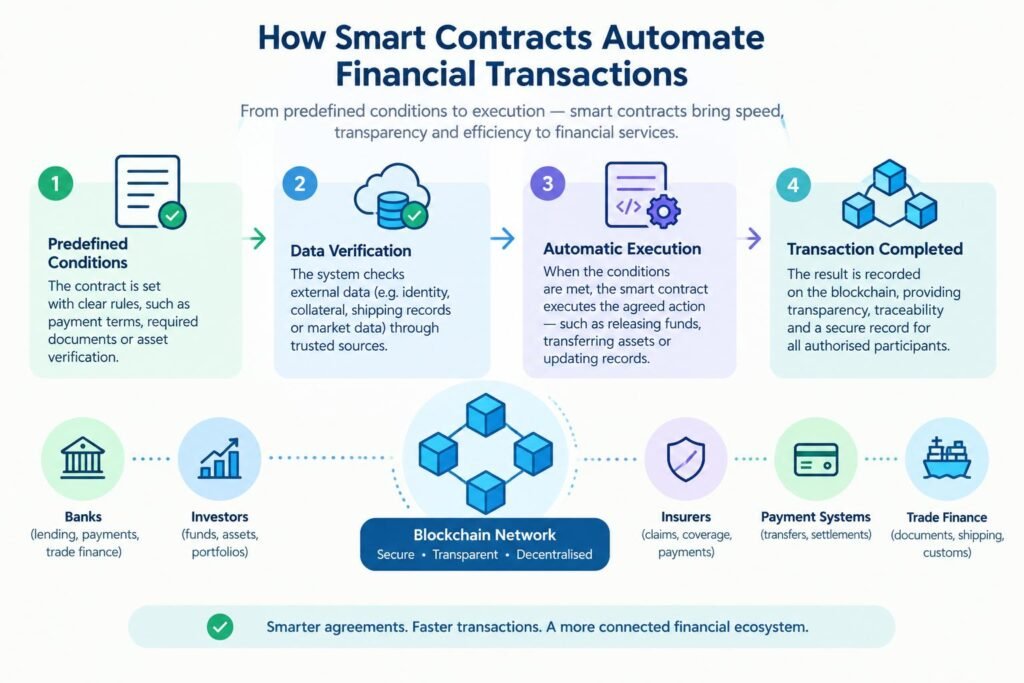
There are many agreements, records, approvals and transactions that involve multiple parties that need to be coordinated for financial industry money or assets to flow. Traditional processes can be complicated and include banks, brokers, insurers, investors, lawyers, custodians and regulators all holding records and performing certain checks. Smart contracts take a different approach: they are computer-readable instructions that can automatically execute when a specific condition is met, which – in the context of an agreement could be the terms. Smart contracts are essentially, working contracts that are programmed into blockchain systems. They can be programmed to check conditions and to cause pre-determined results, rather than just waiting for human intervention. Its ability to cut repetitive administrative tasks, but raise new security, regulatory, and legal questions, is garnering interest from banking, trading, insurance, payments, trade finance, lending and investment services.
What is a Smart Contract?
The smart contract is a program that resides and is run on a blockchain or other distributed ledger network. It includes rules that specify the action to take once a certain condition is fulfilled. For instance, the lending contract may be such that when acceptable collateral is recorded, a loan is issued once necessary conditions are confirmed; and payment of the loan may be handled at a defined time based on the agreed terms. What is crucial however is that a smart contract is not just a paper contract in the digital format. It is a blend of contractual reasoning and software which can automatically perform some of the actions. Smart contracts can help to minimize disputes over a programmed step. But they don’t remove legal agreements, human judgment, or trustworthy outside information sources. They can only be useful if they are programmed correctly, are reliable data, have proper governance and error handling systems.
Application of Smart Contracts in Banking and Lending Systems
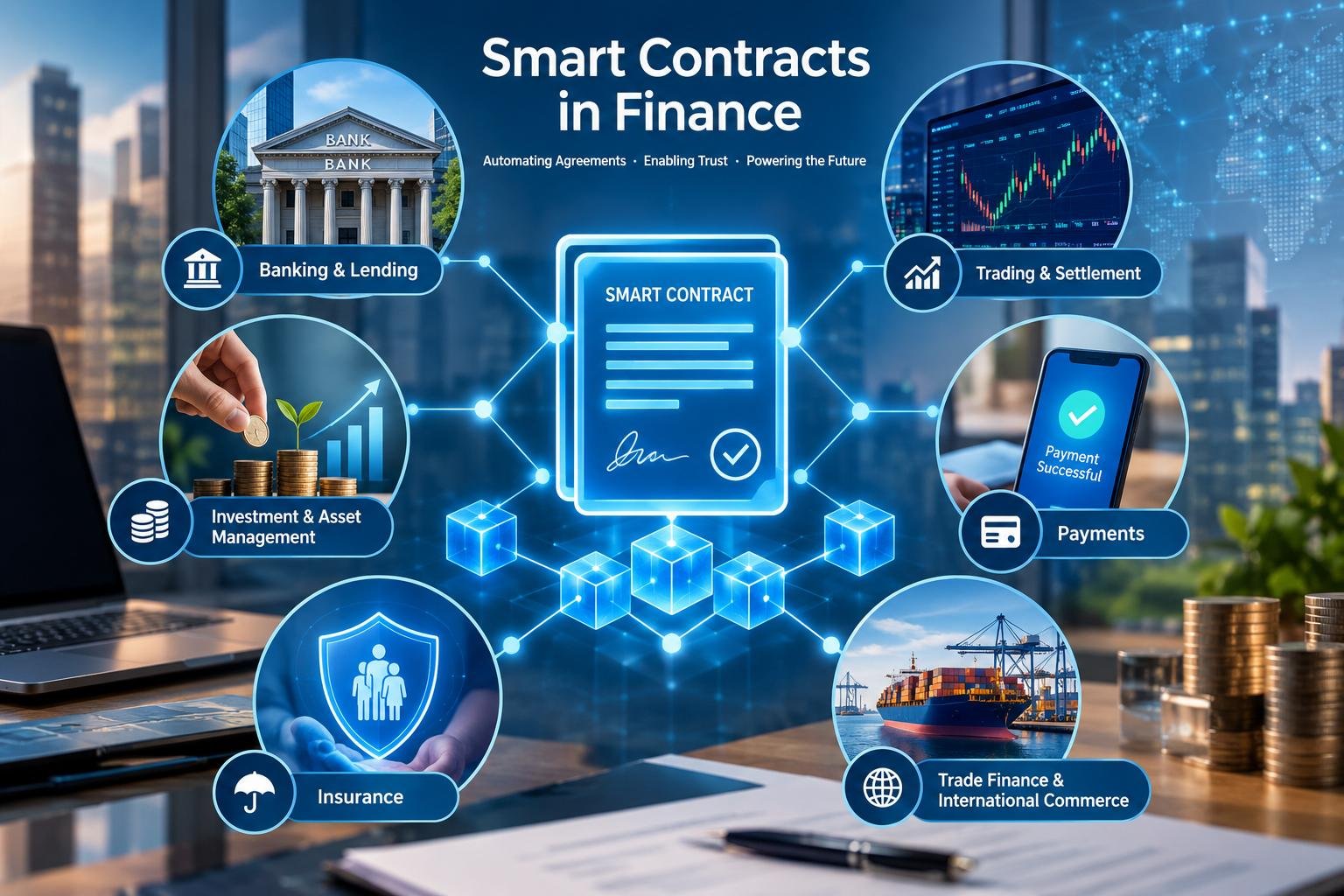
Smart contracts can be applied to lenders to automate various aspects of lending, account servicing, managing collateral, and interbank transactions. A lending deal might tie the release of money to a set of approved lending conditions as well as provide for repayment directions. A smart contract could be used to track if necessary conditions are met if there is digital representation of the collateral and verification is through the appropriate system. Automated processing can minimize paperwork, processing times and transaction records can be more readily viewed by authorized participants. However, there still would be a need for customer due diligence, credit evaluation, regulatory screening, dispute resolution and risk management for banks. A smart contract can provide the instructions, but not by itself decide whether or not a particular borrower is worthy of credit or handle all the complicated situations that might occur through the loan. When financial decisions need judgment or that things change, human involvement is important. This means that smart contracts could be used as complementing instruments in banking system workflows and not as substitutes for existing workflows.
Applications in Insurance
Another sector where programmable agreements could help in automating is insurance. There are numerous terms in insurance policies related to the premiums, coverage duration, claims, exclusions and triggering events. Of these, several are easily represented digitally and can be connected to trusted sources of data. For instance, a policy can be written to start paying for an event when it is either confirmed as an event or meets some predetermined conditions. This can shorten the amount of time that may be needed for some simple claims, and ease admin for insurers and customers. For instance, parametric insurance can be used to pay for events that can be measured and not necessarily evaluated in a manner similar to a conventional loss assessment. But insurance claims can also be complex, have conflicting facts, fall prey to fraud temptation and require legal interpretation. If the smart contract uses incorrect external data, except for its code, it may generate an incorrect automated result. To improve insurance automation, therefore, there must be data reliability and monitoring, as well as error correction systems.
Securities Trading and Settlement
Smart contracts also may impact the way securities are transacted. Conventional securities trading typically includes exchanges, brokers, clearing and settlement systems and entities, custodians, and other entities that act as intermediaries. The individual(s) performing checks and keeping records can be delayed and cost of the operation. Some securities might be represented as digital blockchain objects and smart contracts could be used to coordinate the trade’s execution, transfer of the assets, and payment in accordance with pre-written rules. Some models would allow for a delivery/payment relationship to be programmed such that the ownership of an asset would not transfer until the payment condition was met. This may lower the settlement risk and manual recon as well as provide more visibility of transactions. Financial markets are, however, subject to strict regulation and securities can have complex ownership structure, corporate action rights, restrictions and reporting. Smart contracts would thus have to be part of established market systems and legal systems, not just a piece of code. The value of their products will be determined by their ability to become a part of the current financial market infrastructure.
Use of Smart Contracts to Facilitate Payments.
Another potential area of practical benefit with automation is payments. A smart contract can be programmed to disburse or transfer virtual asset when specific requirements are met. For instance, in a contract of sale, the payment may be made when the subject-matter of sale is delivered, when the contenting documents are approved, etc. This could help to minimize delays due to manual approvals and provide a more streamlined process between parties. Smart contracts could also be used to make financial services conditional payments, where various conditions need to be fulfilled before the payout. But the usefulness will critically rely on the payment system and the type of digital assets used. If payment and asset systems are deployed on different networks, extra steps might have to be taken to integrate them. Automated payment arrangements are also not yet common practice until there are issues of transaction speed, fees, reversals, privacy, compliance and consumer protection addressed.
International Trade Finance and International Commerce
Process automation in trade finance is an ideal fit as it involves a number of parties, including banks, exporters, importers, shipping companies, insurers, customs authorities, and others. Invoices, shipping documents, inspection records, insurance information, letters of credit or payment instructions may be required for transactions. Smart contracts are able to perform these actions: They could determine if required digital records have been received, allowing them to release funds or adjust the status of a transaction. This may decrease manual documentation and help for approved members to track progress. A trade finance solution that is programmed would also minimize the risk of payment not happening when it is supposed to, as conditions are pre-decided. But international trade takes place in a world that is based on various rules of law and technical specifications. Documents can often come from outside blockchain networks and a smart contract won’t be able to determine if an actual delivery is damaged or if a document is a counterfeit without external verification. Cooperation of the participants is thus required for adoption.
Get the Right Investments and Assets.
Smart contracts might be used for certain investment service activities such as recurring transactions, digital asset transfers, and fund distributions and administration. A programmable investment product, for instance, might be programmed with rules for fund transfers or returns and for tracking ownership. Smart contracts can aid in specifying the issuance, transfer, and management of digital representations of assets in tokenized investment structures. This may help make processes more transparent and could enable transactions without a lot of manual involvement. Making investments decisions is not just mechanical, however. The way a portfolio is constructed may rely on market conditions, investor goals and risk tolerance, economic analysis, and professional judgment. While smart contracts can do so much to automate what the investment rule is, it can’t ensure that the investment is successful in the market or eliminate the risk in the market. The legal rights that digital assets convey and what responsibilities organizations have for the underlying systems are also not clearly understood by investors. Software shouldn’t be used to guarantee that financial uncertainty can be eradicated; it should enable people to provide investment services.
Benefits of Smart Contracts in Finance
Automation, consistency, transparency and efficiency of the processes are the main benefits of smart contracts. Organizations can implement very explicit rules, which can help eliminate repetitive work like document checking, record updates, pre-determined payments and standard approvals. Reduced discrepancies between records held by different participants can also be achieved with shared ledger records, which might help to decrease the need for reconciliation. Automation can streamline transaction processing times and enable some services to be more automated, reducing the need for manual involvement. Smart contracts can also be more transparent when it comes to the rules of the business since the parties to the contract have the ability to see how the rules are supposed to be executed. The benefits do not necessarily mean that these are going to be more affordable or result in better outcomes. Creating a secure system, integrating current financial system, meeting regulation and keeping a reliable data can be costly. The biggest gains will probably be seen in situations of repetitive transactions, well-established rules, and more than one party who require a reliable way of coordinating transactions. Therefore, selection of cases for the use is crucial.
Legal, Operational and Security Risks
Law, operation and security risks are introduced by the adoption of smart contracts, which financial institutions cannot ignore. If a code error results from the coding, an unintended result may occur and in some systems it may be difficult to change a contract once it has been deployed. A good blockchain with strong security properties does not necessarily imply that its applications, wallets, interfaces, and services are secure. That’s not to mention the legal issue regarding software-based execution and traditional contracts and consumer rights. When code performs an action that is contrary to the parties’ general contract, it could be difficult to figure out who is liable. Reliable data feeds, system integration and network congestion are possible sources of operational risks, as well as poor governance. Therefore, financial institutions must have access controls, monitoring, audit procedures, contingency plans, security testing and the clear delineation of responsibilities. Automation is not to replace operational risks from paper to software, it’s to eliminate them. Good governance is as crucial as development of technology.
Conclusion
Financial institutions’ efforts to create more robust blockchain infrastructure, tokenize assets, harmonize data, and define regulations will help make smart contracts more useful. They may not be the best option for replacing banks, brokers, insurers, or investment professionals, but they could be the best option to automate certain processes in these institutions that are repetitive and rule-based. Hybrid systems can be a combination of traditional financial institutions and legal agreements, but using blockchain-based execution, so automation can work in traditional governance. Programmable transactions may be more easily incorporated into financial services such as lending, trading, payments and settlement, and investment services as more financial assets become digitized. Meanwhile, however, adoption of such systems will hinge on whether they can satisfy the stringent privacy, security, scalability, interoperability, consumer protection, and legal enforceability requirements. If implemented well, and managed responsibly, smart contracts could prove to be an important part of the contemporary financial infrastructure, while leaving out the hard-to-discuss, complicated and potentially accountability-related aspects of these contracts to the proper human and legal frameworks.
Get more well researched information about Smart Contracts in Finance here.