Introduction
The digital banking journey has begun to take a new turn as financial services will turn more intelligent, swift and personalized in the near future. They generally have the ability to check balances, transfer money, pay bills and manage accounts online, without having to get to a branch, which has been offered in traditional online banking. But new technologies are likely to go beyond these fundamental capabilities, offering customers greater tools to help them make better financial decisions and to efficiently carry out everyday tasks. AI and other technologies driving this change include generative AI, instant payment, digital identity and open finance. Agentic AI for financial tasks, for example, will be able to facilitate banking systems to conduct authorized activities as per the banking customer’s instructions and financial objectives. While there are some innovations that are available already, others are still in a trial phase or only available in certain markets.
How Artificial Intelligence Will Transform Digital Banking
1. Generative AI Assistants in Banking
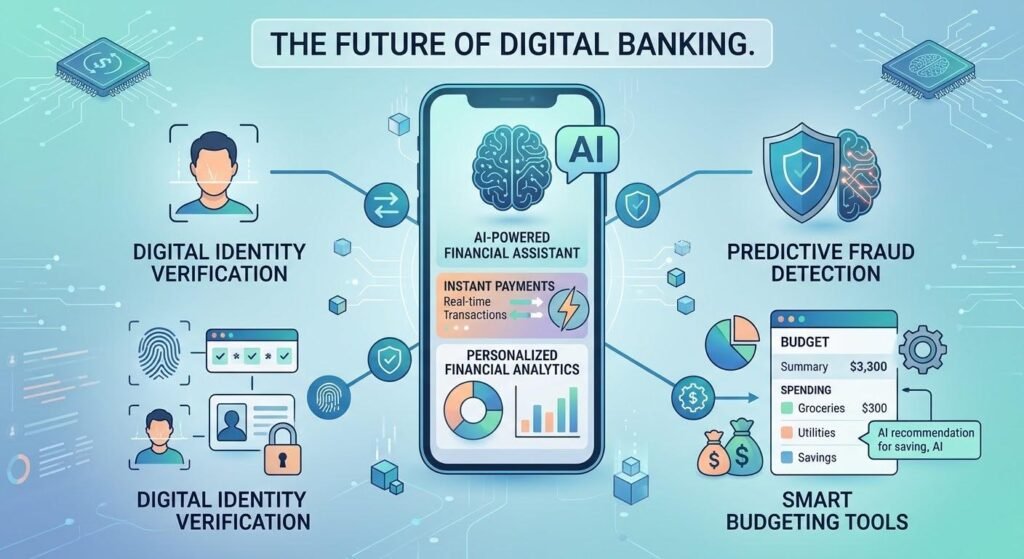
By simplifying the understanding of financial information, generative artificial intelligence is poised to play a significant role in everyday banking in the future. Customers can use a virtual assistant to answer questions, even if it involves navigation through several menus, including how much they spent on transportation last month, why their account balance has gone down or how to cut down on unnecessary expenses. The assistant will be able to review the information that is available in the transactions and give explanations in plain terms. It could also support customers in understanding the terms of the loans, allowing them to compare the choices of savings account, and aid them in creating a budget with regard to their revenue and expenditure. While not all financial institutions are using AI chatbots or conversational assistants, there are those that already are, and they have varying levels of functionality. As the system is more sophisticated, it is important to test it thoroughly, as AI may give inaccurate information, misinterpret requests or fail to consider important financial context. Human assistance should continue to be made available for more complex complaints, more sensitive decisions and situations that call for professional judgment.
2. Agentic AI and Automated Financial Tasks
Agentic AI is one step beyond question answering; it’s when AI is able to think through several actions to reach a predetermined goal. For digital banking, a customer may give permission to a system to keep track of their upcoming bills, to check his/her available banking funds, and to automatically pay bills before they are due. One of the other uses might be to track spending against the monthly budget, and advise on changes if costs are going over budget. Future systems could move funds between eligible accounts, set up savings deductions, or assist customers in structuring debt repayments, among other features, with the appropriate permissions. This capability may help to minimize repetitive work and make financial management more convenient. But an AI agent shouldn’t have unfettered access to the money of a customer. It should have spending limits, transaction confirmations, audit records and it should be possible to cancel and revoke permissions. These systems are still in various stages of development, and are made available based on banking infrastructure, regulations and institutional protection.
3. Predictive Fraud Detection and more Robust Banking Security
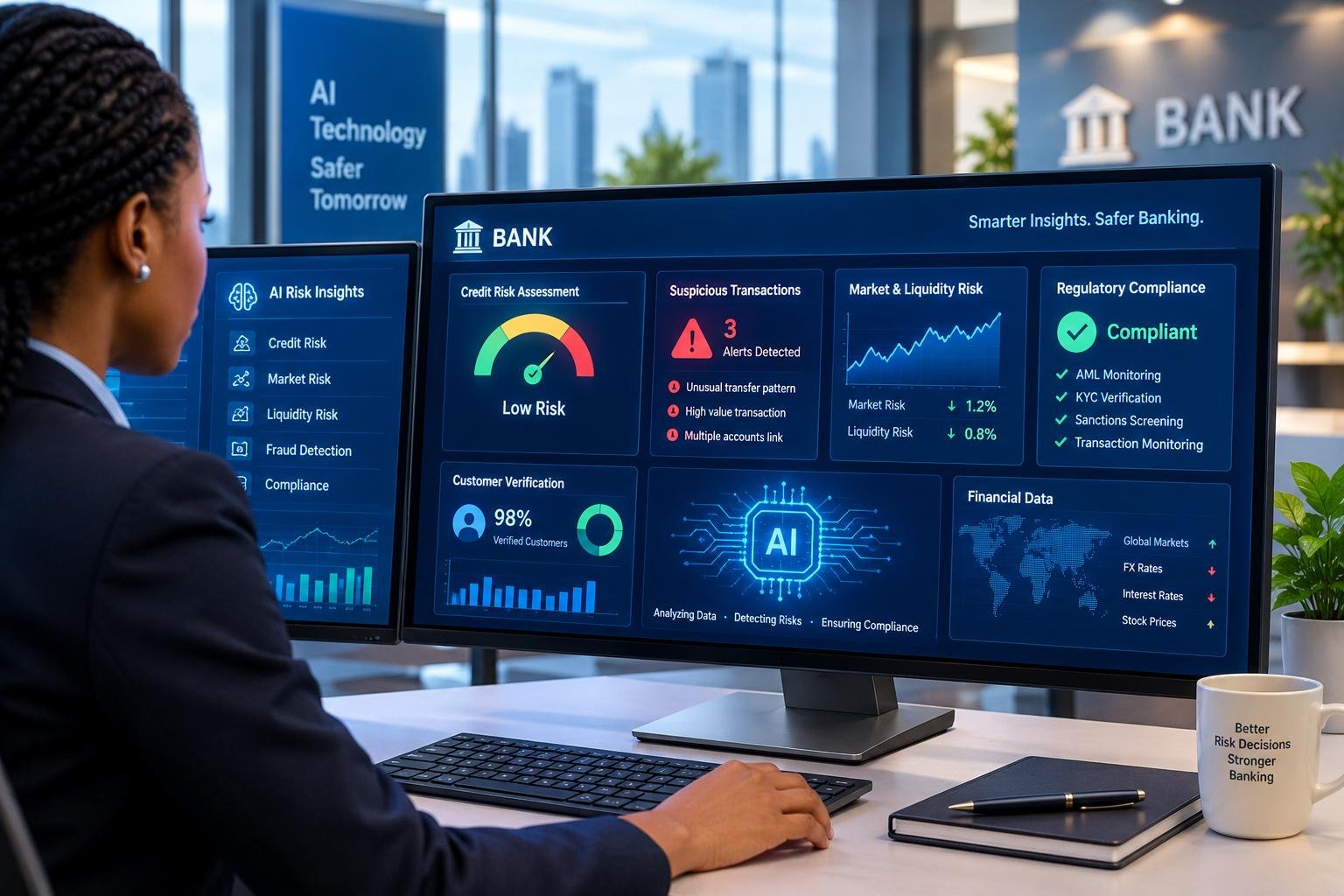
Digital banking is increasingly connected and automated and cybersecurity will continue to be a key focus. Predictive fraud detection involves leveraging AI and machine learning to analyze transaction patterns, device data, account activity, and more to detect fraud. For instance, an abnormal amount of money being transferred out of the account that is very unusual for the customer, or multiple logon attempts from different devices to a customer’s account could trigger an alarm. These can be more sophisticated than the rule-based system, and can recognize complex patterns and react more promptly to new threats. These can be used by banks to place temporary blocks on suspicious transactions, request more verification or make alerts to customers. However, automatic detection of a fire is not foolproof. Normal deals could be misidentified as fraud and high-value fraud may go undetected. Financial institutions need to, therefore, implement technology with human investigation, clear and easy complaint handling, robust customer authentication, and frequent security testing to secure the customers while not unduly hindering access to their funds.
4. The Real-Time Payments and Speed of Financial Transactions
Already, instant payments are driving the change in financial services in many markets by enabling eligible payments to settle near real time or within seconds, even outside banking hours. These systems can assist individuals in sending cash to family members, make it easier for businesses to get cash promptly, and decrease delays linked with traditional transfers. Future payment networks could be more tightly coupled with payment wallets, merchant platforms, financial accounting software, and automated financial assistants. The banking assistant may also be able to have a customer sign for payment of their bill, and provide them with a confirmation once the transaction is complete. The improvement in cash flow could be advantageous for businesses, since they will be able to receive the money they are owed earlier. Instant payments do bring with them some difficulties, though. It can be challenging to reverse a fraudulent transfer after settlement, and maybe costly if an error is made. To keep payments faster, faster and more secure, banks will require recipient verification, easier transaction monitoring, education and understanding for customers, and an easy method to settle disputes.
5. Digital Identity and Secure Customer Verification
Opening new accounts and use of financial services may be more convenient and secure through the use of digital identity systems. Customers might need to take to documents, go to branches and do the same checks across the institutions in “traditional” IDV. Digital identity solutions can be helpful in verifying identities remotely with the support of electronic documents, biometrics and secure identity credentials. These systems can also be used to verify customers’ identities in bank applications and transactions, such as those involving sensitive data. In the future, reusable digital credentials may help to minimize duplication of paperwork in instances where participating institutions and relevant legislation allow use of such credentials. But digital identity systems need to be able to safeguard personal data and serve customers without access to reliable Internet connections or devices or with no recognized documents. Biometric data needs to be protected since if the password is compromised, it can be changed more easily than a person’s fingerprints or face. Digital identity will need to be accessible and trustworthy by establishing strong privacy controls, offering other methods of verification, and ensuring independent oversight.
The New Paradigm of Open Finance and More Personalized Banking
Open finance builds on open banking by giving customers the ability to grant access to financial data to more diverse financial services participating in open finance. This information can consist of bank accounts, savings, investments, pensions or some credit products, depending on the local rules and availability of connections. If given the proper permission, digital platforms can consolidate this information to give a better sense of what a person’s financial standing is. A budgeting application may be able to detect reoccurring costs, and a financial planning tool may be useful for the person to determine what they can save for school, rent or retirement. In addition, more complete data can help to design more customized financial products and evaluations for those with limited credit histories. But data access should be still being permission-based, secure and transparent. Customers should be aware of the information that is shared, who has access to it, why it’s required, and how they can remove access. Lack of uniformity in uptake of open finance due to variations in technical standards, consumer protection and regulatory regimes across markets.
The Impact of Tokenized Deposits on the Future of Digital Money
Another exciting evolution that may transform the way funds are transferred between businesses and financial institutions is tokenized deposits. These are digital tokenized deposits stored in banks, possibly with the help of distributed ledger technology to track ownership and facilitate transfers. In contrast to privately created cryptocurrencies, tokenized deposits are a claim against the bank that issues them and fall under the applicable law and regulation. They could have a number of benefits, such as quicker settlement, better tracing of transactions, and more efficient fund transfer between compatible systems. They might also be able to enable programmable payments, which are payments that are released automatically when stipulated requirements are met. For instance, a business deal may require a payment to be made upon receipt of the delivery notice. But the use of token deposits is not a panacea for the use of traditional bank deposits or existing payment systems. They are only useful if they are interoperable, legally secure, cyber secure, liquid and accepted by regulators. Consumers are not to expect the same security for all digital tokens they use as they would for any money stored in a traditional bank account.
Making Customer-Focused Financial Experiences with Predictive Technology
Digital banking could be more proactive in future, creating proactive services based on the financial information that has been authorized by the customer. As opposed to waiting for customers to realize they are short on cash, a banking application can give them the heads up that they are on the verge of going overdraft. It could also identify account-specific unexpected costs or fees, set a realistic savings goal or outline the implications of a spending change on a savings goal. Small businesses might use predictive tools to forecast cash flow, determine times when the business may well be short of cash and better prepare for payments. Personalization could allow financial guidance to be more relevant by using advice that would align with the specific individual, as opposed to generic advice. However, banks and other financial institutions should not make predictions that are guaranteed. Incomplete information, unanticipated additional costs, fluctuating economic conditions, or faulty assumptions can cause recommendations to be influenced. Customers should be able to comprehend the rationale behind significant recommendations, correct inaccurate information and select to either take or reject suggested actions.
Check Regulation, Privacy, and Human Oversight.
Intelligent Banking will need to be dealt with in an appropriate way through efficient regulation and responsible technology management. Financial institutions are required to adhere to all relevant provisions on financial reporting, cyber security, anti-money laundering, identity verification and data privacy, as well as consumer protection. Regulators will also have to evaluate the impacts on customers of automated decisions, especially where AI impacts financial services access, fraud detection or lending. Often, poorly designed systems can yield biased results, reveal customer’s sensitive information, and make decisions that customers cannot appeal. Banks should regularly test the AI models, track their performance, keep logs of significant decisions, and have easy reporting options for complaints and human oversight. Data minimization is a key principle too – only collect and process data that is required for a lawful reason. It is also important for customers to have meaningful control over automated activities, such as offering clear consent structures, giving customers control over permissions, activity limits, and cancellation options. When a customer is likely to suffer serious consequences or an automated action might result in serious financial consequences, it is especially important for a human to supervise.
Conclusion
Digital banking will be a mix of familiar services and new technologies that will drive more personalized and faster financial management. The financial information could be easier to navigate with generative AI assistants, authorized tasks could be automated by agentic AI, and instant payments could make everyday payments quicker. The forthcoming enhancements to customer access, protection, and movement of money may include digital identity, open finance, predictive fraud detection, and tokenized deposits. The benefits, however, will depend on reliable infrastructure, effective regulation, robust cybersecurity and good implementation. Not all innovations will be available at once, and some uses will need to be studied in more detail before being used in a significant financial decision-making. At the end of the day, the success of digital banking will not just be the ability to use automation. It will rely on the extent to which technology enables customers to be better served in terms of enhancing privacy, transparency, human involvement and control of their funds, and better decisions made.
Get more well researched information about The Future of Digital Banking here.