
Introduction
Known as Financial technology or FinTech, this sector is transforming the core of how capital markets work; bringing together investors, financial institutions, brokers and businesses in increasingly digital systems. Traditional markets are based on well-known practices regarding securities issuance, trade, investments and settling transactions. But, with the advent of artificial intelligence (AI), blockchain, cloud computing and digital identity technologies, new opportunities are emerging to enhance these activities. Cloud-based trading infrastructure provides an example of how financial institutions can modernize and update their technology systems to enable them to operate more flexibly and access the market more efficiently. While these are all exciting opportunities, they will require availability of infrastructure, regulation, cybersecurity and market participant collaboration to achieve success. The knowledge of these developments facilitates the understanding of how capital markets may develop, but does not necessarily offer clues to how all technological progress will lead to improved financial results.
Artificial Intelligence and Automated Investment Research
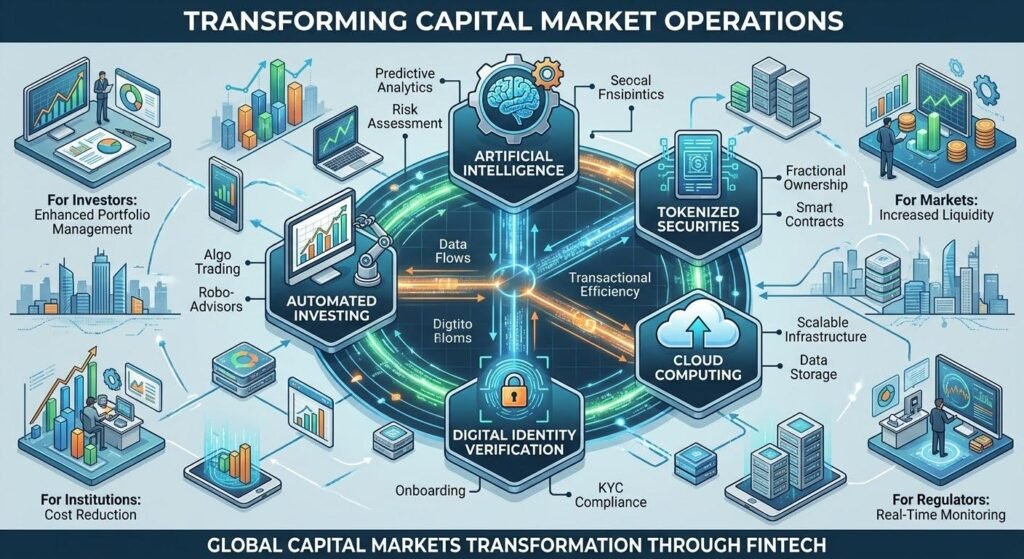
AI is poised to increasingly become a part of investment research and portfolio management. They can use AI to analyze financial statements, economic indicators, market pricing, company releases, and news articles to find patterns that may not be apparent to analysts. Another potential use of machine learning models for investors is to compare securities and evaluate potential risks and investment scenarios. These features can be leveraged by automated investing platforms for portfolio allocation, rebalancing, and risk monitoring, aligned with an investor’s goals. But AI recommendations rely on data, assumptions and design, which can only be as accurate as these. When there are missing data, changing market conditions or atypical market conditions, models can throw false conclusions. This means that no matter how sophisticated trading software gets, it’s still important for humans to take charge, especially in situations where there are substantial financial implications, forecasting uncertainties, or unique circumstances.
Tokenized Securities and Blockchain Technology
In financial tokenization, financial assets are converted into tokens that are stored digitally on a blockchain or another digital ledger, representing ownership rights. Tokenized securities could be shares, bonds, fund interests or other legal entities. This can ease some of the processes of issuance, transfer and recording of ownership through interactions with common digital records by authorized participants. Smart contracts can help streamline some aspects of an investment, such as eligibility requirements, payment terms and investment returns. Fractional ownership may also be enabled and could reduce the minimum investment needed for some investments with the tokenization. However, a digital token does not automatically qualify as a legal asset, as well as a liquid asset or an asset that provides protection for investors. Issuers and regulators will have to create enforceable rights, the appropriate custodial arrangements, and dispute resolution procedures. Whether the tokenized markets will be able to be integrated into the existing financial systems and meet the requirements of the securities laws will be important to widespread adoption.
Cloud Computing, Modern Trading Infrastructure
Cloud computing enables financial institutions to use scalable technology services to obtain computing resources, storage, databases and software without being limited to resources that they maintain in their own facilities. Capital markets can benefit from cloud-based systems to power trading applications, investment analysis, market data processing, and even disaster recovery. When resources are heavily loaded, institutions can allocate more computing power and when they are not being used, less, which can enhance resource usage and help manage some operating costs. The cloud can also help smaller companies to gain access to advanced analytics tools without the need for large-scale physical investment. However there are important considerations to be minded when moving financial operations to the cloud such as service outages, data protection, vendor dependency and concentration risk. Institutions need to be careful with providers, develop good back-up plans, and have contingency plans in place. While cloud adoption can modernize trading operations, the benefits will be contingent on the quality of the implementation, governance and trading operations resilience.
Automation Compliance and Digital Identity Verification
Another area where FinTech might change the way capital markets operate is regulatory compliance. Financial institutions are required to comply with applicable laws, keep records, alert to suspicious activities, and verify customers, among other things. There are technologies available that help you process massive amounts of information, recognize unusual transaction patterns and create reports for compliance staff, which are called automated compliance technologies or RegTech. While AI can help to identify potential misconduct, it can also create more false alarms or miss more subtle types of behavior if not configured correctly. A digital identity system might support these tools with safe and secure electronic proof of investors when opening accounts and at other monetary transactions. Repeated paper-based credentials can be minimized where institutions and regulators use the same sets of credentials. But there are specific requirements to ensure that identity data is not stolen, misused or disclosed without consent. For effective systems, robust authentication, proper consent, clear data management, and oversight by humans over major compliance decisions are essential.
Automated Investing, and More Market Accessibility
The digital investment application and automatic investment guidance are altering the way people make investments in capital markets. Investor accounts can be opened on the internet, portfolios can be viewed, financial data can be accessed and orders placed without having to go to a physical location. Robo-advisers can provide investment suggestions and allocations through questionnaires, algorithms, and portfolio models, which reflect a person’s financial objectives, risk tolerance, and time horizon. These services could help bring the basic investment support to the market and make it more affordable and convenient, especially for those who can’t access traditional investment advice services. Digital platforms can also offer learning tools to help users of understand financial products and market dynamics. But that doesn’t mean that the ease of access will lead investors to make better decisions. Users may incur losses due to poor financial literacy, impulsive trading, hidden fees, deceptive offers, and relying on automated recommendations to make investment choices. Providers should be able to clearly communicate the risks, and create platforms that facilitate informed decision-making, not lead to unnecessary trading.
Integrated Settlement Networks and Faster Transactions
More than just matching buyers and sellers is needed in capital market transactions. Once the trade is done, systems need to confirm the transaction, ascertain obligations, transfer securities and organize payments. In traditional processes, there are various intermediaries, databases, and reconciliation processes, which make it difficult to run the process. More integrated settlement networks would be beneficial for the coordination in that the authorized institutions would be able to share the same set of transaction information and automatically handle some of the settlement steps. Delivery-versus-payment contracts, in which financial assets (securities) and their payments are exchanged under conditions agreed to, can benefit from distributed ledgers and programmable financial assets. There is a possibility of fewer reconciliation delays and inaccuracies with increased integration, but not necessarily faster processing just because a transaction is processed on blockchain or automated. The settlement systems need to address issues of failed transactions, disputes, liquidity needs, and operational disruptions. Agreed technical standards and reliable linkages between payment systems, securities depositories and custodians and trading venues are also essential for market participants.
Interoperability and the Challenge of Fragmented Markets
Fragmentation of capital market technology is one of the biggest hurdles to the development of financial innovation. Exchanges, brokers, banks, custodians and regulators may have different systems for storing information in different formats and/or different technical standards. Consequently, it might not be easy even for two blockchain-based platforms to switch a digital security from one platform to the other. Interoperability is the capability of various systems to share information and carry out coordinated activities in a reliable way. Common Data Standards mutually accepted Digital Identity Standards and agreed settlement procedures may help to minimize duplication and facilitate institutional links. But, interoperability goes beyond technical compatibility. There are also legal duties, data sharing, security and dispute resolution issues that must be agreed upon by the participants. If no cooperation occurs, innovation might generate other isolated systems instead of a system of connected markets.
The Management of the Internet, Regulation and Legacy Technology
Managing security and regulatory issues will be a crucial factor for the success of FinTech in the future. Digital platforms can be a phishing, account takeover, ransomware, API attack, and data breach opportunity. There are extra risks posed by vulnerabilities in software or if private keys are lost in the case of tokenized assets and smart contracts. Multifactor authentication, encryption, limited access, ongoing monitoring, independent security testing, and tried-and-tested recovery plans are all requirements for financial institutions. Regulation is also a challenge, as there may be different regulations in different jurisdictions for securities, the privacy of data, digital assets and transactions taking place across borders. It’s a different story for the established financial institutions that have to rely on legacy systems that are costly and challenging to replace. But modernization needs to be a process that is thoughtfully managed to ensure it is innovative, compliant and service reliable. New technology should be added in a methodical step-by-step approach, with clear accountability, and realistic risk assessment not on the premise that digital systems are always safer or more efficient.
Conclusion
AI powered research, tokenized securities, cloud computing, automated compliance, digital identity, and more seamless settlement networks are likely to have a significant impact on the future of capital markets, thanks to the influence of FinTech. These developments will open up the opportunity for greater investment access, better information processing, better operational efficiency, and how investors interact with financial institutions. But their potential impact won’t be enough; it relies on practicality as well. Adoption or the anticipated benefit may be hindered by cybersecurity risks, regulatory ambiguity, legacy infrastructure, market fragmentation and interoperability. Financial institutions should also shield investors from misinformation and incorrect automated advice and products that have little understanding. It will be imperative to adopt a balanced strategy, where innovation is balanced with good governance, clear communication and good monitoring. Finally, technology is not enough to shape the future of capital markets, it is the way that institutions use it in a responsible manner to develop financial services that are accessible, resilient and trusted.
Get more well researched information FinTech in capital markets here.



zeiniez.fashion