Introduction
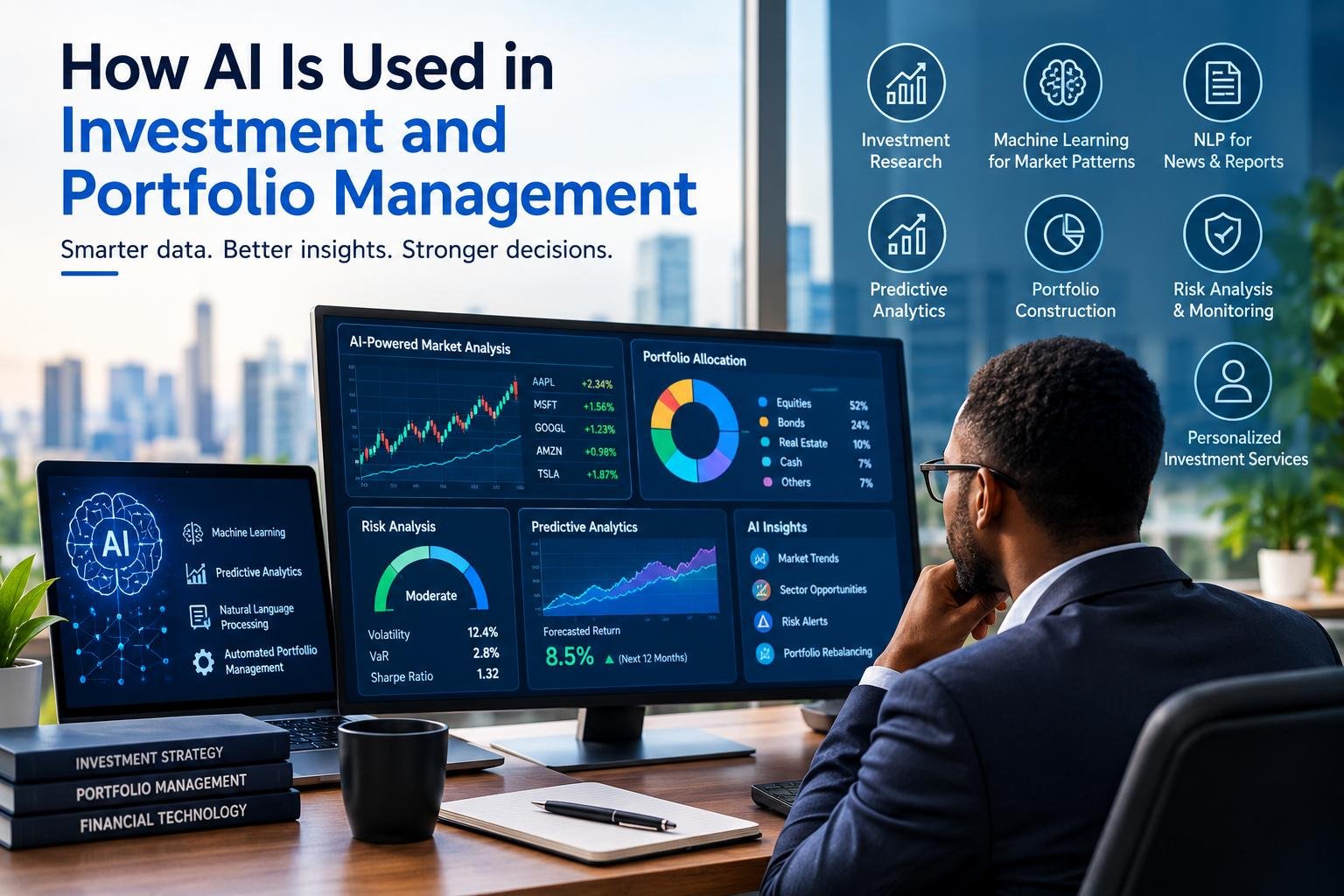
AI is transforming the way investment decisions are being made and researched, evaluated and managed. AI systems can analyze vast quantities of financial and non-financial data in a swift manner, which is beneficial for investment teams. Machine learning can be used to find patterns in market information, natural language processing can be used to analyze news and information from companies, and automated portfolio management can be used to structure investments based on the desired goals and constraints. An application of interest is predictive analytics, where analysis of past and present data can help predict future trends. While these systems are helpful for investment professionals and individuals, the results are not guaranteed, but rather estimate. AI, then, can be seen as a tool for analysis that can augment the pace and scope of investment research, but not with the certainty of certain results, or by removing uncertainty and risk, or by replacing human judgment.
AI in Investment Research
Investment research is a process that gathers data regarding the companies, industries, economies, securities, and markets to make an investment decision. Analysts typically read a lot of material, including annual reports, earnings releases, economic data, analyst reports and articles in the news. AI can help by rapidly analyzing these resources and extracting relevant information to review later. Machine-learning systems can look at past prices, volume of trading, financial ratios and other factors to detect patterns that may be worthy of noting. A natural language processing capability provides another function that enables software to read human language in reports, news, transcripts and other documents. An analyst could employ such a system to find themes that have been repeated, or to compare statements over time, and even to determine language changes in the risks faced by a business. The goal is to minimize repetitive tasks and provide professionals with more time to analyze evidence and to research significant questions.
Identifying Market Patterns and using Machine Learning.
The technology backbone of AI in investment management comprises machine learning. Machine learning is one of the main technologies of AI investment management. A machine-learning model can be trained using historical data to learn relationships between the inputs and outcomes, instead of just following instructions. For investment applications, inputs could be price changes, trading volume, interest rate, company fundamentals, economic indicators or any other data permitted. The model then is able to detect patterns related to certain market conditions. An investment company might, for instance, employ machine learning to label securities on the basis of past traits or discover strange trends in market activity. But past behaviours don’t always indicate future behaviors. Economic conditions, investor behaviour, regulation, unexpected events and technological advancements have an impact on financial markets. Therefore, machine-learning outcomes are not automatically accepted but need to be tested, monitored and interpreted by professionals.
Predictive Analytics and Forecasting
By using historical and current data, predictive analytics can help investment managers make estimates of what they might expect in the future. These approaches can be applied in portfolio management to predict expected returns, volatility, default risk, or other market conditions. One model could be a combination of economic indicators and security-level information that would then result in a forecast that would be part of the investment process. It’s useful in part because it can analyze a large number of variables at once, which is hard to do manually. However, not a prediction of what will occur. Financial markets are uncertain and past relationships may not be as useful when unexpected events occur. The models can also give false signals if the data is incomplete, biased, outdated or poorly selected. Investment professionals should, therefore, review the assumptions of predictive systems and take into account other scenarios and not rely on what a predictive system spits out as a prediction.
The Role of NLP in Investment Decision Making
The majority of information that is relevant to investing is not numerical but written. These types of company announcements, transcripts of earnings calls, regulatory documents, statements made by central banks, research documents, and financial news can include information that could influence the understanding of a security or a market by investors. AI systems can use natural language processing (NLP) to process vast amounts of textual data and identify beneficial cues. Software, for example, can classify documents, recognize common topics of conversation, compare statements over time periods or look for changes in a company’s language. Machine learning can also be used to identify sentiment, providing a possible classification of positive, negative or neutral sentiment in written material. These abilities can facilitate analysts in tracking a wide range of information without reading each document in its entirety. But language is complicated and machines can have trouble understanding context, sarcasm, technical jargon or a vague statement. When text analysis might have a large impact on a big investment decision, human review is still necessary.
Building portfolios using AI
There are two key components of portfolio construction: what assets to include in the portfolio and the amount of the portfolio that should be invested in each asset. AI can help with this by analyzing options of combinations of assets against the objectives of diversification, expected risk, liquidity, or investment constraints. Automated portfolio tools might be able to inform about asset-allocation recommendations or implementations, based on data entered by a person, like his or her time horizon, risk tolerance, financial objectives, and preferred asset classes. For more advanced systems, the market conditions and characteristics of the portfolio can be continuously fed into the system and the manager can explore the performance of various allocations under varying assumptions. AI can also detect concentrations that wouldn’t necessarily be apparent if investors were looking at the individual holdings. But, it’s not just a mathematical exercise to build a portfolio. Taxes, liquidity requirements, investment limitations, costs, individual conditions, and the correlations of assets changing among rough markets are some of the factors that investors need to take into account. While AI can enhance the analytical process, it cannot overcome these practical considerations.

AI and Asset Allocation
Allocation of assets involves the allocation of a portfolio to categories like equities, bonds, cash, real estate, or others. AI can be used to explore asset class interactions and determine potential reactions to economic conditions for various allocations. Big historical data sets could be analyzed by machine-learning models to find patterns in inflation, interest rates, economic growth, currency and market volatility. These findings can be a useful piece of information for an investment team to consider when thinking about whether or not adjusting a portfolio. Additionally, AI-driven systems can aid in scenario analysis, where they analyze the potential reactions of portfolios to various scenarios. The crucial problem is that past market activity doesn’t necessarily capture all future dynamics. Many stable relationships may weaken or die during times of economic change. As a result, judgments on the future must be made in making asset allocation decisions, not just statistical analysis of the past.
Risk Analysis and Portfolio Monitoring
Another practical use of AI in risk management is by helping to assess and forecast financial risks.AI can also be useful for risk management in that it can help to evaluate and predict financial risks. There are a host of information about prices, exposures, volatility, transactions, liquidity and correlations produced by investment portfolios. These parameters can be tracked by AI systems and changes detected that could be a cause for concern. A model might, for instance, alert to an unusual level of “concentration” in a portfolio, to a dramatic change in volatility, or to unusual behaviour that is not similar to past trends. AI can also be used for stress testing, predicting portfolio performance under various market conditions. Manual review may be particularly useful in rapidly changing markets, but continuous monitoring can be helpful. Concurrently, risk models can also be unsuccessful if they are provided with data that do not comprise the event type being experienced. In extreme market conditions there could be a different reaction to the market than during normal conditions. Investors should, therefore, rely on AI-based risk indicators, in addition to traditional risk controls and risk evaluation, instead of taking on the belief that a model can detect all the risks.
Personalized Investment Services and Automated Portfolios
The impact of AI on investment services to consumers is also shaping the way in which services are delivered. An automated investment platform can gather data about an investor’s objectives, time frame, monetary preferences, and danger tolerance, and after that use algorithms to suggest a varied portfolio. A few platforms can automatically adjust the allocation when it deviates from set parameters. AI can also aid with personalized communication, by determining which content is likely to be pertinent to a specific investor, and by generating repetition-free explanations or account alerts. These services can help to make investment management more accessible, particularly for those that might not be able to access an investment professional. But personalization relies greatly on the investor’s input, in terms of the quality and completeness of information. If there is an important circumstance that is left out or was entered incorrectly, the automated recommendation may not accurately depict the person’s needs. Before trusting automated recommendations, investors should be aware of the assumptions and limitations that underlie the recommendations.
The Concept of Data Dependency, Privacy and Automated Decisions
AI investment systems rely on information, and that poses technical and moral issues. Even if the algorithm behind the model is complicated, the model itself can yield unreliable results with incorrect or incomplete, biased or poorly structured information. Data can also evolve over time, so a model that is successful for one market structure can have to be retrained or replaced at a later time. Another concern is privacy as personalized investment services can handle financial information, account activity, preferences, and even more delicate information. When implementing AI, companies need to implement proper access, storage, security and usage restrictions. There are also concerns over transparency and accountability with automated decision-making. It can be challenging for investors to grasp why a particular system would make this recommendation, particularly with complex models. Automation should be held accountable with governance, documentation, testing, monitoring and human oversight.
Importance of Human Judgment to the Process.
Even with the significant strides made in AI, the human element is still significant in investment management, as financial decisions are inherently uncertain, have objectives and constraints which don’t always fit into a dataset, and are subject to change. An investment professional can challenge whether a model’s assumptions are valid, examine an unusual result to see if there is any information that has been overlooked, look at information that the system has not considered and verify that a recommendation applies to a client’s overall situation. Humans can also detect if the market event is fundamentally different than historical data they use to train a model. It shouldn’t come at the expense of traditional analysis and AI, however. The two strategies can complement each other in many investment scenarios. AI can be used for fast information processing, repetitive work, and may generate outputs but with little context, challenge outputs, make uncertainty statements, and may make accountable decisions, while human professionals can provide context, challenge outputs, communicate uncertainty, and make accountable decisions.
Conclusion
AI is increasingly playing a significant role in the field of investment and portfolio management, given its ability to analyze vast amounts of data quickly and efficiently that would be challenging for any individual or investment team to do manually. Machine learning can help to detect patterns, predictive analytics can aid in forecasting, natural language processing can be used to obtain insights from vast amounts of financial text, and automated portfolio management tools can facilitate portfolio allocation and rebalancing. While these abilities can enhance the study and monitoring of water, personalization and efficiency, they do not eliminate the risk of markets. Careful management is required when it comes to model errors, change in market conditions, data restrictions, data privacy, and automated decision making. Thus, the most feasible application of AI is in the context of a decision-support technology and not an automatic financial answer. As long as AI is gathering and interpreting relevant data and then applying it to make informed and structured decisions, it can assist investors and professionals in that process. However, it’s worth noting that no investment can predict the outcome.
Get more well researched information about AI in investment management here.