
Introduction
All organizations, irrespective of scale, sector and function, require good management. This includes those within business and non-business sectors such as education, health care, government and the voluntary sector. Good management is integral in enabling effective control and management of an organization’s resources and personnel so that goals can be met. Management is thus concerned with the planning, organizing, leading and controlling of an organization’s resources. Without good management, individuals may become disorientated and role boundaries may become blurred. Resources may also become mismanaged. Core management principles assist in decision making and managing interactions. Through this they can provide effective control and hence facilitate an environment in which staffs are able to work together well and an organization can successfully attain its aims.
Meaning and Evolution of Management Principles
General in nature, principles of management are used to inform decision making and to manage an organization. Whilst not prescriptive and universal, they are used as a tool to enable good personnel and resource management. During the early 20th Century, the French mining engineer and management theorist, Henri Fayol, made many pioneering management-related findings. He believed that management functioned independently and could be analyzed and enhanced. From his research he identified key aspects of management, namely planning, organization, command, co-ordination and control. His theories are still highly relevant today as they relate to many of the core requirements in organizations; for example to establish control, to distribute roles and to promote discipline and ensure that members of staff work together to meet organizational aims.
Henri Fayol and his Principles of Management
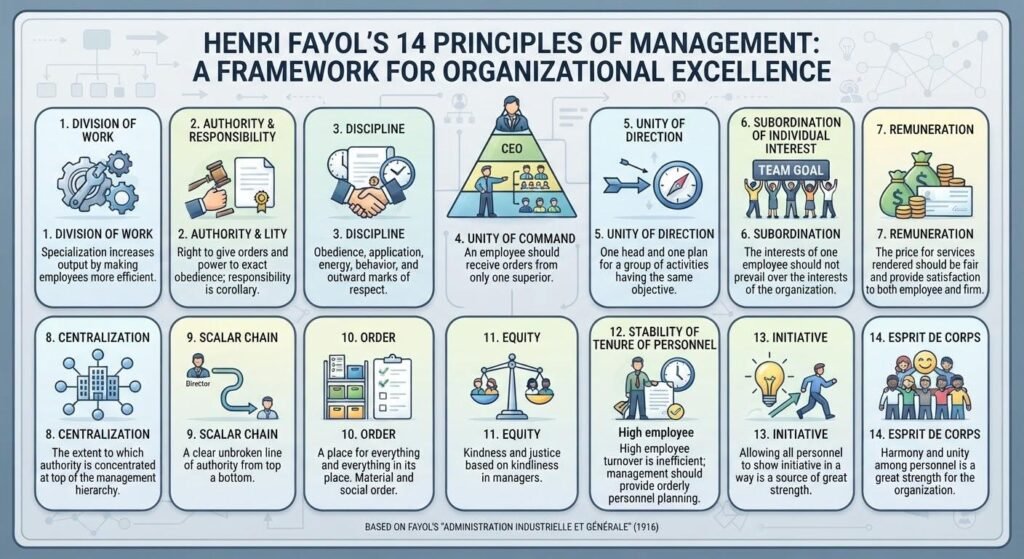
Fayol produced 14 principles of management which administrators can utilize in order to enhance organizational performance. These include: work specialization; authority and responsibility; discipline; unity of command; unity of direction; subordination of self-interest to general interest; remuneration; centralization; scalar chain; order; equity; job security; initiative and esprit de corps. Collectively these principles underpin how organizations can effectively manage themselves. Fayol recognized that good management involves both technical and interpersonal skills. Unlike industry-specific theories, he advocated that his principles should be transferable to a variety of organizational settings. Further information can be obtained regarding the principles of management and their relevance to the development of good management practice.
Work Specialization
Work specialization is where staff or teams undertake specific roles in accordance with their knowledge, expertise and specialisms. Fayol considered that by focusing upon specific areas, staff can enhance their skills and so become more productive. Within an organization, work specialization enables functions to be further segmented and so facilitates the control of intricate operations. For example, in a bank, there may be members of staff specializing in various areas such as customer service, account management, loans and financial reporting. Although each section of the bank will develop niche knowledge, all will work together to enhance the bank’s performance. Nevertheless, work specialization must be complemented by teamwork and communication. Over-specialization can lead to a lack of interest and/or staff may also fail to recognize how their area of specialization relates to and interacts with other functions. Good managers therefore ensure that specialism is suitably integrated with an organization’s aims.
Authority and Responsibility
Authority relates to the power that a manager has to control and direct an organization and make decisions and allocate resources. Responsibility refers to the duty to carry out designated roles and then accept responsibility for the consequences of doing so. Fayol highlighted the importance of ensuring that managers’ authority and responsibility is in equilibrium. It would be unjust to hold them responsible for particular outcomes if they did not possess the authority and/or resources to affect them. Likewise, staff should also be aware of their area of responsibility and the extent of their authority. Within current organizations, good management is underpinned by this principle as it facilitates good delegation, decision making and performance management. For example, a department manager should possess sufficient authority to effectively manage a sales team and put in place suitable sales strategies in order to meet a sales target. Ensuring a good balance between authority and responsibility limits ambiguity and enhances accountability. It also motivates staff by enabling them to feel that they can take ownership for their work.
Discipline
Discipline is concerned with staff abiding by an organization’s policies, rules and behavioral expectations. It is crucial to enabling an orderly, professional and uniform environment. Fayol recognized that discipline was a key element of good management. Staff must be able to adhere to and accept policies in order for an organization to successfully manage them. Alongside enforcing policies, discipline also encompasses respect, justice, timeliness and appropriate behavior. Managers can promote good discipline by communicating expectations, applying policy in an even manner and modeling good behavior. Modern disciplinary mechanisms can include provisions concerning employees’ timekeeping, ethics, health and safety and performance. Good discipline ensures that staffs are conscious of what is expected of them. It therefore frequently results in better teamwork, and staffs are also more inclined to protect an organization’s resources. Consequently, a disciplined environment can be both stable and productive.
Unity of Command
Unity of command is the principle that staff should report to just one immediate superior for a given area of responsibility. Fayol considered that individuals might become confused and experience competing demands and so generate unwarranted tension if they reported to more than one manager. Staff can so identify who is accountable for managing them, assessing their performance and advising them. For instance, a finance department accountant should report to an identified superior who manages and assesses the accountant’s work on a daily basis. Although contemporary organizations are becoming ever more horizontally structured to allow greater adaptability, a firm understanding of an organization’s hierarchy is still important in delineating roles and in managing disagreements. Furthermore, whilst advocating that an organization’s hierarchy should not impede communication unduly, Fayol also recognized the importance of a ‘bridge’ mechanism (sometimes known as a ‘gang plank’) through which, if necessary, staff can communicate directly with others at the correct level provided that their managers are notified of this. Again, this aids both accountability and communication.
Additional Significant Management Principles
In addition to the above, Fayol identified further key principles which also impact upon an organization’s performance. Subordination of self-interest to general interest requires both staff and managers to place organizational aims before personal interests. Good remuneration should be provided for staff in recognition of their work. Centralization is concerned with appropriately distributing decision making power between upper and lower levels of an organization. Order is about ensuring that resources and personnel are situated in optimal locations. Managers should also apply equity in their treatment of staff so that they are both fairly and respectfully managed. Job security was recognized by Fayol as important as it relates to staff retention and continuity. Initiative is about motivating individuals to share ideas and act responsibly. Finally, esprit de corps promotes team working and engenders a sense of organizational spirit. Together then, these principles show that in order to be good managers, in addition to possessing authority, individuals must also be just, inspiring and collaborative, and be able to develop staff.
Significance of Principles of Management
Principles of management are important as they underpin an organization’s control and enable its aims to be realized. They are used to determine roles, to define reporting lines and to manage resources. Staff are also more able to work in an ordered manner and are less likely to encounter disagreement when they are conscious of their roles and of the authority of their superiors. Furthermore, these principles boost productivity as they facilitate work specialization, avoid unnecessary replication and enable effective decision making. Accountability is also improved as both staff and departments can be assessed in relation to their defined roles. Principles of management also promote good communication, as they identify suitable ways to exchange information and to address issues. Moreover, alongside fostering discipline, they enhance teamwork. Thus, organizations can uphold good professional standards and effectively manage emerging issues. Although principles of management must be applied with discernment, they are key in offering structure, and still allow for judgment, adaptability and ongoing enhancement.
Utilization of Classical Principles of Management within Contemporary Organizations
Whilst classical principles of management continue to inform current organizations, their implementation has developed in response to both technological advances and shifting expectations relating to working. Within digital based organizations, for instance, work specialization is used to allocate work to different personnel such as IT developers, data analysts, cyber security experts and project managers. Unity of direction is similarly applied as project management tools are often used to bring together diverse teams around common business aims. Authority and responsibility is manifested in an organization through delegation, performance related objectives and accountability mechanisms. Moreover, modern communication technology enables organizations to sustain their hierarchical structures, and also to enable inter-departmental staff to work together more speedily. Nonetheless, contemporary managers must modify the classical principles to effectively manage newly evolving modes of working, geographically dispersed staff and innovation, as well as to involve staff. Whilst not exclusively adhering to defined structures, good organizations therefore effectively integrate well-defined roles, good communication, team working and mechanisms for staff to share ideas. Hence, classical management principles remain applicable within modern organizations.
Conclusion
Core management principles are integral in managing staff, co-ordinating functions and instilling discipline. Henri Fayol’s theoretical work is highly pertinent as it illustrates how concepts of authority, responsibility, work specialization, unity of command, unity of direction and hierarchy can all contribute to good management. Principles of management thus enable organizations to define expectations, and further boost productivity. They also minimize ambiguity and increase accountability. Despite the increasing complexity and technological nature of contemporary organizations, the necessity for good control, teamwork and managerial accountability has not diminished. Managers must therefore comprehend the significance of principles of management and modify them to suit staff and organizations. Applied discerningly, such principles therefore provide a robust basis upon which to deliver efficient management, to develop good staff-manager relations and to drive sustainable development and realization of organizational aims.
Get more well researched information about Fundamental Principles of Management here.