Introduction
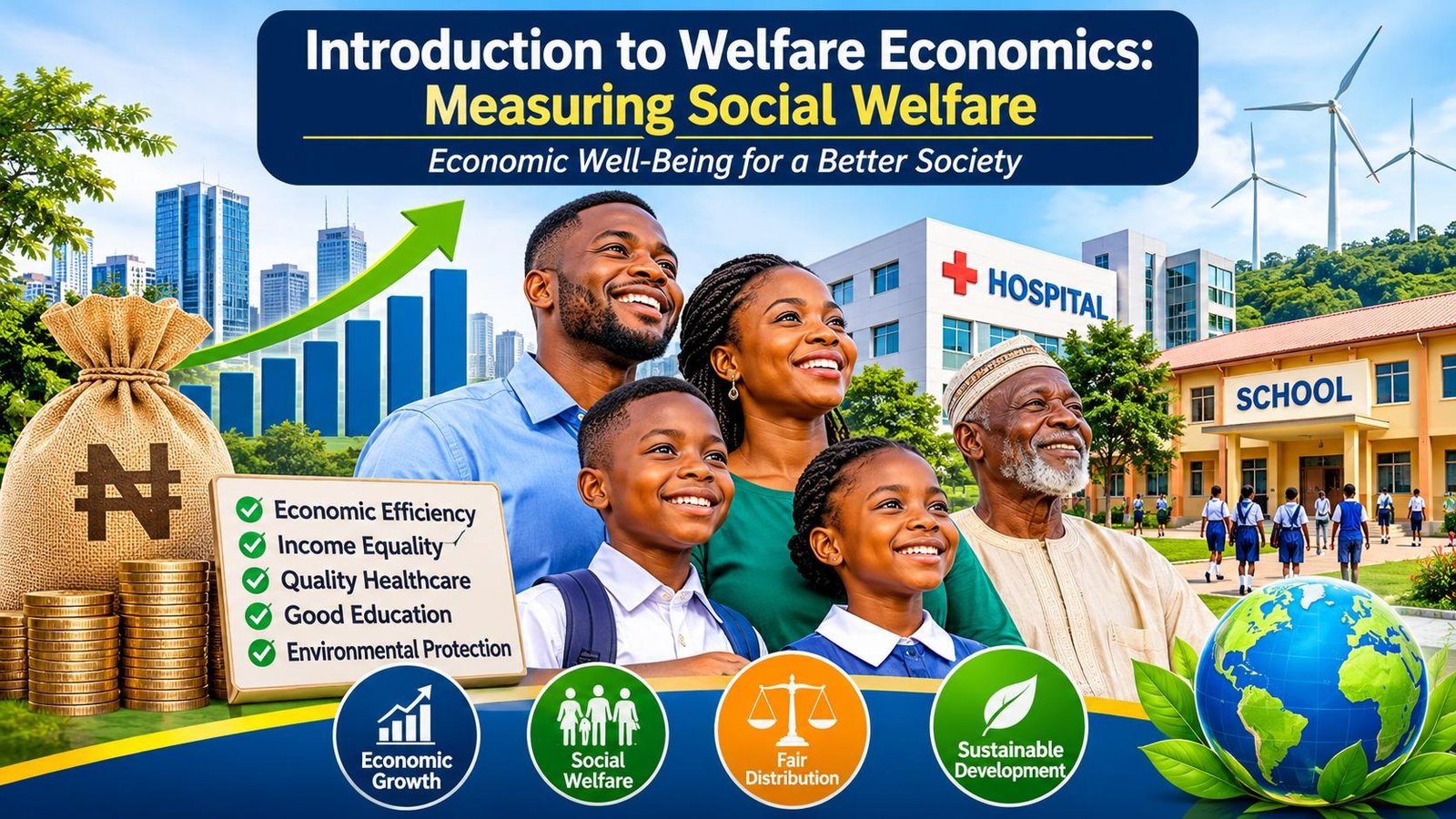
Alongside indicators such as GDP, national income and levels of employment and industry output, economic development can often be analyzed using these criteria. However, simply analyzing economic data does not always allow us to assess how well people are doing. Despite robust economic growth, a country’s citizens may suffer from numerous issues, for example, poor healthcare, educational provision and economic opportunity. Thus, welfare economics is pertinent in analyzing economic development. Within welfare economics, economic activity is analyzed in order to assess the impact it has on people and society as a whole. Welfare economics is a sub discipline of economics and enables individuals to analyze the effect that economic activity has on social welfare and so to assess whether economic development is successfully enhancing people’s lives and ensuring fairness is also upheld.
What is Social Welfare?
Social welfare encompasses the well-being of all members of society including aspects such as economic status, as well as access to services and life experiences. Typically, within economics, reference is made to societal welfare; however there are differing methods of analyzing and comparing welfare. Economists may analyze either the collective satisfaction or ‘utility’ gained by a society, or alternatively assess how welfare and economic resources are shared. Even in a society with a high national income, if there is extreme wealth disparity so that only a minority possesses substantial financial assets, together with many people unable to access fundamental items, then social welfare may be low. Hence, welfare analysis extends beyond consideration of a country’s economic output to assess whether economic resources are appropriately employed to enhance people’s lives.
Well-Being Analysis
Economists analyze multiple aspects to determine well-being. These include utility, which is the satisfaction gained from consumption of goods and services. Unfortunately, utility is hard to quantify as it is highly subjective. Further well-being assessment can involve looking at peoples’ financial position, employment status, housing and access to education and healthcare. Economists also analyze the extent to which economic activity results in and equitably disseminates advantages for society. Additional data such as information on the levels of poverty, life expectancy, literacy and income disparity can further illustrate welfare. Thus, authentic economic development can be recognized as the enhancement of citizens’ lives and economic opportunity.
Consumer and Producer Surplus
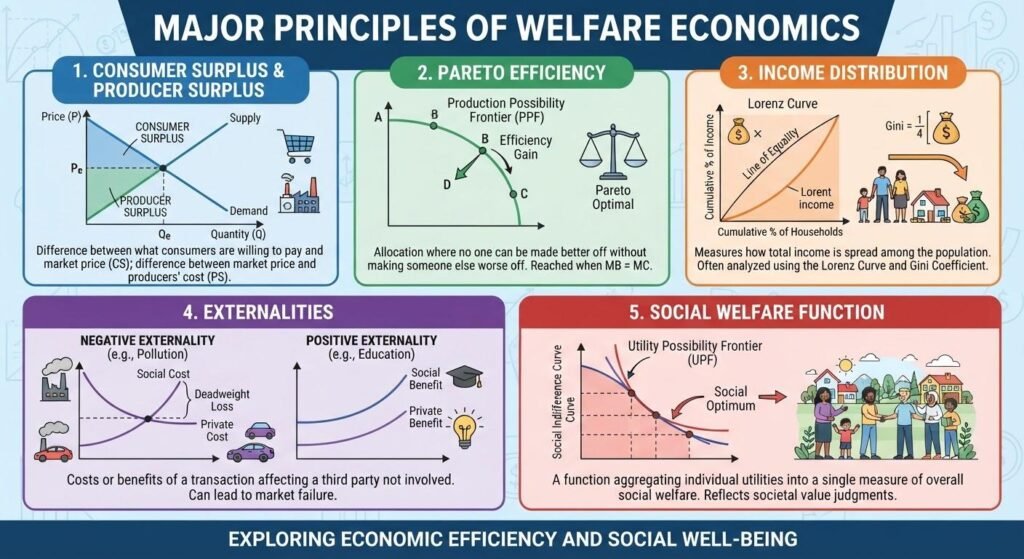
Consumer and producer surpluses are key mechanisms to analyze the value that is added by economic activity. Consumer surplus is the extra satisfaction that consumers gain from buying a good or service for less than they were prepared to pay. For instance, if someone is prepared to pay ₦10,000 but only pays ₦7,000 for an item, then their consumer surplus will be ₦3,000. Producer surplus is the benefit that arises to producers from selling an item for more than the minimum price that they would have accepted. Once again, these methods enable economists to analyze how value is added by both buyers and sellers within markets. Under effective competition, consumer and producer surpluses can both be augmented and so economic resources are successfully adding value.
Efficiency
Resources are allocated in an economically efficient manner when they are deployed in a way that best fulfills requirements and preferences, given the availability of resources. An important principle within welfare economics is that of Pareto efficiency. Here it is not possible to enhance one person’s well-being without simultaneously diminishing another person’s well-being. However, whilst a society may be in a state of Pareto efficiency, it does not necessarily follow that resources are shared fairly. A society could be in this situation even if a minority continues to control a high proportion of wealth. Thus, economists recognize that efficiency and equity are separate themes for consideration in welfare analysis. Economically efficient resource allocation helps to prevent wastage, promotes economic endeavor and facilitates economic growth. Equity is relevant to ascertaining whether the gains that arise from efficiency offer suitable life chances and living standards for various sections of society.
Income Disparity and Welfare
Income disparity is concerned with the variation in income that exists between individuals and/or households. Factors including education, skills, experience, entrepreneurialism and productivity can all influence income. Whilst some degree of income disparity is likely to exist, disproportionate levels can present substantial welfare concerns. Should a society’s wealth and income become highly concentrated, then lower income households may struggle to purchase healthy food, suitable education and healthcare together with appropriate housing. Furthermore, income disparity can impede social mobility and economic engagement and can even lead to community discord. Economists typically analyze income disparity using either a Gini coefficient or Lorenz curve. Such techniques enable comparison of income disparity between different countries or time periods and are often employed by policymakers to ascertain whether economic growth is successfully enhancing the well-being of a wide section of society or mainly just those who are already economically well off.
Externalities
Externalities are impacts (positive or negative) that individuals or firms have on members of society other than their immediate trading partners. Negative externalities encompass, for example, environmental degradation and traffic as well as pollution. These are negative effects that are externally incurred by society as a result of private economic behavior. Positive externalities include education, vaccinations and research and represent added benefits that extend beyond those who initially receive or deliver these. Economic activity can lead to market failure if market prices fail to accurately represent the true social costs and benefits of that economic activity. For example, a factory may manufacture at a relatively low private cost but also emit polluting substances which negatively affect public health and the environment. Welfare economics is used to analyze scenarios such as these and to then advise on how economic resources might be more effectively allocated. It also enables evaluation of how economic decision making can recognize wider ramifications.
Government Intervention
Market failure frequently necessitates government intervention to enhance welfare. Governments can implement taxation, subsidization and regulation together with the delivery of public services and the running of social schemes to resolve market failure. Charging taxes on economic activity causing negative externalities (for example, pollution) can incentivize firms to minimize detrimental behaviors as they will then have to take into account some of the societal costs that their actions incur. Likewise, subsidizing economic endeavors that confer positive externalities (such as education and preventative healthcare) can stimulate engagement in these areas and further amplify their social benefits. Governments may also deliver public goods, for example, national defense, public infrastructure and environmental protection sectors in which private markets may fail to effectively supply. However, governmental intervention must be well conceived as mismanagement can result in inefficiencies, high costs and/or unwarranted outcomes.
Taxation and Redistributive Effects
Governments utilize taxation to significantly shape welfare and to redistribute economic resources. Under a progressive taxation system, higher income people may be required to pay a greater percentage of their earnings in taxation. Governments can then employ these funds to both maintain key services and assist low income households. Tax revenue can be channeled towards the provision of infrastructure, educational, healthcare and social services and thus facilitate enhanced access to economic opportunity. Economic resource redistribution can alleviate both poverty and income disparity and can further underpin societal stability and economic engagement. However, taxation can also involve complex decision making. Overly high or incorrectly structured taxation can act as a disincentive to economic investment, work and/or endeavor. Conversely, inadequate taxation can hinder government capacity to maintain key services. Efficient taxation policy therefore needs to effectively balance revenue acquisition, fairness and stimulation of economic growth.
Education and Healthcare
Education and healthcare are integral to welfare. They can directly affect people’s skills, productivity and life quality. Good education enhances knowledge and skills and therefore affects employment and in turn economic engagement. These sectors also engender positive externalities due to their influence upon innovation, decision-making and social progression. Healthcare also has a significant impact on welfare as it can prevent and ease people’s ill-health and further enhances life expectancy. Healthcare can therefore sustain productivity. Affordable and accessible education and healthcare facilities are key to minimizing disparity and developing human capital. Consequently, government expenditure on education (for example, schools), healthcare (for example, hospitals and medical research) and preventative healthcare can yield social benefits beyond those experienced by individual households. Thus economic development can appropriately also be analyzed with reference to enhancements in people’s health and knowledge together with their economic opportunity.
Environmental Protection and Sustainable Welfare
Environmental protection is highly relevant to welfare economics as the economy relies on natural resources and has the potential to influence the health and well-being of both current and future generations. Manufacturing, transport, farming and energy usage can cause environmental issues including pollution, deforestation and climate change if environmental impacts are not addressed. Environmental harm can adversely affect agricultural output, raise healthcare expenditures and jeopardize people’s livelihoods and can moreover impede long term economic development. Governments can improve welfare by instituting environmental legislation, charging taxes on pollution, offering incentives to adopt renewable energy sources and investing in environmentally sustainable infrastructure. These methods motivate both firms and households to recognize and respond to the wider implications of their economic decisions. Sustainable welfare is attained when economic resources are employed to suit current requirements, without unduly compromising the environmental context and economic opportunity for future generations.
Social Assistance
Social assistance is offered to economically disadvantaged, unemployed and/or disabled people, along with other individuals and households facing economic hardship. This may comprise monetary payments, food and/or unemployment benefits together with housing and specific financial support. Social assistance can improve well-being, lessen economic hardship and foster social inclusion. Moreover, as recipients of social assistance typically allocate a high proportion of their economic resources towards fundamental products and services, social assistance can also stimulate economic engagement. Efficient social assistance is dependent upon good policy conception, clear management and accurate identification of those to whom it should be directed so that economic resources can be effectively delivered to most in need. Combined with education, economic engagement and healthcare access, social assistance can play a key role in enabling sustained welfare enhancement.
Conclusion – Extending beyond National Income
Welfare economics facilitates a more comprehensive comprehension of economic development by assessing resource allocation together with resource transformation into improved human well-being. Principles such as social welfare, consumer and producer surpluses, economic efficiency, income disparity and externalities are all employed by economists to appraise the advantages and disadvantages of economic activity. Governmental taxation, education, healthcare, environmental protection and social assistance policy can then be deployed to modify welfare. These include mechanisms for resolving market failure together with approaches for both reducing poverty and widening access to key life chances. Although growing production and national income are key determinants of economic development, such factors alone are insufficient to establish whether people are enjoying enhanced living standards. Therefore, authentic economic development should be analyzed in terms of how economic resources are utilized to effectively improve health, education, security and life quality. Ideally, a prosperous economy is not merely one that successfully raises production, but is one which employs economic resources in a manner that successfully confers enduring benefits for society as a whole.
Get more well researched information about Welfare Economics here.