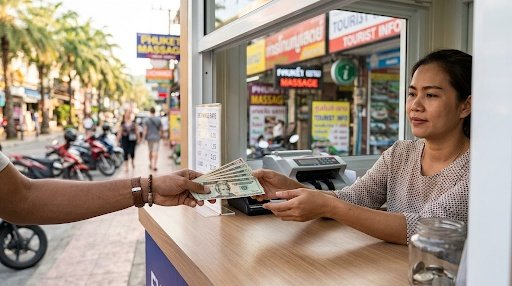
A traveler lands in Phuket with a neat stack of US dollars, walks up to the first exchange counter he sees and hands everything over. He never glances at the rate. Two days later, a friend at the beach bar says she got noticeably more baht for the same amount. It’s a common story, and it’s easy to avoid.
If you plan to exchange USD to Thai baht during a holiday or a longer stay, a few small habits can leave you with more spending money. None of them take much effort.
The rate on the board is only half the story
Every exchange counter shows a buy rate, and that’s the number most people look at. But the real cost sits in the gap between that rate and the “mid-market” rate, the one you’ll see if you search the currency pair online. The wider the gap, the more you quietly pay.
Some places also add a commission or a service fee on top. So the smart question isn’t “what’s the rate?” but “how many baht will I actually walk away with?”
Where people usually exchange, and what to expect
Most visitors end up choosing from the same handful of options. Each has its place, but they aren’t equal.
Airport counters: Handy after a long flight, but the convenience is usually priced in. Many travelers change just enough for a taxi and a meal.
Hotels: Easy, though rarely the best deal. Fine for an emergency.
Banks: Generally reliable, but opening hours are limited and you may need to show your passport.
ATMs: Quick, but Thai ATMs commonly charge a flat fee per withdrawal, and your own bank may add another. Fewer, larger withdrawals tend to make more sense than many small ones.
Independent exchange shops: Often the most competitive, because they live on foot traffic and compete with the shop next door.
Finding a good exchange spot in Phuket
Phuket has plenty of money changers, especially around the busy tourist areas, so comparing a couple takes only a few minutes. Many visitors start by asking a simple question: Where can I exchange USD to Thai baht in Phuket at a good rate? A dedicated local exchange service is a sensible place to begin, since changing money is all it does.
Walk in with the mid-market rate on your phone. If the quote is close, you’re in good shape. If it’s far off, walk out and try the next shop.
Small habits that make a real difference
Picture a couple who spend a week in Phuket and follow a few simple rules. They don’t do anything fancy. They just pay attention at the right moments.
Check the mid-market rate first. It gives you a benchmark before you talk to anyone.
Bring clean, undamaged notes. Torn or heavily creased bills can be refused or valued lower. Larger denominations often get a better rate than small ones.
Ask for the final amount in baht. Say how many dollars you’re changing and ask what you’ll receive after any fees.
Count the cash before you leave the counter. It’s polite and perfectly normal.
Keep your passport handy. Some exchanges ask for it, particularly for larger amounts.
Say no to conversion at the machine. If an ATM or card terminal offers to charge you in dollars, choose baht. The “helpful” conversion usually comes with a poor rate.
If you’re staying longer or sending money home
Residents and long-stay visitors play a slightly different game. Changing a big sum at once feels tidy, but it locks you into one day’s rate. Many people prefer to exchange in a few batches, so one unlucky day doesn’t decide the whole budget.
The same thinking applies to international transfers. Banks and transfer services advertise their fees in different ways, and a “zero fee” label can hide a weak exchange rate. Compare the final amount that lands in the account, not the headline promise.
It also helps to keep a small stash of baht in cash. Local markets, street food stalls, motorbike rentals and songthaew rides all run on notes, and cards won’t help there.
Keep it simple when you exchange USD to Thai baht
Getting a decent deal doesn’t call for spreadsheets or hours of research. Know the mid-market rate, compare one or two places, ask for the total in baht and avoid the airport rush if you can. Do that, and the money you save goes toward something better, like an extra island trip or one more plate of mango sticky rice.