Introduction
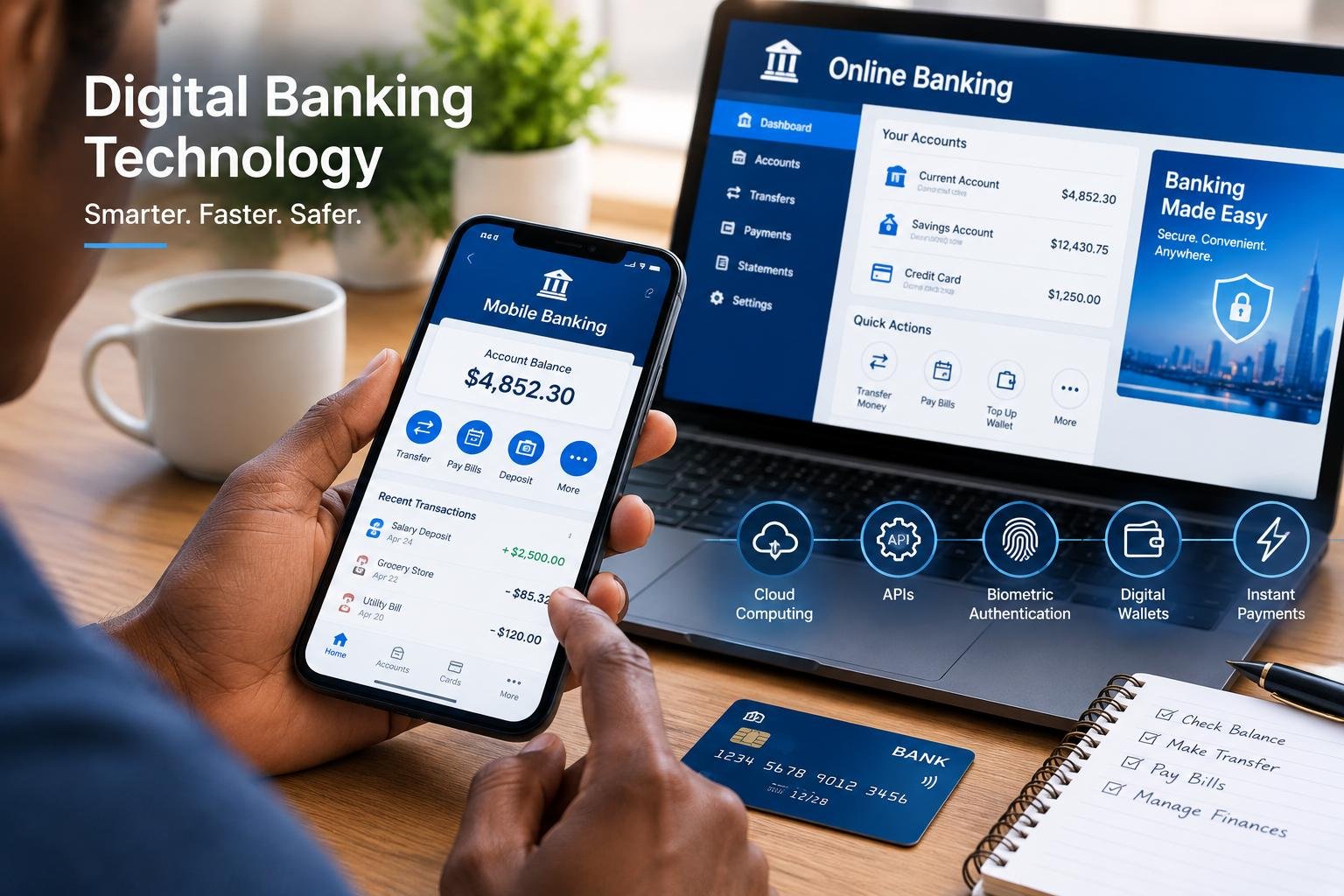
The digital banking technology has revolutionized the way that individuals and businesses access, use and move money. In the old days, customers would have to physically go to the banks, fill out paper applications and wait for the bank staff to do the work for them. In today’s age, someone can conduct numerous financial transactions in mere seconds from a banking app, internet banking or digital wallet. This has revolutionized the banking sector making it more convenient, accessible and efficient, and affected how the banking industry goes about its business. New technology like application programming interfaces (APIs), cloud computing, biometric authentication and automated customer support are essential tools in today’s banking. These innovations assist banks to better deliver their service, enhance security, decrease operating costs and to be more responsive in addressing customer needs. Digital banking, however, also poses issues around cyber security, privacy, technology reliability, and access to technology.
Incorporating the key Features of Traditional Banking into digital Financial Services.
Conventional banking was reliant on the need to have physical branches where customers would have to meet a bank employee to deposit their funds, withdraw cash, transfer their money or check on their accounts. This worked, but sometimes this meant waiting in long lines, limited hours of operation, paperwork and travel costs. By shifting many services to digital platforms, customers can access them from their smartphones, computers and connected devices, digital banking has eliminated these constraints. Mobile banking apps allow people to see their account balances, pay bills, move money from account to account, and see their transaction history, and more, without needing to go to a bank branch. Internet banking provides the same services via secure Web pages and self-service banking, such as automated teller machines (ATMs) and interactive banking terminals, enables customers to handle specific types of transactions. This means banks will be able to offer more customers additional hours outside of standard banking hours and staff will be able to focus more on the more intricate financial requests and on relationship management.
Technologies Powering Modern Digital Banking
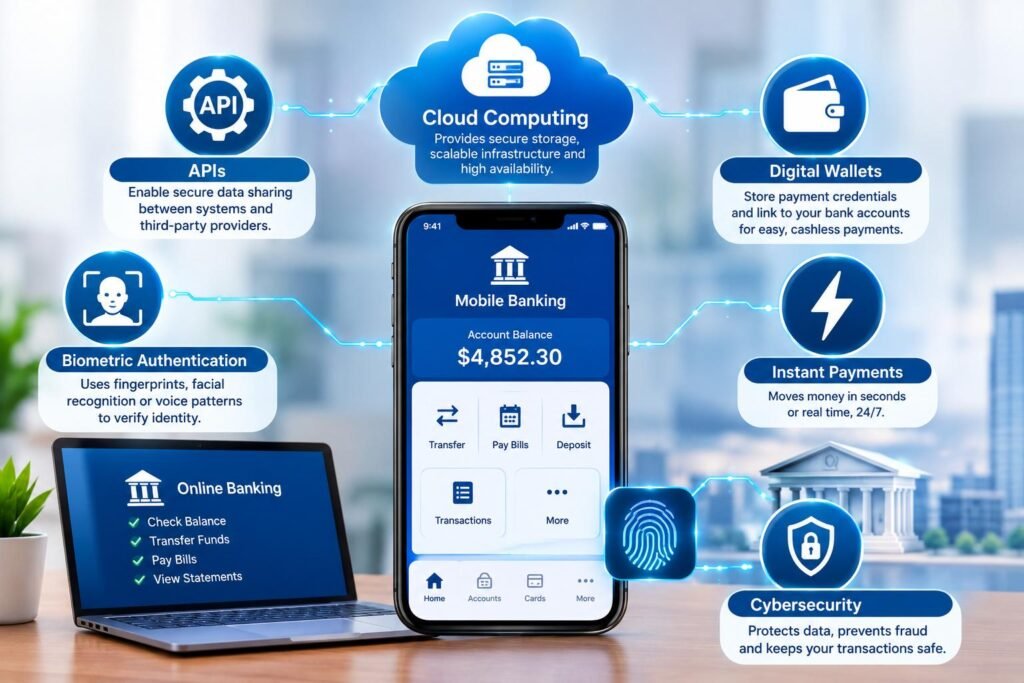
Modern digital banking involves multiple technologies that work together to enable financial institutions to handle transactions, information and provide services efficiently. APIs, or application programming interfaces, help various software systems to securely share data and act together with other systems. APIs can link, for instance, banking systems to payment systems, accounting software and trusted financial technology providers. Cloud computing enables Remote Computing Resources, Storage and Software Infrastructure so that Banks can scale without having to rely on physical servers at each branch. These technologies can help to speed up product development, enhance collaboration and facilitate high transaction volumes during processing. But access controls, data security, system robustness and third-party risk need to be handled with care by financial institutions. There is a need for robust governance and ongoing monitoring to ensure its effective implementation as a failure in any system component can have a knock-on impact on other components of the banking system.
Biometric Authentication and Cyber Security
Financial applications capture personal, delicate information and valuable assets, making it a core need of digital banking to be secure. Personal identification numbers and passwords are still valuable, but can be compromised, guessed or compromised in phishing attacks. Another way of checking identity is through biometric authentication, which relies on unique physical or behavioral traits like fingerprints, facial characteristics or voice patterns. Biometric authentication, as explained, is a type of system that is based on some measurable features to assist in determining if the individual is the one they claim to be. Mobile applications might include fingerprint scanning, or facial recognition to make accessing your account or approving transactions easier. Biometric checks can help to enhance authentication and minimize reliance on passwords if they are used correctly. However, biometrics cannot be used without risks, and requires adequate implementation, data protection, and other security measures like transaction monitoring, device security, and multifactor authentication.
Digital Wallets and Instant Payments
The emergence of digital wallets and instant payment options has revolutionized the way customers pay for goods and services and send and receive payments. A digital wallet is an application that can hold payment credentials or access financial accounts that are linked to the wallet. Depending on the service, wallets can be used to shop online, to pay without a credit card, to pay bills or make transfers among customers. Instant payment systems enable a transaction to be completed within seconds or almost real time if the transaction is eligible, minimizing the delays that can be experienced when using some payment systems. These services are particularly beneficial for companies that want to receive payments promptly, make payments to suppliers or verify transactions with customers without delays. Digital banking can also enable people and small businesses more actively engage in the formal economy in countries with high mobile payment usage rates. But the user must be vigilant and aware of the fraudulent payment requests, fake applications, incorrect transfers and frauds taking advantage of the speed of electronic payments.
Accessibility/ Customer Experience enhancements
A big benefit of digital banking is that financial services are available to their customers outside of regular banking hours. With access to a compatible device and a reliable connection, people can access their accounts, make transfers and pay their bills from home, workplaces, and on the go. This is quite beneficial for employees with tight schedules, those who don’t reside near bank branches, and companies that have offices in various places. Automated customer support also helps with service delivery as it allows for the answers to common customer questions to be omitted via chatbots, virtual assistants, and interactive voice responses. These types of tools can enable customers to verify transaction methods, comprehend account solutions or resolve normal problems without needing to wait on a human representative. For more complex queries, more sophisticated systems can route them to the right department. But automated help must be correct, easy to access and have human backup for judgment and empathy, or in-depth investigations.
The Advantages to Individuals and Businesses
Digital banking offers greater transparency and information to individuals about their finances, allowing them to easily view their account balance, spending history, payment confirmations and transaction history. People can keep track of their activity more often, spot unknown transactions and arrange their monetary commitments using mobile applications. Digital notifications and statements can also provide users with a better understanding of their spending habits and prevent paying late. For businesses, digital banking makes it easier to do things like process payroll, pay suppliers online, collect payments online and keep an eye on cash flow. It can be integrated with accounting software, which can help to minimize repetitive data entry and simplify financial record-keeping. Lower transaction-processing costs, confirmation of payments quicker and faster, and the ability to access online financial services without the need to visit branches may be especially advantageous for small businesses. Banks also gain as the digital processes can decrease paperwork, automate regular features and enhance service capacity. However, these benefits rely on reliable systems, clear charges, adequate customer education and adequate measures to prevent financial crime.
Operational Efficiency and the Part of Automation
Digital transformation can help banks to optimize the use of their resources and streamline their internal processes. Automated systems can aid in verifying identities, conducting transactions, notifying accounts, detecting frauds, and some administrative processes. A bank could use transaction pattern software to monitor transactions and detect any activity that is out of line with its customers’ typical behavior, rather than having to review everything manually. This will assist investigators in prioritizing potentially suspicious charges but automated notifications will still need to be carefully considered to ensure that the accounts are not blocked needlessly. In addition, cloud infrastructure can provide institutions with the ability to scale up or down their computing needs when they need it most, such as during periods of peak transaction volume. APIs can help authorized systems to share information, which helps to minimize duplication and allows for more integrated services. These technologies can combine to reduce processing times, ensure consistency and help to launch new banking products. But where there are consequences for customers, there is no need to get rid of trained staff, accountability, frequent testing of the system and human oversight.
Digital Banking Challenges as well as Risks
While digital banking comes with its benefits, it also poses risks that financial institutions and users need to be aware of and take seriously. Accounts can be accessed via phishing emails, social engineering, malware, stolen credentials and/or fraudulent applications. In addition, customers have the potential to be misled into authorizing themselves, complicating the fraud defence process. Another one of the challenges is service disruptions, which can occur if technical issues, connection problems, cyberattacks or third-party disruptions are present, causing customers to be unable to access critical financial services. However, privacy is also a key concern since digital payments leave behind data on spending patterns, as well as place and financial connections. Banks should ensure that this information is safeguarded by implementing proper access control measures, encrypting data, securely storing information, and adopting responsible data-handling protocols. One of the problems is that digital exclusion arises when individuals do not have a reliable internet connection, appropriate device or tools, digital skills, or easy to use interfaces. There are certain challenges that older adults, those with disabilities, and those who are not served by the community, may encounter. This means inclusive service design, customer education about the service, effective complaint procedure and alternative access arrangements.
The Future of Digital Banking
Digital banking is expected to become more deeply AI-driven, open banking, cloud-based, and real-time payment network in the future. As banks integrate AI solutions, they will be able to indicate suspicious activity, tailor financial guidance to individual customers, and enhance their customer support. However, banks must test systems for accuracy and unfair outcomes. Open banking may make it easier for customers to share financial data that has been authorized to make it easier to use multiple accounts and compare financial products with third parties, as long as those third parties are approved. Cloud-based services and the enhanced APIs also have the potential to help financial institutions rapidly roll out new features and forge partnerships with technology providers. Meanwhile, regulators and banks will have to enhance their cybersecurity, safeguard customer privacy, provide reliable services and ensure that technological advances do not exclude and marginalize vulnerable groups. In the future, it will not only be about new tools, but about innovation and transparency, responsible use of data and good risk management, as well as building customer confidence.
Conclusion
Digital banking technology has changed financial services by bringing new technologies to the sector that cut down on the need for physical branches and allow customers to do financial transactions via mobile app, internet, self-service, instant transfers, and digital wallets. APIs, cloud computing, biometric authentication, and automated customer support are some of the key elements that bring these benefits to banks, making them more accessible, efficient, secure, and customer-friendly. This provides personal convenience and transparency, as well as quicker payments and efficient financial management for businesses. But, cybercrime, issues about privacy, service disruptions and digital exclusion are important challenges. Financial institutions need to invest in their infrastructure, responsible automation, educating customers, and service delivery. The value of digital banking will be maximized by being both innovative and reliable, and by providing good levels of security around financial information and access to key products and services in an equitable way.
Get more well researched information about Digital Banking Technology here.