Introduction
Numerous companies, hospitals, schools, banks and tech firms produce a ton of data on a daily basis. This information is gathered through online shopping, money transactions, medical records, student evaluations, customer services and digital platforms. But data gathering is not enough to generate knowledge. Organizations need to look at their information for patterns, relationships, future implications and decisions.
This is where Data Mining comes into the picture. Data mining is the task of finding patterns, trends, relationships and insights in large datasets through statistical, mathematical, and computing methods. It assists organizations to go beyond the mere storage of information to the understanding of what it tells. Data Mining is a good starting point for the newbies who want to learn more about the modern tools of Business Intelligence, Predictive Analytics, Artificial Intelligence and others that rely on data extraction for value.

What Is Data Mining?
Data mining involves analyzing vast quantities of data to find patterns, relationships, trends and information that are unknown to the user and which can be used to assist in making decisions. It uses statistical, mathematical, database query and machine learning approaches to discover information that might not be found right away. This is because an online retailer could analyse thousands of transactions to determine that customers who bought a particular type of electronic device were also likely to buy certain accessories.
A bank could analyze transactions to look for unusual activities that may be a sign of fraud. Likewise, a school could look at attendance figures and test scores to find what elements are linked to success in school. In each, data mining is used to extract information from the raw data to yield a useful insight that can be used to inform action. Though it may be done with sophisticated algorithms and special software, the goal of this process is quite simple – to find useful information in data that would be hard to find through manual inspection.
Data Mining and Traditional Data Collection
Data mining differs from traditional data collection in a number of ways. Traditional data collection is a process of collecting and storing data, whereas in data mining, the emphasis is on finding meaningful patterns in the data. There can be millions of customer records for a company, with information on purchases, location, preferences, and payment. Maintaining these records alone is not enough to account for why customers are buying certain products or why customers may cease to buy from the company. The relationship in these records can be revealed by data mining and provide answers to these questions. For instance, it may uncover that customers who buy a specific product during an advertising program tend to again return within the next month. These insights can guide the business in creating more targeted marketing strategies, optimizing inventory management, and gaining insights into consumer preferences. Data mining, however, does not guarantee that all the patterns that are found will be useful and correct. The results of their findings must be read with regard to the context of the collection of information, the evaluation of its findings and the check of its data quality before an important decision is made on the basis of the results.
How Does Data Mining Work?
Data mining typically involves a formal process that starts with a problem definition and concludes with a conclusion and action based on that conclusion. The specific steps can vary based on the organization and their goals, but typically include data collection, data cleaning and preparation, data exploration, choice of appropriate techniques, model construction (if required), evaluation of results, and presentation of results. The quality of the outcome depends upon each stage. For instance, if a bank is looking into the possibility of suspicious transactions, it has to first determine which transactions it wants to look at, collect all necessary data, fix any errors on the data, and then choose the methods that will allow them to detect unusual transactions.
Analysts then assess the reliability of the results obtained after applying the selected techniques for further investigation. So the structure prevents organisations from coming to any conclusions from incomplete information, and it makes sure that the data mining process is not generating patterns for no purpose.
1. Data Collection
The first step is to collect data from the sources that are relevant to the problem under study. These can be databases, spreadsheets, Web sites, transaction systems, surveys, mobile applications, sensors, and customer relationship management systems. The data that will be gathered will vary according to the organization’s objectives. For example, a hospital that is investigating patient readmissions would be able to access relevant medical records, treatment histories, and follow-up data, provided there are appropriate privacy safeguards and access controls.
Product information, dates of sale, and anonymous customer information are data that a retailer may want to gather when examining purchasing habits. Data collection should be based on a clear objective, relevant legislation and legal basis and informed consent (or other suitable basis for processing personal data). Too much and too diverse of information can lead to storage expenses, privacy issues, and analysis problems later on. Hence, organizations need to focus on information that is accurate, relevant and appropriate to provide the right answers to the questions.
2. Data Cleaning and Data Preparation
Once collected, analysts process the information for analysis by detecting and correcting any complications that might throw off the results. In the real world, data can often be incomplete or have ties, be mismatched, be wrong, or have information that is irrelevant. A customer database may include the same customer multiple times due to misspellings of names, for instance, or a sales data set may have multiple entries with dates in different formats.
Without these issues being addressed, a data mining model might generate wrong results. Examples of data preparation include eliminating duplicate data, normalizing data, filling missing data, rectifying gross errors, and choosing the appropriate variables. When determining what to do with incomplete records, analysts should be cautious since the process of discarding information or inserting “dummy” values can add bias. Later stages will be more reliable if the work has been well done and the pattern found during mining will be easier to interpret.
3. Exploration and Choice of Technique
After the data is prepared, the analysts look at the structure of the data and consider appropriate data analysis methods to solve the research question. They can analyze summary statistics, distributions, the relationships between variables and any unusual observations to gain an understanding of what the data are about. The technique employed is dependent on the objective. For companies that wish to forecast if a consumer will renew a subscription, classification can be appropriate. For grouping customers into clusters when there are no predefined classification categories, clustering might be more appropriate.
Association rule learning could be used to identify products that often go together in shopping baskets for a retailer. These methods have different answers to different questions, and it is important to choose the appropriate method. The nature and scope of the data set, the amount of computing resources, and the need for the results to be presented in a manner that is easy for the non-technical decision maker to understand are also considerations for the analyst.
4. Pattern Discovery and Model Development
Learn to discover patterns and build models.
Once this stage, analysts use the chosen algorithms or statistical methods for identifying patterns and, if suitable, predicting models. The system can be used to cluster similar records, establish correlations among variables, categorize observations, or predict numerical results, depending on the problem. For instance, in the case of an online store, one might be able to look at their transaction history to determine which items are often bought together. A bank could create a model that rates transactions on the basis of patterns that have been seen in past incidents of fraud. The findings need to be interpreted carefully and algorithms can find correlations that are coincidental, misleading or due to biased data. What’s found in the past does not necessarily create a cause-effect relationship, and a model that is successful with its training data could be problematic with new data. The analysts therefore utilise the suitable method of validation to ascertain the reliability of the results.
5. Evaluation, Interpretation and Implementation
The final steps include assessing the results, interpreting the results, and determining if the results should guide real world decisions. Analysts can evaluate predictive accuracy, compare outcomes with an existing baseline, analyze the errors, and assess the usefulness of the patterns in data not used in training the system. They then share the results via reports, charts, dashboards, or recommendations. For example, a retailer may find that there are certain products that are more in demand during certain seasons, so the company could use this information to enhance inventory planning.
If a school has recognised any reasons for falling attendance, the school could look into the reasons for this and implement any necessary support. Monitoring should be covered under implementation, as customer behaviour, market conditions and other factors can change over time. Data mining is not a one-off project, then. It’s important for the evidence to be of high quality, that the facts are used to make decisions and that the organisation is open to monitoring results and adapting its methods.
Key Data Mining Techniques
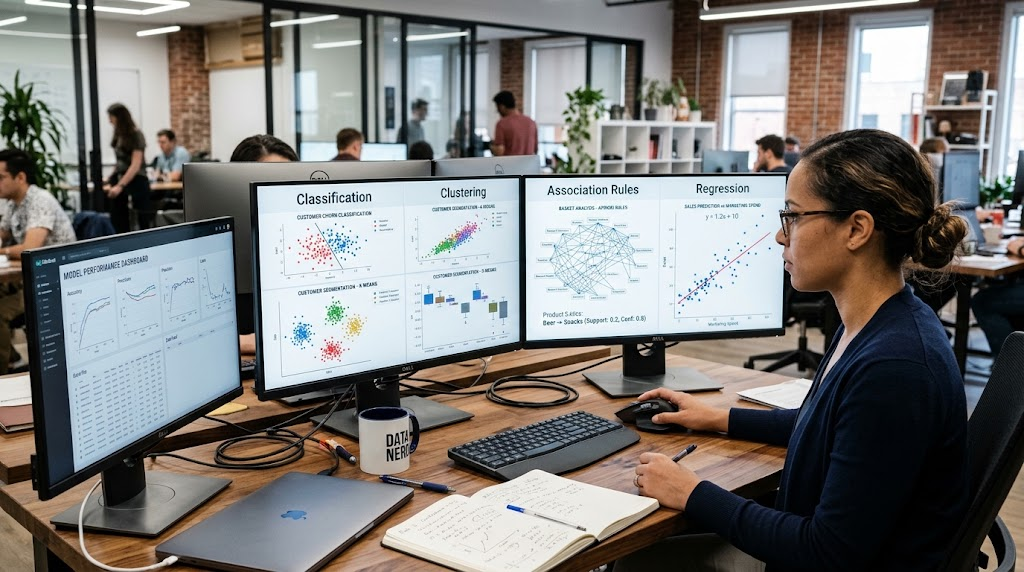
The data mining methods are distinct in solving various types of problems. Some techniques predict categories, others identify groups, relationships or numerical values. These techniques will enable learners to see how information can be obtained from complex data for easy understanding by beginners. There are four popular methods: classification, clustering, association rule learning, and regression. There are a number of different methods, each with its own functions, advantages and disadvantages, and each appropriate to a particular question.
Organizations can also utilize multiple techniques in a project to get a full picture of their data. For instance, a retailer may identify consumer segments using clustering, anticipate which customers and products are likely to be interested in an offer through classification, and discover associations of products that are typically bought together. More important than just picking the most complicated algorithm available is the choice of techniques used dependent on the business problem.
1. Classification
Data mining is the process of using classification to assign records to known categories, based on their attributes. Learns from examples where the correct category is known, applies what it has learned to classify new records. Common classification techniques include decision trees, logistic regression (classification), support vector machines and some machine learning models, such as neural network models. For example, a bank might classify transactions based on the need to follow up on them further for fraud investigations.
It could be used by an educational institution to identify students who may be in need of further academic assistance without allowing this model to supplant informed human judgment in a fair manner. The accuracy, precision, recall and F1 score can be used as metrics to evaluate classification performance. What measure to be implemented depends on the consequences of the various errors. For example, in fraud detection, missing a legitimate transaction that is really fraudulent could result in different consequences than flagging a legitimate transaction that was not actually fraudulent.
2. Clustering
Clustering is a technique which groups similar records together without having to define category labels. A clustering algorithm is used to determine groups based on some similarity measure, rather than relying on examples that have been classified into categories. Methods include K-means, hierarchical clustering, and DBSCAN, which is used for other types of datasets. Using clustering on customer purchasing records can be used to identify groups of customers with similar interests or shopping habits. It can be used by researchers to analyze trends in environmental data measurement and by technology firms to structure massive amounts of documents or other digital data.
The groups that are created can inform analysts about variations in data and guide more focused action plans. Nevertheless, clustering outcomes are variable based on variables used, distance measures and algorithm parameters. The grouping does not necessarily carry meaning just because it is found by an algorithm – this must be understood in context and whether the groupings are meaningful and useful.
3. Association Rule Learning
Association rule learning derives relationships between the items or the events that often appear together in the given data set. It can be very helpful if organizations wish to get an understanding of combinations of products, behaviours, or activities. One of the common examples is market basket analysis, which is a way of analyzing a retailer’s transactions to determine which products are commonly bought together by shoppers. For instance, a supermarket could find that their customers who purchase pasta tend to buy a specific sauce with their pasta. The discovery may be used for product placement, promotional sets, or suggestions, but does not guarantee that customers will purchase a product due to being linked to another product.
Association rule learning can also be explored in the concept of association rule learning where associations are learned from the relationships between items in the dataset. Support, confidence, and lift are typical checkings to assess these rules. Support is the number of times an item combination appears; confidence is the number of times the outcome of a rule appears when the condition appears; lift is the ratio of the outcome’s frequency to the number of times the condition appears.
4. Regression
Regression is a method for making estimates or predictions of numerical values based on relationships between variables. While classification would predict categories, regression would yield a continuous numerical estimate, like expected sales revenue, delivery time, energy use or property value, etc. Linear regression is a frequently used technique, which describes a relationship between a dependent variable and one or more independent variables. Other regression methods, such as those capable of modelling a nonlinear relationship or many explanatory variables may be required for more complex problems.
Historical sales data, price, promotional activity and seasonal trends can be used to predict future demand, for instance, by a business. These predictions can be used to help staff staffing, budgeting and inventory planning. Regression estimates, however, are not promises. They are not reliable if the input data are not accurate or applicable, if the method used relies on assumptions, or if historical relationships remain valid. Analysts should consider the errors of prediction and express uncertainty in applying the results of regression to inform meaningful decisions.
Applications of Data Mining in Different Industries
Data mining in various industries has some interesting uses.There are interesting uses for data mining in different industries.
Because of the vast amount of information generated by the daily activities of organizations, data mining is useful in many industries. They can find patterns in this data, which will allow them to enhance their services, understand their customers, make informed decisions, and reduce risks. Specific applications will vary depending on industry, data available, and the goals of the organization. Data Mining is used in the healthcare field to research patient outcomes. It can be used in banking for fraud detection and for risk assessment. It can be analyzed for educational institutions to understand the learning process, for retailers to gain insights into customer preferences and product demand. Examples of data mining applications in technology firms include recommendation systems, search engines, and optimizing digital services. While such apps have a lot of promise, the results can only be interpreted with the caveat of data quality, along with the right methods, privacy measures, and interpretation.
1. Healthcare
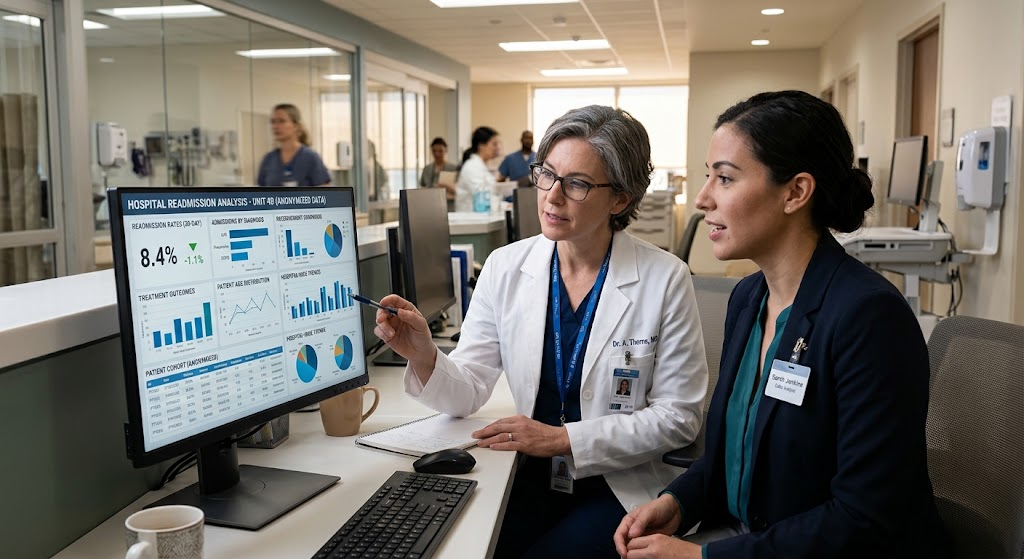
Medical institutions create a lot of data in electronic health records, lab reports, diagnostic processes, treatment histories, and administrative processes. Data mining can assist researchers and health care professionals in identifying patterns relating to the occurrence of diseases, treatment results, hospital readmissions, and use of health care services. Examples include looking at past data to determine if there is a relationship between a patient’s history and the chances of them coming back to the hospital after being discharged.
Data mining is also able to spot patterns in clinical data that warrant additional research. The findings could help health care systems to improve resource planning, identify additional support required and form research questions. Yet for their use in healthcare, there is a need for enhanced protection, as medical data is sensitive and mispredictions can have a significant impact. Data mining should assist rather than supersede qualified clinical judgement and the results should be scrutinized before influencing patient care.
2. Banking and Finance
Data mining can be used by banks and financial institutions to analyze transaction histories, learn about customers’ activities, evaluate some financial risks and detect potential suspicious activities. One such application is fraud detection, as financial systems handle a great volume of transactions, and it’s not feasible to check every single one of them manually. Data mining models can detect transactions that are outliers, or transactions that are not following the pattern, and focus review on those transactions. The financial institutions can also use the information to analyze the interactions with the customer to understand service needs, and can go back through the data to look at information to check the possible risks of credit.
But an atypical transaction is not necessarily fraudulent, and a financial situation is not always accurately reflected in transactions from the past. Banks need to, therefore, integrate automated identification with proper verification, human oversight, and fair decision-making process. The need for strong security measures is also paramount as financial datasets carry sensitive information which should be safeguarded from unauthorized access and misuse.
3. Education
Data mining can provide insights into student engagement, attendance trends, assessment results, and digital learning platform usage in educational institutions. These records could be used by school and/or university to detect issues that might be linked to students’ struggle to learn and decide where extra support might be needed. For instance, an institution may explore the relationship between irregular attendance and assessment performance or whether students who access some learning materials complete assignments consistently.
This information can be used to inform the design of support strategies, course design, and the evaluation of teaching methods. Data mining can also help institutions gain insights into the trends in course enrolments and forecast demand for specific courses. However, educational data needs to be used with caution as students’ achievement will be affected by a host of personal, social and environmental factors. Predictive systems cannot unfairly classify students or infer from their past performance into a future ability. The aim must be to enhance learning opportunities not limit them.
4. Retail and E-Commerce
Data mining helps retailers and online stores to learn about people’s buying patterns, give better product recommendations, predict demand, and assess the effectiveness of marketing efforts. Each transaction contains details of products, prices, when and what was bought, and what customers preferred – all of this data can be consolidated to show useful trends. For instance, association rule learning can be used to discover products that are bought together and clustering can be used to classify the customers based on their buying habits.
For forecasting future sales, regression techniques may be useful, and for determining if a customer is likely to accept a specific promotion, classification models may be useful. These insights enable retailers to: Stock levels planning, Product placement, More relevant shopping experiences. But personalisation should be done in a way that respects customer privacy and it should not be intrusive. Another consideration is whether the businesses’ recommendations actually enhance the customer experience or whether every relationship they find will make for more satisfied customers or more sales.
5. Technology and Telecommunications
Businesses such as tech companies generate tons of data with their search engines, websites, software applications, cloud platforms, and connected devices. They can use data mining to see how products are used, detect unusual use behaviour, understand the way people interact with digital services and improve digital services. For example, a streaming company can analyze a user’s viewing preferences and the nature of the content they have seen to help inform their recommendations. A telecom company could look at network performance and service logs, and determine that a certain customer area is having consistent connectivity issues.
By analysing aggregated error reports, software businesses can uncover common technical problems and prioritize enhancements. In the field of cybersecurity, data mining can be effective in detecting unusual activity, which should be investigated, yet the data signals of such activity should be filtered from normal activity. These applications can enhance the reliability and user experience, but organizations need to take care when handling user information in a way that respects privacy concerns and implements the necessary security safeguards.

Benefits of Data Mining
Data Mining has a lot of advantages.
The organizations that require decisions in the context of large and complex datasets can benefit from data mining in a number of ways. Its most significant benefit is its capacity to uncover trends that might not be obvious when looked at on a case-by-case basis. Organizations can use historical data and relationships between variables to understand customer behavior, operation performance and risks better. The information can be used to guide better planning, resource allocation, and opportunities for innovation. Data mining can also be used to assist with forecasting, enabling businesses to anticipate potential shifts in demand or service needs. With proper application, it can cut down the cost of reviewing vast amounts of data and the time of decision makers to the matters that are likely to have significance. The benefits listed above, however, rely on the quality of the information, the appropriateness of the methods used and the interpretation of the findings to translate into action.
1. Better Decision-Making
Data mining assists decision makers in using evidence as opposed to assuming or using their personal experiences. For instance, a retailer can learn from past buying trends to determine how many units to order and a school can learn from attendance and assessment data to understand where extra educational support is needed. Transaction patterns can be used to identify cases that require attention by a bank. These applications enable organisations to take into account more data when making decisions about what to do.
However, data mining does not replace the need for human expertise. Historical data may be incomplete and/or conditions may change and/or patterns may include the prevailing bias. The results should therefore be interpreted in light of their limitations and should be considered in conjunction with available expertise, information and understanding of the context. In this context, data mining augments the decision-making process by supplementing, not supplanting, the process of reaching a decision.
2. Improved Efficiency and Productivity
Manually analysing large data sets can be time consuming and labor intensive, especially if there are millions of records of information. The search for patterns, grouping similar records and uncovering unusual observations can be automated using data mining techniques. This enables staff members to focus more on the interpretation of results, important cases, and solutions, and less on repetitive examinations. An automated analysis, for example, can help a telecommunications company detect common network issues, and a retailer can help with stock planning by using demand forecasts.
Another benefit of automation is that it can also ensure consistent processes when dealing with a lot of information. But maintenance, evaluation and oversight of data mining systems still need to be performed. Since inadequate models may lead to errors when scaled up, efficiency should be evaluated along with accuracy, reliability, and resources needed to run this system in an ethical manner.
3. Fraud Detection and Risk Management
The objective is to identify fraud and manage risk.The goal is fraud detection and risk management.
Data mining can be used to detect patterns of suspicious activity, operational issues, or even potential losses related to money. It could be used by financial institutions to identify transactions which are unusual for a given account, and by Internet service providers to look for patterns that may indicate the use of their Internet services in an unusual way. Another way for businesses to look at this is to review past records for potential vulnerabilities and look for areas that can be improved in the future. Early identification affords an opportunity to investigate concerns before they become larger problems. But a warning from a data mining system should be considered as a red flag for further investigation of a situation, not proof of misconduct. A false alarm can inconvenience the customer or unfairly impact the individual, and a missed alarm can allow the true problem to go on. Good risk management needs to be supported by appropriate risk assessment techniques, proper risk review processes and ongoing risk system performance monitoring.
Challenges and Limitations of Data Mining
Despite its benefits, data mining presents challenges that organizations must address before relying on its findings. Data quality is a major concern because missing values, inaccurate records, inconsistent formats, and outdated information can lead to misleading results. Privacy and security are also important, particularly when datasets contain financial, medical, educational, or personal information. Organizations must determine whether they have an appropriate legal basis to process the data, restrict access where necessary, and protect information against unauthorized disclosure.
Another limitation is bias: if historical records reflect unequal treatment or incomplete representation, a model may reproduce or reinforce those problems. In addition, some methods are difficult to interpret, making it challenging to explain why a system produced a particular result. Data mining projects may also require skilled personnel, computing resources, and ongoing maintenance. Recognizing these limitations helps organizations develop more reliable systems and avoid treating every discovered pattern as accurate, fair, or practically useful.
Data Mining vs. Data Analysis vs. Machine Learning
Data mining, data analysis, and machine learning are closely related concepts, but they describe different aspects of working with data. Understanding the distinctions helps beginners see how these approaches can complement one another. Data analysis is a broad process of examining and interpreting information to answer questions, assess performance, and communicate findings. Data mining focuses more specifically on discovering patterns, relationships, and useful structures within datasets.
Machine learning is a field of computer science concerned with methods that allow computers to learn patterns from data and use them to make predictions or decisions. These areas overlap because machine learning algorithms are often used in data mining, while data analysis can be used before and after a mining project to understand the dataset and evaluate the results. They should therefore be viewed as connected approaches rather than completely separate activities.
Data Mining vs. Data Analysis
Data analysis involves examining information to answer questions, evaluate performance, test hypotheses, and support decisions. It can include descriptive statistics, visualizations, comparisons, and statistical tests. Data mining, on the other hand, emphasizes discovering patterns or relationships that may not have been specified in advance. For example, a business analyst might calculate monthly sales totals to determine whether revenue has increased, which is a form of data analysis. A data mining project might examine millions of transactions to identify previously unnoticed combinations of products or groups of customers with similar purchasing behavior.
In practice, the distinction is not absolute. Data mining is often part of a broader analytical workflow, and both activities can involve statistical methods and computational tools. The main difference lies in their emphasis: data analysis broadly investigates and interprets information, while data mining concentrates on finding useful patterns within it.
Data Mining vs. Machine Learning
Machine learning focuses on developing algorithms that learn patterns from data and use them to make predictions, classify information, or support decisions. Data mining focuses on extracting useful knowledge from datasets and may use machine learning alongside statistics and other techniques. For example, a machine learning algorithm can be trained to predict whether a customer is likely to cancel a subscription, while a data mining project might use that model together with clustering and exploratory analysis to understand customer behavior and discover relevant patterns.
Not every data mining method requires machine learning, because some approaches rely on statistical analysis or rule discovery. Similarly, machine learning has applications beyond traditional data mining, including computer vision, language processing, and control systems. The two fields overlap substantially, but they emphasize different goals: machine learning develops methods that learn from data, while data mining seeks meaningful knowledge that can be interpreted and used.
Real-World Example of Data Mining
Consider an online retail business that wants to improve its product recommendations and reduce the number of items that remain unsold. The company has records of customer purchases, product categories, prices, seasonal demand, and promotional campaigns. First, its analysts define the problem and collect relevant transaction records. They then clean the data by correcting inconsistencies, removing duplicate entries, and addressing missing values. Next, they apply clustering to identify groups of products or customers with similar characteristics and use association rule learning to discover which products are frequently purchased together.
Regression models may help estimate future demand, while classification may be used to predict whether certain products are likely to sell within a specified period. The analysts evaluate the findings using appropriate validation methods before presenting recommendations to the business. The retailer might then adjust inventory levels, test product bundles, or improve its recommendation system. By measuring the results after implementation, the company can determine whether data mining has actually improved sales planning and customer experience.
The Future of Data Mining
The future of data mining will be shaped by the continued growth of digital information, advances in computing, and the development of more sophisticated analytical methods. Organizations are increasingly interested in processing information from connected devices, online platforms, business applications, and other digital systems. Improvements in machine learning and artificial intelligence are also expanding the range of patterns that can be detected and the types of predictions that can be generated.
At the same time, organizations face growing expectations regarding privacy, transparency, data security, and responsible automated decision-making. Future progress will therefore depend not only on more powerful algorithms but also on better data management, reliable evaluation, and appropriate human oversight. Professionals who understand how to prepare data, select suitable techniques, interpret findings, and communicate uncertainty will remain valuable across many industries. For beginners, developing these foundational skills provides a useful starting point for exploring data science and related careers.

Conclusion
Data mining is an important process for transforming large datasets into useful information that supports decision-making. By discovering patterns, relationships, groups, and trends, it helps organizations understand complex situations and identify opportunities for improvement. Techniques such as classification, clustering, association rule learning, and regression address different problems, from predicting categories and grouping similar records to identifying relationships and estimating numerical outcomes.
These methods have practical applications in healthcare, banking, education, retail, and technology, where organizations use data to improve services, manage risks, and plan more effectively. Although data mining offers significant benefits, its results depend on data quality, appropriate methods, responsible information handling, and careful evaluation. It is also important to understand how data mining relates to data analysis and machine learning, since the three often work together in modern data-driven systems. Ultimately, data mining is most valuable when reliable findings are translated into informed, fair, and practical decisions.