Car fuel consumption is a large part of your driving costs and the performance of your vehicle. Fuel prices, which are ever-present in our daily lives, play a big role in that cost, particularly when a car’s fuel use is higher than what is typical. While the fuel gauge and dashboard indicators are useful, they do not tell the full story. What you really get from calculating fuel consumption is a true picture of your car’s performance from actual fuel use. Drivers may use miles per gallon (MPG), kilometers per liter (km/L), or liters per 100 kilometers (L/100 km) to determine fuel economy.
Fortunately, it is not the case that calculating fuel consumption requires complex equipment. What you mainly need is accurate information on the distance your vehicle traveled and the amount of fuel it used. By recording this information regularly, you may note changes in your car’s efficiency over time. Also, you may use this to see if increased fuel consumption is due to traffic, your driving habits, heavy loads, poor maintenance, or maybe a mechanical problem.
Why Car Fuel Consumption Is Important
Calculating fuel use is a way to see how well your car uses the fuel you put in it. Official fuel economy numbers can be a guide when you are looking at which vehicle to get, but what you see in real life may vary depending on different roads, traffic, weather, speed, and driving behavior. Also, with your own numbers, you are using your own experience of how and where you drive, which in turn gives you more relevant information for your fuel spending.
Tracking fuel use is also a way to notice unexpected changes in your vehicle. If your car has been getting great fuel economy but then suddenly uses much more fuel, there is a change that may have occurred. The reason may be that you are in heavier traffic or are using the air conditioner more, but it may also be from low tire pressure, lack of maintenance, or a mechanical problem. Over many refueling reports, the picture that appears is more reliable than trying to judge the car after just one trip.
Fuel Information You Will Need
You will need to know the distance your vehicle travels, the amount of fuel it uses, and the system of measurement you wish to use. Fuel may be measured in gallons or liters, while distance may be measured in miles or kilometers. Once you have that data in hand, you can determine your MPG, km/L, or L/100 km with some simple math.
Your odometer is a key tool that records the distance traveled by your vehicle. Also, your car’s trip meter can be reset before starting a new trip. To get the best out of this feature, it is important to understand how to record odometer readings. Also, note that some cars present distance in either miles or kilometers, so be sure to identify what units your vehicle uses and write down all numbers exactly as shown.
How to Determine Fuel Consumption by the Full-Tank Method

The full-tank method is a simple method for determining real-world fuel consumption. Begin by filling up your tank and note the current odometer reading, which will be your base, or else put your trip meter at zero. Go about your normal driving until you are due for another fuel-up. At the time of your next fill-up, top off the tank and note down the amount of fuel you have put in.
During the second fill-up, the amount of fuel you put in represents the fuel used for the distance that is recorded. By putting all this together, you are able to determine your car’s fuel economy. For best results, use the same method each time you fill up and do not try to calculate fuel use from the gauge, which is only an estimate and not a precise measurement.
How Do You Calculate MPG?
MPG measures how many miles your car will go on a gallon of fuel. The higher the MPG, the better the fuel efficiency, which in turn means the vehicle is going farther on the same amount of fuel. This is a common measurement in the U.S., and you will see it in vehicle specifications and when comparing fuel economy.
The formula is:
MPG = Miles Driven ÷ Gallons of Fuel Used
For instance, consider a car that travels 300 miles and, at the same time, uses 10 gallons of fuel. In that case, when you divide 300 by 10, the result is 30 MPG. This is to say your car, in that time frame, got 30 miles out of every gallon of fuel used.
Why MPG Can Change

Your fuel efficiency will vary based on how you drive. On the highway, you will see better fuel economy because the vehicle is able to maintain a more constant speed. In city driving, however, you may see a drop in MPG due to stop-and-go traffic, frequent acceleration, and idling, which in turn use more fuel.
For improved results, track your MPG over a few tankfuls of fuel. While a single trip may be out of the ordinary because of bad weather, traffic, or road repairs, tracking your results over time provides a better picture. Looking at multiple fuel reports gives you a better understanding of what your car’s performance is like.
How to Determine Kilometers Per Liter (km/L)
In what is known as km/L, which is a way to report fuel efficiency, a car is measured by how many kilometers it is able to travel on one liter of fuel. Also, like in the case of MPG, we see that a larger number is better for fuel economy. This measurement is very useful when distances are reported in kilometers and fuel is priced in liters.
The formula is:
km/L = Distance Traveled in Kilometers ÷ Liters of Fuel Used
For instance, if you drive 450 kilometers and use 30 liters of fuel, divide 450 by 30. You get 15 km/L. This means the car averaged 15 kilometers per liter of fuel used.
Understanding Your km/L Results
Your fuel consumption will vary based on the way the car is driven. On open roads and long trips, you will get better results as the engine works more steadily. In city traffic and with short trips, your fuel efficiency will go down due to the constant start-and-stop action.
Recording multiple results helps to identify your car’s normal performance. Also, note if your main driving was in the city or on the highway, as you will see that this plays a role in different fuel economy results.
How to Determine Liters Per 100 Kilometers (L/100 km)
Liters per 100 kilometers is a measure of how much fuel your car uses to travel 100 kilometers. Unlike MPG and km/L, a lower liters-per-100-kilometers number means better fuel efficiency because the vehicle uses less fuel to cover the same distance.
The formula is:
L/100 km = Liters of Fuel Used ÷ Kilometers Driven × 100
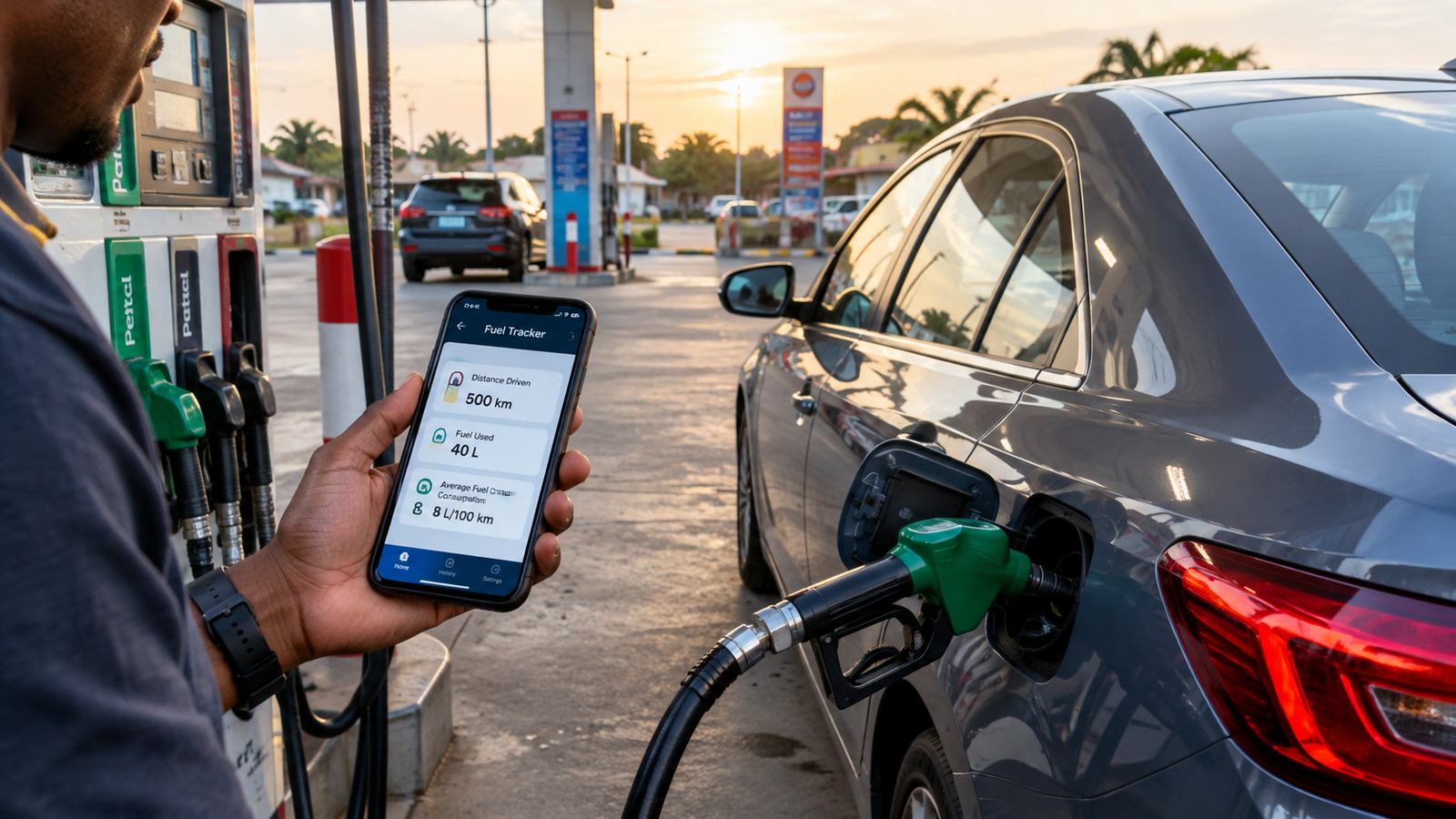
For instance, should your car travel 500 kilometers and use up 40 liters of fuel, do the math by dividing 40 by 500 and then multiplying what you get by 100. You will find that the car uses an average of 8 L/100 km of fuel. This means the vehicle’s average fuel consumption is 8 liters for every 100 kilometers traveled.
Why L/100 km Is Useful
L/100 km is a useful unit that allows for easy comparison of different vehicles’ fuel consumption because it reports precisely what amount of fuel is used over a certain distance. For instance, a car that uses 6 L/100 km is more fuel-efficient than one using 10 L/100 km.
This measurement will also help you determine fuel needs for your next trip. If your car typically uses 8 L/100 km, you can expect that a 300-kilometer trip will use around 24 liters of fuel under the same type of driving conditions.
How to Record Odometer Readings Accurately
Accurate odometer readings are key to correct fuel calculations. Before you start your measurement period, note down the present odometer reading exactly as it is shown. If your car has a trip meter, set it back to zero after you fill up the tank. At your next fuel-up, note the new distance that is recorded.
For instance, at the time of filling the tank, the odometer reads 85,000 kilometers, and at refill, it reads 85,500 kilometers, which means the car traveled 500 kilometers. We recommend noting these down in a notebook, spreadsheet, or app, which in turn will help avoid errors and make past and future calculations easier.
Keep Consistent Fuel Records
Consistent documentation of your vehicle’s fuel economy over time is what you want. What we are saying is to keep a journal of the date, distance traveled, fuel put in the tank, and calculated fuel economy. Also, note that driving conditions can greatly affect the results.
Over an extended period of time, which may be weeks or months, you will see trends develop in the data. You may notice that your car uses more fuel in city driving or that fuel efficiency goes down when you are carrying heavy loads. This information is very useful in getting to know your car better and also helps you note any out-of-the-ordinary changes.
How to Tell When Your Car Is Using More Fuel
It is by comparison to what is normal for your car that you will see if it is using more fuel than it should. A drop in MPG or km/L, or an increase in L/100 km, may be a sign that there has been a change.
Before jumping to the conclusion that you have a mechanical issue, look at what has changed in your driving routine. Heavy traffic, frequent short trips, increased use of the air conditioning, and carrying more weight in the vehicle can all cause an increase in fuel consumption. But if you see that conditions are the same and fuel economy is still going down, the vehicle may need to be taken in for a check-up.
Common Reasons for Higher Fuel Consumption
Low tire pressure can cause higher fuel use because the engine has to work harder for the car to move. Also, extra unnecessary weight in the car and aggressive driving can cause fuel efficiency to drop. Rapid acceleration, going very fast, and heavy braking can also result in greater fuel use.
Maintenance also impacts fuel economy. Issues with tires, filters, engine performance, or other vehicle components may cause higher fuel use. Tracking your results makes it easier to see if the issue is short-term or turning into a trend.
Tips for Getting More Accurate Results
Use the same measurement process whenever you can. The full-tank method is a reliable one because it compares the distance traveled with the precise volume of fuel needed to fill the tank. Do not rely only on the fuel gauge because it does not provide the accuracy needed.
It is also better to report on fuel use over a long distance as opposed to a short trip. The longer the measuring time between refuels, the more clearly you will see your vehicle’s true performance. What is key is that you understand your car’s fuel efficiency in the real world.
Conclusion
Calculating your car’s fuel efficiency is an easy and practical way to see how well your vehicle performs in terms of fuel use. By noting down the distance driven and the amount of fuel used, you can figure out your MPG, km/L, or L/100 km. Each type of measurement reports on different aspects of your car’s actual performance.
Keeping a log of fuel use over many fill-ups is the best way to determine your average fuel economy. We use these calculations to manage fuel costs, compare which times of the year or which trips use the most fuel, and see when your vehicle may be using more fuel than it should. With consistent record-keeping and basic math, any driver is able to improve their knowledge of their car’s fuel efficiency.


